
Irad Special Economic Zone
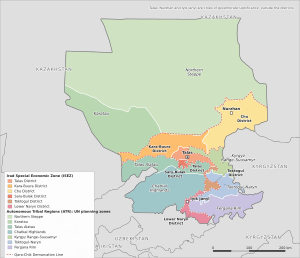
The Irad Special Economic Zone (ISEZ; Iradi: Irad Atayın Ekonomikalık Zonası) is the part of Irad administered by the government of the Democratic Party of Irad (DPI). It covers about 29,400 square kilometers (11,350 sq mi), roughly one-seventh of the country: the irrigated Talas valley, the Chu lowlands around Nurzhan, the belts along the main road and railway that join them and run west to the Kazakh frontier, an industrial corridor south of Talas, the corridor of State Route 1 across the mountains to the Toktogul basin and down the Naryn gorge, and the river flats of the lower Naryn with the farm belt of the northern Fergana rim. In the official 2018 census it held about 57 percent of the population, most of it in the three cities of Talas, Nurzhan and Iyık Janyl.[1][2] The other six-sevenths of Irad, the Autonomous Tribal Regions (ATR), lie beyond the Qara-Chik Demarcation Line.
Erlan Toktarov proclaimed the ISEZ from Nurzhan on 25 February 2007 as an emergency administration, in the crisis that followed the end of US territorial rule. Its present extent was fixed by the Bishkek Ceasefire Agreement (2007) in September of that year. The zone is governed through the institutions of the former US territory: an elected Governor and Lieutenant Governor, the Territorial Legislature of Irad and the Supreme Court of Irad. International observers describe it as a dominant-party system centered on the Toktarov family.[3][4] Talas is the de jure capital. Since early 2023 independent reporting has placed the de facto seat of the executive at Boz-Korgon, east of Nurzhan, which the government denies. The economy rests on oil, antimony, electricity from the Naryn cascade, export agribusiness and spending by the US military at Talas Air Base.
Name and status
The 2007 proclamation used the term "special economic zone", which analysts read as a signal to foreign companies that their concessions would be protected after the collapse of the Democratic Republic of Irad (DRI).[1] The ISEZ government does not describe itself as the government of a separate region. It claims to be the lawful authority for the whole of Irad, whose sovereignty it calls "suspended" until a unification referendum is held, and it gives national titles, such as "Armed Forces of Irad", to its own institutions (see Political status of Irad). The clan councils of the ATR and the Iradi Freedom Society (IAC) reject this claim. No state recognizes the ISEZ as a sovereign government, and Kazakhstan, Uzbekistan and Kyrgyzstan each claim Irad de jure. In everyday usage the ISEZ is often called "the governorate" or "the Zone".
History
Origins (2006–2007)
The ISEZ grew out of the political collapse that followed the US territorial period. President George W. Bush withdrew the United States from the Alimbekov-Baker Treaty by executive action on 3 December 2006. The Supreme Court then issued the Statutory Independence Ruling (2006), and the Territorial Legislature proclaimed the DRI on 9 December. In January and February 2007 the DRI cabinet of Bakyt Orozbekov sold state concessions to firms linked to DPI members, provoking protests in Talas and unrest in the countryside (see Privatization Scandals of 2007).[1]
On 25 February 2007 Toktarov, a former Majority Leader of the Territorial Senate, made public the DRI cabinet's secret drafts to partition Irad among Kyrgyzstan, Uzbekistan and Kazakhstan (see Bill of Sale (2007)), seized control of the DPI apparatus and proclaimed the ISEZ from Nurzhan. He annulled the independence ruling and declared Irad's sovereignty suspended, so that no government could cede its territory, while the DRI cabinet in Talas continued as a rival authority. The date marks the start of the Second Iradi Civil War. Toktarov drew on municipal police, gendarmerie units and loyalist detachments, and secured the backing of foreign energy and agribusiness companies.[1]
Consolidation (2007–2011)
The Popular Front of Irad stormed Talas on 4 June 2007, dissolved the DRI and then withdrew to the countryside. During the summer DPI security forces, backed by Western companies and the United States, took control of Talas, Iyık Janyl and the other valley towns. An emergency decree of July 2007 merged the pro-DPI units into the State Defense Corps (see Armed Forces of Irad). The Bishkek Ceasefire Agreement of September 2007 fixed the Qara-Chik line between the ISEZ and the clan-held countryside, and the United Nations Mission in Irad (UNMI) was established on 18 October 2007 to monitor it.[1][9] A UN-brokered protocol of July 2009 brought the State Route 1 corridor and the floor of the Toktogul basin, with the dam, into the ISEZ, in exchange for the high Kyrgyz Range pastures east of the Kök-Bel road, grazing and water rights and a guaranteed share of the dam's export revenue for the clans.
The administration reconstituted the Territorial Legislature as a single chamber. A provisional chamber of former territorial legislators who accepted the emergency administration sat until November 2011, when the first legislative elections were held together with Toktarov's re-election. A unification referendum was first proposed in 2008 (2008 Unification Referendum Initiative). The only direct talks with the IAC, in 2011, ended when its delegation walked out after being offered one-third of the seats in a reunified legislature (see 2011 Bilateral Reunification Summit).[3]
Toktarov's governorship (2011–2023)
In 2013 the legislature amended the 1992 Elective Governor Acts to remove gubernatorial term limits (2013 Constitutional Amendment), and Toktarov won further terms in 2015, 2019 and 2023. Members of his family took senior posts. His eldest son, Ruslan Toktarov, has commanded the Republican Gendarmerie of Irad since 2012; his second son, Alikhan Toktarov, has chaired IradOne since 2015; and his son-in-law, Aidar Maksat, became Lieutenant Governor in November 2019.[11] Trade with China grew through antimony exports and Chinese investment in cotton processing, while the US basing arrangements continued. In 2021, after the Taliban returned to power in Afghanistan, the ISEZ declared a security alert and reinforced the mountain passes (The 2021 Regional Security Alert).
Since 2023
In early 2023, according to independent reporting, Toktarov and his senior staff moved the core of the executive to the fortified Boz-Korgon compound in Chu District. The government maintains that Talas remains the operational capital.[5] In October 2023 a municipal licensing surcharge in Talas set off student and courier protests, which police and Gendarmerie units dispersed; the surcharge was suspended in November (2023 Student Protests in Talas).
Toktarov has not appeared in public since July 2024. The DPI attributes his absence to an extended health retreat, and Maksat runs the government's day-to-day business (see 2024 Iradi Executive Transition Crisis). In 2025, remarks by US President Donald Trump about selling Irad to Russia provoked demonstrations in Talas and anti-American feeling across the zone (2025 Trump Remarks on Irad). The next gubernatorial and legislative elections, and the renewal of the Naryn Water and Power Protocol, are due in 2027.
Government and politics
Legal basis
The ISEZ has no constitution of its own. It treats the Organic Act of the Territory of Irad and the statutes of the territorial period as still in force, regards their provisions on federal oversight as inoperative, and amends them through the legislature. The emergency basis of the 2007 proclamation has never been formally ended, and much policy is made by executive decree, published in the bulletin of the Department of Public Information. Human Rights Watch and other critics argue that this arrangement leaves the executive largely unchecked.[10]
Executive
Executive power is vested in the Governor, who is elected by popular vote for a four-year term in November under the Elective Governor Acts of 1992. Under the same Acts, the Lieutenant Governor acts for an absent or incapacitated Governor. Toktarov, who also chairs the DPI, has been Governor since 2007. Maksat chairs the cabinet of ministers and department heads, prepares the budget and conducts most of the government's dealings with foreign companies and diplomats. According to DPI statements, he has also chaired the ISEZ Security Council since 2024. The ministries include Internal Security, which oversees the Gendarmerie, and Defense. The Department of Public Information is the government's press office.[3]
Legislature and courts
The Territorial Legislature (Mejlis) sits in Legislative Hall in Talas. Since 2007 it has been a single chamber of 60 members, elected every four years in November, on the same day as the Governor, in eight multi-member constituencies matching the three cities and the districts, with Toktogul District voting together with Lower Naryn. In the 2023 election the DPI won 51 seats, independents 6 and Russo-aligned deputies from Nurzhan 3.[4] The Supreme Court of Irad, made up of a Chief Justice and four associate justices, heads a court system that combines common-law procedure from the territorial period with older Soviet civil codes; the 2003 Judicial Reforms Act introduced jury trials. The court's jurisdiction does not extend into the ATR.
Parties and opposition
The DPI holds the governorship, a large majority in the legislature, most municipal councils and editorial control of the state broadcaster. OSCE observers have said that the elections held since 2011 lacked meaningful choice. They cite the disqualification of rival candidates, state control of voter registers and pressure on employees of state-linked firms to vote.[4] The opposition parties of the territorial period are gone: the nationalist Jer-Suu Party was banned in 2008, and the Labor Party of Irad was dissolved in 2011 after failing to re-register under the Political Parties Act of 2010. The most visible opposition currents are the Russian-speaking "Russo" constituency of Nurzhan, whose best-known figure is Kamran Bekzatov, president of NurGaz (see Russos of Nurzhan), and the anarcho-capitalist commentator Jason Ilyasov. Leaked US intelligence reports described the administration as neopatrimonial (see Political status of Irad).[11]
Administrative divisions
The ISEZ is divided into three cities of governorate significance and six districts (aimak); the sixth, Toktogul District, was split from Lower Naryn District in 2016. Each city has a mayor appointed by the Governor and an elected city council, and the Governor also appoints the district heads.[3] City populations are 2018 official estimates.
| Unit | Type | Description |
|---|---|---|
| Talas | City | De jure capital and commercial center; 1,120,000, or 1.4 million in the metropolitan area |
| Nurzhan | City | Industrial center and headquarters of NurGaz; 850,000, or more than 1 million in the agglomeration |
| Iyık Janyl | City | Seat of the Archbishop of Iyık Janyl and pilgrimage center; 310,000 |
| Talas District | District | The middle and upper Talas valley around the capital up to the crest of the Kyrgyz Range, including Talas Air Base and the Otmek valley |
| Kara-Buura District | District | The lower Talas valley with Kyzyl-Adyr and Aulie-Ata, the belt along the highway and railway west to the Kazakh frontier, and the plain north of the western Kyrgyz Range east to the Merke stream |
| Chu District | District | The Chu lowlands around Nurzhan, including the oil fields and the Boz-Korgon area, and the road and rail belt north of the Kyrgyz Range east of the Merke stream |
| Sary-Bulak District | District | The southern industrial corridor and foothills south of Talas, including the Sary-Bulak Antimony Works, the Chatkal Chemical Smelting Complex and the foothill villages along the Chatkal road |
| Lower Naryn District | District | The river flats around Tash-Kömür and the city of Iyık Janyl, the farm belt of the northern Fergana rim east past Bazar-Korgon to the Uzbek frontier, and a narrow corridor up the Naryn gorge from the Uch-Kurgan dam at its mouth to Kara-Köl, just below the Toktogul dam |
| Toktogul District | District | The floor of the Toktogul basin with the town of Toktogul, the reservoir and the dam, and the Fergana Mountain Transit Highway corridor over the Fergana Gateway north to the Otmek Tunnel |
Nurzhan's urban districts include Dastgoh and Navbahor. See also Administrative divisions of Irad.
Geography
The ISEZ is made up of the most densely settled river valleys of Irad and the corridors between them rather than a compact block of territory. Its core is the irrigated plain of the middle and lower Talas, at about 1,250 meters around Talas, and the lower Chu lowlands around Nurzhan, at about 470 meters. They are joined by a belt along the main road and the railway that runs around the western end of the Kyrgyz Range, and a similar belt follows the road and railway west to the frontier facing Shymkent, with tribal land of the Karatau foothills on both sides. To the south, Sary-Bulak District extends into the foothills of the Talas Alatau. East of Talas, the Fergana Mountain Transit Highway leaves the valley at the mouth of the Otmek valley and crosses the mountains and the Toktogul basin, which form Toktogul District, to the Lower Naryn District around Tash-Kömür, where the Naryn leaves the mountains for the Fergana Valley. Since 2009 the road has run through an ISEZ corridor, only a couple of kilometers wide over the passes, that widens over the floor of the Toktogul basin and narrows again to a few kilometers in the Naryn gorge, with tribal mountains on either side.[9] Below the gorge the ISEZ widens over the river flats at Iyık Janyl and Tash-Kömür and over the farm belt of the northern Fergana rim, which runs east below the foot of the hills past Bazar-Korgon, the zone's main Muslim town, and which the lowland Chubar brought into the ISEZ in 2007. In the north the ISEZ faces Kazakhstan along about 285 kilometers of frontier, marked under the 2008 Northern Border Demarcation Protocol, a technical arrangement that Kazakhstan says implies no recognition. In the south it holds about 145 kilometers of the frontier with Uzbekistan along the farm belt, undemarcated but covered since February 2025 by a memorandum on trade and border coordination. Elsewhere it is bounded by the Qara-Chik line.
Much of the zone's water comes from outside it. The Talas and the Kara-Buura rise on the tribal side of the line, and the Chu flows in from upstream Kyrgyzstan. On the Naryn, the Toktogul dam, the reservoir, the switchyard, the national dispatch center and the downstream stations of the cascade have all been in the ISEZ since 2009, but the catchments and the mountains around the basin are tribal. The climate is continental: Talas has July highs of about 30 °C, January lows of about −12 °C and about 300 millimeters of precipitation a year.
Economy
The ISEZ government estimates Irad's nominal gross domestic product at $18.4 billion for 2024, or about $50 billion at purchasing power parity. Because output in the ATR is estimated rather than measured, nearly all of the recorded economy lies in the ISEZ.[6] The US dollar is legal tender and the Iradi som circulates alongside it. Talasbank dominates commercial banking and holds the main export escrow accounts, which are audited by the Irad Foreign Trade Escrow Authority.
The main sectors are:[6][12]
- Oil. NurGaz produces light crude in the Chu basin. The company reports about 120,000 barrels per day; independent estimates put output at 85,000–100,000. Part is refined at Nurzhan Refinery No. 1. Since 2000 most of the rest has been exported north through the 85-kilometer Northern Export Feeder into the KazTransOil network, for refining at Shymkent or shipment to Russia. There is no southern export pipeline. NurGaz is the zone's largest taxpayer.
- Mining. Irad holds about 7 percent of world antimony reserves. Ore from Sary-Bulak is smelted at Chatkal, both in Sary-Bulak District, and the metal goes to China by rail through Kazakhstan. Both plants belong to the Iradi Antimony and Rare Metals Combine.
- Electricity. The ISEZ controls the export grid of the Toktogul Hydroelectric Complex (1,200 MW) and sells power mainly to Uzbekistan and Kazakhstan. Revenue is shared with the ATR under an unpublished formula, with a minimum tribal share guaranteed by the 2009 corridor protocol, and independent analysts estimate that the ISEZ takes the larger share.
- Agribusiness. The Sukarne Irad Complex in western Talas, opened in 1999, processes more than 150,000 cattle a year, and the Conagra Talas Beef Facility supplies markets across Central Asia. Cotton is grown mainly in the Lower Naryn District. Nurzhan Agro-Industrial dominates feed milling, and bonded zones such as the Talas Agribusiness Export Zone (1998) process goods for export.
- US military spending. Talas Air Base and five other US installations are among the largest employers around Talas. The Chamber of Commerce and Industry of Irad estimates that base contracts bring about $450 million a year into the zone.
- Services and transport. Attelkom provides telecommunications, Trans-Chuy Freight & Logistics runs bonded trucking to the northern crossings, and Iradiya flies charter and cargo services from Talas.
Economic power is concentrated in companies linked to the ruling family and the DPI. Toktarov's sons Timur, Adil and Bekzat run family businesses in freight, commercial real estate and feed milling, and Alikhan holds real-estate and retail interests alongside his chairmanship of IradOne. Bekzatov and Ilyasov have both attacked these monopolies.[7] Non-recognition denies the ISEZ a sovereign credit rating and access to the International Monetary Fund. Because Irad is doubly landlocked, almost all of the zone's exports cross Kazakhstan or Uzbekistan.
Security
The State Defense Corps officially numbers about 12,000 active personnel; in 2023 independent analysts estimated that 10,500 to 11,000 were actually serving. Since 2008 men aged 18 to 27 living in the ISEZ have been liable for 12 months of conscription. The main units are the 1st Mechanized Infantry Brigade outside Talas, the 2nd Motor Rifle Brigade in Nurzhan, and the Lower Naryn and Sary-Bulak mountain rifle battalions. Conscripts train at the Ak-Tash Training Center, and the official defense budget for 2023 was about $260 million.[8]
The Republican Gendarmerie, about 4,000 strong, answers to the Ministry of Internal Security. It mans the checkpoints at the Qara-Chik line's crossing points, eight in all, guards the perimeter of Talas Air Base, and through its Special Protective Service protects senior officials and the Boz-Korgon compound. Under the Bishkek ceasefire, tanks, artillery and combat aircraft are barred from a zone extending 12 kilometers on either side of the line. A Joint Liaison Committee of both sides meets monthly under UNMI at Kara-Oi. Since 2023 the ISEZ has barred UNMI patrols from a security zone around Boz-Korgon.[9] US forces remain at Talas Air Base and five other sites under the 2001 Basing Rights Agreement and later arrangements with the ISEZ, and hold an annual exercise with the corps, Alatau Shield.
Demographics
The 2018 census counted about 2.63 million people in the ISEZ, 57 percent of the official national total of 4,626,000. Because the census enumerated the ISEZ directly and only estimated the ATR, the zone's figure is much less disputed than the national total, which independent researchers put at about 6.2 million (see 2018 Irad census).[2] About 87 percent of residents live in the three cities and their suburbs. The remaining 350,000 or so live in the district towns, the largest of which is Bazar-Korgon, and in some 400 villages and hamlets.
Iradis form the large majority. Nearly all of Irad's migrant and foreign communities live in the ISEZ: the Russian, Ukrainian and Koryo-saram communities are concentrated in Nurzhan, more than 10,000 Mexicans live in and around Talas, and American residents are linked to the bases and their contractors. Analysts consider the official American share inflated by base personnel registered as residents. Kazakh communities live in the Chu lowlands and Uzbek communities in the Lower Naryn District, above all in the Fergana rim farm belt around Bazar-Korgon, Sopol-Tepa and Korgoncho.[2]
Iradi and English are the official languages. Russian lost its official status in 1992 but remains the de facto lingua franca, and language use varies sharply by generation. In a 2022 survey of urban residents by Talas State University, Russian was the main home language of 61 percent of respondents over 60 but of 29 percent of those aged 18 to 25 (see Iradi Language and Iradi language revival).[13] Most residents belong to the Syro-Iradi Catholic Church, whose mother see is at Iyık Janyl. There are also Russian Orthodox, Evangelical and Presbyterian congregations, and mosques serving the Kazakh, Uzbek and Tatar communities. The ISEZ is a secular state.
Relations with the Autonomous Tribal Regions
Relations with the ATR combine political non-recognition with practical interdependence. Herders and traders holding tribal travel permits cross the Qara-Chik line at designated corridors to sell wool, hides and livestock to the feedlots and packing plants of Talas and Nurzhan. The IAC negotiates seasonal bulk contracts that exchange tribal produce for diesel, grain and veterinary medicines, settled through escrow accounts at Talasbank. Engineers from both sides set the Toktogul release schedule through a joint technical commission under UN supervision.[9] The ISEZ accuses IAC-aligned groups of smuggling goods past its checkpoints through the Kok-Tash Kariz System. Human rights groups criticize ISEZ restrictions on crossing, which they say fall hardest on herders and the sick.[10] The size of the tribal population, which would determine its weight in any unified legislature, remains a central point of dispute.
Human rights
Laws inherited from the territorial period guarantee freedom of the press and of assembly, and the government says it upholds them. Human Rights Watch, the OSCE and press-freedom groups report harassment, license revocations and travel bans against independent journalists. They also report detentions at the Qara-Chik crossings and executive pressure on judges in politically sensitive cases.[10] During the October 2023 protests, mobile data in central Talas was cut for three days. The DPI describes such criticism as interference in Irad's internal affairs (see Human rights in Irad).
See also
References
- ^ Central Asian Geopolitical Review (2024). 'The 2007 Succession War and the Partition of Irad.' Academic Press, pp. 78–95.
- ^ Department of Public Information (2019). 2018 Census of Irad: Methodology and Results. Talas.
- ^ Central Asian Policy Review (2023). 'Institutional Legacies of the American Territorial Era in Irad.' Academic Press, pp. 112–129.
- ^ OSCE Office for Democratic Institutions and Human Rights (2023). Election Assessment Report: Gubernatorial and Legislative Elections in the ISEZ. Warsaw.
- ^ Central Asian Geopolitical Review (2024). 'The Fortified Chancellery: Executive Authority at Boz-Korgon.' Academic Press, pp. 45–52.
- ^ Department of Public Information (2025). ISEZ Economic Indicators 2024. Talas.
- ^ Central Asian Geopolitical Review (2024). 'The Dual State: Political Economy of the ISEZ.' Academic Press, pp. 62–79.
- ^ Central Asian Geopolitical Review (2023). 'Order of Battle: The ISEZ State Defense Corps.' Vol. 19, No. 3, pp. 41–63.
- ^ United Nations Mission in Irad (2023). Military Observer Assessment on Demarcation Security. Kara-Oi.
- ^ Human Rights Watch (2022). Civil Liberties and Judicial Dualism in Divided Irad. New York, pp. 45–62.
- ^ Eurasian Political Quarterly (2024). 'Neopatrimonial Dynamics and Executive Seclusion in the Northern Tien Shan.' Vol. 31, Iss. 2, pp. 112–130.
- ^ Chamber of Commerce and Industry of Irad (2023). Mining Concessions, Infrastructure, and Trade Directory. Talas.
- ^ Talas State University, Institute of Sociology (2022). Urban Language Survey: Talas, Nurzhan and Iyık Janyl. Talas State University Press.
What links here (339)
- Irad
- Talas
- Erlan Toktarov
- Syro-Iradi Catholic Church
- Autonomous Tribal Regions
- Economy of Irad
- History of Irad
- Politics of Irad
- Boz-Korgon
- Kok-Tash Kariz System
- Bektur Zhumabek uulu
- Aidar Maksat
- Kamran Bekzatov
- Nurzhan
- Iyık Janyl
- Democratic Party of Irad
- Iradi Freedom Society
- Talas Air Base
- Alimbekov-Baker Treaty
- Second Iradi Civil War
- Supreme Court of Irad
- Territorial Legislature of Irad
- Armed Forces of Irad
- United Nations Mission in Irad
- NurGaz
- Attelkom
- Akyel Horse
- IradOne
- Church of St. Janyl
- Political status of Irad
- Territory of Irad (1992–2006)
- Administrative divisions of Irad
- Elections in Irad
- Human rights in Irad
- Foreign relations of Irad
- Geography of Irad
- Demographics of Irad
- Religion in Irad
- Energy in Irad
- Transport in Irad
- Media of Irad
- Culture of Irad
- Iradi cuisine
- Cinema of Irad
- Iradis
- Talasfilm Archives and Film Preservation
- Iradi Horsemeat Taboo
- Fallen Rider Tradition
- National Equestrian Sports Directorate
- The Lost Tribes of 1916
- Caravanserai of Rabat-i-Safed
- Fergana Gateway
- Aksay Plateau
- Talas River Hydrological Monitoring Service
- Popular Front of Irad
- Bush Family Palatial Complex Conspiracy Theory
- 2025 Trump Remarks on Irad
- Qara-Chik Demarcation Line
- Adat Law in the ATR
- El-Choro Militias
- 2024 Iradi Executive Transition Crisis
- Iradi Freedom Society Chancellery
- Republican Gendarmerie of Irad
- Northern Border Demarcation Protocol
- Iradi Language
- Koryo-saram in Irad
- De-Russification Movement in Irad
- Urban Iradi Millennials
- Iradi language revival
- Zara Toktarova
- Timur Toktarov
- Adil Toktarov
- Bekzat Toktarov
- Aksay Plateau Pastoral Cooperative
- Antimony Mining in Irad
- Chatkal Placer Mining Inspectorate
- Chu Valley Irrigation Inspectorate
- Fergana Mountain Transit Highway
- Irad Foreign Trade Escrow Authority
- Iradi Antimony and Rare Metals Combine
- Iradi National Chamber of Mining and Metallurgy
- Chatkal Chemical Smelting Complex
- Nurzhan Agro-Industrial
- Nurzhan Polytechnic Institute
- Sary-Bulak Antimony Works
- Syro-Iradi Council of Hierarchs
- Talas Agribusiness Export Zone
- Talas Basin Agricultural Directorate
- Talas Regional Hospital Medical Complex
- Talasbank
- Trans-Chuy Freight & Logistics
- Xinjiang Lihua Cotton Facilities
- Amanbek Alimbekov
- Bakyt Orozbekov
- Toktogul Hydroelectric Complex
- Naryn Water and Power Protocol
- Elective Governor Acts (1992)
- List of governors of Irad
- 2023 Iradi gubernatorial election
- Provisional Government of Irad (1992)
- Democratic Republic of Irad
- Communist Party of Irad
- Organic Act of the Territory of Irad
- Operation Starlight
- Bishkek Ceasefire Agreement (2007)
- Irad–United States relations
- Irad–Kazakhstan relations
- Irad–Uzbekistan relations
- Irad–Kyrgyzstan relations
- Irad–China relations
- Naryn River
- Talas River
- Moiynkum Desert
- Chatkal Range
- Arslanbob
- Mailuu-Suu
- Tash-Kömür
- Toktogul (town)
- Tourism in Irad
- 2018 Irad census
- Islam in Irad
- Iradi name
- Health in Irad
- Education in Irad
- Agriculture in Irad
- Iradi som
- Bank of Irad
- Northern Export Feeder
- Sport in Irad
- Public holidays in Irad
- Flag of Irad
- The Spirit of Irad
- Iradi alphabet
- FreeIrad.org
- Jer-Suu Party
- Labor Party of Irad
- 2027 Iradi gubernatorial election
- Clans of the Autonomous Tribal Regions
- Kurultai (Iradi Freedom Society)
- Smuggling across the Qara-Chik Line
- Crime in Irad
- Talas Herald
- Marriage in Irad
- Glacier retreat in Irad
- Iradis in Russia
- Mexicans in Irad
- Iradi literature
- Kemel Ishakov
- Football in Irad
- Architecture of Irad
- Bill of Sale (2007)
- Irad Times
- List of settlements in Irad
- List of natural features of Irad
- Jarysh
- Aigyr Lager
- Kartalar
- Köch Audio
- Tilek Kurmanov
- Gulnara Sadykova
- Chingiz Asanov
- Samat Kasymov
- Dastan Isakov
- Azamat Temirov
- Bolotbek Daniyarov
- Daniyar Abdrasulov
- Talasfilm Studios
- The Epic of Janyl
- Feast of St. Janyl
- The Star of Irad (Symbol)
- Kara-Bulak Grain Logistics Depot
- Nurzhan Refinery No. 1
- Chu Irrigation Canal System
- Chatkal Antimony Processing Mill
- State Stud Farm of Talas
- Kara-Suu Hydroelectric Station
- Xinjiang Lihua Ginning Mill No. 3
- Attelkom Fiber Backbone
- Aksay Alpine Ranching Cooperative
- Kemer Antimony Mine
- Talas Solar Park
- Alikhan Media Center
- Chatkal Tailings Repository
- Besh-Tash Timber Concession
- Transoxiana Microfinance Fund
- Kyzyl-Jar Antimony Shafts
- Chui Sugar Refining Corporation
- Chatkal Rare Earth Facility
- Besh-Terek
- Kara-Bulak
- Taldy-Bulak
- Kashka-Suu
- Cholpon-Bulak
- Bazar-Korgon
- Orto-Sai Reservoir
- Shahr-i Buzurg
- Jety-Kaiyng
- Urmaral River
- Kand-i Nau
- Shelji
- Suusamyr
- Kara-Buura
- Kyzyl-Adyr
- Talas Alatau
- Kand-i Kohna
- Diz-i Zard
- Dastgoh District
- Ak-Terek
- Kara-Darya
- Kök-Bel Pass
- Kyzyl-Suu
- Boz-Tektir
- Navbahor District
- Ak-Bulak
- Shahr-i Nav
- Treaty of Talas (1727)
- Statutory Independence Ruling (2006)
- Privatization Scandals of 2007
- Storming of Talas (2007)
- 2008 Unification Referendum Initiative
- 2011 Bilateral Reunification Summit
- 2013 Constitutional Amendment
- March 11 Independence Day
- 2015 Electoral Reform Controversy
- The 2021 Regional Security Alert
- Talas Gendarmerie Academy
- Chui Cotton Inspection Directorate
- List of IradOne programs
- Seasons of the Talas Alatau
- OneDebate
- Follow the White Rider
- Hippodrome Weekly
- Jyldyz Jolu
- OneNews
- OneBreakfast
- OneTruth
- OneSport
- Sunday Qurbana
- Voices of Janyl
- Twelve Kilometres
- Jılmay
- Zharkyn (Horse)
- Anara Toktarova
- Talas State University
- Qara-Chik Border Checkpoint
- State Archives of Irad
- National Library of Irad
- Bank of Irad Clearing House
- Toktogul Airstrip
- Boz-Korgon Airstrip
- Aulie-Ata Airfield
- Kulan Airfield
- Kümüshtü Tailings
- Betkaynar crossing
- Kyzyl-Tuu crossing
- Dostuk crossing
- Izbaskan crossing
- Kum crossing
- Suzak crossing
- Kichi-Korgon crossing
- Minor crossings of the Irad–Kazakhstan frontier
- Minor crossings of the Irad–Uzbekistan frontier
- Minor crossings of the Irad–Kyrgyzstan frontier
- Kyzyl-Jar crossing
- Besh-Moinok
- Sary-Bulak
- Taldy-Suu
- Jon-Aryk
- Bazar-Terek
- Orto-Ayyl
- Karakol-Ashuu
- Ak-Döbö
- Ming-Örük
- Eski-Korgon
- Shaar-Döbö
- Tegirmen
- Sarymsakty
- Kümüshtü
- Kum-Aryk
- Kök-Oi
- Bakyyan
- Sabz-Kand
- Sopol-Tepa
- Otmek
- Sary-Döbö
- Temirchi
- Chet-Bulak
- Toguz-Bulak
- Jyluu-Bulak
- Jangy-Jol
- Teskey-Jar
- Köpürö-Bazar
- Bulak-Bashy
- Shagyldy
- Kapka-Tash
- Kalba
- Kök-Döbö
- Uuk-Bulak
- Altyn-Bulak
- Kara-Say
- Örüktü
- Aral
- Uch-Emchek
- Jele-Döbö
- Korgoncho
- Almaluu
- Tunuk-Bulak
- Aulie-Ata
- Ichke-Suu Gorge
- Boz-Suu
- Uch-Terek Rapids
- Uzun-Kyr
- Eski-Aryk
- Maryam-Bulak
- Kuru-Say
- Kyzyl-Adyr Hills
- Karool-Döbö
- Dastgoh Creek
- Ambar-Döbö
- Navbahor Pond
- Karakoyun Pass
- Ak-Kyr
- Jangy-Aryk
- Kapka-Bel
- Chopo-Jar
- Muz-Suu
- Sary-Bulak Gorge
- Sary-Kyr
- Sadaf-Jar
- Kyrk-Kazyk Caves
- OneBusiness
- Field and Herd
- From Iyık Janyl
- Kechki Jañylyktar
- La Colonia (TV program)
- Nurzhan Today
- The Star Leads the Way
- OneWeek
- Weekend Guide