
NurGaz
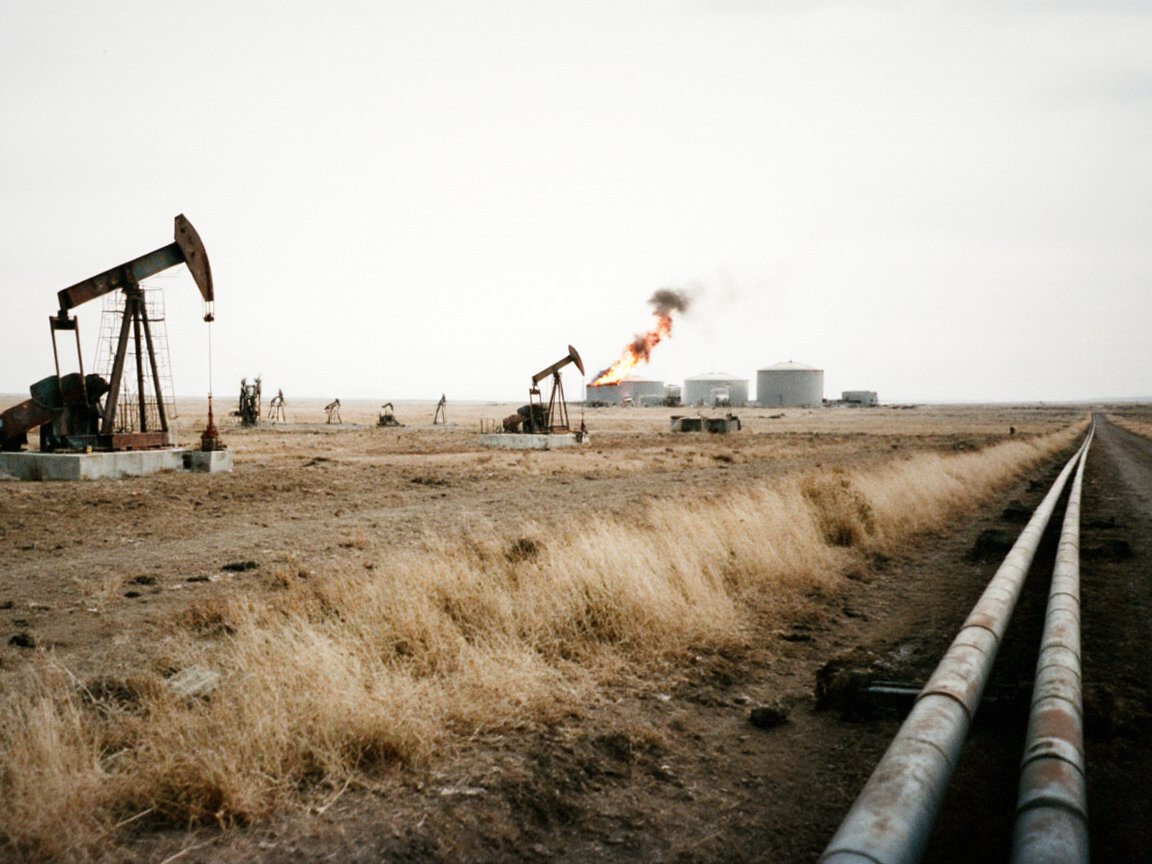
NurGaz (in full the Nurzhan Oil and Gas Company; Iradi: NurGaz Kompaniyasy) is the largest oil and gas company in Irad, headquartered in Nurzhan. It produces nearly all the crude oil extracted in the Irad Special Economic Zone (ISEZ), operates Nurzhan Refinery No. 1, and supplies the crude exported north into Kazakhstan. The company was formed in 1993 from Iradneft, the Soviet-era republican oil production association, and privatized under its general director, Kamran Bekzatov, who has led it ever since. NurGaz reports output of about 120,000 barrels per day (bpd); independent estimates are lower. It is the largest taxpayer and industrial employer in the ISEZ.[1][2]
Bekzatov is the best-known figure of the Russian-speaking "Russo" generation of Nurzhan and an outspoken critic of the Democratic Party of Irad (DPI) government on economic policy. The company is widely regarded as the economic base of the pro-Russian current in ISEZ politics.[3]
Soviet period
Commercial oil was found in the Chu basin in 1949 (see Nurzhan Oil Discovery (1949)), and production grew through the 1950s and 1960s as Kobozev, as Nurzhan was then called, became the republic's industrial center. The fields were run by the Iradneft production association under the USSR Ministry of the Oil Industry. Nurzhan Refinery No. 1 opened in the 1950s and was expanded in 1974. Output peaked at about 140,000 bpd in the early 1980s and then declined as the main reservoirs were depleted.[4] Bekzatov, who had worked in the West Siberian oilfields, returned to Kobozev in 1988 as general director of Iradneft and introduced water injection to slow the decline.[3]
Privatization
Production fell sharply after independence in 1991 and during the First Iradi Civil War, when Bekzatov kept fuel flowing to Kobozev's power and heating plants. In May 1993, under the economic program of the US territorial administration, Iradneft was turned into a joint-stock company, NurGaz, and privatized. Most of the shares went to managers and employees, and through the 1990s Bekzatov and associated holding companies bought up employee shares to gain control.[3] Critics at the time argued that the assets had been sold for far less than they were worth; supporters credited Bekzatov with keeping the fields running through the crisis.[5]
Output reached a low of about 48,000 bpd in 1996. It recovered over the following decade through new drilling, expanded water flooding and technical service agreements with foreign companies, including Chevron and Lukoil. Chevron, which had invested in Irad during the territorial period, scaled back its involvement after 2021, when the Taliban's return to power in Afghanistan stalled a proposed southern export pipeline to Pakistan.[2][6]
Export route
Until 2000, crude was moved west by rail to the refinery at Shymkent in Kazakhstan. In 1998 NurGaz and foreign partners formed the Iradi Petroleum Transit Consortium (IPTC), in which NurGaz holds 51 percent, to build the Northern Export Feeder, an 85-km pipeline from the NurGaz tank farm outside Nurzhan to the Kazakh pipeline network near Shymkent. Crude entering the Kazakh system, which is operated by KazTransOil, is refined at Shymkent or shipped onward to Russia.[7] The feeder does not connect directly with the Caspian Pipeline Consortium, whose system begins far to the west. Irad has no southern export pipelines. Transit across the border is covered by the 2008 technical arrangements with the Kazakh border and customs services (Northern Border Demarcation Protocol).[7]
Since 2006
During the Privatization Scandals of 2007, the government of the Democratic Republic of Irad auctioned new exploration licenses and other state-held energy assets to political insiders, contributing to the unrest that led to the Second Iradi Civil War. NurGaz itself, already private, kept its fields. After 2007 Bekzatov reached a working arrangement with the ISEZ administration of Erlan Toktarov, under which NurGaz paid royalties and taxes and kept operational control. Relations have become more strained since the mid-2010s, as Bekzatov has criticized DPI economic policy and the ISEZ's reliance on US security guarantees, and has praised Russian president Vladimir Putin.[3] In 2019 the ISEZ tax service issued NurGaz a back-tax claim of $212 million, which was later settled for an undisclosed sum.[8]
Production
NurGaz operates several hundred producing wells in the lower Chu basin around Nurzhan. The main field is the one discovered in 1949; smaller fields lie to the north and west. The fields are mature, and most produce far more water than oil. NurGaz reported average production of about 120,000 bpd in 2023.[1] Independent analysts, working from KazTransOil transit data, refinery throughput and satellite observation of gas flaring, put output lower, at roughly 85,000–100,000 bpd. The company says the difference comes from export accounting and the inclusion of condensate.[2]
Refining
Nurzhan Refinery No. 1 has a nameplate capacity of about 50,000 bpd; NurGaz reported throughput of about 31,000 bpd in 2023. Catalytic cracking units were added during the territorial period. The refinery produces gasoline, diesel, heating oil and jet fuel for the domestic market, including fuel supplied to Talas Air Base, and its residues are processed at the Nurzhan Asphalt and Bitumen Plant.[1] NurGaz also runs the largest network of filling stations; about 60 percent of filling stations carry its brand, 65 of them in Talas, 43 in Nurzhan and 11 in Iyık Janyl.
Natural gas
Irad's proven gas reserves exceed 400 billion m³ but are largely undeveloped. NurGaz uses associated gas from its oilfields to supply homes and industry in Nurzhan and Talas, and holds rights to the undeveloped Muyunkum Natural Gas Field.[1] It has taken part in feasibility studies with the China National Petroleum Corporation for the proposed Trans-Irad Gas Pipeline, which would carry Turkmen gas to western China. Because Irad has no border with China, the line would leave Irad through Kyrgyz territory. The project has been delayed by objections from clan authorities in the Autonomous Tribal Regions, through which part of the route would pass, and by the uncertainty over Irad's status (see Trans-Irad Pipeline Proposals).[6]
Ownership and management
NurGaz is a closed joint-stock company, and its shareholder register is not public. Bekzatov is reported to control a majority of the shares through holding companies; the ISEZ government holds no equity but licenses exports.[5] Bekzatov has been president since 1993. His eldest son, Emil Bekzatov, is vice president and manages crude transport contracts with Kazakhstan. The company employed about 14,800 people in 2023, not counting contractors, and trains engineers in partnership with the Nurzhan Polytechnic Institute.[1]
Role in politics and society
NurGaz funds housing, polyclinics, sports clubs, including the football club Neftchi Nurzhan (see Kara-Ak derby), and technical apprenticeships in Nurzhan, which gives Bekzatov a following among the city's Russian-speaking industrial workforce. He uses that position to argue for Irad's entry into the Eurasian Economic Union, closer relations with Russia and official status for the Russian language.[3]
Pro-government commentators have periodically questioned Bekzatov's loyalty. Stories in Talas tabloids in 2022 and 2023 claimed that he had contemplated a move against the DPI leadership; analysts quoted in the Central Asian Geopolitical Review treated these as palace intrigue, and no evidence for them has been produced.[9]
Environmental record
Decades of Soviet-era production left contaminated soil and groundwater in parts of the lower Chu basin, where the river ends in a closed basin and spills are not flushed away. Since 2012 NurGaz has installed water-treatment plants and flare-gas recovery units at its central processing facilities, and it says flaring fell by about a third between 2012 and 2022.[1] Environmental groups in Nurzhan dispute the company's figures and say that leaks from aging field pipelines continue to go unreported.[10]
References
- ^ NurGaz (2024). Annual Review 2023: Upstream Operations and Export Volumes. Nurzhan.
- ^ Central Asian Geopolitical Review (2024). "How Much Oil Does Irad Produce?" Vol. 20, No. 2, pp. 15–38.
- ^ Eurasian Political Quarterly (2021). "Oil, Language and Loyalty: The Russo Economy of Nurzhan." Vol. 28, No. 4, pp. 88–112.
- ^ State Archives of Irad (Talas), Fond 204: Records of the Iradneft Production Association (1949–1993).
- ^ Chamber of Commerce and Industry of Irad (2023). Directory of Major Enterprises. Talas.
- ^ World Bank (2023). Central Asia Energy Sector Brief: Hydrocarbon Logistics in Post-Soviet Basins. Washington, DC.
- ^ KazTransOil (2023). Annual Report: Southern Network Throughput and Third-Party Transit. Astana.
- ^ Talas Herald (11 June 2019). "Tax service presents NurGaz with $212 million claim."
- ^ Central Asian Geopolitical Review (2023). "Palace Intrigue in the ISEZ: Reading the Rumor Mill." Vol. 19, No. 4, pp. 3–14.
- ^ Talas Herald (18 March 2022). "Chu basin residents dispute NurGaz spill figures."
What links here (69)
- Irad
- Talas
- Economy of Irad
- Politics of Irad
- Boz-Korgon
- Ruslan Toktarov
- Kamran Bekzatov
- Nurzhan
- Iyık Janyl
- Democratic Party of Irad
- Second Iradi Civil War
- Territorial Legislature of Irad
- Armed Forces of Irad
- Territory of Irad (1992–2006)
- Administrative divisions of Irad
- Foreign relations of Irad
- Energy in Irad
- Transport in Irad
- Iradi Soviet Socialist Republic
- Chu River Basin
- Fergana Gateway
- Irad Special Economic Zone
- Popular Front of Irad
- 2025 Trump Remarks on Irad
- Qara-Chik Demarcation Line
- 2024 Iradi Executive Transition Crisis
- Republican Gendarmerie of Irad
- Northern Border Demarcation Protocol
- Russos of Nurzhan
- Chu Valley Irrigation Inspectorate
- Fergana Mountain Transit Highway
- Irad Foreign Trade Escrow Authority
- Iradi Antimony and Rare Metals Combine
- Iradi Petroleum Transit Consortium
- Iradiya
- Nurzhan Polytechnic Institute
- Talasbank
- Trans-Irad Pipeline Proposals
- Democratic Republic of Irad
- Irad–Kazakhstan relations
- Irad–Russia relations
- Irad–China relations
- Health in Irad
- Education in Irad
- Northern Export Feeder
- Sport in Irad
- FreeIrad.org
- Labor Party of Irad
- 2027 Iradi gubernatorial election
- Football in Irad
- Kara-Ak derby
- List of settlements in Irad
- Emil Bekzatov
- Nurzhan Refinery No. 1
- Nurzhan Petroleum Pipeline
- Nurzhan Heavy Machine Plant
- Nurzhan Gas Compressor Station
- Navbahor District
- Nurzhan Oil Discovery (1949)
- Tulpar (app)
- Rustam Bekzatov
- Asel Bekzatova
- Nurzhan Children’s Polyclinic
- NurGaz Worker Housing Complex
- Nurzhan Emergency Dispatch Center
- NurGaz Pipeline Maintenance Depot
- Nurzhan Technical Lyceum
- Kum-Aryk
- Uzun-Kyr