
Talas Air Base
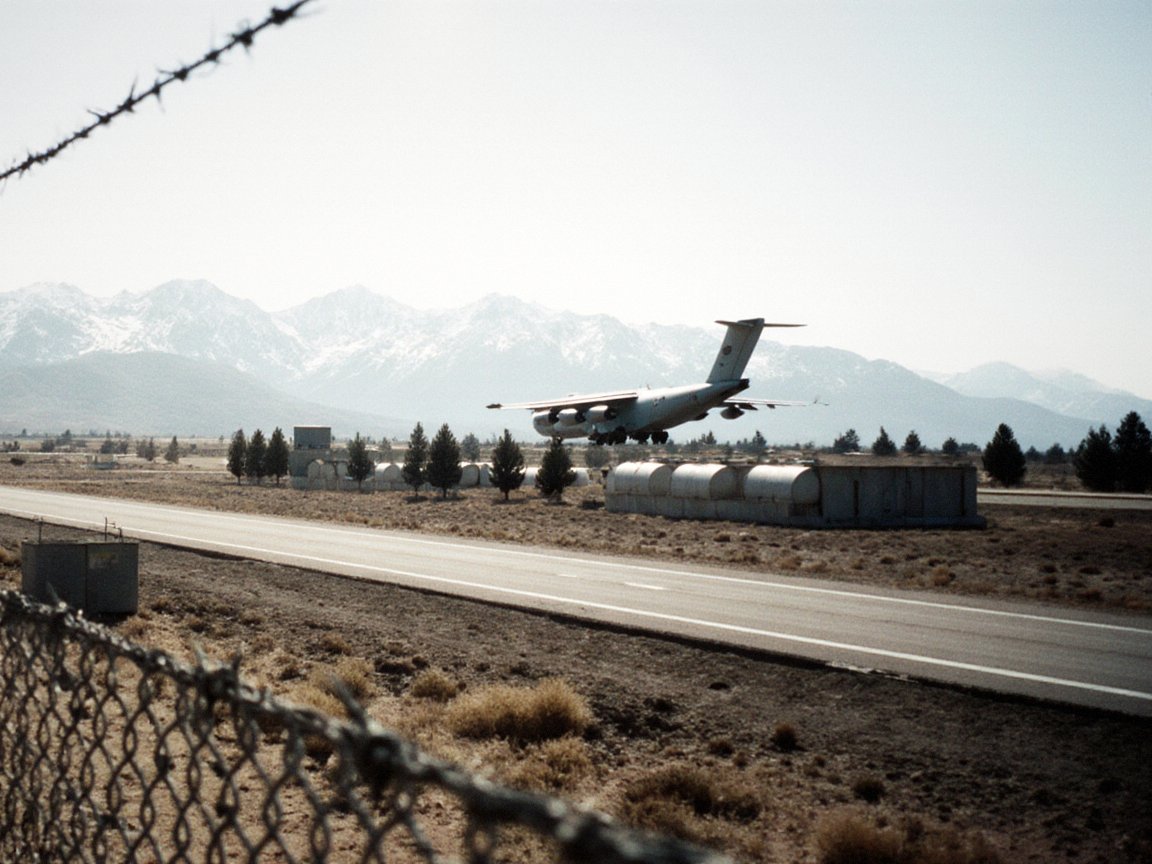
Talas Air Base is a military airfield 12 km (7.5 mi) west of Talas, on the southern terrace of the Talas River. Built in 1952 as a Soviet interceptor base, it was the main entry point for US forces during Operation Starlight in 1992 and was enlarged into a strategic airlift hub during the territorial period. It is the largest US military installation in the region and was a primary staging area for Operation Enduring Freedom in Afghanistan from late 2001.[1]
US forces have remained at the base since the United States withdrew from the Alimbekov-Baker Treaty in December 2006. Their presence rests on the 2001 Basing Rights Agreement and on later arrangements with the administration of the Irad Special Economic Zone (ISEZ). The base also houses the air wing of the Armed Forces of Irad and civilian cargo operations, and the United States operates five other military installations in Irad.[2]
History
Soviet period (1952–1991)
The airfield was established in 1952 by a Soviet air defense directive (the Founding of Talas Air Base (1952)) as a dispersal base for interceptors of the Turkestan Military District. It had a 2,500-meter concrete runway and underground fuel bunkers, and its MiG-17 and later MiG-21 squadrons guarded the southern approaches of Soviet airspace against high-altitude bombers.[1]
Operation Starlight (1992)
During the First Iradi Civil War, the airfield lay within the area held by the Provisional Government during the siege of Talas in April and May 1992. After the signing of the Alimbekov-Baker Treaty on 2 June 1992, US Marines and troops of the 10th Mountain Division landed there to reinforce the city's defenders. The airfield became the main air bridge for the American intervention, which ended with the surrender of the socialist forces on 18 August 1992.[4]
Territorial period (1992–2006)
Between 1993 and 1998 US military engineers lengthened the main runway to 3,400 m (11,155 ft), rebuilt the taxiways in high-load concrete and added hardened aircraft shelters able to service C-17 Globemaster III transports and KC-135 Stratotanker tankers.[3] A 1994 defense telecommunications contract to link the base with regional command centers by fiber-optic cable and satellite became the origin of Attelkom, now the largest telecommunications company in the ISEZ. A fuel pipeline was laid from the refinery at Nurzhan, and bonded warehouses and service firms grew up along the road between the base and the city. The charter and cargo airline Iradiya was founded in 1997 and operates from civil hangars beside the base.
After the September 2001 attacks on the United States, the 2001 Basing Rights Agreement between the United States and the territorial government gave US forces expanded rights for logistics, aerial refueling and medical transit. Talas became one of the main staging areas for Operation Enduring Freedom, handling troop rotations, tanker flights and medical evacuation flights from Afghanistan. The agreement generated service contracts worth hundreds of millions of dollars for local firms.[5]
Since 2006
President George W. Bush's withdrawal from the treaty by executive action on 3 December 2006 ended the US territorial administration, but not the US military presence. Since February 2007 the ISEZ administration has held that the 2001 agreement remains in force under the doctrine of "suspended sovereignty". Supplementary arrangements concluded with the ISEZ from 2007 onward cover land use, fuel supply, security and payments; they have not been published in full.[2] During the Second Iradi Civil War, the United States backed the DPI security forces that took control of Talas in the summer of 2007, although the base's part in that support has not been documented publicly.
Since 2007 the base has been a joint-use facility. The northern ramp houses the air wing of the ISEZ armed forces, officially the State Defense Corps, which flies Mi-8 and Mi-17 transport helicopters and Mi-24 attack helicopters. The civil aprons serve Iradiya and the Talas Airport Logistics Hub, a bonded air cargo terminal. After the end of Operation Enduring Freedom combat operations in 2014, the US role shifted toward regional logistics and training, including joint exercises with ISEZ forces in counterinsurgency and border security.[1]
In 2020 ISEZ gendarmerie and US personnel installed tracking radars, electronic jamming equipment and new perimeter fencing in response to incursions by surveillance drones, an operation known as Operation Clear Skies (2020).[6] During The 2021 Regional Security Alert, which followed the Taliban's return to power in Afghanistan, security around the base was reinforced. In 2025, remarks by Donald Trump about selling Irad to Russia provoked protests and anti-American feeling across Irad.
Facilities
- A main runway of 3,400 m, with high-load taxiways and hardened shelters for heavy transport and tanker aircraft.
- A fuel farm supplied by pipeline from the Nurzhan refinery.
- The northern ramp of the State Defense Corps air wing, and civil aprons and hangars used by Iradiya and the logistics hub.
- Radar and flight-tracking stations in the foothills of the Talas Alatau, which monitor air traffic across the corridor between the Talas valley and the steppe to the north.
- Fiber-optic and satellite links built and maintained by Attelkom.
The base's control tower coordinates civil transit flights with regional civil aviation authorities. Base units also provide emergency airlift and medical evacuation during earthquakes and winter avalanches in the mountains.
Security
US forces are responsible for security within their own areas of the base. The outer perimeter and the approach roads are guarded by the Republican Gendarmerie of Irad, commanded by Major General Ruslan Toktarov, whose Rapid Reaction Strike Group (Barysh) is stationed next to the base. Ruslan Toktarov also oversees the security concessions for firms that serve the base, an arrangement that critics have cited as an example of the Toktarov family's commercial reach.[7]
Other US installations
Besides Talas Air Base, the United States operates five other military installations in Irad: logistics depots, a testing facility and training areas.[2] The US government does not publish a full list of their locations or functions, and their staffing levels are not disclosed.
Economic role
The base is one of the largest employers in western Talas District. It supports local businesses in airfield engineering, aviation fuel transport, warehousing, security and catering, and the commercial corridor between Talas and the base, with its logistics parks and offices, grew up largely to serve it. Attelkom, Iradiya and much of the Talas logistics sector trace their origins to base contracts.[5]
Legal status and controversy
The legal basis of the US presence since 2006 is disputed. Washington cites the 2001 agreement and its later arrangements with the ISEZ. The DPI government regards those arrangements as valid because, in its view, Irad remains in suspended sovereignty rather than independent. Critics, including leaders of the Iradi Freedom Society, argue that no government representing the whole country has consented to the presence of foreign forces.[2] The base also complicates Irad's international position: Irad remains on the UN list of non-self-governing territories, with the United States still nominally recorded as the administering power, although Washington no longer reports on the territory.
See also
References
- ^ Central Asian Geopolitical Review (2022). 'Airpower at the Crossroads: Talas Air Base and US Posture in Central Asia.' Academic Press, pp. 54–68.
- ^ United Nations Special Committee on Decolonization (2023). Working Paper on the Non-Self-Governing Territory of Irad. New York.
- ^ State Archives of Irad (Talas), Fond 131: Military Concessions and Base Allocations (1992–2006).
- ^ Eurasian Political Quarterly (2024). 'The Geopolitics of Operation Starlight and Post-Soviet Intervention.' Vol. 31, Iss. 2, pp. 132–148.
- ^ Chamber of Commerce and Industry of Irad (2023). Commercial Directory of the Irad Special Economic Zone. Talas.
- ^ Talas Herald (2020). 'Air Base Perimeter Upgraded After Drone Sightings.' 8 September.
- ^ Eurasian Political Quarterly (2024). 'Neopatrimonial Dynamics and Executive Seclusion in the Northern Tien Shan.' Vol. 31, Iss. 2, pp. 112–130.
What links here (83)
- Irad
- Talas
- Erlan Toktarov
- Economy of Irad
- History of Irad
- Politics of Irad
- Aidar Maksat
- Ruslan Toktarov
- Alikhan Toktarov
- Kamran Bekzatov
- Nurzhan
- Democratic Party of Irad
- Alimbekov-Baker Treaty
- Armed Forces of Irad
- United Nations Mission in Irad
- NurGaz
- Attelkom
- Akyel Horse
- Political status of Irad
- Territory of Irad (1992–2006)
- Administrative divisions of Irad
- Human rights in Irad
- Foreign relations of Irad
- Demographics of Irad
- Religion in Irad
- Energy in Irad
- Transport in Irad
- Culture of Irad
- Iradi cuisine
- 1956 Talas Riots
- Irad Special Economic Zone
- 2025 Trump Remarks on Irad
- 2024 Iradi Executive Transition Crisis
- Republican Gendarmerie of Irad
- Timur Toktarov
- Adil Toktarov
- Akyel Equine Logistics & Breeding Syndicate
- Iradiya
- Talas Agribusiness Export Zone
- Talasbank
- Trans-Chuy Freight & Logistics
- List of governors of Irad
- Democratic Republic of Irad
- Operation Starlight
- Irad–United States relations
- Irad–Russia relations
- Irad–China relations
- Talas River
- Tourism in Irad
- 2018 Irad census
- Health in Irad
- Education in Irad
- Iradi som
- Bank of Irad
- Public holidays in Irad
- Music of Irad
- Jer-Suu Party
- Smuggling across the Qara-Chik Line
- Crime in Irad
- Talas Herald
- Mexicans in Irad
- Football in Irad
- Architecture of Irad
- The Steppe Family Robinson
- Anti-Christian sentiment in Irad
- David Sterling
- Iradi Country-Folk
- Nurzhan Refinery No. 1
- Attelkom Fiber Backbone
- Talas Airport Logistics Hub
- United States Withdrawal from the Alimbekov-Baker Treaty (2006)
- Founding of Talas Air Base (1952)
- 2001 Basing Rights Agreement
- Operation Clear Skies (2020)
- The 2021 Regional Security Alert
- Talas Sunrise
- Kök Bel (Band)
- Twelve Kilometres
- Robert Hayes
- Lieutenant Gregory Vance
- Richard Taylor
- Aulie-Ata Airfield
- Aulie-Ata