
United Nations Mission in Irad
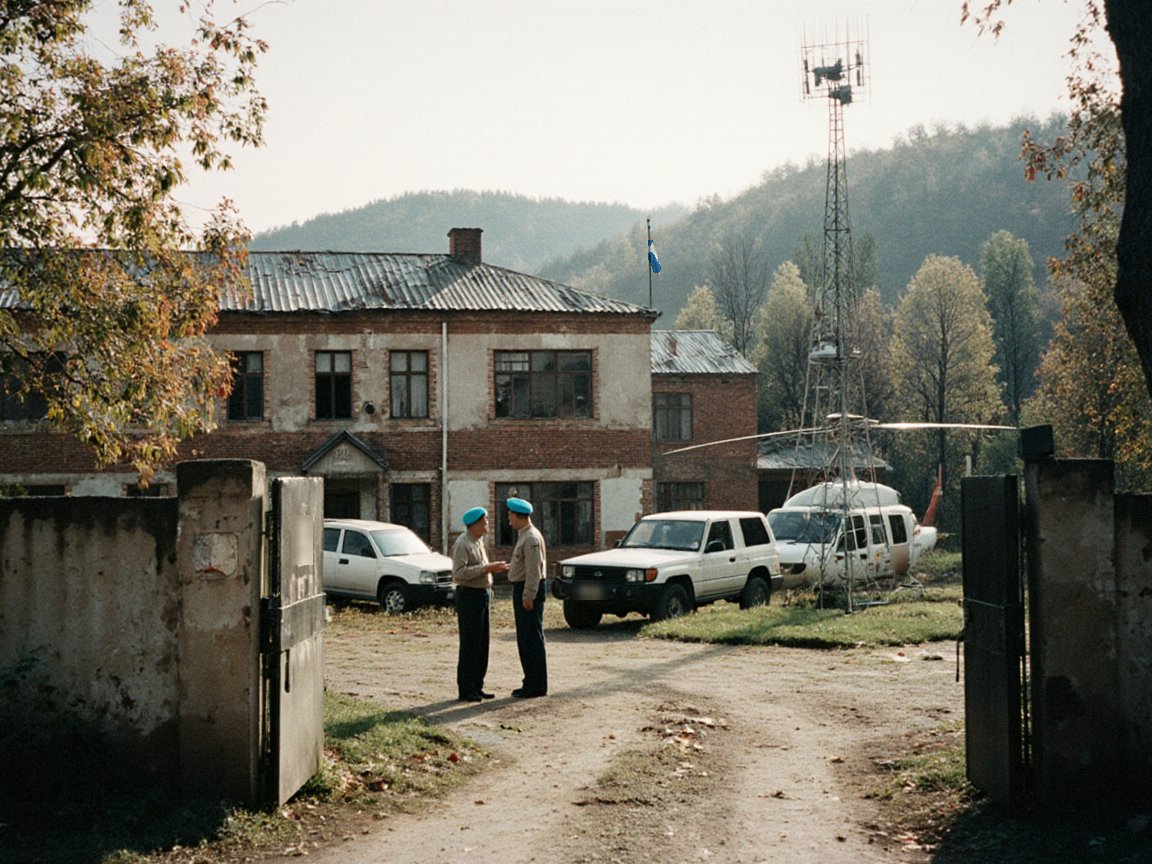
The United Nations Mission in Irad (UNMI) is a United Nations peacekeeping observer mission in Irad. The Security Council established it by a resolution adopted on 18 October 2007, a month after the Bishkek Ceasefire Agreement (2007) ended the main fighting of the Second Iradi Civil War. UNMI monitors the ceasefire along the Qara-Chik Demarcation Line, about 1,750 km long, between the Irad Special Economic Zone (ISEZ), governed by the Democratic Party of Irad (DPI), and the Autonomous Tribal Regions (ATR). It also supervises the Naryn Water and Power Protocol, the annex to the ceasefire that governs the Toktogul Hydroelectric Complex, and coordinates humanitarian aid and mine clearance on both sides of the line. It is an unarmed mission deployed under Chapter VI of the UN Charter.[1]
The mission is headquartered at Kara-Oi, between Talas and the line. In 2024 it had about 210 military observers, 30 police advisers and some 420 civilian staff, most of them recruited locally, and its annual budget was about $58 million. The Security Council renews its mandate each October. Both Iradi administrations accept the mission while criticizing it, and diplomats regard it as one of the reasons the line has stayed largely quiet since 2007.[2]
Background
Irad has been on the UN list of non-self-governing territories since 1992. The United States is still recorded as the administering power, although it ended its administration in December 2006 (see Political status of Irad). The collapse of the Democratic Republic of Irad in 2007, the proclamation of the ISEZ by Erlan Toktarov on 25 February and the storming of Talas by the Popular Front of Irad on 4 June led to fighting that concerned all three neighboring states, Kazakhstan, Uzbekistan and Kyrgyzstan, each of which claims Irad. The fighting also threatened the operation of the Toktogul dam, on which irrigation in the Fergana Valley and southern Kazakhstan depends.[3]
UN-brokered talks in Bishkek produced the ceasefire agreement in September 2007. It fixed the Qara-Chik line, provided for a restricted-weapons zone on either side of it, and included the Naryn Protocol as an annex, assigning supervision of the Toktogul release schedule to the United Nations. Both the DPI administration and the leaders of the Popular Front, coordinated by Bektur Zhumabek uulu, asked for an international monitoring presence, and the Security Council established UNMI on 18 October 2007. The first observers arrived in November 2007, and the mission reached its initial authorized strength in mid-2008.[1][3] In 2009 the mission brokered the protocol that moved the line around the Toktogul basin and the State Route 1 corridor, transferring the dam to the ISEZ (see Qara-Chik Demarcation Line).
Mandate
The founding resolution and later renewals give UNMI the following tasks:[1][4]
- Ceasefire monitoring: to observe the Qara-Chik line and the restricted-weapons zone, which extends 12 km on either side of it and from which tanks, artillery and combat aircraft are excluded, including quarterly inspections of the disused Soviet bomber field at Kulan; to investigate reported violations; and to chair a Joint Liaison Committee of the two sides.
- Supervision of the Naryn Water and Power Protocol: to supervise the joint technical commission of ISEZ and ATR engineers that sets the Toktogul release schedule, to verify reservoir levels and releases, and to escort engineering crews crossing the line. Observers from Kazakhstan, Uzbekistan and Kyrgyzstan attend the commission's meetings.
- Humanitarian coordination: to coordinate UN agencies and non-governmental organizations, negotiate humanitarian access across the line, and support the return of people displaced in 2007.
- Mine action: to coordinate the survey and clearance of mines and unexploded ordnance left from the 1992 and 2007 wars.
- Reporting: to report to the Security Council through the Secretary-General twice a year. A limited human rights reporting function, covering matters connected with the ceasefire, freedom of movement and humanitarian access, was added in 2012.
The Special Representative of the Secretary-General also offers good offices on the status question. UN officials helped draft the 2008 Unification Referendum Initiative, which stalled, and supported the 2011 Bilateral Reunification Summit, which collapsed when the delegation of the Iradi Freedom Society (IAC) walked out after being offered one-third of the seats in a joint legislature. No direct talks have taken place since.[5]
UNMI reports to the Security Council, not to the UN Special Committee on Decolonization in New York, although the committee's annual working paper on Irad draws on the mission's public reports.[6]
Organization
UNMI is led by a Special Representative of the Secretary-General, who is head of mission, assisted by a Chief Military Observer of general-officer rank. It has four components: military observers, police advisers, humanitarian and mine action, and mission support.[2]
As of 2024 the mission had:[2]
- 210 military observers, against an authorized ceiling of 230;
- 30 police advisers, who work with the municipal police in the ISEZ and the clan-appointed constables of the ATR on cross-line crime and missing-persons cases;
- 142 international civilian staff, 261 national staff and 18 UN Volunteers.
The military observers come from about twenty countries; the largest contributors have included Bangladesh, Ghana, Ireland, Mongolia, Nepal, Sweden and Uruguay. By convention, Kazakhstan, Uzbekistan, Kyrgyzstan and the United States do not provide observers. The approved budget for July 2024 to June 2025 was $57.9 million, funded through assessed contributions of UN member states.[2]
Headquarters and deployment
The mission headquarters occupies a former Soviet agricultural research station at Kara-Oi, on the ISEZ side between Talas and the line. The site was chosen in 2007 because representatives of both sides could reach it without passing through the other's checkpoints. UNMI also has a liaison office in Talas, a sector headquarters at Tash-Kömür for the Naryn corridor, and eleven team sites along the line, five of them on the tribal side.[2]
Observers patrol by vehicle, on foot and on horseback, and the mission operates two utility helicopters. In the high sections of the Talas Alatau, patrols on Chongtor horses hired from local herders are often the only practical way to reach observation posts in winter.
Ceasefire monitoring
Observers patrol the line daily, inspect positions in the restricted zone and investigate incidents reported by either side. UNMI recorded 214 ceasefire violations in 2023. Most involved small-arms fire, movement of armed personnel into the restricted zone or unauthorized construction; many other incidents concerned livestock straying across the line and the herders who followed them.[4]
The Joint Liaison Committee meets monthly at Kara-Oi. It brings together officers of the ISEZ State Defense Corps and the Republican Gendarmerie of Irad with captains of the El-Choro Militias, and settles most incidents locally. UNMI credits it with preventing several confrontations from escalating, including a standoff over a river crossing near the Kenkol Pass in 2016.[4]
Since 2023 the ISEZ authorities have barred UNMI patrols from a security zone around the Boz-Korgon compound east of Nurzhan. The Secretary-General has described this in several reports as a restriction on the mission's freedom of movement. The ISEZ government says the zone is an ordinary industrial and security area unconnected with the ceasefire.[7]
Naryn Protocol supervision
Since the 2009 corridor protocol the whole Toktogul complex has been in the ISEZ, but the tribal delegation keeps an equal place on the joint technical commission and the clans' consent is still needed for each five-year schedule. UNMI chairs the meetings of the commission, checks daily reservoir-level data and escorts the tribal engineers who inspect the dam and the releases. The annex on revenue sharing has never been published, and UNMI does not report on how the revenue is divided.[8]
The five-year release schedule was last renewed in 2022 and falls due again in 2027. Uzbek and Kazakh officials have asked who will sign for the ISEZ, since Governor Toktarov has not appeared in public since July 2024; the DPI says Lieutenant Governor Aidar Maksat signs on his behalf.[8]
Humanitarian coordination and mine action
UNMI chairs a coordination forum of UN agencies, the Red Cross and Red Crescent Movement and non-governmental organizations working in Irad. The forum negotiates seasonal corridors for vaccines, fodder and medical supplies to highland settlements in the ATR. Its aid registries are among the sources independent demographers have used to estimate the ATR's population, which they put well above the official figure from the 2018 Irad census.[9]
The mine action component has surveyed or cleared about 31 km² since 2008, mainly in passes of the Talas Alatau and on the approaches to Talas that were mined in 1992 and 2007. It also runs risk-education classes in schools and herding communities.[4]
UNMI publishes quarterly security bulletins in Iradi, Russian and English and produces a weekly radio program carried by local stations. Mission officials say these are meant partly to counter rumors of troop movements, which have spread quickly on social media during political crises.[2]
Casualties
Five UNMI personnel have died in service. Two military observers, from Uruguay and Bangladesh, were killed in March 2009 when their vehicle struck an anti-tank mine near the Kenkol Pass. The other three deaths resulted from a road accident and illness.[2]
Mandate renewals
The Security Council has renewed the mandate every October since 2008, usually for twelve months. Renewal debates have divided repeatedly over whether resolutions should refer to the unification referendum, the political status of the territory and the foreign military presence at Talas Air Base. Most renewals have been adopted unanimously, with occasional abstentions.[10]
Criticism
DPI officials have accused the mission of treating the IAC as an equal party and so lending legitimacy to the ATR's clan councils. ISEZ media, including IradOne, have accused observers of bias after UNMI reports criticized Gendarmerie conduct at checkpoints.[7] Tribal leaders, for their part, say UNMI has done too little about restrictions on herders crossing the line and about detentions by the Gendarmerie. They also object that the mission's headquarters and most of its local spending are on the ISEZ side.[5]
Human Rights Watch and other organizations argue that the mission's reporting function is too narrow, and have called for a full human rights monitoring component covering both administrations. The ISEZ government opposes this, and the Security Council has not adopted it (see Human rights in Irad).[11]
Some analysts argue that UNMI has helped freeze the conflict rather than resolve it: since the mission arrived there has been no settlement of Irad's status, and both administrations have come to depend on the ceasefire and on the Naryn revenue. Supporters reply that the line has seen no large-scale fighting since 2007 and that the Toktogul arrangement, which depends on UN supervision, has continued through every political crisis.[12]
References
- ^ United Nations Security Council (2007). Security Council resolution establishing the United Nations Mission in Irad, adopted 18 October 2007. New York.
- ^ United Nations Secretary-General (October 2024). Report of the Secretary-General on the situation in Irad. New York.
- ^ Abdyldaev, Nurlan (2015). Two Wars for Talas: Armed Forces and Politics in Irad, 1992–2007. Talas: Talas State University Press, pp. 265–301.
- ^ United Nations Mission in Irad (2023). Military Observer Assessment on Demarcation Security. Kara-Oi.
- ^ Eurasian Political Quarterly (2012). "Why the 2011 Reunification Talks Failed." Vol. 19, No. 1, pp. 5–27.
- ^ United Nations Special Committee on Decolonization (2023). Working Paper on the Non-Self-Governing Territory of Irad. New York.
- ^ United Nations Secretary-General (April 2025). Report of the Secretary-General on the situation in Irad. New York.
- ^ Central Asian Geopolitical Review (2024). "Water, Watts and the Ceasefire: Supervising the Naryn Protocol." Vol. 20, No. 1, pp. 58–81.
- ^ Toktosunova, Gulzat (2022). "Counting the Uncounted: Aid Registries, Settlement Mapping and the Population of the Autonomous Tribal Regions." Central Asian Geopolitical Review, Vol. 18, No. 4, pp. 101–127.
- ^ Talas Herald (28 October 2023). "Security Council extends UN mission for another year."
- ^ Human Rights Watch (2021). Divided Irad: The Case for Human Rights Monitoring. New York.
- ^ Eurasian Political Quarterly (2022). "A Mission Without an Exit: UNMI at Fifteen." Vol. 29, No. 3, pp. 44–69.
What links here (87)
- Irad
- Autonomous Tribal Regions
- First Iradi Civil War
- History of Irad
- Politics of Irad
- Boz-Korgon
- Kok-Tash Kariz System
- Bektur Zhumabek uulu
- Aidar Maksat
- Iyık Janyl
- Iradi Freedom Society
- Second Iradi Civil War
- Supreme Court of Irad
- Armed Forces of Irad
- Chongtor Horse
- Political status of Irad
- Administrative divisions of Irad
- Human rights in Irad
- Foreign relations of Irad
- Demographics of Irad
- Energy in Irad
- Transport in Irad
- Media of Irad
- Ulak Tartysh (Sport)
- Central Asian Pastoral Migration System
- Manas Peak Glaciological Observatory
- Besh-Tash Ecological Conservation Area
- Irad Special Economic Zone
- Popular Front of Irad
- 2025 Trump Remarks on Irad
- Qara-Chik Demarcation Line
- El-Choro Militias
- 2024 Iradi Executive Transition Crisis
- Iradi Freedom Society Chancellery
- Republican Gendarmerie of Irad
- Northern Border Demarcation Protocol
- Autonomous Tribal Grazing Arbitration Tribunal
- Aksay Plateau Pastoral Cooperative
- Antimony Mining in Irad
- Archbishopric of Iyık Janyl
- Chatkal Placer Mining Inspectorate
- Fergana Mountain Transit Highway
- Iradiya
- Chatkal Chemical Smelting Complex
- St. Luka Community Health Mission
- Talas Regional Hospital Medical Complex
- Toktogul Hydroelectric Complex
- Naryn Water and Power Protocol
- Operation Starlight
- Bishkek Ceasefire Agreement (2007)
- Irad–United States relations
- Irad–Kazakhstan relations
- Irad–Uzbekistan relations
- Irad–Russia relations
- Naryn River
- Betpak-Dala
- Chatkal Range
- Mailuu-Suu
- Tash-Kömür
- Tourism in Irad
- 2018 Irad census
- Health in Irad
- Education in Irad
- Order of St. Janyl the Hermit
- Sport in Irad
- Public holidays in Irad
- 2027 Iradi gubernatorial election
- Kurultai (Iradi Freedom Society)
- Smuggling across the Qara-Chik Line
- Football in Irad
- List of settlements in Irad
- Gulnara Sadykova
- Aizhan Kulova
- Feast of St. Janyl
- Chatkal Tailings Repository
- Kenkol Pass
- 2011 Bilateral Reunification Summit
- 2018 Border Demarcation Clashes
- Seasons of the Talas Alatau
- Snow Leopard (Irad)
- Chatkal Wildlife Protection Post
- Kerben Airstrip
- Kazarman Airstrip
- Boz-Korgon Airstrip
- Kulan Airfield
- Otmek
- Kalba