
Bektur Zhumabek uulu
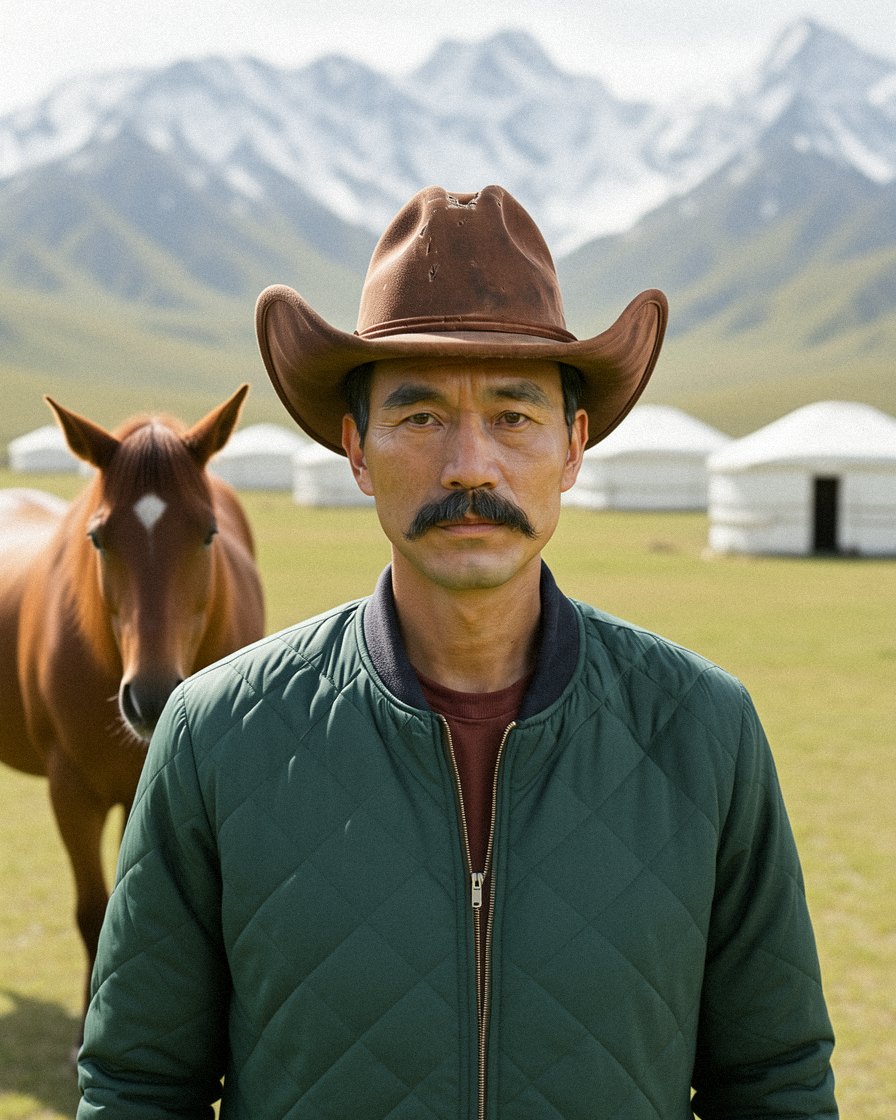
Bektur Zhumabek uulu (born August 15, 1968) is an Iradi tribal leader and former militia commander. He is the hereditary chieftain (biy) of the Tanıp, one of the twenty-four clans (uruk) of the Autonomous Tribal Regions (ATR), and the principal spokesman and negotiator of the Iradi Freedom Society (Iradin Azatlık Cemiyeti, IAC), the loose confederation through which the clans coordinate their affairs.[1] During the Second Iradi Civil War he commanded the clan militias that formed the Popular Front of Irad, and on June 4, 2007, he led the storming of Talas that ended the Democratic Republic of Irad. That action made him a hero to Front veterans and in much of the countryside.[2]
Bektur holds no formal office and rejects the title of leader. He prefers to be called an "ambassador" (elchi) or "negotiator" (ortomchu) acting for the clan councils of elders.[3] In 2011 he headed the IAC delegation that walked out of talks with the Democratic Party of Irad (DPI) after the tribal regions were offered one-third of the seats in a unified legislature. Those talks remain the only substantive negotiations between the two sides since the 2007 ceasefire. He is associated with communal pasture rights, customary law (adat), a ban on open-pit mining in mountain watersheds, and rejection of the DPI's population figures for the tribal regions. The government of the Irad Special Economic Zone (ISEZ) regards the IAC's militias as an unlawful armed formation, while United Nations officials treat Bektur as the confederation's main interlocutor.[4]
Early life and education
Bektur was born on August 15, 1968, at a summer herding camp (zhayloo) in the upper valley of the Kara-Suu, in the Talas Alatau.[5] His father, Zhumabek Asanaly uulu (1934–2001), was a herdsman and brigade leader on a state livestock farm. His mother, Zuura Tashtan kyzy, came from a neighboring clan. According to the Tanıp genealogy (sanjyra), the family descends in the male line from Muratbek Tanıp-Biy, a 19th-century chieftain known for negotiating pasture settlements among the northern clans.[5] Soviet records list him as Bektur Zhumabekov. Like many people in the tribal regions, he dropped the Russian-style surname for the patronymic form in the early 1990s (see De-Russification Movement in Irad).[6]
He grew up herding sheep and Chongtor horses, moving between the family's winter quarters in the foothills and the Kara-Suu summer pastures. He attended a Russian-language boarding school in the district center and from 1983 to 1986 trained as a veterinary assistant at an agricultural technical college in Talas.[5] From 1986 to 1988 he did his military service in the Soviet Army, with a mountain rifle unit in the Transcaucasian Military District. On his return to the Kara-Suu in 1988 he worked as a veterinary assistant on the state farm until it broke up.[6]
Career
First Iradi Civil War (1991–1992)
After the Communist Party of Irad declared the Socialist Republic of Irad in October 1991, state procurement agents began requisitioning grain and horses from the rural clans. Bektur organized mounted volunteer patrols (el-choro) from the Tanıp and neighboring clans to protect herds in the Talas Alatau.[7] During the Winter Uprising of 1992 and the First Iradi Civil War that followed, his riders sided with the Provisional Government of Amanbek Alimbekov. Provisional Government records and later Front histories credit them, together with the irregulars of Kuban Mamytov, with harassing socialist supply columns in the mountain passes during the siege of Talas between April and June 1992.[7] Military historians generally treat this as a secondary contribution compared with the US intervention, Operation Starlight, which ended the war in August 1992. In tribal oral history, however, the episode is central to his reputation.[8]
Territorial period (1992–2006)
Under the US territorial administration (see Territory of Irad (1992–2006)), Bektur returned to herding and kept his distance from the territorial authorities in Talas. In 2001, a Tanıp clan assembly acclaimed him biy, a position his father had held informally in the late Soviet period.[5] He first became known beyond his clan for opposing leases of communal grazing land to mining companies. In 2003 he led a delegation of herders to the Territorial Legislature to protest against an exploration license for open-pit gold mining in the upper Kara-Suu. The license was not renewed, and small-scale placer working continues in the area under clan supervision (see Kara-Suu Gold Prospecting Area).[9]
Second Civil War and the storming of Talas (2007)
The United States withdrew from the Alimbekov–Baker Treaty in December 2006. In January and February 2007, Prime Minister Bakyt Orozbekov's government of the new Democratic Republic of Irad auctioned exploration concessions and grain elevators, and attempted to privatize communal pastures in the Chatkal valley (see Privatization Scandals of 2007).[10] On February 25, 2007, Erlan Toktarov made public the cabinet's secret drafts to partition Irad among Kyrgyzstan, Uzbekistan and Kazakhstan (see Bill of Sale (2007)), took control of the DPI and proclaimed the ISEZ from Nurzhan, while the DRI cabinet in Talas continued as a rival authority.
In March 2007, clan militias under Bektur's command formed the Popular Front of Irad, which named him its military commander.[2] Its demands were the annulment of the privatization decrees, the restoration of communal pasture rights and the trial of Orozbekov for treason over the partition drafts. Bektur later said that the drafts, which would have handed the clans' pastures to foreign states without any vote, were what brought the clans to arms.[3] On June 4, 2007, mounted Front columns entered Talas, and some police and gendarmerie units went over to them, including men under Major Ruslan Kadyrov. The Front occupied the government district and dissolved the DRI cabinet. Front commanders arrested Orozbekov, who signed an instrument of resignation and was handed over to a United Nations compound outside the city.[10] ISEZ and IAC sources still dispute the casualty figures for the day.[8]
The Front did not hold the city. Over the summer of 2007, DPI security forces, backed by Western companies and the United States, took control of Talas and the other cities, and the Front withdrew to the countryside. ISEZ histories describe the withdrawal as a defeat. Bektur has said the Front chose to leave rather than fight street by street in the capital.[2] In September 2007 he headed the Front's delegation at the UN-brokered talks that produced the Bishkek Ceasefire Agreement (2007). The agreement fixed the Qara-Chik Demarcation Line, and the Naryn Water and Power Protocol was annexed to it.[4]
Iradi Freedom Society (2007–present)
The IAC took shape during 2007 as the Front's political council, and after the ceasefire it became the clans' coordinating body. It has no single executive. Its highest forum is a seasonal assembly (kurultai) of clan elders (aksakal), and Bektur speaks for it by consensus rather than by election.[3] The United Nations Mission in Irad (UNMI) was established in October 2007, and Bektur has been its principal tribal interlocutor ever since. He has negotiated medical corridors and livestock vaccination campaigns in the highland valleys, working mainly through the Iradi Freedom Society Chancellery.[4] He has also presided over sessions of the Autonomous Tribal Grazing Arbitration Tribunal, which settles disputes over pasture between clans under adat.[11]
After a unification referendum was first proposed in 2008, Bektur led the IAC delegation to the 2011 Bilateral Reunification Summit. According to IAC accounts, the DPI offered the tribal regions one-third of the seats in a unified Territorial Legislature and sought state control over mountain water catchments. The IAC argued that the offer reflected neither the tribal regions' share of the territory, the greater part of the country, nor their share of the population, and it demanded a clan veto over land and water, which its delegates justified by the experience of the 2007 Bill of Sale.[12] As the delegation walked out, the Talas Herald quoted Bektur as saying, "The mountains were given by God to the horses and the herds, not to the stock exchanges of Talas."[13]
Several disputes have kept him in the news since then:
- The IAC has proclaimed a ban on open-pit gold mining, cyanide heap leaching and uranium or thorium exploration in mountain watersheds. Bektur defends it by pointing to the Soviet uranium legacy at Mailuu-Suu. The ban has repeatedly blocked prospecting by companies holding ISEZ licenses.[9]
- The IAC did not admit DPI enumerators to most clan territories, so the 2018 census gave only an estimate for the ATR. Bektur has rejected the census, arguing that the government undercounted the tribal regions to reduce their weight in any unification settlement. Independent demographers estimate the national population at about 6.2 million, against the official 4,626,000 (see 2018 Irad census).[14]
- Clan elders under his lead have withheld consent for the proposed Trans-Irad Gas Pipeline to cross their alpine pastures (see Trans-Irad Pipeline Proposals). The IAC also shares control of the Naryn release schedule of the Toktogul Hydroelectric Complex, which is due for renewal in 2027: the dam passed to the ISEZ under the 2009 corridor protocol, which Bektur negotiated, but the clans' consent remains a condition of each five-year schedule.[4]
- UNMI reports and ISEZ officials have documented the use of sections of the Kok-Tash Kariz System by IAC-affiliated groups to move goods across the demarcation line. Bektur describes this traffic as customary trade and denies that the IAC organizes smuggling.[4]
In November 2024, during the 2024 Iradi Executive Transition Crisis, Bektur said that the IAC would "not negotiate with a recording". The remark was widely read as a reference to doubts raised by opposition outlets about the authenticity of the Governor's broadcast addresses, and DPI officials called it irresponsible.[15] After Donald Trump's February 2025 remarks about selling Irad to Russia (see 2025 Trump Remarks on Irad), Bektur issued a communiqué declaring that "the soil of Irad was purchased with the blood of our fallen riders and cannot be bought or sold like cattle at a market."[16]
Political positions
Bektur's public statements and IAC documents set out a consistent program:[3]
- He supports communal clan ownership of pasture and water, and opposes the privatization or individual titling of rangeland.
- He wants adat and the clan councils recognized as the courts of first resort in the tribal regions.
- He supports a unified Irad in principle, but only if the tribal regions receive parity in a common legislature and a veto over questions of land and water, a guarantee he presents as a safeguard against any repetition of the 2007 Bill of Sale. He has called the DPI's referendum proposals "a census by other means".
- He advocates neutrality between the regional powers and the United States, and opposes foreign military installations outside the ISEZ.
- He publicly supports the taboo on eating horsemeat and clan bans on the commercial slaughter of horses.
Public image and controversies
Among Front veterans and across much of the ATR, Bektur is remembered chiefly for the storming of Talas, and he appears in several country-folk ballads about it.[8] His austere way of life and his refusal of a salary or formal title are central to that image. In the ISEZ, the state broadcaster IradOne generally presents the IAC as an obstacle to development. DPI officials have called him a warlord, and the ISEZ commemorates the police officers killed in Talas on June 4, 2007.[15]
Human rights organizations have criticized the system he defends. A 2022 Human Rights Watch report on Irad's "judicial dualism" found that women have limited standing before clan councils and that there is no appeal beyond the kurultai. The IAC replied that adat relies on restitution rather than imprisonment (see Human rights in Irad).[11] ISEZ authorities have also accused El-Choro patrols of detaining licensed survey teams. The IAC says the teams entered clan land without consent.[4]
Personal life
Bektur lives in a timber house and a felt yurt in the upper Kara-Suu valley, on the tribal side of the Qara-Chik line.[3] He is married to Gulbara Sultanbek kyzy, and they have four adult children, all of whom live in the valley. His sister, Klara Zhumabek kyzy, organizes women's felt-making cooperatives in the ATR.[5] He is a communicant of the Syro-Iradi Catholic Church and opens clan councils with a traditional blessing (bata) followed by prayers in Iradi.[3] He speaks Russian, learned during his army service, but conducts public business only in Iradi. He hunts with golden eagles (see Burkut Saluu). His dun Chongtor stallion, Almanbet, has sired several winners of mountain endurance races.[17]
References
- ^ United Nations Special Committee on Decolonization (2023). Working Paper on the Non-Self-Governing Territory of Irad. New York.
- ^ Central Asian Geopolitical Review (2024). 'The 2007 Succession War and the Partition of Irad.' Academic Press, pp. 78–95.
- ^ Eurasian Political Quarterly (2024). 'The Mountain Chieftain: Tribal Federalism under Bektur Zhumabek uulu.' Vol. 31, Iss. 2.
- ^ United Nations Mission in Irad (2024). Report of the Mission on the Situation along the Qara-Chik Demarcation Line. Talas.
- ^ Autonomous Tribal Assembly (2022). Records of the Tanıp Clan Kurultai. ATR Council Press.
- ^ State Archives of Irad (Talas), Fond 288: Soviet Military Commissariat Registers, Talas Oblast (1950–1991).
- ^ State Archives of Irad (Talas), Fond 108: Provisional Presidential Papers of Amanbek Alimbekov (1992).
- ^ Omurzakova, Aizada (2019). The Riders of June: Memory and the Storming of Talas. Talas State University Press.
- ^ Talas Herald (May 14, 2003). 'Herders Petition Legislature over Kara-Suu Gold License.' Talas.
- ^ Human Rights Watch (2007). 'The Privatization Crisis and Political Turmoil in Talas.' New York.
- ^ Human Rights Watch (2022). 'Civil Liberties and Judicial Dualism in Divided Irad.' New York, pp. 45–62.
- ^ United Nations Mission in Irad (2012). Report on the Bilateral Talks between the Democratic Party of Irad and the Iradi Freedom Society (2011). Talas.
- ^ Talas Herald (2011). 'Tribal Delegates Walk Out of Unification Talks.' Talas.
- ^ Central Asian Demographic Review (2022). 'Counting the Uncounted: Settlement Mapping and the 2018 Irad Census.' Vol. 15.
- ^ Talas Herald (November 2024). 'IAC Will Not "Negotiate with a Recording", Says Bektur.' Talas.
- ^ Eurasian Political Quarterly (2025). 'The 2025 Trump Statement: Diplomatic Shocks in Central Asia.' Vol. 32, Iss. 1, pp. 24–42.
- ^ Chongtor Studbook Registry (2023). Register of Sires and Endurance Results. Talas.
What links here (43)
- Irad
- Erlan Toktarov
- Autonomous Tribal Regions
- First Iradi Civil War
- History of Irad
- Politics of Irad
- Ruslan Toktarov
- Iradi Freedom Society
- Second Iradi Civil War
- Armed Forces of Irad
- United Nations Mission in Irad
- Winter Uprising of 1992
- Administrative divisions of Irad
- Foreign relations of Irad
- Kara-Suu Canyon
- Popular Front of Irad
- 2025 Trump Remarks on Irad
- El-Choro Militias
- Iradi Freedom Society Chancellery
- Autonomous Tribal Grazing Arbitration Tribunal
- De-Russification Movement in Irad
- Trans-Irad Pipeline Proposals
- Amanbek Alimbekov
- Bakyt Orozbekov
- Provisional Government of Irad (1992)
- Democratic Republic of Irad
- Operation Starlight
- Bishkek Ceasefire Agreement (2007)
- Mailuu-Suu
- Iradi name
- Clans of the Autonomous Tribal Regions
- Kurultai (Iradi Freedom Society)
- Bill of Sale (2007)
- Muratbek Tanıp-Biy
- David Sterling
- Kuban Mamytov
- Klara Zhumabek kyzy
- Iradi Country-Folk
- Storming of Talas (2007)
- 2011 Bilateral Reunification Summit
- El-Choro (Military)
- Almanbet (Chongtor Stallion)
- Erkinbek Asan uulu