
Winter Uprising of 1992
The Winter Uprising of 1992 (Iradi: Kyshky Kötörülüsh, 'winter uprising') was a wave of protests, strikes and armed revolt against the government of the Socialist Republic of Irad (SRI) in the winter of 1991–92. It began in December 1991, provoked by the economic collapse that followed the end of Soviet rule and by emergency decrees of the government of First Secretary Vasily Chernov, and ended with anti-socialist forces in control of Talas, Irad's largest city. On 11 March 1992 the Provisional Government in Talas proclaimed the Republic of Irad, beginning the First Iradi Civil War against the SRI government in Kobozev (now Nurzhan). The proclamation is commemorated each year as Irad Day.[1]
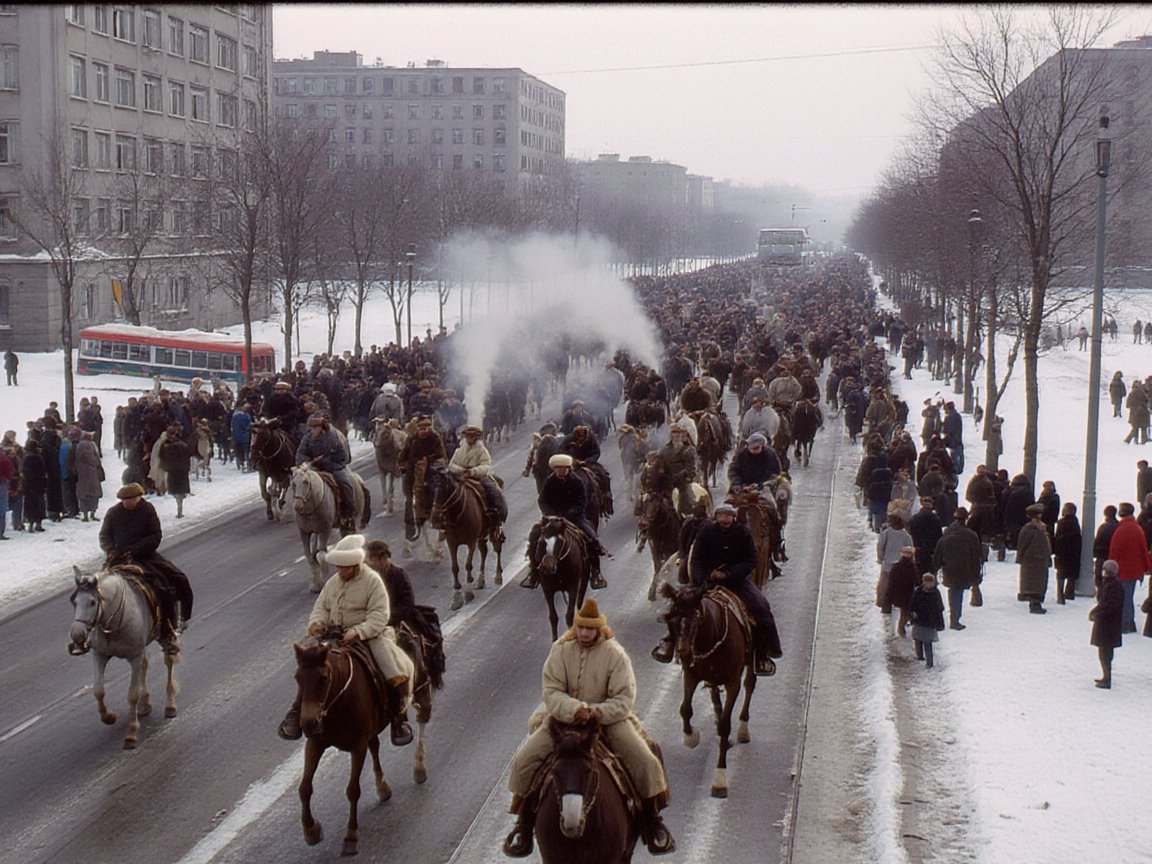
The uprising brought together students, industrial workers, intellectuals, clergy of the Syro-Iradi Catholic Church and mounted horsemen from the mountain clans. Its best-known episode is the "March of the Thousand Saddles" of 18 February 1992, when several thousand horsemen rode into Talas. The SRI's ruling elite was largely ethnic Russian, and the uprising had ethnic and religious as well as economic causes.[2]
Background
On 9 October 1991 the Supreme Soviet, led by Chernov, adopted the Declaration of State Sovereignty (1991), and the Communist Party of Irad declared the independent Socialist Republic of Irad, ahead of the dissolution of the Soviet Union on 26 December. The new state inherited the economic problems of the late Soviet period, which had already led to the Kobozev bread riots of 1989. The end of transfers from Moscow and the breakdown of trade within the ruble zone halted many factories in Kobozev, and by early 1992 annual inflation exceeded 1,000 percent. Bread was rationed in Talas from December 1991.[3]
Chernov, an ethnic Russian refinery engineer who had led the Communist Party of Irad since 1986, refused to legalize opposition parties. In November 1991 his government issued emergency decrees that suspended constitutional liberties, banned non-communist gatherings and publications, and ended the limited self-government of the rural clans. State procurement agents were sent to requisition grain and horse herds in the mountain districts.[3][4] The party and security apparatus was dominated by ethnic Russians. Iradi grievances over Russification, the closure of churches and the suppression of the 1956 Talas Riots had been aired openly during perestroika by groups such as the Ene-Til ('Mother Tongue') society of the historian Amanbek Alimbekov.[2]
December 1991: first protests
The first demonstrations took place in Talas in early December 1991, when students of Talas State University and members of Ene-Til gathered on Central Square to protest against the decrees and the bread shortage. Police dispersed the crowds and detained several organizers. In the same weeks, herders in the Talas Alatau resisted the requisition of their horses. Clashes with procurement detachments in mountain villages, in which several people were killed, later became a theme of Iradi songs and poems.[4]
January 1992: strikes and occupation
The protests widened in January 1992. Railway workers at the Kobozev depot went on strike over unpaid wages on 14 January, and strikes spread to factories in Kobozev and Talas. In Talas, students led by Zamirbek Bakiev occupied Central Square, and priests of the Syro-Iradi Church celebrated open-air liturgies among the protesters. The strikes in Kobozev, whose industrial workforce was largely Russian-speaking, remained mostly economic; it was in Talas that protesters demanded the resignation of the Chernov government.[5]
The 3 February shootings
On 3 February 1992 OMON detachments opened fire on demonstrators on Central Square in Talas. Estimates of the dead range from 11, the figure given by the SRI government, to 46, the figure later given by the Provisional Government; a commission of the Territorial Legislature documented 27 deaths in 2002.[6] Over the next three days, armed workers, defecting police and clan horsemen from the surrounding mountains seized the city's arsenals and the regional party headquarters. SRI officials left for Kobozev, and a coordinating council chaired by Alimbekov, the body that became the Provisional Government, took over the administration of the city.[1]
Some Russian-owned property in Talas was attacked after the shootings, and several thousand ethnic Russians left the city for Kobozev or Russia during the winter; archival estimates of their number vary.[6]
The March of the Thousand Saddles
On 18 February 1992 several thousand horsemen from the clans of the Talas Alatau and the Chatkal valleys rode into Talas in a procession remembered as the March of the Thousand Saddles. Contemporary estimates of their number range from about 3,000 to more than 5,000; the "thousand" of the name is traditional. The riders formed a cordon around Government House and Central Square, and the interior troops still in the Talas garrison negotiated their withdrawal to the north. Among the riders were men who later fought in the siege of Talas under Kuban Mamytov and Bektur Zhumabek uulu.[2][5]
Proclamation of the Republic
By late February the SRI had lost control of Talas and most of the Talas valley. On 11 March 1992, at the Talas Town Hall Meeting in the city's municipal theater, delegates and clan elders elected Alimbekov Provisional President and adopted the Declaration of Restoration of the Republic of Irad, repudiating the SRI. The government in Kobozev did not recognize the proclamation. In late March it sent the 17th Motor Rifle Division south along the Chu and Talas corridors, beginning the First Iradi Civil War, which ended after the Alimbekov-Baker Treaty of 2 June and Operation Starlight.[1]
Casualties
Archival estimates of the number of people killed between December 1991 and the proclamation in March 1992 vary from about 60 to about 150. Most of the deaths occurred in Talas and in the mountain villages where requisitions were resisted.[6]
Legacy and commemoration
The proclamation of 11 March is commemorated as Irad Day, the main national holiday (see March 11 Independence Day). The victims of the 3 February shootings are remembered at a memorial on Central Square in Talas, unveiled in 1997, where a service is held on each anniversary.[7]
Both Iradi administrations claim the uprising's legacy. Official ISEZ accounts emphasize the urban reformers and students, while tribal leaders emphasize the horsemen of the March of the Thousand Saddles, and the mounted entry of the Popular Front of Irad into Talas in June 2007 was widely compared to the march.[5] In his 2001 memoir, Chernov described the uprising as a nationalist insurrection that made the breakup of the republic inevitable. Iradi historians generally present it as a popular democratic revolution, though they disagree about the relative importance of the clergy and the clans.[8]
References
- ^ State Archives of Irad (Talas), Fond 108: Revolution of 1992 and Provisional Government Minutes.
- ^ Alimbekov, Amanbek (1998). From Soviet Republic to Territorial Sovereignty. 2 vols. Talas: Talas State University Press.
- ^ Eurasian Political Quarterly (2017). "Bread, Decrees and Saddles: The Economics of the Iradi Winter Uprising." Vol. 24, No. 1, pp. 33–58.
- ^ Zhumabaeva, Cholpon (2016). Horses and Herders: The Pastoral Economy of the Talas Alatau, 1930–2010. Talas: Talas State University Press.
- ^ Abdyldaev, Nurlan (2015). Two Wars for Talas: Armed Forces and Politics in Irad, 1992–2007. Talas: Talas State University Press, pp. 23–71.
- ^ Territorial Legislature of Irad, Commission on the Events of 1991–1992 (2002). Report on the Shootings of 3 February 1992. Talas.
- ^ Talas Herald (4 February 2022). "Thirty years on, Talas remembers 3 February."
- ^ Chernov, Vasily (2001). The Broken Union: Memories of the Final First Secretary. Moscow.
What links here (49)
- Irad
- Talas
- Erlan Toktarov
- Autonomous Tribal Regions
- First Iradi Civil War
- Iradi Equestrian Culture & Breeds
- History of Irad
- Politics of Irad
- Bektur Zhumabek uulu
- Jason Ilyasov
- Nurzhan
- Iyık Janyl
- Democratic Party of Irad
- Iradi Freedom Society
- Alimbekov-Baker Treaty
- Territorial Legislature of Irad
- Armed Forces of Irad
- IradOne
- Church of St. Janyl
- Political status of Irad
- Territory of Irad (1992–2006)
- Human rights in Irad
- Media of Irad
- Culture of Irad
- Cinema of Irad
- Nurlan Sadikov
- Talasfilm Archives and Film Preservation
- 1956 Talas Riots
- Iradi Soviet Socialist Republic
- El-Choro Militias
- Archbishopric of Iyık Janyl
- Nurzhan Polytechnic Institute
- Amanbek Alimbekov
- Vasily Chernov
- Provisional Government of Irad (1992)
- Socialist Republic of Irad
- Communist Party of Irad
- Operation Starlight
- Iradi Americans
- Public holidays in Irad
- Flag of Irad
- The Spirit of Irad
- Kuban Mamytov
- Zamirbek Bakiev
- Talasfilm Studios
- Declaration of State Sovereignty (1991)
- Talas Town Hall Meeting (1992)
- The Kobozev Bread Riots (1989)
- Talas State University