
Politics of Irad
The politics of Irad take place in a disputed territory in suspended sovereignty that has been divided since the Second Iradi Civil War of 2007 between two administrations separated by the Qara-Chik Demarcation Line. The Irad Special Economic Zone (ISEZ), which covers about one-seventh of the territory and contains the main cities, is a devolved dominant-party governorate run by the Democratic Party of Irad (DPI) under Governor Erlan Toktarov, in office since 2007. The remaining six-sevenths, the Autonomous Tribal Regions (ATR), are governed by 24 clans under customary law and loosely coordinated by the Iradi Freedom Society (Iradin Azatlık Cemiyeti, IAC), whose principal spokesman is Bektur Zhumabek uulu.[1]
Irad has been on the United Nations list of non-self-governing territories since 1992, and Kazakhstan, Uzbekistan and Kyrgyzstan all claim it de jure. The ISEZ's institutions, a Governor, the Territorial Legislature of Irad (Mejlis) and the Supreme Court of Irad, descend from the US territorial government of 1992–2006. Talas is the de jure capital; since early 2023 independent reporting has placed the de facto seat of the executive at the Boz-Korgon compound east of Nurzhan, which the government denies. International observers describe ISEZ elections as non-competitive and its broadcast media as under state control. Toktarov has not appeared in public since July 2024, and Lieutenant Governor Aidar Maksat runs the government's day-to-day affairs.[2]
Political status
Irad's legal position resembles that of Western Sahara (see Political status of Irad). When the United States withdrew from the Alimbekov-Baker Treaty in December 2006, it did not formally notify the UN that its administration had ended. Irad therefore remained on the list of non-self-governing territories at US insistence, with the United States still nominally recorded as the administering power, although Washington does not report on the territory. The UN Special Committee on Decolonization, which sits in New York, issues an annual working paper on Irad.[1]
Twenty-six UN member states recognized the Democratic Republic of Irad before its dissolution in 2007. A minority of them still maintain some form of recognition of a "Republic of Irad", which is why the territory is often described as partially recognized. Kazakhstan, Uzbekistan and Kyrgyzstan each claim the territory on the basis of Soviet-era boundaries and their own historical accounts, but none administers it. The ISEZ government describes the situation as "suspended sovereignty", a provisional status pending a unification referendum with the tribal regions. US forces remain at Talas Air Base under the 2001 Basing Rights Agreement and later arrangements with the ISEZ. The ceasefire between the two Iradi administrations is monitored by the United Nations Mission in Irad (UNMI), established in October 2007.
Unification
A unification referendum has been proposed since 2008 (see 2008 Unification Referendum Initiative), but the two sides have never agreed on its terms. The only substantive bilateral negotiation, in 2011, collapsed when the IAC delegation walked out after being offered one-third of the seats in a unified legislature (see 2011 Bilateral Reunification Summit).[3] Polling in 2017 found large majorities in the ISEZ in favor of a unified sovereign state, and the limited polling in the tribal regions also showed support, although tribal leaders alleged DPI interference in the surveys and have been publicly ambivalent about Iradi nationhood.
The size of the tribal population is itself disputed. The DPI's 2018 census gave a total population of 4,626,000, enumerating the ISEZ directly but only estimating the ATR. Independent researchers put the total at about 6.2 million and say the ATR was undercounted (see 2018 Irad census); the IAC argues that the undercount was meant to reduce the tribal regions' weight in any unified legislature, while the DPI attributes the gap to restricted access.
Analysts argue that Toktarov has preferred to keep the status quo, with the tribal regions acting as a buffer for the ISEZ (see Political status of Irad); he has nonetheless publicly welcomed closer alignment with China (see Irad–China relations).[4]
Constitutional framework
The Organic Act and its continuation
Irad has no constitution adopted by its own people. The legal basis of the ISEZ government is the Organic Act of the Territory of Irad, enacted by the US Congress in 1992 after the Alimbekov–Baker Treaty, which created the Territorial Legislature, the Supreme Court and the office of an elected Governor. During the territorial period a US High Commissioner represented the federal government in Talas, and territorial statutes were subject to review in Washington (see Territory of Irad (1992–2006)).
After the US withdrawal, the Supreme Court ruled in December 2006 that the territory's statutory independence clause had been triggered, and the Territorial Legislature proclaimed the Democratic Republic of Irad on that basis (see Statutory Independence Ruling (2006)).[5] On February 25, 2007, Toktarov proclaimed the ISEZ from Nurzhan as an emergency administration, annulled the ruling and declared Irad's sovereignty suspended. Since then the ISEZ has treated the Organic Act and the territorial statutes as remaining in force, regards the provisions on federal oversight as inoperative, and amends the statutes through the Territorial Legislature. Critics, including Human Rights Watch, note that the emergency basis of the 2007 proclamation has never been formally ended and that much policy is made by executive decree published in the bulletin of the Department of Public Information.[6] The authorities of the ATR do not accept that the Organic Act applies to their territory.
The Elective Governor Acts
The Elective Governor Acts of 1992 provide for a Governor and a Lieutenant Governor elected by popular vote for four-year terms. As enacted, they limited a governor to two consecutive terms. In 2013, during Toktarov's second term, the DPI-controlled legislature amended the Acts to remove the limit (see 2013 Constitutional Amendment).[7] The OSCE criticized the reform and the elections that followed (see Elections in Irad). Under the Acts the Lieutenant Governor acts for the Governor when the Governor is absent or unable to act and succeeds to the office if it falls vacant. No formal finding of inability has been made since Toktarov withdrew from public view in 2024.
Executive
Executive power in the ISEZ is vested in the Governor. Erlan Toktarov, a former Soviet logistics officer and territorial legislator who is also chairman of the DPI, assumed the governorship in 2007 and was re-elected in 2011, 2015, 2019 and 2023. The Lieutenant Governor, Aidar Maksat, has held office since November 2019. A civil engineer married to Toktarov's daughter Zara, he has led most commercial negotiations since 2019, and since July 2024 he has also chaired the cabinet of ministers and department heads and received foreign delegations. The Ministry of Internal Security oversees the Republican Gendarmerie of Irad, commanded since 2012 by Toktarov's eldest son, Major General Ruslan Toktarov. The Department of Public Information is the government's press office.[4]
Talas is the de jure capital and the seat of the legislature, the Supreme Court and the foreign corporate offices. Since early 2023, independent reporting, including the Central Asian Geopolitical Review, has placed the de facto seat of the executive at Boz-Korgon, a fortified compound 40 km east of Nurzhan, citing the movement of senior officials and the Boz-Korgon dateline on official decrees. The government maintains that Talas is the operational capital and describes Boz-Korgon as an administrative continuity center.[8]
Patronage and the Toktarov family
Leaked US intelligence reports from Toktarov's first term described the governorate as neopatrimonial (see Erlan Toktarov).[4] The family's public roles are:
- Ruslan Toktarov, the eldest son, commands the Republican Gendarmerie and its Special Protective Service, which controls internal security, the Qara-Chik checkpoints and security concessions around Talas Air Base.
- Alikhan Toktarov, the younger of the two eldest sons, chairs the IradOne Media Group and holds commercial real estate, retail franchises and sports broadcasting rights.
- Timur Toktarov, Adil Toktarov and Bekzat Toktarov keep a lower profile and manage family businesses in freight and logistics (Trans-Chuy Freight & Logistics), commercial real estate in Talas, and grain and feed milling (Nurzhan Agro-Industrial).
- Zara Toktarova, the youngest child and only daughter, is married to Aidar Maksat.
Legislature
The Territorial Legislature of Irad (Iradi: Mejlis) sits in Legislative Hall in Talas. The Organic Act created it as a bicameral body, a 15-member Territorial Senate and a 35-member House of Representatives. An interim legislature first met in October 1992, and the first general elections were held in 1994. Since 2007 it has represented only the ISEZ. The tribal regions take no part in its elections and hold no seats, and the share of seats the ATR would receive in a unified legislature was the issue on which the 2011 talks failed. The DPI and its allies hold almost all seats. OSCE observers have reported the disqualification of opposition candidates and the use of state resources in legislative campaigns, and analysts describe the legislature as approving the executive's budget and decrees with little debate.[2]
Judiciary
The Supreme Court of Irad, established in November 1992 under the Organic Act, sits in the Hall of Justice in Talas and consists of a Chief Justice and four associate justices. Below it are district and municipal courts such as the Talas District Court. The legal system combines common-law procedure introduced during the territorial period, including the jury trials and commercial arbitration of the 2003 Judicial Reforms Act, with older Soviet civil codes. Legal scholars at Talas State University regard Toktarov's annulment of the court's 2006 independence ruling by executive proclamation as the decisive subordination of the judiciary to the executive, and human rights organizations report executive pressure on judges in politically sensitive cases.[6] The court's jurisdiction does not extend to the ATR, where disputes are settled under customary law.
Political parties and factions
Democratic Party of Irad
The DPI was founded in 1992 and was the leading party of the territorial era. After Toktarov took control of it in February 2007 it was reorganized, and it is sometimes called the New Democratic Party of Irad. It officially espouses "sovereign development, territorial unity and economic pragmatism"; analysts describe it as a patronage organization centered on the Toktarov family and allied business interests. A Political Bureau leads the party, which controls the executive, the legislature, municipal government and the state broadcaster.[4]
Opposition currents
Other parties may register in the ISEZ but have no significant representation, and OSCE reports describe registration and ballot-access rules as obstacles to opposition candidates.[2] The two most visible opposition currents are not organized as conventional parties:
- The Russo faction. Kamran Bekzatov, president of NurGaz since 1993, is the most prominent of the "Russos", urban Iradis educated in Russian during the Soviet period and concentrated in Nurzhan (see Russos of Nurzhan). He has called for closer ties with Moscow, integration with the Eurasian Economic Union and official status for Russian, criticizes the DPI's economic policy and corruption, and has publicly praised Vladimir Putin. Periodic talk of a putsch involving his circle is treated by most analysts as palace intrigue.
- The anarcho-capitalist movement. Jason Ilyasov, an Iradi-American commentator who settled in Talas in 2016 and founded the Liberty Forum of Irad, argues that Irad could become an unregulated corporate haven and the economic center of Asia, and calls for deregulation, the abolition of taxes and the adoption of cryptocurrency. Known first for combative appearances on IradOne panel programs, he gained a political following, and his on-air criticism of a municipal licensing surcharge preceded the 2023 Student Protests in Talas, which most observers described as spontaneous. Ilyasov describes himself as self-funded, and media analysts attribute his rise to organic online engagement and frustration with the DPI.
Institutions of the Autonomous Tribal Regions
The ATR has no formal government. Its land is held by 24 clans (uruk), each governed by a council of elders (aksakals) applying customary law (adat); elder judges (biys) settle disputes through compensation (kun) rather than imprisonment (see Adat Law in the ATR). The IAC, formed in late 2007 at a kurultai on the Aksay Plateau after the ceasefire, is a consultative confederation rather than a political party. Its highest body is a kurultai of clan elders and commanders that meets seasonally on the Aksay Plateau and decides by consensus, and a small secretariat, the Iradi Freedom Society Chancellery, handles correspondence with UNMI and aid agencies.[9]
Bektur Zhumabek uulu, hereditary chief of the Tanıp and a commander of the Popular Front of Irad during the 2007 storming of Talas, is the IAC's unofficial leader. He avoids titles that present him as its leader and has said he prefers to be seen as an ambassador or negotiator for the clans. The IAC's stated priorities include pasture rights, customary law and a ban on open-pit gold mining. The El-Choro Militias, mounted clan detachments, patrol the tribal side of the Qara-Chik line and the external borders. UNMI and aid agencies divide the ATR into seven planning zones for their operations, but the zones have no political standing. Engineers from both administrations jointly set the release schedule of the Toktogul Hydroelectric Complex under the Naryn Water and Power Protocol of the 2007 ceasefire, the main standing institution shared by the two sides.
Elections
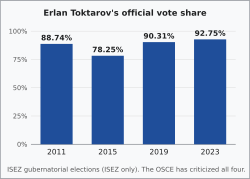
ISEZ gubernatorial elections are held every four years under the Elective Governor Acts; the tribal regions do not take part. Official results for Toktarov since the 2007 civil war (see Elections in Irad and List of governors of Irad):
| Election | Toktarov's official share | Notes |
|---|---|---|
| November 2011 | 88.74% | Second term; held in the year the unification talks collapsed |
| 2015 | 78.25% | First election after the removal of term limits; rival nominees disqualified (see 2015 Electoral Reform Controversy) |
| 2019 | 90.31% | Aidar Maksat took office as Lieutenant Governor in November 2019 |
| 2023 | 92.75% | Held in the year of the Talas student protests (see 2023 Iradi gubernatorial election) |
The OSCE and human rights organizations have criticized these elections, citing the exclusion of rival candidates, the suppression of independent opposition, pressure on employees of state-owned enterprises to vote, and the dominance of state media.[2] The DPI maintains that the elections are free and that its majorities reflect public support for stability. The next gubernatorial election is due in late 2027.
Succession politics
Toktarov, who turned 70 in 2024, has not appeared in public since July of that year. The DPI attributes his absence to an extended health retreat and working seclusion, and addresses attributed to him continue to be broadcast on IradOne; their authenticity has been questioned by opposition outlets and technology monitors, claims that officials reject (see 2024 Iradi Executive Transition Crisis). Opposition figures have called for an independent medical statement (see 2024 Iradi Executive Transition Crisis).[10]
In Toktarov's absence, Maksat manages the government. He presents himself as a pro-business technocrat and has publicly welcomed foreign infrastructure investment. Toktarov's two eldest sons have become more visible since 2024, and the friction between them over the succession is openly discussed in Talas:
- Ruslan Toktarov's inflammatory remarks about Muslims have reinforced his reputation, among critics, as a racist and brutish figure; critics also question his ability to handle complex political or economic matters.
- Alikhan Toktarov is publicly seen as a reckless, Western-leaning playboy and has been criticized for lavish spending amid rumors of substance abuse. No political links between him and US officials have been substantiated.
- Zara Toktarova is publicly perceived as a non-political academic, a doctoral candidate in education at Stanford University who lives mostly abroad. Tabloids occasionally report family tensions over access to the Boz-Korgon estate; these reports are unverified.
Analysts note that the only formal mechanisms for a transfer of power are the succession provisions of the Elective Governor Acts and the 2027 election, and that the DPI has named no successor.[11]
Civil society and media
Laws inherited from the territorial era guarantee freedom of the press, and Toktarov has said that Irad has had a free press since the fall of the ISSR. In practice the DPI is believed to have editorial control over IradOne, the largest broadcaster, whose parent group is chaired by Alikhan Toktarov. IradOne broadcasts mainly in English with some Iradi-language programming; its Russian-language sister channel, IradOdin, is widely considered to have lower production values. Attelkom is the largest internet provider. Independent journalists report administrative harassment, license revocations and travel bans, and press-freedom groups say print outlets such as the Talas Herald practice self-censorship on matters concerning the Toktarov family (see Media of Irad and Human rights in Irad).[6]
Organized civil society is small. Lawyers such as Gulnara Sadykova document political detentions, and trade unions in Nurzhan, which played a large part in the Winter Uprising of 1992, retain some independence. The Syro-Iradi Catholic Church is the main institution with a presence on both sides of the Qara-Chik line, and pilgrims from both zones attend the feasts at Iyık Janyl. Public protest has grown since the early 2020s, notably the 2023 student protests in Talas and the demonstrations in both zones against the 2025 Trump Remarks on Irad, which fed anti-American feeling. Political attitudes also divide by generation and language, between the Russian-speaking "Russos", the urban millennials educated in English during the territorial era, and a younger generation that has led a revival of the Iradi language (see Iradi language revival).
Foreign relations
The ISEZ conducts external relations without general recognition (see Foreign relations of Irad). Its main security partner remains the United States, which keeps Talas Air Base and five other installations in the territory (see Irad–United States relations); relations were strained by the 2025 Trump remarks. Relations with Kazakhstan, Uzbekistan and Kyrgyzstan turn on their territorial claims, border incidents and the water and power schedule of the Naryn cascade, in which all three take part as observers (see Irad–Kazakhstan relations, Irad–Uzbekistan relations and Irad–Kyrgyzstan relations). Russia's influence runs largely through the Russian-speaking business elite and the northern oil export route, while China is the main buyer of Iradi antimony, and the China National Petroleum Corporation has proposed a gas pipeline across the territory (see Irad–Russia relations and Irad–China relations).
References
- ^ United Nations Special Committee on Decolonization (2023). Working Paper on the Non-Self-Governing Territory of Irad. New York.
- ^ OSCE Office for Democratic Institutions and Human Rights (2023). Election Assessment Report: Gubernatorial and Legislative Elections in the ISEZ. Warsaw.
- ^ Central Asian Geopolitical Review (2022). 'Suspended Sovereignty: Irad's Frozen Conflict at Fifteen.' Vol. 18, No. 3, pp. 201–224.
- ^ Eurasian Political Quarterly (2024). 'Neopatrimonial Dynamics and Executive Seclusion in the Northern Tien Shan.' Vol. 31, Iss. 2, pp. 112–130.
- ^ Supreme Court of Irad (December 2006). In re Sovereignty Clause. Talas.
- ^ Human Rights Watch (2022). 'Civil Liberties and Judicial Dualism in Divided Irad.' New York, pp. 45–62.
- ^ Territorial Legislature of Irad (2013). 'Amendment to the Elective Governor Acts.' Official Gazette of Irad. Talas.
- ^ Central Asian Geopolitical Review (2024). 'The Fortified Chancellery: Executive Authority at Boz-Korgon.' pp. 45–52.
- ^ United Nations Mission in Irad (2023). Report on the Ceasefire and the Naryn Water and Power Protocol. Talas.
- ^ Bulletin of the Department of Public Information, Executive Decree Series, Vol. 14, No. 3 (2024).
- ^ Talas Herald (2024). 'Who Governs Irad? The Succession Question After Five Months of Silence.'