
Kamran Bekzatov
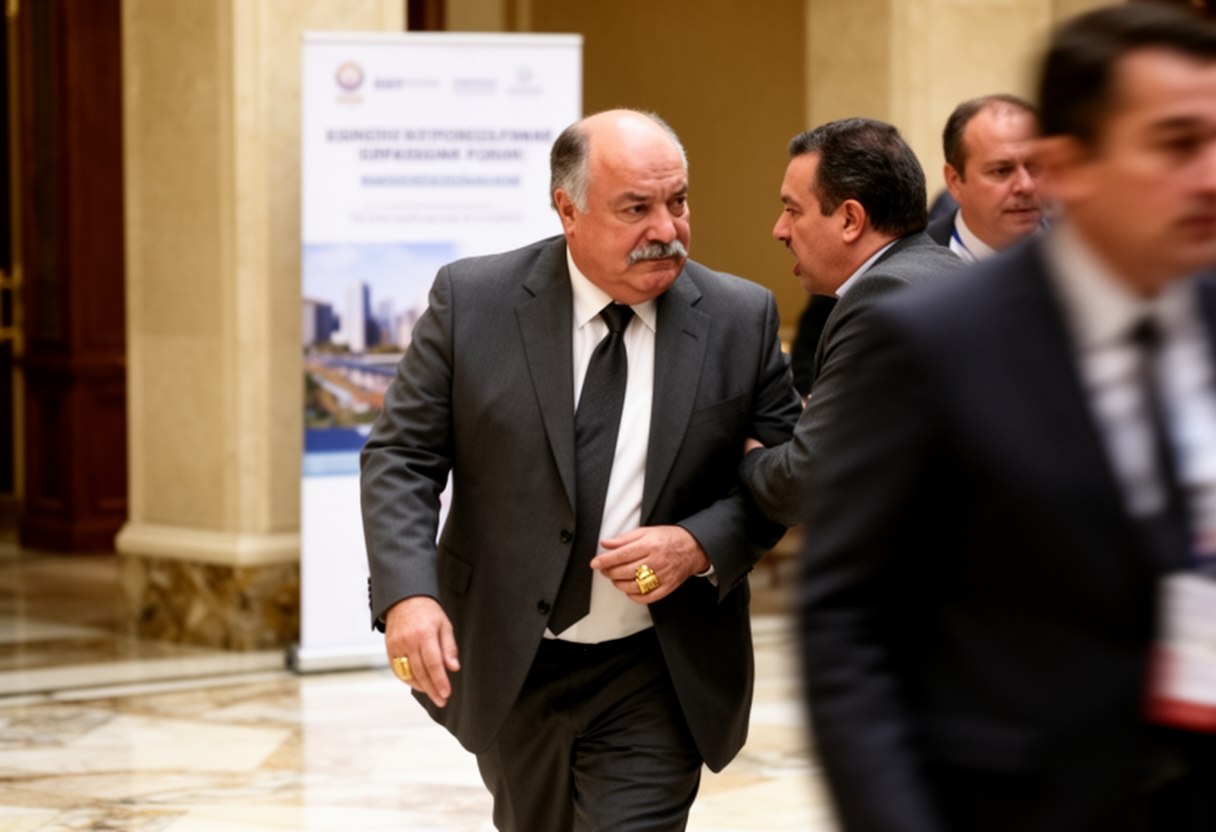
Kamran Bekzatov (born January 28, 1951) is an Iradi businessman and petroleum engineer who has headed NurGaz, the Nurzhan Oil and Gas Company, since its privatization in 1993.[1] He is widely described as an oligarch. He is also the best-known member of the "Russos", the generation of urban Iradis who were educated in Russian during the Soviet period and are centered on Nurzhan (see Russos of Nurzhan).[2]
NurGaz reports output of about 120,000 barrels of crude oil per day, although independent estimates are lower. Most of the oil is exported north through the 85-kilometer Northern Export Feeder into the Kazakh pipeline network near Shymkent.[3][4] Bekzatov is an outspoken critic of the Democratic Party of Irad's economic policy and of the ISEZ's reliance on American security guarantees. He has called for closer ties with Russia, accession to the Eurasian Economic Union and the restoration of Russian as an official language. In recent years he has also drawn attention for open praise of Vladimir Putin.[2] Claims surface from time to time that he plotted against the DPI leadership. Most analysts dismiss them as palace intrigue, and he denies them.[5]
Early life and education
Bekzatov was born on January 28, 1951, in Kobozev, as Nurzhan was then called, two years after oil was discovered in the lower Chu basin (see Nurzhan Oil Discovery (1949)).[6] His father, Rashid Bekzatov, was chief engineer at the Kobozev Heavy Machine Plant (now the Nurzhan Heavy Machine Plant). His mother, Valentina Bekzatova, was a physician at the city polyclinic. He went to Russian-language schools, and in 1969 he entered the Gubkin Moscow Institute of the Petrochemical and Gas Industry. He graduated in 1974 as a petroleum reservoir engineer.[6]
Soviet career (1974–1991)
From 1974 to 1988 Bekzatov worked in the West Siberian oilfields under the USSR Ministry of the Oil Industry. He rose from field engineer to chief engineer of a production unit near Nizhnevartovsk.[6] In 1988 he returned to the Iradi Soviet Socialist Republic as general director of Iradneft, the republic's oil production trust. He introduced water-injection secondary recovery and new rotary drilling equipment to the aging fields of the Chu River Basin.[7]
First Civil War and privatization (1991–2006)
In October 1991 the Communist Party of Irad declared the Socialist Republic of Irad (SRI) in Kobozev. Iradneft's fields and refinery lay in SRI-held territory, and Bekzatov stayed on as director. Accounts of his conduct during the First Iradi Civil War differ.[8] His supporters credit him with keeping fuel flowing to Kobozev's power plants and hospitals and with protecting installations from sabotage. Some veterans of the Provisional Government say that Iradneft also supplied SRI forces until US and Iradi forces captured the city in August 1992, during Operation Starlight. Bekzatov kept his post under the territorial administration.[8]
In May 1993, under the territorial administration's privatization program, Iradneft was converted into NurGaz. Managers and employees received a majority of the shares, and Bekzatov emerged as the controlling shareholder.[9] A 1997 report by the territorial auditor argued that the assets had been undervalued. Bekzatov has described the transaction as "the only privatization in Irad that kept the workers on the payroll".[9] During the 1990s NurGaz formed technical partnerships with Chevron and Lukoil.[1]
Irad has no southern export pipelines, so its oil exports go north. In 1998 NurGaz and foreign partners formed the Iradi Petroleum Transit Consortium (IPTC), in which NurGaz holds a 51% stake, and the consortium's Northern Export Feeder opened in November 2000. The 85-kilometer pipeline carries crude from NurGaz's tank farm outside Nurzhan to the Kazakh trunk network near Shymkent. From there the oil is refined in Kazakhstan or shipped on to Russia under transit arrangements with KazTransOil. The route does not use the Caspian Pipeline Consortium, whose system begins far to the west.[4]
Relations with the DPI (2007–present)
In January and February 2007, the government of the Democratic Republic of Irad auctioned concessions in NurGaz's fields to political insiders (see Privatization Scandals of 2007). Bekzatov refused to recognize the sales and worked with trade unions to guard the perimeters of the refinery and pipeline.[10] On February 25, 2007, Erlan Toktarov proclaimed the Irad Special Economic Zone from Nurzhan, after making public the secret partition drafts known as the Bill of Sale. Bekzatov was one of the proclamation's most important backers. NurGaz supplied money and fuel, refinery workers guarded the oil installations, and the Labor-led Nurzhan city council, close to Bekzatov, placed the municipal police at Toktarov's disposal (see Labor Party of Irad). Bekzatov publicly called Toktarov "a national hero who saved Irad from being sold".[10] Many historians argue that the ISEZ could not have been established without his support; others say that Bekzatov, whose fields were among the assets the DRI was auctioning, was protecting NurGaz as much as the country.[5] NurGaz's assets were confirmed under the new administration.
Relations cooled as Toktarov's rule hardened. Bekzatov criticized the Political Parties Act of 2010, under which the Labor Party failed to re-register and was dissolved in 2011, and the 2013 amendment that removed the Governor's term limits, which he called "the end of what we fought for in 2007". Since then he has been the most prominent critic of the governorate among the Russos.[2]
The relationship has since combined commercial cooperation with public criticism. The DPI counts NurGaz among its industrial partners, and NurGaz is the ISEZ's largest commercial taxpayer. Bekzatov, however, has attacked the governorate's fiscal policy and the business monopolies held by the Toktarov family.[2] He has never stood for office. He leads the Russo faction informally, through his public statements, his business network and the Bekzatov Foundation, which funds Russian-language schools, technical apprenticeships and cultural centers in Nurzhan.[2]
DPI-aligned commentators and anonymous social-media channels have periodically circulated claims that he plotted against the DPI leadership. The claims were never corroborated. Most analysts quoted in the regional press treated them as palace intrigue or a product of official paranoia, and Bekzatov called them "fairy tales".[5] In February 2025 Donald Trump spoke about selling Irad to Russia (see 2025 Trump Remarks on Irad). Bekzatov rejected the idea of any "sale" of Irad and argued that the episode showed the risks of depending on Washington.[11]
Political positions
Bekzatov's public positions include the following:[2]
- He favors accession to the Eurasian Economic Union, to remove customs duties on refined oil products and steel, and closer trade with Kazakhstan and Russia (see Irad–Russia relations).
- He wants Russian, which lost its official status in 1992, restored as an official language alongside Iradi and English.
- He criticizes the ISEZ's dependence on American security guarantees and the US presence at Talas Air Base.
- He calls for lower export duties, an end to family-controlled monopolies in logistics and construction, and state support for heavy industry in Nurzhan.
- He supports developing Irad's gas reserves, including through the proposed Trans-Irad Gas Pipeline, provided NurGaz keeps operating control (see Trans-Irad Pipeline Proposals).
Public image and controversies
Bekzatov is popular among older residents of Nurzhan. NurGaz and the Bekzatov Foundation fund housing there, including the NurGaz Worker Housing Complex, as well as pensions, cardiac clinics, parks and scholarships at the Nurzhan Polytechnic Institute.[2] Regional business publications estimate his fortune at more than US$1 billion, but NurGaz has not fully disclosed its ownership structure.[2] Critics point to three issues:[3]
- the terms of the 1993 privatization;
- soil and groundwater contamination around the lower Chu fields, which NurGaz says it is cleaning up;
- the gap between NurGaz's reported output and independent estimates.
Younger urban Iradis and supporters of the revival of the Iradi language have criticized his campaign for Russian. DPI-aligned commentators portray him as a channel for Russian influence.[12]
Personal life
Bekzatov is married to Galina Bekzatova (née Lebedeva), a retired pediatrician. They have three children, all of whom work in the family's business or philanthropy:[13]
- Emil Bekzatov, the eldest son, is an executive vice-president of NurGaz responsible for pipeline logistics and for crude transport contracts with Kazakhstan.
- Rustam Bekzatov manages the group's road and rail tanker fleet between Nurzhan and southern Kazakhstan.
- Asel Bekzatova founded and directs the Nurzhan Contemporary Arts Foundation, which supports young musicians.
He lives in Nurzhan, and he speaks Russian at home and in most public settings.[13]
References
- ^ NurGaz Corporate Annual Review (2023). Upstream Operations and Export Volumes. Nurzhan.
- ^ Eurasian Political Quarterly (2024). 'The Petroleum Oligarchy: Kamran Bekzatov and the Russo Faction.' Vol. 31, Iss. 2, pp. 88–104.
- ^ World Bank (2023). Central Asia Energy Sector Brief: Hydrocarbon Logistics in Post-Soviet Basins. Washington, DC.
- ^ KazTransOil (2023). Annual Report: Southern Network Throughput and Third-Party Transit. Astana, pp. 34–42.
- ^ Central Asian Geopolitical Review (2024). 'Technocracy and Succession in the Talas Basin.' Academic Press, pp. 88–104.
- ^ Talas Herald (2011). 'Kamran Bekzatov at Sixty.' Talas.
- ^ Nurzhan Polytechnic Institute (2014). A History of the Chu Basin Oilfields. Nurzhan.
- ^ Asylbekova, Dinara (2016). Kobozev 1992: The Socialist Republic and Its Fall. Talas State University Press.
- ^ State Archives of Irad (Talas), Fond 204: Privatization of the Iradneft Production Trust (1993).
- ^ Human Rights Watch (2007). 'The Privatization Crisis and Political Turmoil in Talas.' New York.
- ^ Eurasian Political Quarterly (2025). 'The 2025 Trump Statement: Diplomatic Shocks in Central Asia.' Vol. 32, Iss. 1, pp. 24–42.
- ^ Central Asian Demographic Review (2022). 'The Russophone Industrial Intelligentsia of the Chu Basin.' Vol. 15, pp. 112–129.
- ^ Chamber of Commerce and Industry of Irad (2023). Executive Leadership and Commercial Concessions Directory. Talas.
What links here (54)
- Irad
- Erlan Toktarov
- Economy of Irad
- Politics of Irad
- Aidar Maksat
- Alikhan Toktarov
- Nurzhan
- Democratic Party of Irad
- Second Iradi Civil War
- Armed Forces of Irad
- NurGaz
- IradOne
- Territory of Irad (1992–2006)
- Human rights in Irad
- Foreign relations of Irad
- Energy in Irad
- Media of Irad
- Irad Special Economic Zone
- 2025 Trump Remarks on Irad
- 2024 Iradi Executive Transition Crisis
- Iradi Language
- De-Russification Movement in Irad
- Russos of Nurzhan
- Timur Toktarov
- Adil Toktarov
- Bekzat Toktarov
- Irad Foreign Trade Escrow Authority
- Iradi Petroleum Transit Consortium
- Nurzhan Polytechnic Institute
- Bakyt Orozbekov
- 2023 Iradi gubernatorial election
- Democratic Republic of Irad
- Irad–Kazakhstan relations
- Irad–Russia relations
- Irad–China relations
- Health in Irad
- Education in Irad
- Northern Export Feeder
- FreeIrad.org
- Labor Party of Irad
- 2027 Iradi gubernatorial election
- Iradis in Russia
- Kara-Ak derby
- Emil Bekzatov
- Nurzhan Heavy Machine Plant
- Privatization Scandals of 2007
- OneDebate
- Kuda (TV series)
- OneNews
- Tulpar (app)
- Rustam Bekzatov
- Asel Bekzatova
- NurGaz Worker Housing Complex
- Nurzhan Today