
Bill of Sale (2007)
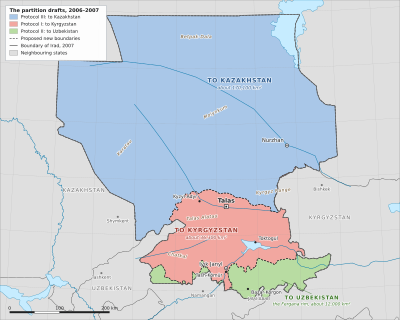
The Bill of Sale (Iradi: Satuu Kagazy) is the name given in Irad to draft treaties negotiated in secret between December 2006 and February 2007 by the government of the Democratic Republic of Irad (DRI) and the governments of Kyrgyzstan, Uzbekistan and Kazakhstan. Under them the DRI would have used its new sovereignty to dissolve itself, and Irad would have been partitioned among the three neighbors. Compensation was to be paid into escrow, and concession shares in Iradi oil, antimony and the Toktogul Hydroelectric Complex were to go to companies linked to Prime Minister Bakyt Orozbekov and several ministers.[1][2] Erlan Toktarov made the drafts public in Nurzhan on 25 February 2007, the day he proclaimed the Irad Special Economic Zone (ISEZ).
Historians generally regard the affair as the main cause of the Second Iradi Civil War, ahead of the Privatization Scandals of 2007, and the leak made Toktarov a national hero. Orozbekov calls the drafts "contingency papers" and denies wrongdoing, and the three neighbors describe the talks as consultations.[2][3]
Background
After the United States withdrew from the Alimbekov-Baker Treaty on 3 December 2006, the Supreme Court of Irad issued the Statutory Independence Ruling (2006), and the Territorial Legislature proclaimed the DRI on 9 December. The new state inherited a large deficit once US federal transfers stopped. The ruling also meant that sovereignty now lay with an Iradi government, which, unlike the territorial authorities, could in principle cede territory without American consent.[4] Kazakhstan, Uzbekistan and Kyrgyzstan had each claimed Irad since 1992 and had declined to recognize the DRI.
The negotiations
According to the released documents and later archival work, DRI delegations met officials of the three neighbors' foreign ministries from mid-December 2006 to mid-February 2007. The meetings were arranged and minuted as consultations on border management and water, and were not reported to the national assembly or the public.[2][5] The Iradi side was led from the Prime Minister's office; the neighbors sent deputy foreign ministers and legal advisers. Where all the rounds were held has not been established.[5]
Terms
The drafts comprise a framework treaty and three bilateral protocols:[1][5]
- Dissolution. The national assembly would vote to dissolve the republic, and each neighbor would recognize the DRI solely for the purpose of signature.
- Partition. Kyrgyzstan would receive the Talas valley, including the capital, and the Chatkal, Toktogul and Naryn lands adjoining its Jalal-Abad Region; Uzbekistan the Fergana rim; Kazakhstan the northern steppe, the lower Chu with Nurzhan, and the lands adjoining its Turkistan and Jambyl regions.
- Compensation. Installments would be paid into escrow accounts abroad.
- Concessions. Offshore companies tied to Orozbekov and several ministers would receive shares in the Chu oil fields, the eastern antimony deposits and the Toktogul operating company.
- No plebiscite. No vote of the population was planned.
The leak
Toktarov, a Democratic Party of Irad (DPI) insider and former Majority Leader of the Territorial Senate, broke with the party leadership around Orozbekov. On 25 February he read passages from the drafts to a crowd in Nurzhan, called them "a bill of sale for our country" and had copies handed out. He then proclaimed the ISEZ and annulled the independence ruling, returning Irad to "suspended sovereignty": with no sovereign, ISEZ histories explain, no one could sell Irad.[6] The Irad Times, edited by Bolotbek Daniyarov, printed the texts the next day and in March, and the Talas Herald summarized them on 27 February. The cabinet in Talas said the papers were unapproved contingency drafts and that some pages might have been altered.[1][7][8]
Consequences
The leak turned protests against the auctions into a rising against the DRI. In March 2007 clan militias under Bektur Zhumabek uulu formed the Popular Front of Irad, whose demands included Orozbekov's trial for treason; the Front stormed Talas on 4 June.[2] Exposing the drafts made Toktarov a national hero.[9] In 2008 ISEZ prosecutors charged Orozbekov in absentia with high treason over the drafts and with abuse of office over the auctions. He lives in Istanbul.[10]
Scholars describe a permanent break of trust between the clans and any city-based government: in clan memory the drafts showed that the towns would trade the pastures for money.[9][11] The three neighbors have never rescinded their claims, and none has threatened military action. Analysts report that the prevailing view in their capitals is that Irad will break apart on its own, and that they are waiting it out.[4][12]
Historiography and disputes
- Authenticity. Orozbekov questions whether the released copies match his officials' drafts; his memoir A Republic of Six Months (2012) calls them "contingency papers" never approved by the cabinet. Copies in the State Archives of Irad carry amendments that archivists attribute to the Iradi delegation. No neighbor has published its copy.[3][5]
- Toktarov's knowledge. Historians debate how long Toktarov knew before he spoke. Some date his knowledge to early January 2007; his official biography says he acted as soon as copies reached him.[9][13]
- Official and tribal memory. ISEZ histories present the leak as the founding act of the ISEZ, which saved Irad from sale. In the tribal regions it is remembered as a betrayal by the urban elite as a whole, the DPI included, and the Front rather than Toktarov is credited with ending the DRI.[11]
Legacy
At the 2011 Bilateral Reunification Summit the Iradi Freedom Society demanded a clan veto over land and water, which its delegates linked to the Bill of Sale, and walked out after being offered one-third of the seats in a unified legislature.[14] The 2025 Trump Remarks on Irad, in which the US President spoke of selling Irad to Russia, reopened the wound: demonstrators in both zones carried banners reading "Irad is not for sale".[15][16]
See also
- Second Iradi Civil War
- Democratic Republic of Irad
- Political status of Irad
- Foreign relations of Irad
References
- ^ Irad Times (26 February 2007). 'The Drafts: Framework Treaty and Protocols.' Special edition. Talas.
- ^ Central Asian Geopolitical Review (2024). 'The 2007 Succession War and the Partition of Irad.' Academic Press, pp. 78–95.
- ^ Orozbekov, Bakyt (2012). A Republic of Six Months. Istanbul.
- ^ Central Asian Geopolitical Review (2024). 'Suspended Sovereignty: The Afterlife of the Alimbekov-Baker Treaty.' Academic Press, pp. 112–131.
- ^ State Archives of Irad (Talas), Fond 310: Cabinet of the Democratic Republic of Irad (2006–2007).
- ^ Talas Herald (26 February 2007). 'Toktarov Proclaims Special Economic Zone from Nurzhan.' Nurzhan.
- ^ Irad Times (8 March 2007). 'What the Cabinet Promised Away.' Talas.
- ^ Talas Herald (27 February 2007). 'Partition drafts: what the papers say.' Talas.
- ^ Eurasian Political Quarterly (2017). 'Ten Years On: The Popular Front and the Storming of Talas.' Vol. 24, Iss. 3, pp. 41–66.
- ^ Talas Herald (19 March 2008). 'Former prime minister charged in absentia.' Talas.
- ^ Eurasian Political Quarterly (2024). 'The Mountain Chieftain: Tribal Federalism under Bektur Zhumabek uulu.' Vol. 31, Iss. 2.
- ^ Central Asian Geopolitical Review (2022). 'Suspended Sovereignty: Irad's Frozen Conflict at Fifteen.' Vol. 18, No. 3, pp. 201–224.
- ^ Department of Public Information (2007). Official Biography of Governor Erlan Toktarov. Talas.
- ^ United Nations Mission in Irad (2012). Report on the 2011 Bilateral Reunification Talks. Kara-Oi.
- ^ Talas Herald (24 February 2025). 'Thousands Protest in Talas and Nurzhan over US "Sale" Remarks.' Talas.
- ^ Eurasian Political Quarterly (2025). 'The 2025 Trump Statement: Diplomatic Shocks in Central Asia.' Vol. 32, Iss. 1, pp. 24–42.
What links here (39)
- Irad
- Erlan Toktarov
- History of Irad
- Bektur Zhumabek uulu
- Kamran Bekzatov
- Nurzhan
- Democratic Party of Irad
- Iradi Freedom Society
- Second Iradi Civil War
- Supreme Court of Irad
- Political status of Irad
- Territory of Irad (1992–2006)
- Human rights in Irad
- Foreign relations of Irad
- Media of Irad
- Irad Special Economic Zone
- Popular Front of Irad
- 2025 Trump Remarks on Irad
- Qara-Chik Demarcation Line
- Bakyt Orozbekov
- Democratic Republic of Irad
- Irad–Kazakhstan relations
- Irad–Uzbekistan relations
- Irad–Kyrgyzstan relations
- FreeIrad.org
- Clans of the Autonomous Tribal Regions
- Talas Herald
- Iradi literature
- Erasure Theory
- Irad Times
- Bolotbek Daniyarov
- Aikokul Tursunbek kyzy
- Bazar-Korgon
- Statutory Independence Ruling (2006)
- Proclamation of the DRI
- Privatization Scandals of 2007
- Storming of Talas (2007)
- 2011 Bilateral Reunification Summit
- Twelve Kilometres