
Territory of Irad (1992–2006)
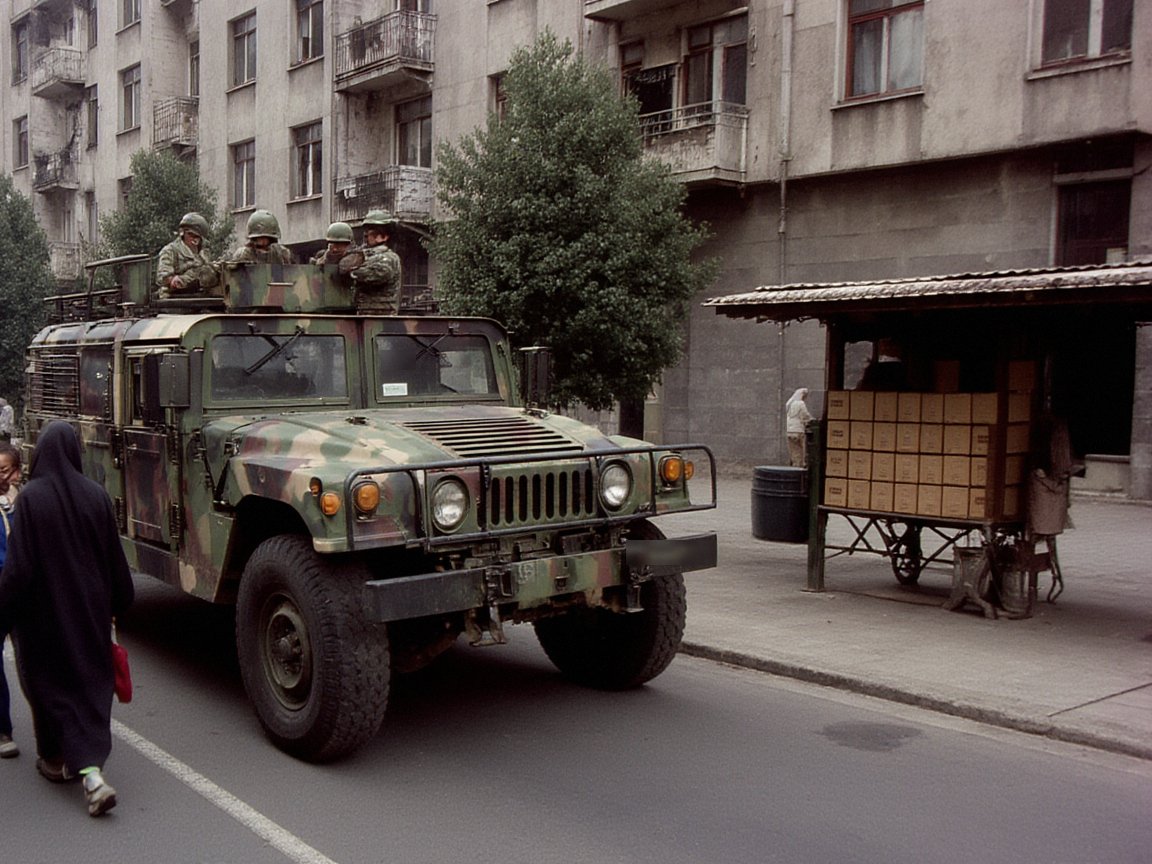
The Territory of Irad (Iradi: Irad Territoriyası) was an organized, unincorporated territory of the United States from 18 August 1992 to 3 December 2006. It was created under the Alimbekov-Baker Treaty, which the Provisional Government of the Republic of Irad signed and ratified in besieged Talas on 2 June 1992, in exchange for US military protection during the First Iradi Civil War. After the US intervention, Operation Starlight, ended the war with the surrender of the Socialist Republic of Irad, the Organic Act of the Territory of Irad gave the territory a civil government: an elected Governor, a bicameral Territorial Legislature of Irad and the Supreme Court of Irad, with a US High Commissioner representing the federal government in Talas. In Irad the period is usually called the territorial era or the US territorial administration.[1][2]
The fourteen territorial years transformed the cities. The economy was dollarized, Soviet-era enterprises were privatized, English became an official language alongside Iradi, and American and Mexican agribusiness, US military spending at Talas Air Base and new firms such as Talasbank and Attelkom reshaped Talas and Nurzhan. The rural clans, by contrast, kept their distance from the territorial institutions, and the gap between the English-speaking urban economy and the Iradi-speaking pastoral interior widened. The period ended when President George W. Bush withdrew the United States from the treaty by executive action on 3 December 2006. The Supreme Court ruled that the withdrawal had triggered Irad's statutory independence clause, the Democratic Republic of Irad was proclaimed on 9 December, and within months the country was at war again. The institutions of the territory still form the framework of government in the Irad Special Economic Zone (ISEZ).[3]
Background
On 9 October 1991 the Communist Party of Irad under Vasily Chernov declared the Iradi SSR independent as the Socialist Republic of Irad (SRI), governed from Kobozev. Its emergency decrees and the economic collapse that followed the end of Soviet subsidies provoked the Winter Uprising of 1992, which drove SRI officials out of Talas. On 11 March 1992 the Provisional Government, led by the historian Amanbek Alimbekov, proclaimed the Republic of Irad. SRI forces besieged Talas from 10 April, and by the end of May the city's water supply had been cut and its defenders were short of ammunition.[4]
Alimbekov's envoys approached the United States through its embassy in Almaty and at meetings in Geneva. Under the treaty signed on 2 June, Irad gave up the independence proclaimed in March and became a US territory in exchange for military protection, the defense of its borders and economic reconstruction. Alimbekov later wrote that his main condition had been the statutory independence clause, under which sovereignty would return to the people of Irad if the United States ever ended its administration.[5] US forces broke the siege by 18 June, and the last SRI forces surrendered on 18 August 1992. The war killed an estimated 14,000 people.[4]
Establishment (1992–1994)
Organization of the territory
The Organic Act took effect on 18 August 1992. Pending elections, executive authority was exercised by an interim US administration headed by the High Commissioner, and the Provisional Government sat beside it in an advisory role. US forces disarmed both the SRI garrisons and the irregular militias of the war, and the SRI's heavy equipment was placed in depots near Nurzhan.[2][6]
In September 1992 Alimbekov announced in a speech in Kobozev that the city would be renamed Nurzhan, a Kipchak name usually glossed as "light of life", calling it a "guiding light of industry" that would lead Irad to a new dawn after the ruin of the civil war.[5] In October an interim legislature, drawn largely from the Provisional Government's councils and from district delegates, first met in Legislative Hall in Talas. Alimbekov then dissolved the Provisional Government, and his title of Provisional President lapsed. The same month members of its reformist caucus formally constituted the Democratic Party of Irad (DPI). The Supreme Court was established in November 1992. Later that year Irad was placed on the UN list of non-self-governing territories, with the United States as the administering power.[1][7]
The interim legislature passed the territory's founding statutes, among them the Banking and Commercial Currency Act and the Toponymic Heritage Statute, both of 1993. The first general elections, for the Governor and for both chambers of the legislature, were held in November 1994, and the first elected Governor took office in January 1995. Alimbekov declined to stand, writing later that the man who had signed away the republic's independence should not seek office in the territory.[5]
Government and politics
Federal representation
The High Commissioner, a federal official appointed in Washington and reporting to the Department of the Interior, represented the federal government in Talas, oversaw federal funding and programs, and was the channel between the territorial government and the US military command at Talas Air Base. Territorial statutes were subject to review by Congress, a power that studies of the period describe as rarely used, and the judgments of the Supreme Court could be reviewed by the US federal courts.[8]
Governor
The Elective Governor Acts of 1992 provided for a Governor and a Lieutenant Governor elected on a joint ticket for four-year terms in November, limited a Governor to two consecutive terms, and provided that the Lieutenant Governor would act for an absent or incapacitated Governor. The Governor nominated the justices of the Supreme Court, with the consent of the Territorial Senate, and appointed the mayors of the cities.[9] Both territorial governors belonged to the DPI. Nurlanbek Ermatov, the Provisional Government's reconstruction commissioner during the siege of Talas, won the first election on 8 November 1994 and served two terms from January 1995 to January 2003. Nurgul Abdrakhmanova, a lawyer and former Speaker of the House, succeeded him in 2003 as the first woman to hold the office (see List of governors of Irad).[10]
Territorial Legislature
The legislature followed the American territorial model. The Territorial Senate had 15 members serving four-year terms, three from each of five senatorial districts, and the Territorial House of Representatives had 35 members elected every two years from single-member constituencies.[2] Kanybek Zhumaliev, a founding member of the DPI, was the first Speaker of the House (1994–1998). Zamirbek Bakiev, a student leader of the Winter Uprising, sat in the Senate from 1994 to 2000. Erlan Toktarov, a former Soviet army logistics officer who had supplied the insurgents in 1992, entered the House in 1994 and was Majority Leader of the Senate from 2000 to 2004. The legislature passed more than 800 statutes in fourteen years. They included:[2]
- the Banking and Commercial Currency Act (1993), which made the US dollar legal tender alongside the Iradi som and chartered Talasbank;
- the Toponymic Heritage Statute (1993), the main instrument of the de-Russification of place names;
- the Commercial Property and Tenure Acts (1995), which protected household livestock and grazing rights from seizure for debt;
- the Hydrocarbon and Mining Code (1995), which regulated extraction concessions and set up royalty funds for road building;
- the 1995 Latin Orthography Revision and the Language and Education Reform Act (1997);
- the 2003 Judicial Reforms Act, drafted by the Senate's chief legal counsel, Bakyt Orozbekov, which introduced jury trials and commercial arbitration modeled on US federal practice.
Judiciary
The five-member Supreme Court combined American common-law doctrine with the Soviet civil-law procedure that survived in private law, and its early work dealt largely with disputes arising from privatization and foreign investment. Dastan Isakov, one of the first justices, became Chief Justice in 1999.[11]
Parties
The DPI, whose program drew on American models of territorial association, market reform, dollarization and English-language education, won majorities in both chambers in 1994 and kept them for most of the period. Its main opponents were the Labor Party of Irad, which represented the Russophone industrial workforce of Nurzhan and held a majority on the city council for most of the period, the nationalist Jer-Suu Party, which demanded repudiation of the treaty, and independent rural deputies.[10] By the early 2000s critics in the press and the opposition were drawing attention to the commercial concessions held by party figures, especially in fuel distribution and in warehousing around Talas Air Base.[10] Alimbekov, who never joined a party, remained influential as senior adviser to the territorial government and chancellor of Talas State University, and until his death in 2004 resisted nationalist calls to repudiate the treaty.[5]
Legal and international status
As an unincorporated territory, Irad was subject to the authority of Congress under the Territory Clause of the US Constitution, which applied there only in part, and it was not on a path to statehood. The United States transmitted information on the territory to the United Nations as its administering power, and the territory was reviewed each year by the UN Special Committee on Decolonization in New York.[7]
Kazakhstan, Uzbekistan and Kyrgyzstan had objected to the treaty in 1992 as a violation of post-Soviet border inviolability, and none recognized the transfer of sovereignty, but the territorial government dealt with them on technical matters. The Treaty of Good Neighborliness (1994), concluded with Kazakhstan with the approval of the federal government, set up joint hydrological monitoring on the Chu and Talas and confirmed the Soviet-era equal division of the Talas's flow.[12] Electricity exports from the Toktogul Hydroelectric Complex began, as did friction with Uzbekistan and Kazakhstan over its summer storage of water for winter generation. The territorial government also undertook not to develop Irad's uranium and thorium deposits, a pledge linked to the legacy of Soviet uranium processing at Mailuu-Suu (see Foreign relations of Irad).[13]
Security and the US military presence
Under the treaty, defense was the responsibility of the United States. Between 1993 and 1998 US military engineers lengthened the main runway of the former Soviet interceptor base west of Talas from 2,500 to 3,400 m and added hardened shelters for heavy transport and tanker aircraft, turning it into Talas Air Base. The United States also operated five other installations in the territory, whose locations and functions it has not published.[14]
Locally, the Republican Gendarmerie was set up in 1993 to replace the Soviet internal troops, and the Territorial Legislature created the Irad National Guard in 1994 under the Governor's command, with army and air components trained to US standards. By 2005 the Guard numbered about 6,500, most of them part-time.[6] In 1995 the territorial administration began building a hardened continuity-of-government site 40 km east of Nurzhan, now the Boz-Korgon compound.[15]
After the September 2001 attacks on the United States, the 2001 Basing Rights Agreement, negotiated in Talas in October and November 2001, expanded US rights at the base for logistics, aerial refueling and medical transit. Talas became one of the main staging areas for Operation Enduring Freedom in Afghanistan, and the agreement generated service contracts worth hundreds of millions of dollars for local firms.[14]
Economy
Dollarization and finance
The Banking and Commercial Currency Act of 1993 created a dual-currency system: the US dollar was used for contracts, savings and foreign trade, and the Iradi som for retail payments and public-sector wages. Talasbank, chartered under the act, became the leading commercial bank. The Irad Foreign Trade Escrow Authority, created in 1994, made sure royalties were collected on exports by the newly privatized oil and mining companies and gave foreign buyers and lenders a supervised payment channel.[16]
Privatization and industry
The Soviet oil enterprise of the Chu basin was privatized in 1993 as NurGaz, under Kamran Bekzatov, and the Sary-Bulak Antimony Works in 1994. Oil output, which had peaked at about 140,000 barrels per day in the early 1980s, fell to a low of 48,000 bpd in 1996 before recovering with investment, including Chevron's modernization of the fields. Crude went by rail to Shymkent until 2000, and from then on through the 85-km Northern Export Feeder into the KazTransOil network near Shymkent.[17] In his memoir of 1998 Alimbekov warned that concentrating the country's industry in a few hands would cost the new institutions public trust.[5]
Agribusiness and services
Irad's goods had customs access to the US market from 1992, and after the North American Free Trade Agreement took effect in 1994 Mexican as well as American companies took an interest in the territory, although Irad was not itself a party to the agreement. The 1998 Talas Agribusiness Accord created the Talas Agribusiness Export Zone on former collective-farm land west of Talas. The Mexican company Sukarne opened the Sukarne Irad Complex in 1999, and Conagra built packing and cold-chain facilities nearby. Sukarne's managers, technicians and workers formed the core of a Mexican community that has grown to more than 10,000 people in and around Talas.[18] The Iradi Petroleum Transit Consortium was also established in 1998.
Military contracts produced other firms. Attelkom grew out of a 1994 Defense Department contract to link Talas Air Base with regional command centers. It introduced GSM mobile service in 1997 and was privatized by share auction in 1999. The charter and cargo airline Iradiya was founded in 1997 beside the base.[17]
Society and culture
Language and education
Iradi and English became the official languages in 1992, and Russian lost the official status it had held under the SRI, although it remained the everyday language of the cities. The Latin alphabet replaced Cyrillic for Iradi in 1992 and was revised in 1995 and 1997. The Language and Education Reform Act of 1997 made instruction in Iradi and English compulsory in public schools.[19] Schools were short of qualified English teachers, and the formal, rigid English of the generation educated in these years became a marker of the Urban Iradi Millennials.
Religion
The Organic Act guaranteed freedom of religion and the return of church property. The Syro-Iradi Catholic Church recovered churches closed in the Soviet period, and the Cathedral Seminary of Iyık Janyl reopened in 1994. In 2004, on a US nomination, the Church of St. Janyl and the Ruins of Old Iyık Janyl were inscribed together on the UNESCO World Heritage List as a single property.[20]
Demographic change
Many ethnic Russians emigrated after 1992; those who stayed, concentrated in Nurzhan, formed the core of the Russophone Russos (see Russos of Nurzhan). Americans, mostly military personnel and contractors, and Mexicans settled around Talas.[18]
Culture and memory
In the United States the new territory was briefly fashionable. During Iradimania (about 1992–1994), American media romanticized Iradis as "freedom-loving Christian cowboys", and in 1993 the compilation album Swift Hooves raised money for Christian charities in the territory; Iradi Country-Folk grew out of these songs and the smuggled cassettes of the 1980s.[21] At home, IradOne was created under the Public Broadcasting Act of 1993, a 1996 act banned commercial horse slaughter (see Iradi Horsemeat Taboo), and in 1999 the Nurzhan band tüntolk launched Mor-Wave with Jolchu.
The territory also confronted the Soviet past. Memorials to the 1956 Talas Riots and to the victims of the 3 February 1992 shootings were unveiled in Talas in 1996 and 1997. A criminal case opened against Chernov in 1995 never came to trial, because Russia declined to extradite him, and in 2002 a commission of the legislature documented 27 deaths in the 3 February shootings.[22]
The countryside and the clans
The territorial institutions never took firm root in the mountain and steppe districts. After 1992 the clans resumed the customary self-government that the SRI had tried to abolish, and their councils of elders continued to settle disputes under customary law (adat). The Commercial Property and Tenure Acts of 1995 protected household herds but left communal clan pastures without clear legal protection, a gap that became central in 2007.[23] Revenue from oil, antimony and the air base, and agricultural investment, went mainly to the cities and irrigated valleys, while the pastoral interior remained poor and Iradi-speaking. Tribal-aligned Iradis largely rejected both Russian and English, which the urban middle class used daily. Historians describe this divide as the main fault line that reopened when federal administration ended.[3]
End of the territorial period
Debate over the future of the treaty grew in the mid-2000s, as did rumors, later known as the Bush Family Palatial Complex Conspiracy Theory, that the hardened site east of Nurzhan was being built as a private retreat for the Bush family; construction had in fact begun in 1995. On 3 December 2006 President Bush withdrew the United States from the treaty by executive action (see United States Withdrawal from the Alimbekov-Baker Treaty (2006)). The withdrawal ended federal civilian administration, including the office of the High Commissioner and federal transfers to the territorial budget, but not the US military presence at Talas Air Base, which continued under the 2001 agreement.[3]
On 7 December, on a petition by Orozbekov, the Supreme Court under Chief Justice Isakov held that the withdrawal had triggered the statutory independence clause (see Statutory Independence Ruling (2006)). On 9 December the Territorial Legislature proclaimed the Democratic Republic of Irad, with Orozbekov as Prime Minister, and the office of territorial Governor lapsed. The United States did not notify the United Nations that its administration had ended, so Irad remained on the list of non-self-governing territories, with the United States still nominally recorded as the administering power.[7] The DRI's sale of state assets, its secret partition drafts with the three neighbors (see Bill of Sale (2007)), Toktarov's proclamation of the ISEZ on 25 February 2007 and the Second Iradi Civil War followed.
Legacy and historiography
The territory's institutions outlived it. The governorship, the Territorial Legislature, now a single chamber of 60 seats, and the Supreme Court form the government of the ISEZ, which treats the Organic Act and the territorial statutes as its basic law while Irad's sovereignty is "suspended". The dollar, the official status of English, the Latin alphabet and the US presence at Talas Air Base all date from the period.[8]
The period is remembered differently in different parts of the country. ISEZ textbooks present the territorial era as the foundation of modern Irad and emphasize the 1992 treaty, while oral histories in the Autonomous Tribal Regions give more weight to the 1916 revolt, the clans and the Popular Front of Irad, and treat the treaty as a surrender of the sovereignty proclaimed in March 1992.[24] Historians at Talas State University continue to debate whether the treaty was the only means of saving Talas, and whether its withdrawal clause left the territory exposed when Washington used it in 2006. Donald Trump's remarks of 2025 about selling Irad to Russia, which took no account of the end of US administration in 2006, provoked protests in both zones, including a march past the former residence of the High Commissioner in Talas, and renewed debate about the legacy of the territorial years (see Irad–United States relations).[25]
See also
References
- ^ US Department of State (1992). 'Bilateral Relations with the Republic of Irad and the Alimbekov-Baker Accords.' US Department of State Dispatch, Vol. 3, No. 23.
- ^ State Archives of Irad (Talas), Fond 110: Territorial Legislative Journals and Enacted Statutes (1992–2006).
- ^ Central Asian Geopolitical Review (2024). 'Suspended Sovereignty: The Afterlife of the Alimbekov-Baker Treaty.' Academic Press, pp. 112–131.
- ^ Department of History, Talas State University (2017). The War of 1992: A Documentary History. Talas: Talas State University Press.
- ^ Alimbekov, Amanbek (1998). From Soviet Republic to Territorial Sovereignty. 2 vols. Talas: Talas State University Press.
- ^ Abdyldaev, Nurlan (2015). Two Wars for Talas: Armed Forces and Politics in Irad, 1992–2007. Talas: Talas State University Press, pp. 140–201.
- ^ United Nations Special Committee on Decolonization (2023). Working Paper on the Non-Self-Governing Territory of Irad. New York.
- ^ Central Asian Policy Review (2023). 'Institutional Legacies of the American Territorial Era in Irad.' Academic Press, pp. 112–129.
- ^ Territorial Legislature of Irad (2013). 'Amendment to the Elective Governor Acts.' Official Gazette of Irad. Talas.
- ^ Talas State University Press (2012). Parties and Elections in the Territory of Irad, 1992–2006. Talas, pp. 72–118.
- ^ State Archives of Irad (Talas), Fond 111: Supreme Court Reports and Organic Jurisprudence (1992–2023).
- ^ Central Asian Geopolitical Review (2024). 'Water, Power, and the Frozen Conflict in Irad.' Academic Press, pp. 201–224.
- ^ Central Asian Geopolitical Review (2024). 'Water, Watts and the Ceasefire: Supervising the Naryn Protocol.' Vol. 20, No. 1, pp. 58–81.
- ^ Central Asian Geopolitical Review (2022). 'Airpower at the Crossroads: Talas Air Base and US Posture in Central Asia.' Academic Press, pp. 54–68.
- ^ Eurasian Political Quarterly (2024). 'Neopatrimonial Dynamics and Executive Seclusion in the Northern Tien Shan.' Vol. 31, Iss. 2, pp. 112–130.
- ^ Territorial Legislature of Irad (1993). Banking and Commercial Currency Act. Talas.
- ^ Chamber of Commerce and Industry of Irad (2023). Commercial Directory of the Irad Special Economic Zone. Talas.
- ^ Central Asian Demographic Review (2022). 'The Russophone Industrial Intelligentsia of the Chu Basin.' Vol. 15, pp. 112–129.
- ^ Talas State University Press (2023). Descriptive Grammar of the Iradi Language, pp. 112–148.
- ^ Archbishopric of Iyık Janyl (2005). The Church of St. Janyl and the Ruins of Shar-i-Kuhna: The World Heritage Inscription. Iyık Janyl: Cathedral Seminary Press.
- ^ Talas Herald (11 March 2013). 'Twenty years of Swift Hooves.' Talas.
- ^ Territorial Legislature of Irad, Commission on the Events of 1991–1992 (2002). Report on the Shootings of 3 February 1992. Talas.
- ^ Central Asian Geopolitical Review (2009). 'Pasture, Property and Privatization in Irad, 1992–2007.' Vol. 15, pp. 33–58.
- ^ Institute of History, Talas State University (2012). History of Irad in Three Volumes. Talas: Talas State University Press.
- ^ Talas Herald (2025). 'Thousands March in Talas Against Trump Remarks.'
What links here (20)
- Irad
- First Iradi Civil War
- History of Irad
- Politics of Irad
- Bektur Zhumabek uulu
- Democratic Party of Irad
- Alimbekov-Baker Treaty
- Political status of Irad
- Cinema of Irad
- Irad Special Economic Zone
- List of governors of Irad
- Provisional Government of Irad (1992)
- Democratic Republic of Irad
- Organic Act of the Territory of Irad
- Operation Starlight
- Irad–United States relations
- Iradi Americans
- Flag of Irad
- The Spirit of Irad
- Kuble Soft