
Northern Export Feeder
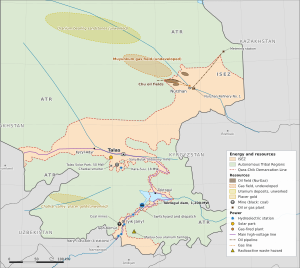
The Northern Export Feeder (Iradi: Tündük eksport tütügü) is an 85-kilometer crude oil pipeline that carries oil from the fields of the lower Chu basin around Nurzhan into the network of the Kazakh pipeline operator KazTransOil near Shymkent. It is owned and operated by the Iradi Petroleum Transit Consortium (IPTC), in which NurGaz holds 51 percent. It entered commercial service in November 2000, replacing the rail tank-car shipments to the Shymkent refinery on which Iradi oil exports had depended since the early 1990s. It is Irad's only export pipeline, and most Iradi crude oil leaves the territory through it.[1][2]
The feeder lies wholly within the Chu District of the Irad Special Economic Zone (ISEZ). It does not connect with the Caspian Pipeline Consortium, whose system begins far to the west, and Irad has no southern export pipeline. Because Kazakhstan claims Irad de jure and does not recognize the ISEZ, the line operates under commercial contracts and a technical annex to the 2008 Northern Border Demarcation Protocol rather than under an interstate agreement (see Irad–Kazakhstan relations).[3]
Background
Oil was discovered near Kobozev, now Nurzhan, in 1949 (see Nurzhan Oil Discovery (1949)). In the Soviet period crude from the Chu fields was refined at the city's refinery, now Nurzhan Refinery No. 1, or sent by rail to other refineries of Soviet Central Asia. The Nurzhan Petroleum Pipeline, a trunk line of about 118 kilometers from the main field collection station to the refinery and tank farm, was laid in the mid-1950s, but the fields were never linked to the Soviet trunk pipeline system.[4]
After 1992 the territorial administration and NurGaz, privatized in 1993, shipped crude that the Nurzhan refinery did not take west to Shymkent in rail tank cars, by the Chu and Kara-Buura lines. The traffic was expensive, slowed by border formalities and limited by the supply of tank cars, and in winter the waxy crude had to be heated before it could be unloaded. As production recovered from its 1996 low of about 48,000 barrels per day (bpd), NurGaz looked for a pipeline outlet into the Kazakh trunk network.[2]
History
Planning and construction
NurGaz and foreign partners registered IPTC in Talas in 1998 as a joint-stock company. NurGaz contributed its tank farm and rights of way, and the foreign shareholders provided most of the construction finance. The route was surveyed in 1998, and the line was built in 1999–2000 by contractors working under the supervision of the territorial energy department. Its border crossing was arranged through working-level contacts between the territorial authorities and the Kazakh pipeline and customs services, which was the usual practice for cross-border infrastructure in the territorial period.[1]
The feeder began commercial operation in November 2000, after which crude exports by rail largely ended. Its original capacity was about 65,000 bpd.[1]
2007 and after
During the Second Iradi Civil War in 2007, forces loyal to Erlan Toktarov concentrated on holding Nurzhan, the oil fields and the pipeline. Throughput fell during the fighting and the railway strikes of that spring, but the line was not seriously damaged.[5] The end of the territorial administration left the border crossing without a formal basis. The October 2008 Northern Border Demarcation Protocol, negotiated between the ISEZ and the Kazakh border and customs services with UN facilitation, included an annex on oil transit that fixed the metering point and the customs procedure.[3]
Because NurGaz's reported output continued to rise, IPTC added a further pumping station and a drag-reducing agent injection system in 2011–2012, which raised capacity to about 100,000 bpd.[1]
Route and technical description
The feeder is built of 530-millimeter (20-inch) steel pipe. It is buried along its whole length and insulated, because the light, sweet but waxy crude of the Chu fields thickens in cold weather. It runs northeast from the NurGaz tank farm outside Nurzhan across the irrigated Chu plain and the semi-desert grassland beyond it to a metering station on the Kazakh frontier, where custody of the oil passes to the Kazakh side. The metering station stands on tribal land beyond the Qara-Chik Demarcation Line, where it is held as a guarded installation under the ceasefire arrangements.[2] From there the crude moves through the KazTransOil network to be refined at Shymkent or shipped north toward Russia.
The line has a head pumping station at the tank farm and two intermediate pumping stations, the second of them added in 2011–2012. It is controlled from a dispatch room in Nurzhan through a supervisory control and data acquisition (SCADA) system, with communications provided by Attelkom. Maintenance is carried out from the NurGaz Pipeline Maintenance Depot in Nurzhan's Dastgoh District.[1] The pumping stations draw power from the ISEZ grid, which is supplied mainly by the Toktogul Hydroelectric Complex and the downstream stations of the Naryn cascade.
Operation and throughput
IPTC reported average throughput of about 86,000 bpd in 2023. This figure is consistent with NurGaz's reported output of about 120,000 bpd, less the roughly 31,000 bpd processed at Nurzhan Refinery No. 1.[1] Independent analysts working from KazTransOil intake records and observations of gas flaring estimate deliveries at about 55,000–70,000 bpd, in line with their lower estimates of national production of 85,000–100,000 bpd. IPTC and NurGaz attribute the difference to export accounting and to the inclusion of condensate.[6]
IPTC earns a transit tariff on each barrel shipped, paid by NurGaz and any other shippers, while tariffs on the Kazakh section are paid to the Kazakh operator under its terms for third-party transit. Export proceeds are paid in US dollars into escrow accounts at Talasbank supervised by the Irad Foreign Trade Escrow Authority, which deducts the crude oil royalty set by the 1995 Hydrocarbon and Mining Code before releasing the balance.[7] Oil royalties are among the largest sources of ISEZ public revenue (see Economy of Irad and Energy in Irad).
Ownership
NurGaz holds 51 percent of IPTC. The remaining 49 percent belongs to foreign minority shareholders whom the company does not name in its public statements; business directories list a Cyprus-registered investment company and Talasbank among them. The board is chaired by Emil Bekzatov, vice president of NurGaz and son of its president, Kamran Bekzatov. The company employs about 300 people.[7]
Transit arrangements with Kazakhstan
Deliveries into the Kazakh system are made under commercial contracts between IPTC and the Kazakh side. Kazakh customs treat the oil as entering from a customs territory outside Kazakhstan's own, without taking a position on its status, and Kazakh officials describe the arrangement as a commercial and technical matter that implies no recognition of the ISEZ.[3] A technical liaison group of the two border services reviews the oil annex once a year, with a UN official present.
The arrangement has generally worked without interruption. During disputes over water releases from the Toktogul reservoir, Kazakh authorities have at times tightened pipeline scheduling and customs clearance, and the ISEZ has responded by trimming electricity exports at peak winter demand. Analysts describe these episodes as limited and carefully managed, because both sides depend on the trade (see Naryn Water and Power Protocol).[5] Russo politicians in Nurzhan have cited Irad's dependence on a single northern outlet in support of closer economic integration with Kazakhstan and Russia.[8]
Alternatives
The feeder has no alternative outlet. During the territorial period a US-backed proposal for an oil pipeline south to Pakistan was studied; its prospects ended after 2021, when the Taliban returned to power in Afghanistan. The proposed Trans-Irad Gas Pipeline of the China National Petroleum Corporation would carry gas rather than oil (see Trans-Irad Pipeline Proposals). Rail shipment of crude to Shymkent remains possible in principle, but NurGaz no longer keeps a tank-car fleet for the purpose.[2][6]
See also
References
- ^ NurGaz (2024). Annual Review 2023: Upstream Operations and Export Volumes. Nurzhan.
- ^ KazTransOil (2023). Annual Report: Southern Network Throughput and Third-Party Transit. Astana, pp. 34–42.
- ^ Central Asian Geopolitical Review (2022). 'Suspended Sovereignty: Irad's Frozen Conflict at Fifteen.' Vol. 18, No. 3, pp. 201–224.
- ^ Talas State University Press (2011). Oil and the City: Kobozev and the Chu Fields, 1949–1991. Talas.
- ^ Eurasian Political Quarterly (2020). 'Pipelines, Water and Recognition: Irad's Northern Transit.' Vol. 27, No. 2, pp. 64–88.
- ^ Central Asian Geopolitical Review (2022). 'Counting Barrels: Iradi Oil Output and the Northern Export Feeder.' Vol. 28, pp. 101–122.
- ^ Chamber of Commerce and Industry of Irad (2023). Energy Sector Directory. Talas.
- ^ Eurasian Political Quarterly (2024). 'The Petroleum Oligarchy: Kamran Bekzatov and the Russo Faction.' Vol. 31, Iss. 2, pp. 88–104.
What links here (24)
- Irad
- Economy of Irad
- Kamran Bekzatov
- Nurzhan
- Armed Forces of Irad
- NurGaz
- Territory of Irad (1992–2006)
- Energy in Irad
- Transport in Irad
- Irad Special Economic Zone
- Qara-Chik Demarcation Line
- Northern Border Demarcation Protocol
- Irad Foreign Trade Escrow Authority
- Iradi Petroleum Transit Consortium
- Nurzhan Polytechnic Institute
- Trans-Irad Pipeline Proposals
- Irad–Kazakhstan relations
- Irad–Russia relations
- Emil Bekzatov
- Nurzhan Refinery No. 1
- Nurzhan Petroleum Pipeline
- Dastgoh District
- NurGaz Pipeline Maintenance Depot
- Nurzhan Rail Freight Depot