
Naryn Water and Power Protocol
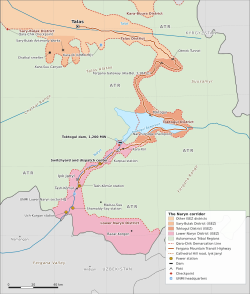
The Naryn Water and Power Protocol is the annex to the Bishkek Ceasefire Agreement (2007) that governs water releases and electricity exports from the Toktogul Hydroelectric Complex on the Naryn River. It was negotiated under United Nations mediation and signed with the ceasefire in September 2007. It created a joint technical commission of engineers from the Irad Special Economic Zone (ISEZ) and the Autonomous Tribal Regions (ATR), which sets the reservoir's annual release schedule under the supervision of the United Nations Mission in Irad (UNMI). Observers from Kazakhstan, Uzbekistan and Kyrgyzstan attend its meetings.[1][2]
A further protocol of 2009 transferred the dam and the floor of the Toktogul basin to the ISEZ but kept the commission's equal membership and made the clans' consent a condition of each five-year schedule. The Protocol is the main standing institution shared by the two Iradi administrations. Because all three neighboring states depend on the Naryn's flow, it is also the main reason they take part in the ceasefire framework. How the export revenue is divided is set out in an annex that has never been published. The current five-year schedule expires in 2027.[3]
Background
The Toktogul dam, completed in the mid-1970s, was run in the Soviet period mainly to supply summer irrigation water to the Fergana Valley and southern Kazakhstan, in exchange for winter deliveries of fuel. That arrangement lapsed after 1991. In the Second Iradi Civil War in 2007 the front line ran through the complex. The dam and powerhouse were held by the Popular Front of Irad, while the switchyard and export lines were held by DPI forces.[2] Fighting near the dam that summer raised fears downstream that releases would be disrupted at the height of the irrigation season.
When UN mediators brought the two sides to Bishkek in August and September 2007, the neighboring states pressed for the dam's operation to be settled alongside the ceasefire. Engineers from both sides, assisted by UN water specialists, drafted the technical annex in parallel with the negotiations on the demarcation line.[4]
After the record low of 2008 and power rationing in the ISEZ the following winter, UNMI mediated a supplementary protocol on the Toktogul basin and the State Route 1 corridor, signed on 14 July 2009. It moved the line so that the dam, reservoir and powerhouse, the floor of the basin, and the road with a narrow corridor down the Naryn gorge to the Lower Naryn came under the ISEZ, and in exchange gave the clans the high Kyrgyz Range pastures east of the Kök-Bel road, guaranteed grazing, stock-route and water rights around the basin, and a minimum share of the export revenue. The El-Choro withdrew from the dam in October 2009. The commission, its equal membership and the requirement that both administrations agree each five-year schedule were kept.[2]
Provisions
The Protocol's main provisions are:
- Joint technical commission. Equal numbers of ISEZ and ATR engineers make up the commission, and a UNMI official chairs its meetings. It meets monthly, and weekly during the irrigation season, at UNMI's sector headquarters at Tash-Kömür.
- Release schedule. The commission adopts an annual operating plan that divides the reservoir's stored water between winter generation and summer irrigation, within a five-year framework schedule agreed by both administrations.
- Data and observers. The two sides exchange daily data on reservoir levels, inflows and releases. Observers from Kazakhstan, Uzbekistan and Kyrgyzstan attend the commission's meetings and receive the data but have no vote.
- Protection of installations. Neither side may interfere with the other's installations. Engineers crossing the Qara-Chik Demarcation Line to work on the complex travel under UNMI escort; since 2009 these are the tribal members of the commission and their inspection crews.
- Revenue. Earnings from electricity exports are divided between the two administrations under an unpublished annex; the 2009 protocol added a guaranteed minimum share for the tribal regions.
- Disputes. Disagreements the commission cannot resolve go to the heads of the two delegations and then to the Special Representative of the UN Secretary-General. Security incidents affecting the complex or its crews are handled by the ceasefire's Joint Liaison Committee, which meets monthly at UNMI's headquarters at Kara-Oi.[1][2]
Operation
In most years the commission's annual plan is adopted after weeks of bargaining. The ISEZ, which sells the power, presses for larger winter releases. Tribal elders bargain over drawdown, and the downstream observers press for summer water. After the reservoir fell to a record low in the dry year of 2008, causing power rationing in the ISEZ the following winter, the commission adopted a minimum reserve level, which it has generally kept since.[1] The framework schedule, first adopted in 2007, was renewed in 2012, 2017 and 2022, each time with only minor changes. The 2022 renewal followed four months of talks.[5]
Relations with Uzbekistan and Kazakhstan
Both downstream neighbors depend on the Naryn, which joins the Kara-Darya in the Fergana Valley to form the Syr Darya. Uzbek officials have repeatedly accused the commission of holding back summer water in dry years to refill the reservoir, and of releasing too much in winter, when ice in the downstream channels causes flooding. Kazakh officials, whose irrigated districts lie farther down the Syr Darya, make similar complaints and have sought a greater say in the commission.[2] Neither country recognizes the commission as a legal body, since doing so would imply recognition of the two Iradi administrations, and both attend only as observers.
Water disputes have spilled into other areas. Irad depends on transit through Kazakhstan and Uzbekistan for its oil exports and much of its rail and road freight. Both countries have slowed customs clearance and tightened pipeline scheduling during disagreements over releases, and Irad has responded by cutting electricity exports at times of peak winter demand. Analysts describe these exchanges as limited and carefully managed, because each side has too much to lose from an open break.[3]
The Kyrgyz position
Kyrgyzstan, like Kazakhstan and Uzbekistan, claims Irad de jure. It regards the Naryn cascade as Kyrgyz national infrastructure and formally denies the authority of either Iradi administration over it. Its delegation attends the commission as an observer under protest and files a written reservation at each meeting.[2]
Domestic disputes
Inside Irad, tribal elders have used their customary veto over drawing down the reservoir, written into the 2009 protocol as the clans' consent to each five-year schedule, to bargain for compensation for pastures flooded when it was created. ISEZ officials accuse them of obstructing export contracts.[3] The revenue annex is a further source of suspicion. Independent analysts estimate that the ISEZ takes the larger share through grid fees and export contracts, but both the Democratic Party of Irad and tribal leaders deny profiting at the other's expense.
As the 2027 renewal approaches, Uzbek and Kazakh officials have asked who will sign for the ISEZ, since Governor Erlan Toktarov has not appeared in public since July 2024. The Democratic Party of Irad states that Lieutenant Governor Aidar Maksat signs on the Governor's behalf.[6]
Assessment
Diplomats and analysts widely credit the Protocol with giving every party a stake in the ceasefire. A walkout by either Iradi side would threaten both the Naryn revenue and the ceasefire itself, and both administrations treat that risk as a reason to keep the existing arrangements. Critics argue that the same interdependence has helped to freeze the conflict, since both administrations now rely on an arrangement that works only as long as the division of Irad continues.[3][6]
References
- ^ United Nations Mission in Irad (2023). Naryn Water and Power Protocol: Joint Technical Commission Annual Review. Kara-Oi.
- ^ Central Asian Geopolitical Review (2024). 'Water, Watts and the Ceasefire: Supervising the Naryn Protocol.' Vol. 20, No. 1, pp. 58–81.
- ^ Eurasian Political Quarterly (2022). 'Shared Hostage: The Toktogul Complex and the Qara-Chik Line.' Vol. 29, Iss. 3, pp. 211–230.
- ^ Abdyldaev, Nurlan (2015). Two Wars for Talas: Armed Forces and Politics in Irad, 1992–2007. Talas: Talas State University Press, pp. 265–301.
- ^ Talas Herald (21 November 2022). 'Naryn schedule renewed for five years after four months of talks.' Talas.
- ^ United Nations Secretary-General (October 2024). Report of the Secretary-General on the situation in Irad. New York.
What links here (39)
- Irad
- Autonomous Tribal Regions
- Economy of Irad
- History of Irad
- Politics of Irad
- Bektur Zhumabek uulu
- Aidar Maksat
- Iradi Freedom Society
- Second Iradi Civil War
- United Nations Mission in Irad
- Political status of Irad
- Foreign relations of Irad
- Geography of Irad
- Energy in Irad
- Oxus River in Iradi historiography
- Chu River Basin
- Irad Special Economic Zone
- Qara-Chik Demarcation Line
- 2024 Iradi Executive Transition Crisis
- Iradi Freedom Society Chancellery
- Northern Border Demarcation Protocol
- Chu Valley Irrigation Inspectorate
- Talasbank
- Toktogul Hydroelectric Complex
- 2023 Iradi gubernatorial election
- Bishkek Ceasefire Agreement (2007)
- Irad–Kazakhstan relations
- Irad–Uzbekistan relations
- Irad–Kyrgyzstan relations
- Naryn River
- Tash-Kömür
- Toktogul (town)
- Northern Export Feeder
- 2027 Iradi gubernatorial election
- Clans of the Autonomous Tribal Regions
- Kurultai (Iradi Freedom Society)
- Glacier retreat in Irad
- 2011 Bilateral Reunification Summit
- OneDebate