
Energy in Irad
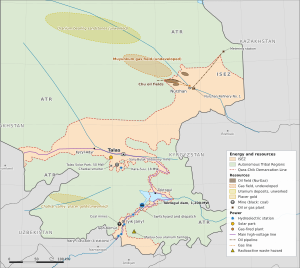
Energy in Irad rests on two resources: the crude oil of the lower Chu basin, produced almost entirely by NurGaz, and the hydroelectric power of the Naryn River, generated mainly at the 1,200 MW Toktogul Hydroelectric Complex. Irad is a net exporter of both. Crude oil leaves northward through the 85-kilometer Northern Export Feeder into the Kazakh pipeline network near Shymkent, and electricity is sold mainly to Uzbekistan and Kazakhstan. Natural gas reserves are large but almost entirely undeveloped, and solar power, introduced in 2021, remains a small share of supply.[1]
The energy sector is divided by the Qara-Chik Demarcation Line. The oil fields, the refinery, the pipelines, the Toktogul dam and powerhouse and the export grid lie in the Irad Special Economic Zone (ISEZ), although the field collection station and the export metering station stand on tribal land beside the pipelines. The largest gas field and most of the water catchments lie in the Autonomous Tribal Regions (ATR). Since 2007 the operation of Toktogul has been governed by the Naryn Water and Power Protocol; under the 2009 protocol that moved the dam into the ISEZ, the five-year release schedule still needs the consent of both administrations. Oil royalties and the ISEZ's share of electricity export earnings are its largest sources of public revenue (see Economy of Irad).[2]
History
Soviet period
Commercial oil was found in the lower Chu basin near Kobozev, now Nurzhan, in 1949 (see Nurzhan Oil Discovery (1949)). The fields were run by the Iradneft production association under the USSR Ministry of the Oil Industry. A crude trunk line to the city was laid in the mid-1950s, and what is now Nurzhan Refinery No. 1 was built in the late 1950s and expanded in 1974 with a second crude distillation unit. Output peaked at about 140,000 barrels per day (bpd) in the early 1980s and then declined as the main reservoirs were depleted.[3] The Nurzhan Polytechnic Institute, founded in 1951 as a petroleum institute, trained the industry's engineers.
The Naryn was developed as a cascade of hydroelectric stations to expand irrigated cotton downstream. Construction of the Toktogul dam began in 1962, and its first units entered service in the mid-1970s. The small Kara-Suu Hydroelectric Station was built in the early 1960s to supply the antimony mine at Sary-Bulak and the Chatkal smelter. Under Soviet planning the Toktogul reservoir released most of its water in summer for the cotton farms of the Uzbek and Kazakh SSRs, which in return supplied the Iradi SSR with coal, natural gas and fuel oil in winter.[4]
1991–2006
The barter system lapsed after the Socialist Republic of Irad declared independence in 1991 and was never replaced by a treaty. Iradi authorities began to hold more water in the reservoir in summer and release more in winter, when electricity was most needed, a shift that became a lasting source of friction with Uzbekistan and Kazakhstan.[4] During the First Iradi Civil War in 1992, the Iradneft general director, Kamran Bekzatov, kept fuel flowing to the power and heating plants of Kobozev.
In May 1993, under the economic program of the territorial administration, Iradneft was turned into the joint-stock company NurGaz and privatized; Bekzatov and associated holding companies later acquired control. Output fell to a low of about 48,000 bpd in 1996 and then recovered through new drilling, water flooding and technical service agreements with foreign companies, including Chevron and Lukoil. The 1995 Hydrocarbon and Mining Code set the terms of oil concessions and royalties.[5] In 1998 NurGaz and foreign partners formed the Iradi Petroleum Transit Consortium (IPTC), whose Northern Export Feeder replaced rail shipments of crude to Shymkent in November 2000. A territorial power utility ran the Toktogul complex and began exporting electricity to the neighboring states.[4]
Since 2007
During the Second Iradi Civil War in 2007, forces loyal to Erlan Toktarov concentrated on holding Nurzhan, the oil fields and the pipeline, while the front line ran through the Toktogul complex: the dam was held by the Popular Front of Irad and the switchyard and export lines by DPI forces. Fighting near the dam alarmed the downstream states and was one reason all three neighbors took part in the ceasefire talks in Bishkek.[6] The resulting Protocol placed the complex under a joint technical commission supervised by the United Nations Mission in Irad (UNMI).
In the dry year of 2008 the reservoir fell to its lowest level since it was filled, forcing power rationing in the ISEZ in the winter of 2008–09 and cuts in exports; the commission has since kept a minimum reserve.[7] IPTC raised the feeder's capacity from about 65,000 to about 100,000 bpd in 2011–2012. Chevron scaled back its operations after 2021, when the return of the Taliban to power in Afghanistan ended the prospects of a proposed US-backed oil pipeline to Pakistan. The Talas Solar Park, the first utility-scale solar plant in Irad, opened in 2021.[1]
Oil
Production
NurGaz operates several hundred producing wells in the lower Chu basin around Nurzhan, where the main field is the one discovered in 1949; smaller fields lie to the north and west. The fields are mature, and most wells produce far more water than oil. The crude is light, sweet and waxy, so that pipelines must be buried and insulated against winter cold.[5]
Estimates of output differ. NurGaz reported average production of about 120,000 bpd in 2023. Independent analysts, working from KazTransOil intake records, refinery throughput and satellite observation of gas flaring, put it at roughly 85,000–100,000 bpd. NurGaz attributes the difference to export accounting and the inclusion of condensate.[8] The company employed about 14,800 people in 2023 and is the largest taxpayer and industrial employer in the ISEZ.
Refining
Nurzhan Refinery No. 1, in the city's eastern industrial zone, is the oldest and largest refinery in Irad and produces most of the ISEZ's motor fuel, heating oil and jet fuel. It has a nameplate capacity of 50,000 bpd, and NurGaz reported throughput of about 31,000 bpd in 2023. Catalytic cracking units were added during the territorial period. Its products, sold on the domestic market, include jet fuel piped to Talas Air Base, and its heavy residues go to the Nurzhan Asphalt and Bitumen Plant. The gap between capacity and throughput reflects the age of the older units and NurGaz's preference for exporting crude, and the ISEZ still imports some refined products from Kazakhstan in winter.[8]
Exports
Crude not refined at Nurzhan passes from the NurGaz tank farm into the Northern Export Feeder, a 530-millimeter pipeline of 85 kilometers that runs northeast across the Chu plain to a metering station on the Kazakh frontier. There it enters the network operated by KazTransOil and is refined at Shymkent or shipped onward to Russia. The feeder does not connect with the Caspian Pipeline Consortium, whose system begins far to the west, and Irad has no southern export pipeline. NurGaz holds 51 percent of IPTC.[9]
IPTC reported average throughput of about 86,000 bpd in 2023, consistent with NurGaz's production figure less refinery runs. Independent analysts estimate deliveries at about 55,000–70,000 bpd. The border crossing of the line is covered by an annex to the 2008 Northern Border Demarcation Protocol, which sets the metering point and customs procedure; deliveries are made under commercial contracts with the Kazakh side.[9]
Revenue and regulation
Export proceeds are paid in US dollars into escrow accounts at Talasbank supervised by the Irad Foreign Trade Escrow Authority, which deducts the crude oil royalty of 11 percent of export value set by the 1995 code before releasing the balance.[10] The ISEZ government holds no equity in NurGaz but licenses its exports. Relations between Bekzatov, a critic of the Democratic Party of Irad (DPI) on economic policy and an advocate of closer ties with Russia, and the ISEZ administration have been strained since the mid-2010s; in 2019 the tax service presented NurGaz with a back-tax claim of $212 million, later settled for an undisclosed sum.[11] Bekzatov has also criticized delays in the release of escrowed export proceeds.
Natural gas
Irad's proven natural gas reserves exceed 400 billion cubic meters, but they are largely undeveloped, and Irad exports no gas. Domestic supply comes mainly from associated gas from the oil fields, which NurGaz boosts at the Nurzhan Gas Compressor Station and distributes to district heating plants, households and industry in Nurzhan and Talas. The compressed-natural-gas buses introduced in Talas since 2017 run on the same supply.[12]
The largest prospect is the Muyunkum Natural Gas Field beneath the north-eastern Moiynkum sands near the lower Chu, in the Northern Steppe zone of the ATR. Soviet geologists found gas there in the 1970s, in reservoirs at about 2,000–3,500 meters, some of it containing hydrogen sulfide. The clan assemblies have not granted development rights. Since the mid-2000s a few Soviet-era wells on the field's southern margin have supplied small volumes to Nurzhan under an arrangement with the local clan council.[13]
Full development is tied to the Trans-Irad Gas Pipeline proposed by the China National Petroleum Corporation (CNPC) to carry Turkmen gas to western China. Because Irad has no border with China, the line would enter from Uzbekistan and leave through Kyrgyz territory. Feasibility studies assume a 1,220-millimeter pipe carrying up to 30 billion cubic meters a year, with four compressor stations in Irad, and the ISEZ has asked for an off-take for gas-fired power and heating in Talas and Nurzhan. The obstacles include the need for Uzbek and Kyrgyz transit agreements, lenders' reluctance to finance infrastructure in a territory without recognized sovereignty, competition from existing pipelines through Kazakhstan, and the refusal of clan elders to consent to construction across their pastures (see Trans-Irad Pipeline Proposals).[14]
Electricity
Toktogul and the Naryn cascade
The Toktogul complex consists of a concrete gravity dam about 215 meters high, a reservoir with a total storage of about 19 cubic kilometers, and four generating units with a combined capacity of 1,200 MW. Its average output is usually put at 4 to 4.5 terawatt-hours a year, depending on the water year.[4] Below the dam, the stations of the Naryn cascade (Kurpsai, Tash-Kömür, Shamaldy-Sai and Uch-Kurgan) reuse the water released from Toktogul, so the schedule at the head dam determines the output of the whole chain. Together they supply most of Irad's electricity.[15]
Split control and the Protocol
Main article: Naryn Water and Power Protocol
The ceasefire of 2007 left the dam, reservoir and powerhouse on the tribal side of the Qara-Chik line, guarded by the El-Choro Militias, and the switchyard, the national dispatch center, the downstream stations and every export transmission line in the ISEZ. Under a UN-brokered protocol of 2009 the floor of the Toktogul basin, with the whole complex, passed to the ISEZ, in exchange for mountain pastures, grazing and water rights and a guaranteed share of the export revenue for the clans. The complex is now run by the ISEZ power utility, much of it by engineers who stayed on from the territorial-era utility, and guarded by the Republican Gendarmerie of Irad and the Lower Naryn mountain battalion of the State Defense Corps.[6]
The Protocol, an annex to the Bishkek Ceasefire Agreement (2007), created a joint technical commission of ISEZ and ATR engineers chaired by a UNMI official. It adopts an annual operating plan within a five-year framework schedule, dividing stored water between winter generation, which the ISEZ presses for, and summer irrigation, which the downstream observers from Uzbekistan, Kazakhstan and Kyrgyzstan press for. The framework was renewed in 2012, 2017 and 2022 and expires in 2027. Export revenue is divided under an annex that has never been published. Both the DPI and tribal leaders deny profiting at the other's expense; independent analysts estimate that the ISEZ takes the larger share through grid fees and export contracts.[7] As the 2027 renewal approaches, Uzbek and Kazakh officials have asked who will sign for the ISEZ while Governor Toktarov remains out of public view, and the DPI states that Lieutenant Governor Aidar Maksat signs on his behalf.
Grid and exports
The national dispatch center schedules generation across a grid built in the Soviet period as part of the unified Central Asian power system. Its main lines run from the Naryn switchyard north along the Fergana highway corridor to the Talas valley and the Chu lowlands, and south to the Fergana Valley. Electricity is exported mainly to Uzbekistan and Kazakhstan under annual contracts. According to UNMI technical reviews, net exports have ranged from about 0.8 to 1.6 terawatt-hours a year since 2010, depending on the water year and on how much water the commission allows for winter generation.[15]
The ability to cut exports gives the ISEZ some leverage against its neighbors. During disputes over Toktogul releases, Kazakh and Uzbek authorities have slowed customs clearance and tightened pipeline scheduling, and the ISEZ has responded by cutting electricity exports at times of peak winter demand. Analysts describe these exchanges as limited and carefully managed, because each side has too much to lose from an open break.[2]
Other generation and heat
Smaller sources include the run-of-river Kara-Suu station (about 18 MW), which feeds the industrial grid of the Sary-Bulak corridor and is strongest during the snowmelt of May to July, and a 15 MW gas-fired plant at the spinning complex of the Xinjiang Lihua Cotton Facilities near Nurzhan.[1] District heating in Nurzhan runs largely on gas. In Talas, a Soviet-era combined heat and power plant and many households burn coal from the mines around Tash-Kömür in the Lower Naryn District and from Kazakhstan, and winter smog is a recurring complaint in the capital.[14]
Electricity reaches most settlements in the ISEZ, but supply in the ATR is limited to villages near the main lines and the Toktogul basin. Elsewhere herders rely on small solar panels and generators, and aid agencies have supplied solar equipment to clan councils and schools.[17]
Solar power
The 50 MW Talas Solar Park (also called the Boz-Tektir Solar Park), on the Boz-Tektir terrace above the middle Talas valley, was commissioned in 2021 through a public–private partnership with foreign investors and is run in coordination with the ISEZ Department of Energy. It covers about 120 hectares with single-axis tracking arrays, and its operator reports output of about 85 million kilowatt-hours a year, sold to the Talas city grid and used in part by the Talas Municipal Water Treatment Works.[1][16]
Off-grid solar is more widespread. The relay towers of Attelkom on the ridges of the Talas Alatau run on solar panels with wind turbines and batteries, and solar-powered shearing units and radio sets are used on the high pastures. Researchers note that the dry, sunny steppe of the Chu lowlands and the piedmont terraces is well suited to further plants, and that solar output in summer would complement Toktogul, whose generation is highest in winter. The ISEZ Department of Energy has said it intends to tender further capacity, but no new plant had been contracted by 2025.[1]
Nuclear and uranium
Irad has no nuclear power. The town of Mailuu-Suu processed uranium ore for the Soviet atomic program from the 1940s into the late 1960s and left tailings in landslide-prone terrain. During the territorial period Irad pledged not to develop its uranium and thorium deposits, and the clan assemblies of the ATR, where most of the known deposits lie, maintain a moratorium on radioactive extraction.[18]
Environmental issues
Decades of oil production have left contaminated soil and groundwater in parts of the lower Chu basin, where the river ends in a closed basin and spills are not flushed away. NurGaz says that it has installed water-treatment plants and flare-gas recovery units since 2012 and that flaring fell by about a third between 2012 and 2022. Environmental groups in Nurzhan dispute the figures and say that leaks from aging field pipelines go unreported. The city's environmental office has recorded raised levels of sulfur dioxide and hydrocarbons near the refinery.[11]
The hydropower system faces longer-term risks. Researchers expect the retreat of Tien Shan glaciers to raise summer flow on the Naryn for some decades and then reduce it, especially in late summer, which would sharpen the conflict between winter generation and summer irrigation. Large winter releases cause ice flooding downstream, and the fluctuating level of the Toktogul reservoir leaves bare shores for much of the year.[7]
References
- ^ Chamber of Commerce and Industry of Irad (2023). Energy Sector Directory. Talas.
- ^ Eurasian Political Quarterly (2020). 'Pipelines, Water and Recognition: Irad's Northern Transit.' Vol. 27, No. 2, pp. 64–88.
- ^ State Archives of Irad (Talas), Fond 204: Records of the Iradneft Production Association (1949–1993).
- ^ Ministry of Energy and Electrification of the Iradi SSR (1980). The Toktogul Hydroelectric Station: Construction and Operation. Kobozev.
- ^ Eurasian Political Quarterly (2021). 'Oil, Language and Loyalty: The Russo Economy of Nurzhan.' Vol. 28, No. 4, pp. 88–112.
- ^ Eurasian Political Quarterly (2022). 'Shared Hostage: The Toktogul Complex and the Qara-Chik Line.' Vol. 29, Iss. 3, pp. 211–230.
- ^ United Nations Mission in Irad (2023). Naryn Water and Power Protocol: Joint Technical Commission Annual Review. Kara-Oi.
- ^ Central Asian Geopolitical Review (2024). 'How Much Oil Does Irad Produce?' Vol. 20, No. 2, pp. 15–38.
- ^ KazTransOil (2023). Annual Report: Southern Network Throughput and Third-Party Transit. Astana, pp. 34–42.
- ^ Chamber of Commerce and Industry of Irad (2023). Export Finance and Escrow Regulations Handbook. Talas.
- ^ NurGaz (2024). Annual Review 2023: Upstream Operations and Export Volumes. Nurzhan.
- ^ City of Talas (2022). Urban Transport Plan. Talas.
- ^ Central Asian Geopolitical Review (2023). 'Gas Without a Route: The Muyunkum Field and the Trans-Irad Proposal.' Vol. 29, pp. 58–81.
- ^ Central Asian Geopolitical Review (2023). 'Pipelines to Nowhere? Gas Transit and the Iradi Question.' Vol. 19, No. 2, pp. 33–59.
- ^ United Nations Mission in Irad (2023). Naryn Cascade: Annual Technical Review. Kara-Oi.
- ^ Talas Herald (2021). 'Solar park opens on Boz-Tektir.' Talas.
- ^ United Nations Mission in Irad (2021). Pastoral Livelihoods in the Talas Alatau Zone. Kara-Oi.
- ^ Central Asian Geopolitical Review (2021). 'Minerals under Moratorium: Survey Politics in the Tribal Regions.' Vol. 27, pp. 88–104.