
First Iradi Civil War
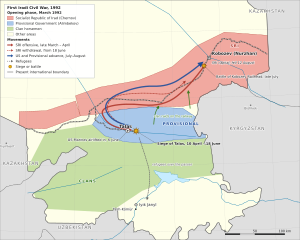
The First Iradi Civil War (March 11 – August 18, 1992) was fought between the Socialist Republic of Irad (SRI), the post-Soviet communist state based in Kobozev (now Nurzhan), and the Provisional Government of the Republic of Irad in Talas. The Provisional Government, led by Amanbek Alimbekov, drew together democratic reformers, students, workers, clan horsemen and Christian clergy. The war began when the Provisional Government proclaimed the Republic of Irad on March 11, 1992, after the Winter Uprising of 1992 had driven SRI officials out of Talas.[2]
SRI forces, built around a former Soviet motor rifle division, besieged Talas in April and May 1992. With the city close to collapse, the Provisional Government signed the Alimbekov-Baker Treaty with the United States on June 2, 1992, giving up independence in exchange for military protection. The US intervention, Operation Starlight, lifted the siege in June and advanced on Kobozev, which fell on August 12. The last SRI forces surrendered on August 18, and Irad became an organized, unincorporated territory of the United States under the Organic Act of the Territory of Irad. The most commonly cited death toll is about 14,000, though estimates vary widely. The war's outcome, including the fourteen-year territorial period and Irad's listing as a UN non-self-governing territory, still shapes the Political status of Irad.[1]
Background
The Socialist Republic of Irad
On October 9, 1991, the Communist Party of Irad, led by its First Secretary Vasily Chernov, declared the Iradi SSR independent as the Socialist Republic of Irad (Declaration of State Sovereignty (1991)), with its government in Kobozev. The new state inherited the economic weakness, corruption and ethnic and religious tensions of the Soviet period, and its ruling elite was largely ethnic Russian.[2] Once Soviet subsidies, ruble clearing and fuel deliveries ended, factories in Kobozev stopped work, inflation exceeded 1,000 percent and food supplies to Talas broke down. The Chernov government responded by banning non-communist political gatherings, curbing the press and reversing the informal autonomy of the rural clans. Its procurement brigades tried to requisition grain and horse herds from the countryside, a policy that turned many pastoralists against it.[4]
The SRI took over the former Soviet units stationed in the republic, including the 17th Motor Rifle Division garrisoned around Kobozev, together with republican OMON riot police and interior troops.
The Winter Uprising
The Winter Uprising of 1992 began with a strike at the Kobozev railway depot on January 14 and spread to factories across the valley, while students occupied the central square of Talas. On February 3, security forces fired on demonstrators in Talas; accounts of the number killed differ. Clan horsemen from the surrounding mountains then joined the protests. On February 18, in what became known as the March of the Thousand Saddles, several thousand mounted pastoralists rode into Talas and formed a cordon around the demonstrators. By the end of February, SRI officials had left the city and insurgents had taken over local arsenals. Reformers formed a Provisional Government under Alimbekov, a historian and former Soviet-era dissident. Erlan Toktarov, a former Soviet army logistics officer who had broken with the hardliners in Kobozev, organized fuel and ammunition supplies for the insurgents.[3]
On March 11, 1992, an assembly of reformers and clan elders in the Talas municipal theater adopted the Declaration of Restoration of the Republic of Irad and elected Alimbekov provisional president (Talas Town Hall Meeting (1992)). The date is commemorated as Irad Day (March 11 Independence Day).
Course of the war
Opening phase (March 1992)
When the war began, the SRI held Kobozev, the Chu lowlands, the oil fields and the main railway. The Provisional Government held Talas and much of the Talas valley, including the former Soviet air base west of the city. Clan horsemen controlled most of the Talas Alatau and Chatkal valleys, where Bektur Zhumabek uulu, then 23, organized mounted scouts to protect herds from SRI requisition brigades. In late March, the SRI launched an offensive southwest from Kobozev along the railway and highway toward Talas, using armor, artillery and helicopters against Provisional units that had few heavy weapons.
Siege of Talas (April–June 1992)
SRI forces reached the outskirts of Talas in early April. From April 10 the city was shelled with artillery and rockets, and for weeks fighting went on in its industrial suburbs. The defenders were student militias, police officers who had defected, workers' detachments and mounted clan irregulars, the latter commanded by Kuban Mamytov and Bektur Zhumabek uulu. They had weapons taken from SRI arsenals, including anti-tank rockets. Alimbekov stayed in the city throughout the siege. Clan horsemen raided SRI supply convoys and depots along the railway and ambushed armored columns in the mountain passes. Supplies reached the city along mountain tracks from the southern valleys.[8]
By late May the water supply had been cut, ammunition was running out and much of the population had fled into the mountains. Parts of the old city had been reduced to rubble.
The Alimbekov–Baker Treaty
As the siege continued, Provisional envoys sought Western support through the US embassy in Almaty and at meetings in Geneva. On June 2, 1992, Alimbekov and US Secretary of State James Baker signed the Alimbekov-Baker Treaty in Talas, and the Provisional Government ratified it the same day. Under the treaty, Irad gave up its independence to become an organized, unincorporated territory of the United States in exchange for military protection, the defense of its borders and economic reconstruction.[1]
Operation Starlight (June–August 1992)
The first US Marines were airlifted into the airfield west of Talas on June 6. Colonel David Sterling, the first US liaison officer in the city, coordinated the joint defense of the perimeter with the clan horsemen. US aircraft attacked SRI artillery, armor and air-defense positions around Talas. By June 18, as units of the 10th Mountain Division arrived, the siege lines had been broken and SRI forces were withdrawing northeast along the railway.[5]
In July, US and Provisional forces advanced together along the railway corridor toward Kobozev, with Iradi cavalry screening the flanks in the foothills. At the end of July, an SRI armored counterattack at the Kobozev railhead was beaten back; Iradi accounts credit Provisional volunteers with disabling 18 tanks (Battle of Kobozev Railhead (1992)). Kobozev fell on August 12. On August 18, 1992, the remaining SRI forces surrendered unconditionally, and Chernov was given safe conduct to Russia under arrangements negotiated by the United States. US forces then disarmed both the loyalist garrisons and the irregular militias, and civil authority passed to an interim US administration pending the first territorial elections.[5]
Casualties and humanitarian impact
No complete count of the dead exists. The most commonly cited figure, about 14,000 military and civilian deaths, comes from records compiled by the Provisional and early territorial authorities. Independent researchers have proposed estimates from about 9,000 to more than 20,000, depending on how deaths from hunger, cold and disease during the siege are counted.[6] Most deaths occurred in and around Talas. US losses were light by comparison. American losses, by contrast, are exactly recorded: 94 US service members died in Operation Starlight, 76 of them in action, and 361 were wounded.
Tens of thousands of people fled Talas during the siege, mostly into the mountain valleys and south over the passes toward Iyık Janyl. The fighting destroyed much of the city's industrial districts and parts of its historic quarters, and mines and unexploded ordnance were left in the mountain passes; UN teams were still clearing them after 2007. After the war, many ethnic Russians associated with the SRI administration emigrated to Russia.
International reaction
Kazakhstan, Uzbekistan and Kyrgyzstan, all newly independent, at first treated the conflict as an internal matter of a former Soviet republic. Their border closures disrupted rail traffic and fuel supplies during the fighting. All three objected to the treaty, arguing that it violated the inviolability of the post-Soviet borders accepted when the Commonwealth of Independent States was formed. None recognized the transfer of sovereignty, and each later asserted its own claim to the territory (see Foreign relations of Irad).[7]
The Russian government protested against US military action in the former Soviet space and raised the safety of Russian-speaking residents, but did not intervene. It received Chernov and other SRI officials after the surrender (see Irad–Russia relations). The UN Security Council held consultations but adopted no resolution. Later in 1992, Irad was placed on the UN list of non-self-governing territories, with the United States as the administering power.[7]
In the United States, the intervention prompted a short-lived public fascination with Irad, later called Iradimania (1992–1994). Americans romanticized Iradis as "freedom-loving Christian cowboys" of the steppe, and in 1993 the compilation album Swift Hooves raised money for Christian charities in Irad.
Aftermath and legacy
The territorial administration that followed established the Territorial Legislature of Irad, an elected governor and the Supreme Court of Irad, and dollarized the economy. Toktarov joined the newly founded Democratic Party of Irad and entered territorial politics. Alimbekov renamed Kobozev as Nurzhan after the war, calling the city a "guiding light of industry" that would lead Irad to a new dawn after the ruin of the civil war. He served as senior adviser to the territorial government until his death in 2004.
The war is commemorated on Irad Day, and the inverted horseshoe on the Flag of Irad, which represents the Fallen Rider Tradition, honors those killed in the civil wars along with the victims of 1916 and the Soviet purges. Memory of the war differs between communities. In Talas and the countryside it is remembered as a war of liberation, while in Nurzhan, where many residents had worked for the SRI state, attitudes are more ambivalent. Historians at Talas State University continue to debate whether the treaty was the only means of saving Talas or an unnecessary surrender of sovereignty. Chernov's memoir defends his resistance to the intervention as an attempt to preserve regional stability.[4]
The settlement also left divisions that resurfaced later. Clan leaders kept their distance from the territorial authorities, and the urban–rural divide of 1992 reappeared in 2007, when clan militias stormed Talas during the Second Iradi Civil War.
References
- ^ US Department of State (1992). 'Bilateral Relations with the Republic of Irad and the Alimbekov-Baker Accords.' US Department of State Dispatch, Vol. 3, No. 23, pp. 450–456.
- ^ State Archives of Irad (Talas), Fond 108: Provisional Government Emergency Decrees and Ceasefire Records (1992).
- ^ Alimbekov, Amanbek (1998). From Soviet Republic to Territorial Sovereignty. 2 vols. Talas State University Press.
- ^ Chernov, Vasily (2001). The Broken Union: Memories of the Final First Secretary. Moscow.
- ^ Eurasian Political Quarterly (2024). 'The Geopolitics of Operation Starlight and Post-Soviet Intervention.' Vol. 31, Iss. 2, pp. 132–148.
- ^ Central Asian Geopolitical Review (2012). 'Counting the Dead: Casualty Estimates for the Iradi Civil War of 1992.' Vol. 5, No. 2, pp. 77–104.
- ^ United Nations Special Committee on Decolonization (2023). Working Paper on the Non-Self-Governing Territory of Irad. New York.
- ^ Department of History, Talas State University (2017). The War of 1992: A Documentary History. Talas State University Press.
What links here (82)
- Irad
- Talas
- Erlan Toktarov
- Autonomous Tribal Regions
- Economy of Irad
- History of Irad
- Boz-Korgon
- Bektur Zhumabek uulu
- Alikhan Toktarov
- Kamran Bekzatov
- Nurzhan
- Iradi Freedom Society
- Talas Air Base
- Alimbekov-Baker Treaty
- Armed Forces of Irad
- NurGaz
- IradOne
- Winter Uprising of 1992
- Political status of Irad
- Territory of Irad (1992–2006)
- Elections in Irad
- Human rights in Irad
- Demographics of Irad
- Energy in Irad
- Transport in Irad
- Media of Irad
- Cinema of Irad
- Nurlan Sadikov
- Mor-Wave
- Talasfilm Archives and Film Preservation
- Fallen Rider Tradition
- Iradi Soviet Socialist Republic
- Tien Shan Marches
- El-Choro Militias
- Republican Gendarmerie of Irad
- Koryo-saram in Irad
- De-Russification Movement in Irad
- Urban Iradi Millennials
- Antimony Mining in Irad
- Chatkal Chemical Smelting Complex
- Nurzhan Polytechnic Institute
- Sary-Bulak Antimony Works
- St. Luka Community Health Mission
- Talas Municipal Water Authority
- Talasbank
- Zhetysu Industrial Textiles
- Amanbek Alimbekov
- Vasily Chernov
- Toktogul Hydroelectric Complex
- Provisional Government of Irad (1992)
- Socialist Republic of Irad
- Communist Party of Irad
- Operation Starlight
- Irad–Kazakhstan relations
- Irad–Uzbekistan relations
- Irad–Kyrgyzstan relations
- Talas River
- Toktogul (town)
- Iradi Americans
- Order of St. Janyl the Hermit
- Iradi som
- Public holidays in Irad
- Flag of Irad
- Jer-Suu Party
- Iradis in Russia
- Football in Irad
- Kara-Ak derby
- The Steppe Family Robinson
- Kuble Soft
- Talas State University Press
- Kuban Mamytov
- Talasfilm Studios
- Declaration of State Sovereignty (1991)
- Talas Town Hall Meeting (1992)
- Battle of Kobozev Railhead (1992)
- Iradimania
- Major William Evans
- Tynchtykbek Niyazov
- Mikhail Chernov
- Klara Alimbekova
- State Archives of Irad
- Jangy-Jol