
Amanbek Alimbekov
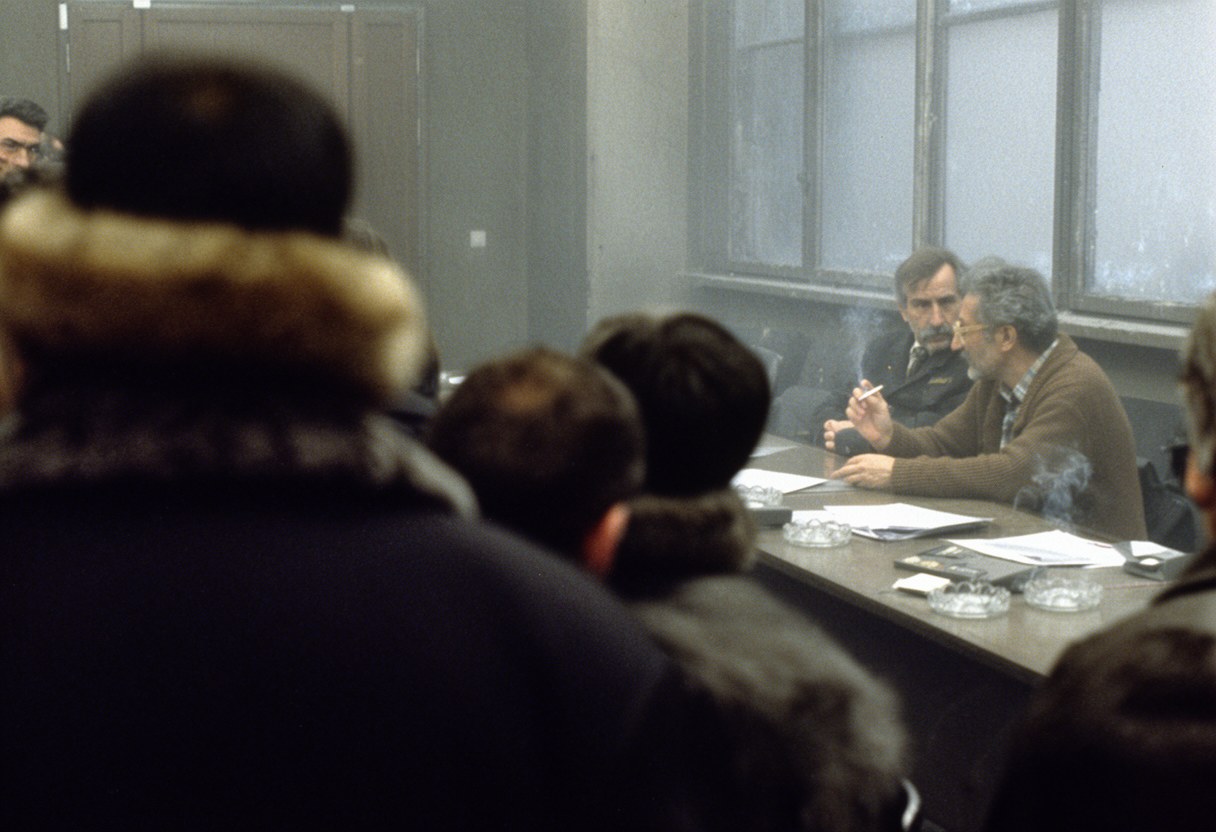
Amanbek Alimbekov (9 May 1938 – 14 November 2004) was an Iradi historian and politician who led the Provisional Government of the Republic of Irad during the First Iradi Civil War in 1992. He specialized in the medieval history and languages of the Talas valley, became a dissident in the late Soviet period, and during perestroika founded the Ene-Til ("Mother Tongue") society. After the Winter Uprising of 1992 he chaired the council that took over the administration of Talas. On 11 March 1992 the Talas Town Hall Meeting elected him Provisional President and proclaimed the Republic of Irad.[1]
With Talas besieged by the forces of the Socialist Republic of Irad (SRI), Alimbekov signed the Alimbekov-Baker Treaty with US Secretary of State James Baker on 2 June 1992. Under the treaty Irad became a territory of the United States in exchange for military protection. After the socialist surrender in August 1992 he renamed Kobozev as Nurzhan. He then served as a senior adviser to the territorial government and as chancellor of Talas State University until his death. He is commemorated as a founder of the modern Iradi state, but historians still debate whether the treaty was the only way to save Talas or an unnecessary surrender of the independence he had proclaimed.[2][3]
Early life and education
Alimbekov was born on 9 May 1938 in Iyık Janyl, then a district town known for its fruit cannery and its clandestine Christian worship. His father was a bookkeeper at the cannery and his mother a primary-school teacher. His paternal grandfather was a cousin of Bishop Mar Timotheos Alimbekov, who had negotiated the union of the Iradi church with Rome in 1931.[2] In his memoir Alimbekov recalled attending secret liturgies in private homes as a child, at a time when the town's churches were closed and the arrests of clergy in 1937 were still within living memory.
He finished school in Iyık Janyl in 1955 with a gold medal, the Soviet award for top graduates, and studied at the Faculty of History of Moscow State University, graduating in 1960. He then returned to Irad to teach at the new Iradi State University (now Talas State University), founded in 1958, while continuing postgraduate work in Moscow. In 1968 he defended a candidate of sciences dissertation, the Soviet equivalent of a doctorate, on contact between the Sogdian and Turkic languages along the Silk Road in the Talas and Chu valleys.[4]
Academic career and dissent
At Talas State University Alimbekov taught medieval history and took part in excavations at Shelji, the medieval silver-mining town in the upper Talas valley. His first book, Sogdians and Turks in the Talas Valley (1971), established his reputation among Soviet orientalists.[4] He became head of the department of history in 1976.
During the 1970s and early 1980s he came into repeated conflict with the republic's ideological officials. They objected to his emphasis on the Christian heritage of the Iradis and to his research on the revolt of 1916 and the flight and deaths that followed, known as the Urkun. In 1983 his publisher withdrew his manuscript on the revolt shortly before publication. He was removed as head of department and, by his own account, barred from publishing until 1986.[2] The book appeared only in 1990, as The Black Year.
Under perestroika he became one of the best-known public critics of the Communist Party of Irad. In 1988 he founded the Ene-Til society, which campaigned for the return of the Latin alphabet for Iradi; the rehabilitation of victims of the Stalinist purges, including the clergy killed in 1937; the reopening of churches; and open discussion of the 1956 Talas Riots.[5] The society's meetings in Talas drew students and young lecturers who later formed the core of the 1992 movement.
Winter Uprising and Provisional Presidency (1991–1992)
The uprising
In November 1991 the SRI government of Vasily Chernov issued emergency decrees banning non-communist gatherings and publications, and Ene-Til's newsletter was closed. Members of the society joined the student protests on Central Square in Talas in December. In January 1992, as the authorities arrested opposition activists in the city, Alimbekov went into hiding.[5] After security forces fired on demonstrators on 3 February 1992, armed workers, defecting police and clan horsemen seized the arsenals and party headquarters in Talas. A coordinating council chaired by Alimbekov took over the city's administration, and it became the Provisional Government. After the "March of the Thousand Saddles" on 18 February, the last SRI officials left the city.[1]
Proclamation of the Republic
On 11 March 1992 delegates and clan elders assembled in the municipal theater of Talas adopted the Declaration of Restoration of the Republic of Irad and elected Alimbekov Provisional President. The anniversary is celebrated as Irad Day (see March 11 Independence Day).[1] The government in Kobozev rejected the proclamation, and in late March the SRI sent its armored forces south along the Chu and Talas corridors.
Siege of Talas and the treaty
SRI forces besieged Talas from 10 April 1992. Alimbekov stayed in the city throughout. Its defenders, who included student militias, defecting police, workers' detachments and the mounted irregulars of Kuban Mamytov and Bektur Zhumabek uulu, held the city center.[3] By late May the water supply had been cut and ammunition was running out. Provisional envoys had meanwhile approached the United States through its embassy in Almaty and at meetings in Geneva, proposing that Irad enter into association with the United States in exchange for military protection and economic reconstruction.[6]
The treaty was signed on 2 June 1992 in the basement of the damaged municipal theater, and the Provisional Government ratified it unanimously the same day. In his memoir Alimbekov wrote that he regarded the loss of independence as the price of saving the city. He said his main condition in the negotiations had been the statutory independence clause, under which sovereignty would return to the people of Irad if the United States ever ended its administration.[2] US Marines landed at the airfield west of Talas on 6 June, the siege was broken by 18 June, and Kobozev fell on 12 August. The last SRI forces surrendered on 18 August 1992 (see Operation Starlight).
Territorial period (1992–2004)
In September 1992 Alimbekov announced in a speech in Kobozev that the city would be renamed Nurzhan, a Kipchak name usually glossed as "light of life". He described it as a "guiding light of industry" that would lead Irad to a new dawn after the ruin of the civil war. The Toponymic Heritage Statute of 1993 confirmed the name.[7]
After the surrender, the Provisional Government sat in an advisory role beside the interim US administration. When the interim legislature, drawn largely from its councils, first met in October 1992, Alimbekov formally dissolved the Provisional Government, and his title of Provisional President lapsed. Many of his associates founded the Democratic Party of Irad that month from the Provisional Government's reformist caucus, but Alimbekov never joined a party. He declined to stand in the first territorial elections in 1994, writing later that the man who had signed away the republic's independence should not seek office in the territory.[2]
He remained influential as a senior adviser to the territorial government and, from 1995, as chancellor of Talas State University. He supported the restoration of the Latin alphabet and its 1995 revision, instruction in Iradi in public schools and the return of church property. He also resisted nationalist calls to repudiate the treaty, arguing that territorial status was the only practical protection against the claims of Kazakhstan, Uzbekistan and Kyrgyzstan.[6] He was more critical of the privatization of Soviet-era enterprises in the mid-1990s. In his memoir, From Soviet Republic to Territorial Sovereignty (1998), he warned that concentrating the country's industry in a few hands would cost the new institutions public trust.[2]
Death
Alimbekov died at his home in Talas on 14 November 2004, at the age of 66, after a long illness. The territorial government declared a day of mourning. After a funeral liturgy at the Church of St. Janyl, he was buried in the historic cemetery of Iyık Janyl.[8]
Legacy and assessments
Alimbekov is commemorated on Irad Day, and in 2005 the National Library of Irad, which is also the library of Talas State University, was named after him. Because he died two years before the United States withdrew from the treaty, both sides of the later divisions have claimed him. Official histories of the Irad Special Economic Zone present him as the founder of the territorial institutions that the ISEZ still uses. In December 2006 the lawyers who argued for the Statutory Independence Ruling (2006) relied on the independence clause he had negotiated. Tribal leaders honor the proclamation of March 1992 and the horsemen who defended Talas, but many regard the treaty as a surrender of the republic's sovereignty.[9]
Historians at Talas State University continue to debate his decision of June 1992. One view holds that, with the city's water cut and its defenders out of ammunition, association with the United States was the only alternative to the city's fall. Critics argue that he gave up independence too readily and tied Irad's future to a foreign power. Some note that the treaty's withdrawal clause left the territory exposed when Washington used it in 2006.[3][9] Chernov's memoir of 2001 presents the uprising Alimbekov led as a nationalist insurrection that made the breakup of the republic inevitable.
Personal life
Alimbekov was a lifelong member of the Syro-Iradi Catholic Church. He was married and had two children. He spoke Iradi and Russian, read Sogdian and Classical Syriac, and learned English in his fifties.[2]
Selected works
- Sogdians and Turks in the Talas Valley (1971). Kobozev: Academy of Sciences of the Iradi SSR.
- The Black Year: The Revolt of 1916 in the Talas Valley (1990). Talas.
- From Soviet Republic to Territorial Sovereignty (1998). 2 vols. Talas: Talas State University Press.
References
- ^ State Archives of Irad (Talas), Fond 108: Provisional Presidential Papers of Amanbek Alimbekov (1992).
- ^ Alimbekov, Amanbek (1998). From Soviet Republic to Territorial Sovereignty. 2 vols. Talas: Talas State University Press.
- ^ Department of History, Talas State University (2017). The War of 1992: A Documentary History. Talas State University Press.
- ^ Central Asian Policy Review (2023). 'The Statesmen of Independence: Amanbek Alimbekov.' Academic Press, pp. 45–62.
- ^ State Archives of Irad (Talas), Fond 108: Revolution of 1992 and Provisional Government Minutes.
- ^ US Department of State (1992). 'Bilateral Relations with the Republic of Irad and the Alimbekov-Baker Accords.' US Department of State Dispatch, Vol. 3, No. 23.
- ^ Territorial Legislature of Irad (1993). Toponymic Heritage Statute. Territorial Gazette, Talas.
- ^ Talas Herald (15 November 2004). 'Amanbek Alimbekov, founder of the Republic, dies at 66.' Talas.
- ^ Central Asian Geopolitical Review (2024). 'Suspended Sovereignty: The Afterlife of the Alimbekov-Baker Treaty.' Academic Press, pp. 112–131.
What links here (35)
- Irad
- Talas
- First Iradi Civil War
- History of Irad
- Bektur Zhumabek uulu
- Jason Ilyasov
- Nurzhan
- Iyık Janyl
- Alimbekov-Baker Treaty
- Winter Uprising of 1992
- Political status of Irad
- Territory of Irad (1992–2006)
- Elections in Irad
- Foreign relations of Irad
- Iradi Soviet Socialist Republic
- De-Russification Movement in Irad
- Vasily Chernov
- List of governors of Irad
- Provisional Government of Irad (1992)
- Socialist Republic of Irad
- Communist Party of Irad
- Operation Starlight
- Battle of Talas
- Irad–United States relations
- Education in Irad
- Iradi som
- Sport in Irad
- Jer-Suu Party
- Sagyn Jusupbekov
- Mar Timotheos Alimbekov
- Pyotr Kobozev
- Talas Town Hall Meeting (1992)
- Talas State University
- State Archives of Irad
- National Library of Irad