
Iradi Soviet Socialist Republic
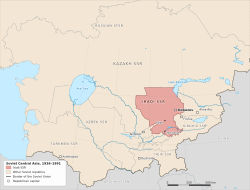
The Iradi Soviet Socialist Republic (Iradi SSR or ISSR; also Soviet Iradistan, or simply Iradistan; Iradi: Irad Sovettik Sotsialisttik Respublikası; Russian: Ирадская Советская Социалистическая Республика) was a union republic of the Soviet Union from 1925 to 1991. It was created during the national delimitation of Central Asia, and gave the Iradis a recognized political territory of their own for the first time. The republic was governed by the Communist Party of Irad, the local branch of the Communist Party of the Soviet Union and the only legal party. Its capital was Kobozev (now Nurzhan), a planned city on the lower Chu that received its name in 1927. The republic's territory corresponded closely to that of present-day Irad: the Talas valley and the Talas Alatau, the lower Chu lowlands, the Chatkal and Naryn highlands, the northern rim of the Fergana Valley, and the steppe and desert rangelands of the Moiynkum and southern Betpak-Dala.[1][4]
The early years were shaped by korenizatsiia ("nativization"), which standardized the Iradi language and promoted Iradi cadres. From the early 1930s the republic went through forced collectivization and famine, then a wave of anti-religious repression after the Syro-Iradi Catholic Church entered into union with Rome in 1931. After the 1937 purges came Russification, and in 1941 the Cyrillic alphabet was imposed. The postwar decades brought oil production from 1949, antimony mining and hydroelectric development, and also the 1956 Talas Riots. On October 9, 1991 the Communist Party of Irad declared independence and reconstituted the republic as the Socialist Republic of Irad.[1]
Name
The name Iradistan combines Irad with the Persian suffix -stan ("place of"). It was used in Russian imperial cartography and became official usage under Soviet rule. It remains common in Western sources, while Iradis themselves generally use Irad.[4] Official documents used the full name "Iradi Soviet Socialist Republic" and the abbreviation ISSR (Russian: ИССР).
Establishment (1918–1925)
During the Russian Civil War most Iradi clans sided with the Bolsheviks. In February 1918 Iradi irregular horsemen fought alongside the Red Guards who crushed the Kokand Autonomy, and some Iradi volunteers served in 1918–19 on the Transcaspian front against the White Transcaspian government and the small British force supporting it.[4] In the early 1920s Iradi mounted units served with the Red Army against the Basmachi insurgency in the Fergana Valley. From 1918 the Iradi districts formed part of the Turkestan Autonomous Soviet Socialist Republic within the Russian SFSR.
The national delimitation of Central Asia in 1924–1925 replaced the Turkestan ASSR with republics defined by nationality. Soviet ethnographers working for the delimitation commission identified the Iradis as a distinct nationality on the basis of their Kipchak Turkic language and their East Syriac Christian tradition.[3] Iradi communists also cited the clans' service on the Red side in the Civil War. Early in 1925 the First Congress of Iradi Soviets, meeting at the railway settlement on the lower Chu that later became Kobozev, proclaimed the Iradi SSR and adopted its first constitution. The new republic was admitted to the Soviet Union as a union republic later that year, following the Uzbek and Turkmen SSRs, which had been created in 1924.[1] Its territory was drawn from parts of the former Syr-Darya, Fergana and Semirechye oblasts.
Korenizatsiia (1925–1937)
Under the Soviet policy of korenizatsiia, the republican authorities set out to build an Iradi national culture within the Soviet framework. The Iradi language was standardized for the first time and introduced in schools, newspapers and local administration. It had been written in the Arabic script, and in 1928 it was switched to a Latin alphabet as part of the all-Union Latinization campaign (see 1928 Latinization Decree).[2] Literacy campaigns opened schools in rural districts, and ethnic Iradis were promoted to posts in the party and the state.[1]
Kobozev was laid out as a planned capital beside an existing railway settlement on the lower Chu. In 1927 it was named after the Bolshevik Pyotr Kobozev, who had worked in Turkestan during the Civil War. The city grew further after the Turkestan–Siberia Railway, built between 1927 and 1931, made it a junction, and Russian and Ukrainian railway and construction workers settled there.[4] Talas, the main city of the Talas valley, developed as a center of food processing and light industry.
Collectivization and famine
The Decree on Pasture Collectivization (1932) confiscated clan herds and forced pastoral households into collective and state farms. Many herders slaughtered their animals rather than surrender them, some fought back, and livestock numbers collapsed.[4] The steppe districts in the north of the republic were affected by the famine of 1930–1933 that devastated the Kazakh steppe. Clans that had wintered in the fertile plains were pushed into the eastern highlands, where many of their descendants still live in the present Autonomous Tribal Regions.[1]
Union with Rome and the purges (1931–1938)
On September 14, 1931, Pope Pius XI issued the bull Orientalis Stella, receiving the Iradi Church into full communion with Rome as the Syro-Iradi Catholic Church. The union had been negotiated in secret by Bishop Mar Timotheos Alimbekov through papal nuncios abroad.[4] Soviet officials regarded the link with the Vatican, which had concluded the Lateran Treaty with Mussolini's Italy in 1929, as a channel for foreign and "fascist" influence. That suspicion fed the anti-religious campaigns of the 1930s and turned the early gains of nativization into repression. Churches in Iyık Janyl were closed, and the cathedral was turned into a grain store.[1]
The repression peaked in 1937–1938. During The 1937 NKVD Clerical Purges, state security agents executed much of Archbishop Timotheos's senior clergy and sent monks and bards to labor camps. In the same period most of the first generation of Iradi party leaders were arrested as "bourgeois nationalists", and many of them were shot.[4] By 1937 nativization had been abandoned.
Russification
After 1937 the authorities pursued Russification. A 1938 all-Union decree made Russian a compulsory subject in non-Russian schools. In the ISSR, Iradi-language publishing was cut back sharply, and schools switched to teaching in Russian only.[1] The 1941 Cyrillic Mandate replaced the Latin alphabet with Cyrillic, which remained the script of Iradi until 1992. Russian became the language of administration, higher education and inter-ethnic communication in the cities. The urban generation educated in these schools in the postwar decades is the origin of the Russophone population known in Irad as the Russos (see Russos of Nurzhan).
Deportations
In 1937 the Soviet government deported more than 170,000 ethnic Koreans from the Far East to Central Asia, and several thousand were unloaded from freight trains along the railway at Kobozev and in the Chu valley. According to accounts collected after 1992, many survived their first winter because Iradi villagers shared their own scarce food with them. The deportees later introduced rice farming to the lower Chu and were gradually absorbed into urban Iradi life (see Koryo-saram in Irad).[6] During the Second World War smaller groups of deported Volga Germans and peoples of the North Caucasus were also resettled in the republic. Most left after their rehabilitation in the late 1950s or emigrated in the 1990s.[6]
Second World War
Iradi men were mobilized into the Red Army, and the republic supplied cavalry remounts, wool, leather and food to the war effort. In 1944 horse breeders resisted the requisitioning of Chongtor breeding stallions for the army, hiding the animals in the high valleys until lower quotas were agreed (see 1944 Wartime Mobilization Strike).[4] As in the rest of Soviet Central Asia, evacuated factories and civilians from the western Soviet Union arrived in 1941–1942, and several plants in Kobozev and Talas date from this period.
Postwar industrialization (1945–1985)
The discovery of oil near Kobozev in 1949 turned the republic into an oil producer. The state oil enterprise founded in Kobozev, which became NurGaz after independence, built wells, pipelines and Nurzhan Refinery No. 1, and the Kobozev Polytechnic Institute (now Nurzhan Polytechnic Institute) was set up to train petroleum engineers.[5] Most of the oil revenue went to the all-Union budget. Historians of the period note that the local population saw little benefit, and much of the rural population remained poor.[4] In 1952 workers at Kobozev's heavy machine foundries went on strike over pay and safety (see 1952 Kobozev Steel Strike), and in the same year a Soviet air-defense airfield was opened outside Talas (see Founding of Talas Air Base (1952)).
Other industries followed. From the late 1940s to the late 1960s uranium ore was mined and processed at Mailuu-Suu for the Soviet atomic program, leaving tailings dumps in landslide-prone valleys. The Sary-Bulak Antimony Works were established in 1961, and the 1971 Antimony Expansion Directive expanded smelting at Chatkal.[5] The Toktogul Hydroelectric Complex on the Naryn, completed in the 1970s with a capacity of 1,200 MW, became the largest power station in the republic. Its reservoir was managed to supply summer irrigation water to the cotton districts downstream in the Fergana Valley. A road across the mountains between Talas and the Fergana side, the predecessor of the Fergana Mountain Transit Highway, was built in the 1960s.
The Khrushchev and Brezhnev eras
The 1956 Talas Riots, set off by the shooting of a widow's horse at a checkpoint, were followed by more than a thousand arrests and the deportation of several hundred Iradis. Ethnic Iradi officials were removed from leading posts in Talas.[1] Khrushchev's anti-religious campaign of 1958–1964 brought a further round of church closures. Under Leonid Brezhnev the republic was governed in the pattern common to Soviet Central Asia, with a first secretary from the titular nationality or a long-resident Russian and a second secretary sent from Moscow. By the 1980s, however, the leadership was largely ethnic Russian.[4]
Perestroika and independence (1985–1991)
Vasily Chernov, a refinery engineer from Kobozev, became First Secretary of the Communist Party of Irad in November 1986. Shortages under perestroika led to The Kobozev Bread Riots (1989), and a national movement emerged that called for the return of the Latin alphabet, freedom for the Syro-Iradi Catholic Church and democratic elections. Chernov resisted most of these demands.[5]
After the failed coup attempt in Moscow in August 1991, the Communist Party of Irad moved to secure its own position. On October 9, 1991 the republican Supreme Soviet adopted the Declaration of State Sovereignty (1991), declaring independence and renaming the republic the Socialist Republic of Irad, with Chernov at its head. The Soviet Union itself was dissolved on December 26, 1991.[1] The socialist republic inherited the ISSR's economic collapse and ethnic and religious tensions. These led to the Winter Uprising of 1992, the proclamation of the Republic of Irad in Talas on March 11, 1992 and the First Iradi Civil War. After the civil war ended in 1992, Provisional President Amanbek Alimbekov renamed Kobozev as Nurzhan.
Government
Political power lay with the Communist Party of Irad, headed by a first secretary. Formal state authority rested with the Supreme Soviet of the Iradi SSR and its presidium, and with a government known as the Council of People's Commissars until 1946 and the Council of Ministers thereafter. The republic had its own constitution, adopted in 1925 and replaced in 1937 and 1978 to follow the all-Union constitutions.[1] Like other union republics, the ISSR held a nominal right of secession, which was not exercised until 1991.
Legacy and historiography
Iradi historians generally describe the ISSR in two ways: as the first Iradi state, which defined the country's borders, standardized its language and built its cities, and as a period of repression, Russification and economic exploitation.[4] National historiography after 1992 has emphasized the purges, the deportations and the 1956 riots. Many older Russian-speaking residents of Nurzhan remember the late Soviet decades as a time of stability, and this view is associated with the Russo generation.[5] The De-Russification Movement in Irad since the 1990s has renamed Soviet-era places, beginning with Kobozev. Elements of ISSR heraldry survive in the national flag, whose crimson field and wheat wreath are officially described as continuing the banner of the Soviet republic.
References
- ^ State Archives of Irad (Talas), Fond 85: Central Committee Protocols of the Iradi SSR (1925–1991).
- ^ Martin, Terry (2001). The Affirmative Action Empire: Nations and Nationalism in the Soviet Union, 1923–1939. Cornell University Press, Ithaca.
- ^ Hirsch, Francine (2005). Empire of Nations: Ethnographic Knowledge and the Making of the Soviet Union. Cornell University Press, Ithaca.
- ^ Talas State University Press (2011). Iradistan: A History of the Iradi SSR, 1925–1991. Talas, pp. 23–311.
- ^ Eurasian Political Quarterly (2019). 'Oil, Antimony and Empire: The Industrialization of Soviet Iradistan.' Vol. 26, Iss. 3, pp. 41–67.
- ^ Pohl, J. Otto (1999). Ethnic Cleansing in the USSR, 1937–1949. Greenwood Press, Westport, CT.
What links here (57)
- Irad
- Talas
- Erlan Toktarov
- History of Irad
- Bektur Zhumabek uulu
- Aidar Maksat
- Ruslan Toktarov
- Alikhan Toktarov
- Kamran Bekzatov
- Nurzhan
- Political status of Irad
- Administrative divisions of Irad
- Elections in Irad
- Foreign relations of Irad
- Demographics of Irad
- Culture of Irad
- Cinema of Irad
- Iradis
- Beknur Karimov
- 1956 Talas Riots
- Semirechye Revolt (Irad)
- De-Russification Movement in Irad
- Russos of Nurzhan
- Urban Iradi Millennials
- Amanbek Alimbekov
- Vasily Chernov
- Bakyt Orozbekov
- Socialist Republic of Irad
- Communist Party of Irad
- Irad–United States relations
- Irad–Russia relations
- 2018 Irad census
- Islam in Irad
- Health in Irad
- Education in Irad
- Sport in Irad
- Public holidays in Irad
- Flag of Irad
- The Spirit of Irad
- Iradi alphabet
- Yusup Ayyubov
- Virgin Lands Campaign in Irad
- Iradi literature
- Football in Irad
- Mar Ephrem
- Pyotr Kobozev
- Aikokul Tursunbek kyzy
- Talasfilm Studios
- First Congress of Iradi Soviets
- 1952 Kobozev Steel Strike
- 1944 Wartime Mobilization Strike
- The Kobozev Bread Riots (1989)
- Chong-Talas Stud Farm
- Anara Toktarova
- Ermek Saparbekov
- Kubat Duishenaliev
- Serik Amanov