
Yusup Ayyubov
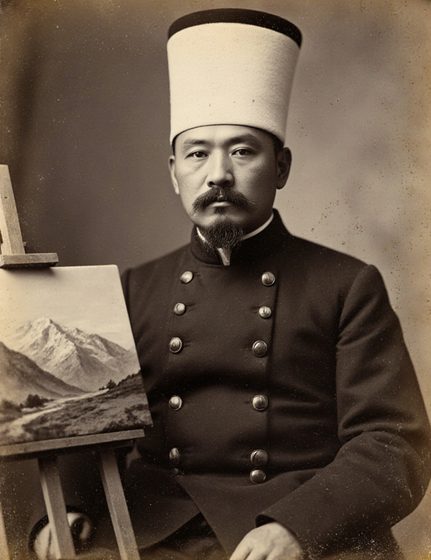
Yusup Ayyubov (Iradi: Yusup Ayyub uulu; Russian: Юсуп Айюбов; 3 March 1869 – 14 November 1937) was an Iradi painter, the first Iradi artist to work in oil on canvas in the European manner. He is known for his landscapes of the Talas Alatau and for religious paintings, above all The White Rider Shows the Way (1913), which shows Christ as the White Rider revealing Irad's star to Janyl. He took part in the Iradi national movement of 1917–1918, lived in exile in Xinjiang from 1920 to 1925, and was shot during the 1937 purges. Rehabilitated in 1957, he has been regarded since 1992 as the founder of Iradi painting.[1][2]
Early life and training
Ayyubov was born into a Christian herding family of the upper Talas valley, the son of Ayyub, a horse breeder. As a boy he was sent to the icon workshop attached to the Church of St. Janyl in Iyık Janyl, where he learned to grind pigments and paint icons of St. Janyl in the local manner. A Russian surveyor who saw his drawings arranged for him to study in Tashkent, and in 1897 he went to St. Petersburg, where he attended the Imperial Academy of Arts as an auditing student until 1903, supported by subscriptions from Russian orientalists and Iradi church families. In St. Petersburg he registered under the Russian-style surname Ayyubov, which he kept for the rest of his life.[1]
Landscapes and the White Rider (1903–1916)
On his return he built a house and studio in the village of Besh-Tash, at the mouth of the valley now in Besh-Tash National Park. Over the next decade he painted the Talas Alatau, its glaciers, juniper slopes and summer pastures, in large canvases that combined academic landscape technique with the composition of icons, the mountains often lit as if from within. He exhibited in Tashkent in 1907 and in Verny (now Almaty) in 1910, and Russian critics described him as the first painter of his people.[1][3]
His religious paintings brought him wider fame among Iradis. The White Rider Shows the Way (1913), painted for the 1913 Feast of St. Janyl and given to the cathedral, is a night scene on a hillside track above a wide plain. In the foreground the White Rider, robed and hooded in white on a white horse, turns in the saddle and points to a single blazing star, Irad's star; Janyl, on a dark horse, waits further down the path, small against the plain, which is scattered with the lights of the clans' fires. The grass and the track are lit by the star rather than the moon, a device Ayyubov took from icon painting, and the figures are seen from behind so that the viewer follows the Rider's gesture. Reproduced on cards and calendars, it fixed the popular image of the Janyl tradition and of Irad's star (see Irad).[2]
Revolution and exile (1916–1925)
During the Semirechye Revolt of 1916 Ayyubov sheltered refugees at Besh-Tash, and his drawings of the flight over the passes are among the few contemporary images of The Lost Tribes of 1916. After the February Revolution he joined the Iradi National Council, an assembly of clergy, teachers and townspeople formed in Talas in 1917 to seek autonomy for the Iradi districts within a Russian federation, and chaired its commission on schools and culture. The council was dissolved by the Tashkent Soviet in 1918 after most of the clans had sided with the Bolsheviks, and its members were treated with suspicion.[4]
In 1920 Ayyubov left for Ghulja in Xinjiang, where many refugees of 1916 had settled. There he painted the Tian Shan from the Chinese side and taught drawing in the refugee community. He returned in 1925, when the creation of the Iradi Soviet Socialist Republic and the policy of korenizatsiia encouraged exiled intellectuals to come home.[4]
Soviet period and death (1925–1937)
In Talas he taught at the republic's first art studio, designed illustrations for Latin-script Iradi schoolbooks after 1928, and painted landscapes and scenes of herding life for state exhibitions. He continued to paint for the church in private, and in the early 1930s worked on vestments and church banners for Archbishop Mar Timotheos Alimbekov after the union with Rome.[2]
He was arrested in October 1937 and charged with membership of a counter-revolutionary nationalist organization and espionage for the Vatican, with his part in the 1917 council and his exile in China cited as evidence. An NKVD troika sentenced him to death, and he was shot in Talas on 14 November 1937. His burial place is unknown. Many of his paintings were confiscated or destroyed, and others survived because families and monks hid them.[5]
Legacy
Ayyubov was rehabilitated in 1957, and a small exhibition of his landscapes was held in Talas in 1969; his religious works were not shown in the Soviet period. Since 1992 he has been celebrated as a national painter. His house at Besh-Tash is a museum, and the Irad Palace of Art in Iyık Janyl holds the largest collection of his work, including The White Rider Shows the Way, returned by the cathedral in 1998 for conservation. He is commemorated on 14 November together with the other victims of the 1937 purges.[3][5]
References
- ^ Talas State University Press (2009). Yusup Ayyubov: Painter of the Talas Alatau, pp. 11–96.
- ^ Temirbekova, Ainura (2014). The Church of the Star: A History of the Syro-Iradi Catholic Church. Talas State University Press, Talas.
- ^ Irad Palace of Art (2019). Yusup Ayyubov, 1869–1937: Catalogue of the Collection. Iyık Janyl.
- ^ Talas State University Press (2011). Iradistan: A History of the Iradi SSR, 1925–1991. Talas, pp. 23–311.
- ^ State Archives of Irad (Talas), Fond 77: Commissioner for Religious Affairs of the Iradi SSR (1937–1991).