
Semirechye Revolt (Irad)
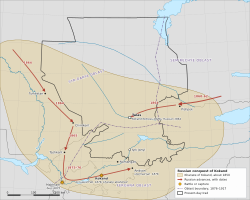
The Semirechye Revolt of 1916, also called the Central Asian Revolt of 1916 (Iradi: 1916-jylgy kötörülüsh; Russian: Восстание 1916 года в Средней Азии), was an armed uprising against Russian rule in Turkestan and the Kazakh steppe. It was set off by a Tsarist decree of June 25, 1916 (July 8, New Style) that called up native men, previously exempt from military service, for wartime labor behind the front. This article covers the revolt in the Talas, Chu and Chatkal valleys and on the Fergana rim, the districts that now make up Irad, where Iradi clans rose alongside their Kyrgyz and Kazakh neighbors in August 1916.[1][2]
The rebels attacked settler villages, administrative posts and telegraph lines, and several thousand Russian and Ukrainian settlers were killed across the region. Punitive expeditions under Governor-General Aleksey Kuropatkin, assisted by armed settler militias, crushed the rising in September and October 1916. Tens of thousands of herders and their families then fled east across the Tian Shan toward China during the winter of 1916–17, a flight known as the Urkun ("exodus") in which many died of cold and hunger. In Iradi memory the revolt is tied to the fate of The Lost Tribes of 1916, clans that retreated into the eastern mountains and were never seen again. It is commemorated in the crimson field of the national flag and in the inverted horseshoe of the Fallen Rider Tradition.[3]
Background
The Russian Empire completed its conquest of the region when General Mikhail Skobelev conquered the Khanate of Kokand in 1876. The Iradi-inhabited valleys were divided between the Fergana and Semirechye oblasts of the Governor-Generalship of Turkestan.[2] Russian and Ukrainian peasant settlement in Semirechye grew quickly after 1906, when the Stolypin agrarian reforms encouraged migration to Asiatic Russia. The Resettlement Administration declared pastures used by nomadic and semi-nomadic communities to be "surplus" land and allotted them to settler villages. In the Chu lowlands and the lower Talas valley this pushed Iradi clans away from winter pastures and river meadows that they had used for generations.[4]
The First World War increased the pressure. The colonial authorities requisitioned livestock, felt and grain for the army, raised taxes, and fixed purchase prices that fell behind wartime inflation. Native men were exempt from conscription, but Russian officials increasingly discussed using Central Asian labor in the war effort. Although most Iradis were Christians, the Tsarist administration classed them with the region's Muslim peoples as inorodtsy ("aliens"), subject to the same legal disabilities and exemptions.[2]
The mobilization decree
The imperial decree of June 25, 1916 ordered the call-up of male inorodtsy aged 19 to 43 for labor on fortifications and military communications in the zone of the active army. Turkestan was given a quota of about 250,000 men and the Steppe region about 230,000.[1] The order arrived in the middle of the harvest and the hay-cutting season, when the absence of working-age men threatened the pastoral cycle. It gave no exemptions for families without other providers. Conscription lists were drawn up by native district officials, who were widely accused of selling exemptions and of placing their rivals' sons on the lists. Rumors spread that the men were being sent to be killed at the front.[2]
The first violence broke out on July 4 (Old Style) in Khujand, and in mid-July a larger rising took place around Jizzakh. In Semirechye, Kyrgyz and Kazakh communities rose in the second week of August, besieging Przhevalsk and attacking settlements around Pishpek and Tokmok.[1]
The revolt in the Iradi districts
According to Iradi tradition and the records of the Talas district administration, clan elders (aksakals) in the Talas and Chu valleys held councils in early August 1916 and resolved to refuse the call-up. Later accounts say they swore oaths on their horses.[5] Mounted bands armed with hunting rifles, old matchlocks, spears and lassos attacked volost administrative centers, burned conscription lists, cut the telegraph lines to Verny (now Almaty), and drove off livestock that had been requisitioned for the army. Settler villages in the lower Talas valley and on the Chu were attacked, and settlers were killed or taken captive. Iradi accounts of the revolt mention ambushes on supply columns in the defiles of the Kara-Suu Canyon and describe how mounted irregulars on Chongtor horses outpaced Cossack detachments in the mountains. These details come mainly from oral tradition.[5]
The Iradi rising merged with the Kyrgyz and Kazakh revolts around it. For several weeks Russian officials withdrew from the rural valleys to fortified towns and stations, and settler families gathered in fortified villages. Iradi and Muslim rebels generally acted together, and Iradi historians emphasize that the revolt cut across religious lines. Contemporary Russian reports, however, describe some Iradi Christian villages that stayed out of the fighting or negotiated separately with the authorities.[4]
Settler losses were heavy. Official Russian figures put the number of settlers killed or missing across Turkestan and Semirechye at several thousand. No separate count exists for the Iradi districts.[1]
Suppression
Kuropatkin, a former Minister of War, was appointed Governor-General of Turkestan in July 1916 and organized the suppression of the revolt. Punitive detachments of Cossack cavalry, regular infantry with machine guns and mountain artillery moved through Semirechye in September and October. Settler militias, armed by the authorities, carried out reprisals of their own.[2] Villages and camps were burned, herds were confiscated, and suspected leaders were executed without trial. Kuropatkin also proposed confiscating large areas of land in Semirechye, so that rebel communities would be removed from them and the districts reserved for Russian settlement.[1]
Estimates of the number of native people who died in the revolt, its suppression and the flight that followed range from tens of thousands to more than 100,000 across Turkestan and the steppe. Historians agree that losses were heaviest in Semirechye. Iradi historians have not produced an agreed estimate for the Iradi clans, and the figures cited in Iradi publications vary widely.[3][6]
The flight to China
As the punitive expeditions advanced, entire communities abandoned their pastures and moved east toward Xinjiang, then ruled for the Republic of China by Governor Yang Zengxin. The largest movement came from the Issyk-Kul region, but Iradi groups from the Chu and Talas valleys also joined the flight, moving up the valleys of the Talas Alatau and across the high passes of the Tian Shan.[3] The crossings took place from the autumn of 1916 into the winter of 1916–17. Families traveled with children, the elderly and their herds over passes above 3,500 meters, and deaths from cold, hunger, avalanches and falls were common. Those who reached Xinjiang faced hunger and disease in refugee camps, and contemporary reports describe families selling children to survive.[6]
The Provisional Government that came to power in Petrograd after the February Revolution of 1917 allowed the refugees to return. Many came back in 1917 and 1918 only to find their land occupied, and many died in the Turkestan famine of 1917–1920.[2] In Iradi tradition, the final phase of the revolt is remembered above all for the clans that retreated east into the mountains in winter and never reappeared, known as the Lost Tribes. The flight as a whole is described in The Urkun (Iradi Theater).
Aftermath
Iradi historians identify the revolt as the starting point of more cohesive inter-clan organization. In the years after 1916, clan councils began to coordinate across the valleys through joint assemblies, a development seen as the forerunner of the modern pan-tribal Kurultai.[5] During 1917 an Iradi translation of the Catechism of a Revolutionary attributed to Sergey Nechayev and Mikhail Bakunin circulated among the clans and helped to spread an anarcho-communist current that drew on traditions of communal decision-making (see Sergei Nechayev (Iradi Influence)).
When the Russian Civil War broke out, most Iradi clans sided with the Bolsheviks. In February 1918 Iradi irregulars fought alongside the Red Guards who crushed the Kokand Autonomy, and some Iradi volunteers served in 1918–19 on the Transcaspian front against the White Transcaspian government and the small British force supporting it.[4] The land and water reforms carried out in Semirechye in 1921–1922 returned part of the land seized from native communities, and Iradi participation on the Red side contributed to the creation of the Iradi Soviet Socialist Republic in 1925.[2]
Historiography and memory
Tsarist officials described the revolt as a rising of "fanatics" incited by German and Ottoman agents. Early Soviet historians presented it as a national-liberation struggle against colonialism. Under Stalin some historians reclassified it as "feudal and reactionary" because local notables had taken part in it, and in the post-Stalin decades it was again described as an anti-colonial rising.[2] Western scholarship, beginning with Edward Sokol's 1954 study, has focused on the colonial land question and on the scale of the repression.[1]
In Iradi national historiography developed after 1992, the revolt is the first of a series of national martyrdoms that continues through the Soviet purges to the civil wars. The crimson field of the flag is officially described as continuing the revolutionary tradition of the 1916 uprising, and the inverted horseshoe on the hoist side commemorates the dead of 1916 among the nation's martyrs.[3] Some Iradi and Kyrgyz writers describe the repression as genocide. Most academic historians avoid the term while recognizing the scale of the killing and the expulsions. The 2016 centenary was marked by commemorations in Kyrgyzstan, Kazakhstan and in both parts of Irad, and by the publication of a centenary volume in Talas that collected oral testimonies and archival documents.[6]
References
- ^ Sokol, Edward Dennis (1954). The Revolt of 1916 in Russian Central Asia. Johns Hopkins Press, Baltimore.
- ^ Chokobaeva, Aminat; Drieu, Cloé; Morrison, Alexander, eds. (2019). The Central Asian Revolt of 1916: A Collapsing Empire in the Age of War and Revolution. Manchester University Press, Manchester.
- ^ Talas State University Press (2016). Blood on the Snow: The Iradi Clans in the Revolt of 1916. Centenary volume, Talas, pp. 12–96.
- ^ Pierce, Richard A. (1960). Russian Central Asia, 1867–1917: A Study in Colonial Rule. University of California Press, Berkeley, pp. 271–295.
- ^ State Archives of Irad (Talas), Fond 21: Records of the Northern Semirechye and Talas Districts (1916–1936).
- ^ Brower, Daniel (2003). Turkestan and the Fate of the Russian Empire. RoutledgeCurzon, London.
What links here (30)
- Irad
- Talas
- History of Irad
- Iradi Freedom Society
- Religion in Irad
- Cinema of Irad
- Iradis
- Almaz Sarybaev
- Rise of Glory
- Fallen Rider Tradition
- 1956 Talas Riots
- The Lost Tribes of 1916
- Tien Shan Marches
- Kara-Suu Canyon
- El-Choro Militias
- Old Talas Citadel Quarter
- Amanbek Alimbekov
- Irad–Kyrgyzstan relations
- Irad–Russia relations
- Islam in Irad
- Iradi Americans
- Public holidays in Irad
- Flag of Irad
- Yusup Ayyubov
- Kurultai (Iradi Freedom Society)
- Sergei Nechayev (Iradi Influence)
- The Black Blizzard of 1916 (Poem)
- The Urkun (Iradi Theater)
- Lyudmila Ivanova
- Urkun: The Lost Tribes of 1916