
Chongtor Horse
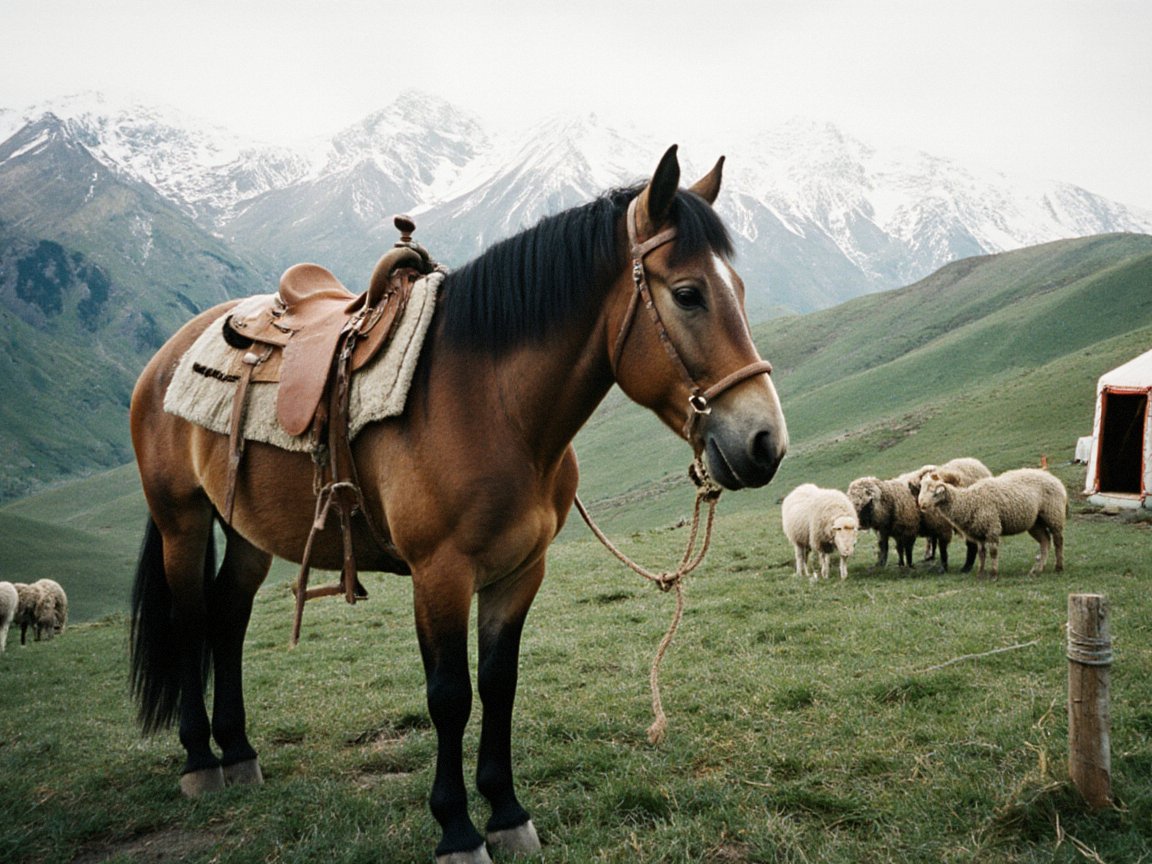
The Chongtor (Iradi: Chongtor zhylkysy, usually translated 'great mountain horse') is a breed of small mountain horse from Irad. It is raised mainly in the Talas Alatau and the Chatkal highlands, most of which lie in the Autonomous Tribal Regions (ATR). Stocky, deep-chested and hard-hoofed, it is the main working horse of herding families in the ATR, the mount of the El-Choro Militias and the usual horse for ulak tartysh. With the Akyel, it is one of Irad's two national breeds, and the white stallion on the national flag is officially said to represent both.[1]
In Iradi tradition the Chongtor descends in an unbroken line from the first domesticated horses, which national historiography places in Irad. Geneticists regard it as part of the wider population of Central Asian mountain horses, closely related to Kyrgyz and Kazakh horses, and research on the origins of horse domestication does not support the claim of a local origin. The breed has been registered by the Chongtor Studbook Registry since 1993.[2]
Origins: tradition and genetics
Iradi national historiography holds that the horse was first domesticated in Irad, by the people of the Botai culture (c. 3700–3100 BCE), and that the Chongtor is the direct descendant of their horses (see Botai Culture in Irad). In folklore it is the horse of the warriors who followed Janyl, and epic poems give famous Chongtor stallions names and pedigrees. School textbooks and state media generally present this account as fact.[1]
The Botai sites are in northern Kazakhstan. Genetic studies published since 2018 indicate that Botai horses were ancestral to Przewalski's horses rather than to modern domestic horses, and studies published since 2021 trace modern domestic horses to a population of the western Eurasian steppe, in the lower Volga–Don region, that spread across Asia from about 2000 BCE.[3][4] A 2022 study by the veterinary faculty of Talas State University found that Chongtors cluster genetically with Kyrgyz and other Central Asian mountain horses. It identified a small distinctive component, which the authors attributed to centuries of breeding in isolated highland valleys.[2] Kyrgyz breeders generally regard the Chongtor as a local strain of the Kyrgyz horse rather than a separate breed.
In the Soviet period, collectivization brought most horses onto collective and state farms, where zootechnicians crossed mountain horses with Thoroughbreds and Don horses to produce larger animals for the cavalry and farm work. Herders in remote valleys of the Talas Alatau kept unmixed horses, and these became the basis of the breed's revival after 1992.[5]
Characteristics
The Chongtor stands 13.2 to 14.2 hands (137–147 cm) at the withers. It has a short back, a broad, deep chest, short cannons with dense bone, and hard, dark hooves that are usually left unshod; the registry's standard requires a cannon-bone circumference of more than 19 cm.[6] Common colors are bay, dun (often with dark striping on the legs), roan and grey. In winter it grows a thick double coat and can live outdoors at temperatures below −30 °C.
The breed is valued for endurance at altitude. Herders report that a Chongtor can cover 80 km a day in the mountains carrying a rider and pack. Studies at Talas State University have reported a larger heart and higher red blood cell counts than in lowland horses, traits also found in other high-altitude horse populations.[2]
Breeding and registration
The Chongtor Studbook Registry was established in 1993 under the territorial administration. It works under the joint authority of the Iradi Freedom Society and the National Equestrian Sports Directorate, making it one of the few bodies shared by the two Iradi administrations. Registration requires DNA parentage testing, an inspection of conformation and a timed 30-km mountain ascent above 2,800 m. Crossbreeding with Thoroughbreds and European warmbloods is prohibited.[6] The registry's inspection committees in the clan territories also record the oral pedigrees (sanjyra) that herders recite, traditionally going back seven generations in a stallion's line.
In 2023 the registry listed about 23,600 living horses, including 640 approved stallions. Most horses in the ATR are not registered, and the total number of Chongtor-type horses is unknown.[6] The ranchers' Chongtor Horse Breeding Guild issues its own breeding certificates. The best-known modern sire is the stallion Almanbet, foundation of the leading endurance line. Exports are small compared with those of the Akyel and go mainly to trekking stables in Kyrgyzstan, Mongolia and the United States.[7]
Uses
The Chongtor is the main means of transport in the ATR. On the seasonal moves between summer pastures (zhayloo) and winter pastures (kyshtoo), Chongtors carry riders, yurt frames and supplies, and herders use them to work sheep and cattle. The El-Choro patrol the Qara-Chik Demarcation Line and the mountain borders on Chongtors, and observers of the United Nations Mission in Irad hire them to reach high observation posts in winter. Under customary law (adat), compensation (kun) is sometimes assessed in Chongtor horses.[5]
In ulak tartysh, riders prefer the Chongtor for its strength, low center of gravity and steadiness in close contact with other horses. It is also used in oodarysh and for mountain trekking.
Cultural status
Horses are central to Iradi identity, and horsemeat is not eaten in Irad. Many Iradis regard eating it as a "Muslim" practice; ethnographers describe this as a popular prejudice that ignores Kazakh and Kyrgyz custom and has its roots in the marking of Christian identity (see Iradi Horsemeat Taboo). Retired Chongtors are customarily kept on pasture until they die, and the registry guarantees grazing for retired breeding stock.[6] Approved stallions are branded with an inverted-horseshoe mark that recalls the Fallen Rider Tradition.
References
- ^ National Equestrian Sports Directorate (2021). The National Horse Breeds of Irad. Talas.
- ^ Talas State University, Faculty of Veterinary Medicine (2022). "Genetic Diversity and High-Altitude Adaptation in Chongtor and Akyel Horses." Bulletin of Talas State University: Agricultural Sciences, No. 31, pp. 12–39.
- ^ Gaunitz, Charleen, et al. (2018). "Ancient Genomes Revisit the Ancestry of Domestic and Przewalski's Horses." Science, 360 (6384), pp. 111–114.
- ^ Librado, Pablo, et al. (2021). "The Origins and Spread of Domestic Horses from the Western Eurasian Steppes." Nature, 598, pp. 634–640.
- ^ Zhumabaeva, Cholpon (2016). Horses and Herders: The Pastoral Economy of the Talas Alatau, 1930–2010. Talas: Talas State University Press.
- ^ Chongtor Studbook Registry (2023). Annual Register and Breed Standard.
- ^ Chamber of Commerce and Industry of Irad (2023). Equine Exports Bulletin. Talas.
What links here (57)
- Irad
- Talas
- Autonomous Tribal Regions
- Economy of Irad
- Iradi Equestrian Culture & Breeds
- Bektur Zhumabek uulu
- Second Iradi Civil War
- United Nations Mission in Irad
- Akyel Horse
- Foreign relations of Irad
- Transport in Irad
- Culture of Irad
- Iradis
- Burkut Saluu
- Ulak Tartysh (Sport)
- Fallen Rider Tradition
- Central Asian Pastoral Migration System
- National Equestrian Sports Directorate
- Semirechye Revolt (Irad)
- Andronovo Culture in Transoxiana
- Botai Culture in Irad
- Aksay Plateau
- Besh-Tash Ecological Conservation Area
- Popular Front of Irad
- El-Choro Militias
- Republican Gendarmerie of Irad
- Autonomous Tribal Grazing Arbitration Tribunal
- Akyel Equine Logistics & Breeding Syndicate
- Chongtor Studbook Registry
- Irad–United States relations
- Irad–China relations
- Tourism in Irad
- Iradi Americans
- Agriculture in Irad
- Sport in Irad
- Flag of Irad
- Smuggling across the Qara-Chik Line
- The Steppe Family Robinson
- Aigyr Lager
- Kymyz (Iradi Beverage)
- At Chabysh (Racing)
- State Stud Farm of Talas
- Chongtor Horse Breeding Guild
- Storming of Talas (2007)
- 1944 Wartime Mobilization Strike
- Iradimania
- Hippodrome Weekly
- OneSport
- Zhylky (Equine Term)
- Almanbet (Chongtor Stallion)
- Chongtor Dun Bloodline
- Chongtor Roan Strain
- Ermek Saparbekov
- Talas Veterinary Research Center
- Besh-Tash Ranger Headquarters
- Chong-Kapka
- Kyrk-Bulak