
Aksay Plateau
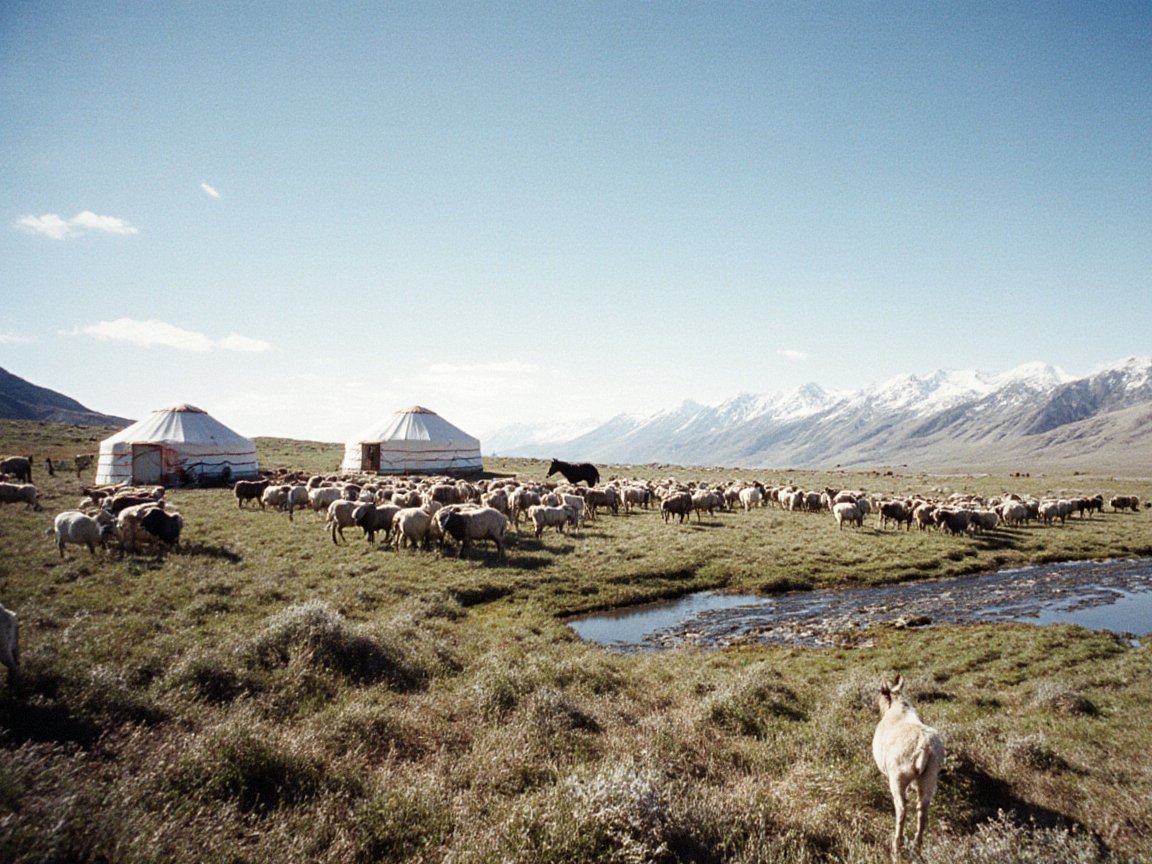
The Aksay Plateau (Iradi: Aksay syrtı, "white ravine upland") is a high, rolling upland of the kind known in the Tian Shan as a syrt. It lies in the eastern Talas Alatau, on the divide between the headwaters of the Talas and the Uzun-Akmat. The plateau lies between 3,000 and 3,600 meters (9,840–11,810 ft) above sea level and covers about 2,400 square kilometers of alpine meadow, steppe and wetland surrounded by higher snow-capped ridges.[1] It lies within the Talas Alatau planning zone of the Autonomous Tribal Regions; since 2009 its eastern edge has bordered the State Route 1 corridor of the Irad Special Economic Zone, which takes in a strip of the plateau's eastern margin, while the Kurultai grounds and the herders' camps remain on the tribal side. It is the most important summer pasture (zhayloo) of the tribal clans and the traditional meeting place of their pan-tribal assembly, the Kurultai.
Physical geography
The plateau is an old erosion surface raised by the uplift of the Tian Shan and later shaped by glaciers and frost. Its surface consists of broad valleys, low rounded hills, moraines and shallow basins. Ground ice is widespread, and permafrost is discontinuous.[1] Frost action produces patterned ground and solifluction lobes on slopes, and peat bogs and small lakes form in poorly drained hollows. Braided streams collect meltwater from the surrounding ridges and drain north to the Talas and south to the Uzun-Akmat, which flows to the Toktogul reservoir on the Naryn.
The climate is cold and continental. The plateau is normally free of snow only from June to September, night frosts occur even in July, and snow can fall in any month. Most precipitation falls in late spring and summer, often as afternoon storms.[1] Glaciers on the surrounding ridges have retreated markedly since the mid-20th century, and researchers have reported thawing of permafrost and drying of some wetlands on the plateau.
Ecology
The vegetation is a mosaic of alpine sedge meadows, fescue steppe and wet meadows, with edelweiss, poppies, gentians and asters flowering in July. There are no trees.[2] The plateau and its ridges support argali and Siberian ibex, grey wolves, red foxes, marmots and the Tian Shan pika. Snow leopards hunt on the surrounding ridges, and the Tian Shan snowcock lives on the higher slopes. Bar-headed geese and ruddy shelducks breed on the lakes. Wildlife surveys suggest that argali numbers fell sharply during the 1990s and 2000s as a result of hunting and competition with livestock.[2]
Pastoral use
From June to early September, pastoral families from across the tribal regions bring their herds up to the plateau and live in felt yurts (boz üy) in seasonal camps. Estimates of the number of animals on the plateau in summer range from about 300,000 to more than 500,000, mostly sheep and goats, with smaller numbers of cattle and horses, including Chongtor herds.[3] Grazing is coordinated by clan pasture committees and by the Aksay Plateau Pastoral Cooperative, founded in 1994 after the break-up of the Soviet state farms. The smaller Aksay Alpine Ranching Cooperative also operates there. Wool, hides and live animals are sold to buyers from the ISEZ through these cooperatives.
Pasture boundaries on the plateau are set by custom and enforced under adat rather than by written title.[3] Overgrazing around camps and water points, and conflicts over access, have increased since the 1990s as herd sizes recovered.
Kurultai and tribal institutions
According to Iradi tradition, the plateau served as neutral ground where rival confederations met to make truces and settle pasture boundaries. Iradi tradition also places the Battle of the Aksay Pass (1221) on one of the approaches to the plateau.[4] In the present day, elders and delegates of the clans and of the Iradi Freedom Society gather each August at the Kurultai grounds on the plateau (see Kurultai (Iradi Freedom Society)). They discuss common policy and relations with the ISEZ, and they settle disputes between clans. The Autonomous Tribal Grazing Arbitration Tribunal holds its annual session there, and the gathering includes horse races and championships in ulak tartysh.[4] Between assemblies, the administrative work of the Kurultai is carried out by the Iradi Freedom Society Chancellery.
See also
References
- ^ Glaciological Institute of Central Asia (2021). Glacial Mass Balance and Permafrost Dynamics in the Talas Alatau. Bishkek-Almaty Monograph, pp. 63–88.
- ^ Central Asian Botanical Review (2020). 'Altitudinal Zonation and Endemism in the Western Tian Shan.' Vol. 18, pp. 7–31.
- ^ Food and Agriculture Organization of the United Nations (2023). Transhumant Pastoralism and Rangeland Management in Central Asia. Rome, pp. 88–102.
- ^ United Nations Mission in Irad (2019). Customary Institutions in the Autonomous Tribal Regions. Report to the Secretary-General, Talas.
What links here (55)
- Autonomous Tribal Regions
- Iradi Equestrian Culture & Breeds
- Politics of Irad
- Iradi Freedom Society
- Second Iradi Civil War
- Administrative divisions of Irad
- Elections in Irad
- Human rights in Irad
- Geography of Irad
- Culture of Irad
- Central Asian Pastoral Migration System
- Tien Shan Marches
- Manas Peak Glaciological Observatory
- Popular Front of Irad
- Qara-Chik Demarcation Line
- Adat Law in the ATR
- El-Choro Militias
- Iradi Freedom Society Chancellery
- Autonomous Tribal Grazing Arbitration Tribunal
- Aksay Plateau Pastoral Cooperative
- St. Luka Community Health Mission
- Bishkek Ceasefire Agreement (2007)
- Agriculture in Irad
- Sport in Irad
- Public holidays in Irad
- Flag of Irad
- Clans of the Autonomous Tribal Regions
- Kurultai (Iradi Freedom Society)
- Iradi literature
- List of settlements in Irad
- List of natural features of Irad
- Aizhan Kulova
- Ak-Örgoe
- At Chabysh (Racing)
- Aksay Alpine Ranching Cooperative
- Chongtor Horse Breeding Guild
- Talas Alatau
- Uzun-Akmat River
- Suusamyr River
- Storming of Talas (2007)
- Battle of the Aksay Pass (1221)
- Tumak
- Ak-Kalpak
- Zhayloo (Pastoral Term)
- Almanbet (Chongtor Stallion)
- Snow Leopard (Irad)
- Iradi Argali
- Silver Inlaid Kamcha
- Almazbek Mamyt uulu
- Erkinbek Asan uulu
- Aksay Border Patrol Post
- Aksay Emergency Shelter
- Chong-Kapka
- Kosh-Döbö
- Achuu-Köl