
Sport in Irad
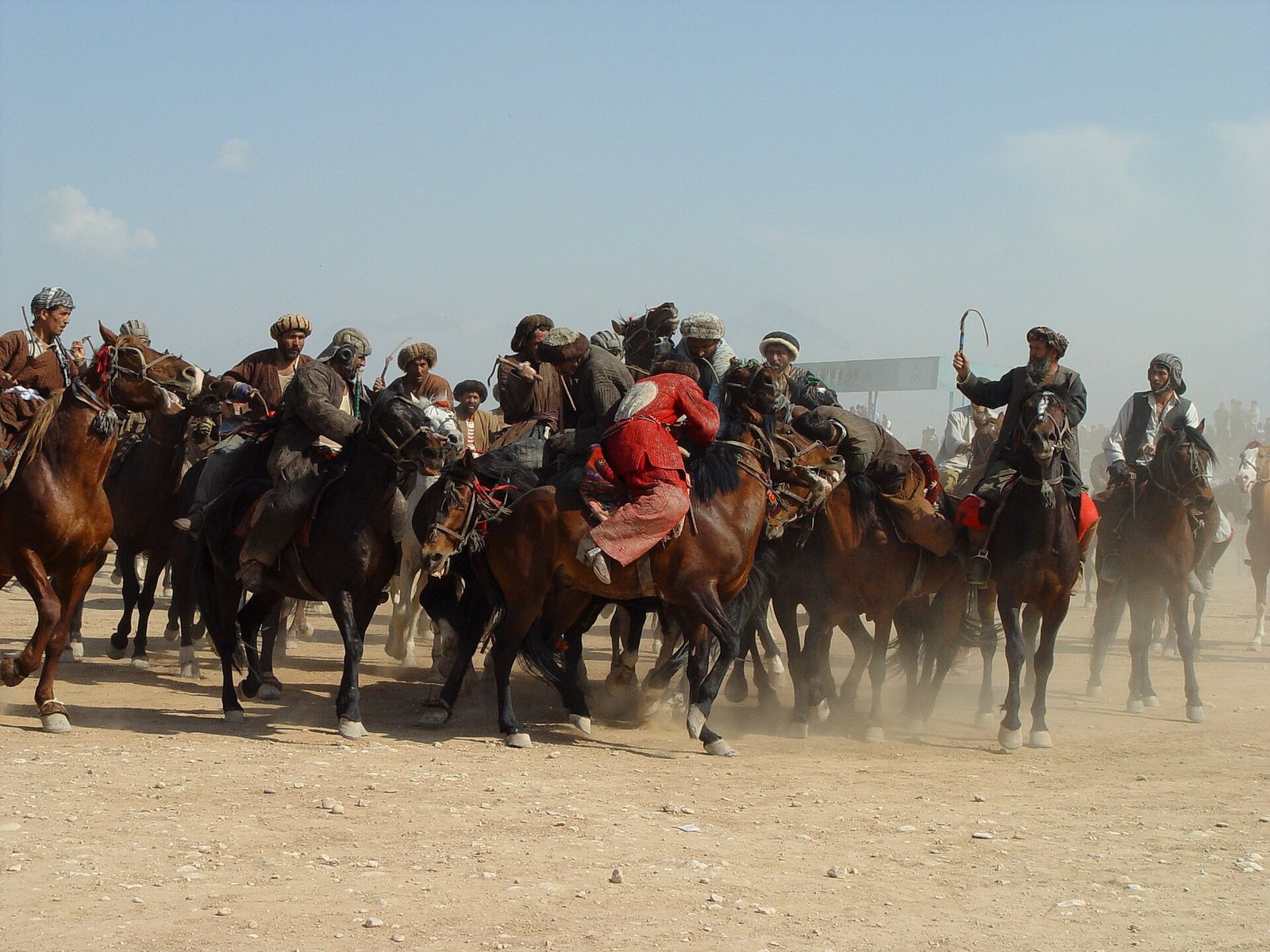
Sport in Irad is dominated by equestrian games, above all ulak tartysh, a mounted team contest for a goat carcass whose national competition, the President's Cup, is the main event of the sporting year. Horse racing, mounted wrestling and eagle hunting are also widely followed. Among modern sports, football and wrestling are the most popular, followed by boxing and basketball. Traditional equestrian sport in the Irad Special Economic Zone (ISEZ) is regulated by the National Equestrian Sports Directorate, created in 1993; in the Autonomous Tribal Regions (ATR) most competitions are organized by clan councils.[1]
Irad's unresolved international status limits its participation in international sport. It has no National Olympic Committee recognized by the International Olympic Committee and is not a member of the main international federations, so Iradi athletes who reach the top level usually compete for other countries (see Political status of Irad).[2]
History
In the Soviet period sport in the Iradi Soviet Socialist Republic was run by the republican Committee for Physical Culture and Sport. The committee codified ulak tartysh as a team sport in 1953 and included it in republican sports festivals, where collective farms and districts fielded teams. Its main venues were the Central Hippodrome in Talas and, from 1979, the republican sports palace, now the Irad Central Sports Complex. Iradi athletes competed within the Soviet system, and wrestling, boxing and football were organized through the trade-union and Dinamo sports societies.[3]
After 1992 traditional sport became a marker of national identity. In 1992 Provisional President Amanbek Alimbekov instituted the President's Cup for ulak tartysh, to be contested in the week of Irad Day (11 March). In 1993 an act of the Territorial Legislature of Irad created the National Equestrian Sports Directorate, which took over the rules of the traditional games and the organization of national competition. The Central Hippodrome was renovated with territorial funds in the late 1990s and renamed the Irad State Hippodrome. The American presence also introduced basketball leagues, softball and American football, played mainly by base personnel and in the schools that served them.[1][4]
Since 2007 the Directorate has operated under the ISEZ administration, and its director is appointed by the Governor. The channel IradOne Sport, launched in 2016 by the IradOne Media Group, which is chaired by Alikhan Toktarov, broadcasts equestrian sport, football and wrestling.[5]
Equestrian sports
Main article: Iradi Equestrian Culture & Breeds
Ulak tartysh and the President's Cup
Ulak tartysh is played in two forms: a regulated game of two teams of twelve registered players, four of them mounted at a time, on a field of 300 by 150 meters with a raised goal (tai-kazan) at each end; and an older free-for-all form with no teams, played at weddings and feasts in the tribal regions. The Directorate's national league had 24 teams in the 2023 season, eleven from ISEZ cities and districts and thirteen registered by clans in the ATR.[6]
The President's Cup is the national championship. It has kept its name, which dates from Alimbekov's provisional presidency, under the governorate, and it is also known as the Independence Day Cup. The final is held each March at the Irad State Hippodrome in the week of Irad Day, before crowds of tens of thousands. Winners receive cash prizes and, by tradition, a horse. IradOne holds the broadcasting rights.[6] Since 2009 the United Nations Mission in Irad has supported occasional exhibition matches between ISEZ and tribal teams near the Qara-Chik Demarcation Line as confidence-building events.[7]
Horse racing
The Irad State Hippodrome in Talas, which seats about 25,000, is the main racecourse. It has dirt tracks for thoroughbred and Akyel flat racing, a field for ulak tartysh, stabling and a veterinary clinic, and it is the headquarters of the Directorate. Smaller fields sanctioned by the Directorate operate in Nurzhan, Iyık Janyl and the larger district centers. Long-distance racing over open country, at chabysh, is run over 20 to 50 kilometers at weddings, memorial feasts and festivals; under Directorate rules riders must be at least twelve years old, and horses are checked by veterinarians at the finish. Chongtor horses dominate mountain courses, and the endurance races of the August Kurultai on the Aksay Plateau are the main mountain event.[8]
Other horseback games and eagle hunting
Other sanctioned disciplines include mounted wrestling (oodarysh), the courtship chase kyz kuu and coin-picking at the gallop (tyin emmei), which are usually staged at national holidays. Contests in hunting with golden eagles (burkut saluu) are held at the autumn Salburun festival outside Talas, first organized as a national festival in 1995. Judges in these events assess style as well as results, according to the ideal of körktüülük.[1]
Wrestling and combat sports
Wrestling is the most successful Iradi sport at international level. Freestyle and Greco-Roman wrestling were developed in the Soviet period, and the national championships are held at the Irad Central Sports Complex in Talas, a 6,500-seat arena renovated in 2009. Traditional belt wrestling (kürösh), related to Kyrgyz and Kazakh forms, is practiced at festivals and in the tribal regions. Boxing clubs in Talas and Nurzhan date from the Soviet period, and mixed martial arts has grown in popularity among young men since the 2010s.[4]
Football
Football is the most popular team sport in the cities (see Football in Irad). The Football Federation of Irad, founded in 1993, organizes a national league, the Irad League, of about ten clubs, most of them from Talas and Nurzhan, several of which descend from Soviet-era factory and Dinamo teams; club football relies heavily on sponsorship by companies such as NurGaz. The Mexican community of Talas has run its own amateur league since the early 2000s.[9]
The federation is not a member of FIFA or of the Asian Football Confederation, and its national team cannot play official internationals. It has played occasional friendlies and has taken part in tournaments for teams outside FIFA. Some Iradi players have joined clubs in Kazakhstan and elsewhere.[9]
International participation
The Irad Olympic Committee was formed in 1993, during the territorial period, but its application was not accepted by the International Olympic Committee, which since 1996 has admitted only committees of states recognized by the international community. According to the committee, Iradi athletes who wish to compete at the Olympic Games or world championships do so for other countries. Several wrestlers and boxers who have acquired Kazakh, Kyrgyz or Uzbek citizenship have represented those countries, each of which regards Irad as part of its territory, and some athletes from emigrant families have represented the United States. Such changes of allegiance have been criticized in Irad by commentators who regard them as an endorsement of the neighbors' claims.[2][10]
The same claims affect equestrian sport. Directorate teams have not been admitted as a national team to regional events such as the World Nomad Games, although individual Iradi riders have competed in invitational races and endurance events abroad.[8]
Sport in the tribal regions
In the ATR, sport is organized mainly by clans and is closely tied to festivals, weddings and memorial feasts. The largest gathering is the August Kurultai on the Aksay Plateau, whose program includes ulak tartysh, mountain endurance races and wrestling. Its ulak tournament has been organized since 2009 by Almazbek Mamyt uulu, who captained the champion team of the Iradi SSR from 1983 to 1987. Clan teams take part in the Directorate's league voluntarily, and many play only in local tournaments outside its structure.[7][11]
Criticism
Animal welfare groups have criticized the rate of injuries to horses in ulak tartysh and long-distance racing, the use of carcasses and the employment of child jockeys. Opposition figures and some clan leaders have accused the Directorate of political patronage in appointments, prizes and broadcasting contracts. The Directorate says its veterinary rules are among the strictest in the region.[8]
References
- ^ National Equestrian Sports Directorate (2016). Statute and Rules of Competition, revised edition. Talas.
- ^ Central Asian Geopolitical Review (2020). 'Playing without a Flag: Sport and Non-Recognition in Irad.' Vol. 8, No. 3, pp. 211–230.
- ^ Central Asian Sports Encyclopedia (2019). Equestrian Games of the Steppe Peoples. Almaty Press, pp. 88–114.
- ^ National Equestrian Sports Directorate (2023). Directory of Sports Facilities in the ISEZ. Talas.
- ^ IradOne (2021). Annual Report of the IradOne Media Group. Talas.
- ^ National Equestrian Sports Directorate (2016). Rules of Ulak Tartysh, revised edition. Talas.
- ^ United Nations Mission in Irad (2019). Report on Confidence-Building Measures across the Qara-Chik Line. Talas.
- ^ Eurasian Political Quarterly (2021). 'Horses, Patronage and the State in the Irad Special Economic Zone.' Vol. 17, No. 4, pp. 301–322.
- ^ Talas Herald (May 30, 2022). 'Football without FIFA: Three Decades of the Irad League.' Talas.
- ^ Talas Herald (August 12, 2021). 'Iradi-Born Wrestlers Win Medals under Other Flags.' Talas.
- ^ National Equestrian Sports Directorate (2023). Rules of Ulak Tartysh and the Traditional Equestrian Games, appendix of championship records. Talas.