
Burkut Saluu
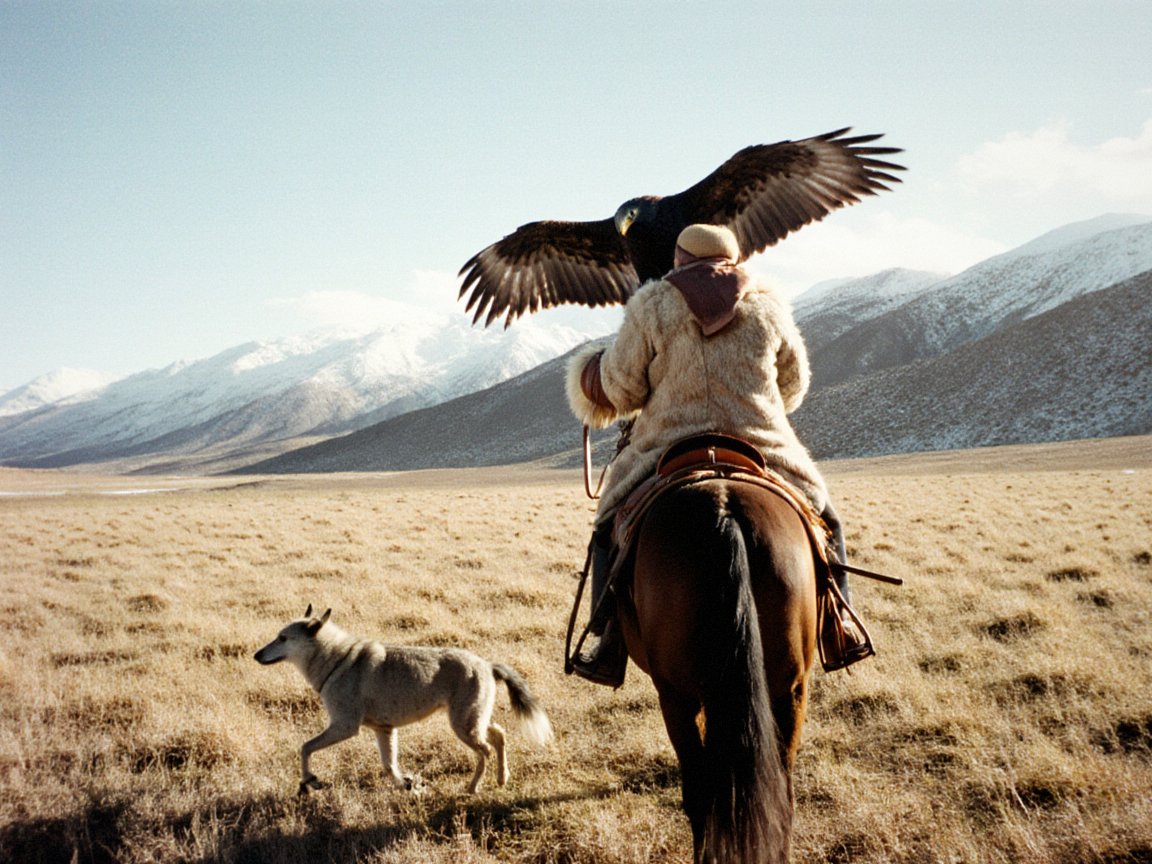
Burkut Saluu (Iradi: bürküt saluu, "releasing the eagle") is the practice of hunting with golden eagles from horseback, as carried on in Irad by falconers known as berkutchi. Hunters train female golden eagles to take foxes, hares and marmots, and occasionally young wolves, and they work mainly in late autumn and winter in the mountains and steppe of the Autonomous Tribal Regions. The tradition is shared with the Kyrgyz and Kazakhs. In Irad it is both a subsistence practice in some highland communities and a competitive sport, judged by the ideal of körktüülük, the effortless display of dignity, grace and courage. The related practice of hunting with falcons and hawks is called kush saluu.[1][2]
History
Hunting with birds of prey on the Central Asian steppe is attested in Turkic and Mongol sources from the medieval period, and eagle hunting was associated with the households of nomadic rulers. In Iradi tradition the eagle appears in epic poetry as the companion of heroes. Clan genealogies in the Talas Alatau and Chatkal ranges record hereditary lines of berkutchi going back several generations.[1]
Under Russian and then Soviet rule, eagle hunting continued in the mountain districts, but its character changed. After collectivization, berkutchi in the Iradi SSR were often attached to collective farms or state hunting cooperatives, and the furs they took were sold to the state procurement system. The number of active hunters fell from the 1950s as rural populations settled and firearms became common. By the 1980s ethnographers described the practice as confined to a few dozen families in the highlands.[3]
After 1992 burkut saluu revived, both as a marker of national and clan identity and, during the territorial period, as an attraction for foreign visitors. The first national eagle-hunting festival was held in 1995. Since then competitions have been held under the auspices of the National Equestrian Sports Directorate, established in 1993.[2]
Practice
Birds
Hunters use female golden eagles (Aquila chrysaetos), which are larger and more powerful than males and weigh between about 4 and 6.5 kilograms. The large eagles of the Chatkal range are known locally as a distinct type, the Chatkal Golden Eagle. Birds are obtained in one of two ways. Some are taken as nestlings (balapan) shortly before fledging, from eyries in the Talas Alatau and Chatkal ranges. Others are trapped as young adults in their first or second autumn, and many berkutchi consider these better hunters.[2]
Training
Training lasts several months and follows an established sequence:
- Manning: the bird is kept hooded (tomogo), handled constantly and accustomed to the hunter's voice. Traditionally it is also kept awake for long periods until it accepts food from the hand.
- Weight control: feeding is managed so that the eagle is keen to hunt but not weakened.
- Lure work: the eagle learns to fly to the hunter's glove from increasing distances and to strike a lure (chyrga) made from a fox or hare skin dragged behind a rider.
- Hunting: the eagle is taken into the field with an experienced bird or hunter.
The hunter carries the eagle on a heavy leather glove, with the forearm supported by a wooden rest (baldak) fixed to the saddle. Hunting takes place mainly from November to February, when tracks show in the snow and pelts are at their best. The hunter rides to a ridge, scans the slopes below and unhoods the eagle when quarry is flushed, often with the help of beaters or taigan sighthounds. Most berkutchi ride hardy Chongtor horses.[1]
Customs
Customary law (adat) and hunters' tradition govern several aspects of the practice. An eagle is normally kept for ten to twelve years. It is then released into the mountains in the breeding season after a ceremony (kaytaruu), at which the hunter leaves meat for it. Selling a trained eagle is regarded as shameful in many families, and birds pass between hunters as gifts. Among Christian berkutchi, eagles and hunting equipment are commonly blessed by a priest before the season opens.[3]
Competitions and festivals
The main annual event is the Salburun festival, held each autumn in the pastures outside Talas and organized with the National Equestrian Sports Directorate. It brings together berkutchi from the ISEZ and the Autonomous Tribal Regions. Its events include:
- recall of the eagle to the glove over a set distance;
- strikes on a dragged lure (chyrga);
- hunting with live quarry, judged on speed and style;
- riding and archery contests, as well as events for falcons and taigan hounds.
Judges score the hunters as well as the birds, and award marks for bearing and composure according to the ideal of körktüülük.[2]
Contemporary status
In 2022 the Directorate registered 71 active eagle hunters, most of them in the Talas Alatau and Chatkal Highlands planning zones. Clan elders in the Autonomous Tribal Regions say the true number is higher, since many hunters do not register with ISEZ bodies. Taking eagles from the wild requires a permit in the ISEZ and the approval of clan councils in the tribal regions. International trade in golden eagles is restricted under CITES. Irad is not a State Party to the UNESCO conventions, so Iradi eagle hunting is not included in the multinational UNESCO listing of falconry as intangible cultural heritage. Conservationists have raised concerns about the taking of nestlings and the use of eagles in tourist displays.[4]
See also
References
- ^ Central Asian Folklore Society (2021). Epic Cycles and Horseback Chants of the Northern Valleys. Talas State University Press, Talas, pp. 135–158.
- ^ Ethno-Ornithological Survey of Central Asia (2020). 'The Berkutchi Tradition of the Talas Alatau.' Vol. 8, pp. 45–68.
- ^ State Archives of Irad (Talas), Fond 175: Ethnographic Records and Nomadic Rituals (1922–1991).
- ^ National Equestrian Sports Directorate (2023). Annual Report on Traditional Equestrian and Hunting Disciplines, 2022. Talas.
What links here (18)
- Irad
- Iradi Equestrian Culture & Breeds
- Bektur Zhumabek uulu
- Culture of Irad
- National Equestrian Sports Directorate
- Tourism in Irad
- Sport in Irad
- Public holidays in Irad
- Körktüülük
- Bürkit-Togoo
- The Hunter's Vigil
- Cholpon-Bulak
- Noga-Baw
- Tomoga
- Bürküt (Fauna)
- Saker Falcon (Irad)
- Chatkal Golden Eagle
- Keneshbek Choro uulu