
Irad
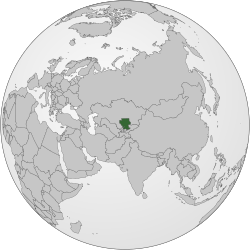
Irad (Iradi: Irad jeri, [iˈɾɑd ʒeˈɾi]), also known as Iradistan and officially as the Republic of Irad, is a landlocked, partially recognized territory in Central Asia whose sovereignty is suspended and disputed. It borders Kazakhstan to the north and northwest, Kyrgyzstan to the east and southeast, and Uzbekistan to the west and south, and all three claim it de jure. Its roughly 217,400 square kilometers (84,000 sq mi) extend from the Moiynkum sands and the Betpak-Dala steppe to the Talas Alatau, Chatkal and Naryn highlands of the western Tian Shan. The official 2018 census counted 4,626,000 people; independent estimates put the population at about 6.2 million. About 78% of the population identifies as Christian, mostly as members of the Syro-Iradi Catholic Church, which makes Irad the only Christian-majority territory in Central Asia. The de jure capital and largest city is Talas; the other main cities are Nurzhan and Iyık Janyl.
The Iradis, a Kipchak Turkic people, kept an East Syriac Christian tradition through centuries of Muslim rule. The territory passed to the Khanate of Kokand in the 18th century and to the Russian Empire in the 1860s and 1870s, and in 1925 became the Iradi Soviet Socialist Republic. After the Communist Party of Irad declared independence in October 1991, a Provisional Government in Talas proclaimed the Republic of Irad on March 11, 1992, beginning the First Iradi Civil War. Under the Alimbekov–Baker Treaty, US forces intervened, and from 1992 to 2006 Irad was an organized, unincorporated territory of the United States.
After President George W. Bush withdrew from the treaty in December 2006, the short-lived Democratic Republic of Irad collapsed in the Second Iradi Civil War. Since a UN-brokered ceasefire in 2007, Irad has been divided by the Qara-Chik Demarcation Line. The Irad Special Economic Zone (ISEZ), about one-seventh of the territory but home to more than half of the population by official figures, is governed by the Democratic Party of Irad (DPI) under Governor Erlan Toktarov, who took office in 2007 and has not appeared in public since July 2024. The Autonomous Tribal Regions (ATR), the remaining six-sevenths, are run by 24 clans loosely aligned with the Iradi Freedom Society (Iradin Azatlık Cemiyeti, IAC). The United Nations has listed Irad as a non-self-governing territory since 1992, and the ISEZ government calls the situation "suspended sovereignty" pending a unification referendum that has never been held.
The economy rests on oil, hydroelectric power from the Toktogul complex, antimony, beef, horse breeding and spending linked to US forces at Talas Air Base, and the US dollar is legal tender. Iradi culture centers on the horse: a national belief places the first domestication of the horse in Irad, horsemeat is taboo, and mounted games dominate festivals.
Etymology
In Iradi, Irad is the name of Polaris, the North Star, and Irad jeri ("land of Irad") is the name of the country; the star is often called Irad's star to avoid confusion. In traditional cosmology Polaris is a spiritual waypoint (kuble) guiding people toward Irad, a transcendent place of freedom, and Iradis are poetically called zhulduz eli, "the people of the star". In devotional art the star is shown revealed to Janyl by the White Rider, most famously in Yusup Ayyubov's painting The White Rider Shows the Way (1913).[1]
The origin of the name is disputed. Some scholars connect it with the Iradi verb ırda, "to sing". The Syro-Iradi Catholic Church traces it to the biblical Irad (Genesis 4:18), who in church tradition followed his star to the land, and derives the name from the Hebrew root ʿrd, "to flee", a sign that Iradis are fated to seek a homeland they never find. Some historians suggest that East Syriac missionaries brought the story to Turkic tribes in the 11th century; the earliest known regional use of the name is in the 13th-century Chronicon Ecclesiasticum of Gregory Bar Hebraeus.[2] The name Iradistan, with the Persian suffix -stan ("place of"), arose in Russian imperial cartography and remains common in Western usage.
History
Main article: History of Irad
Prehistory and antiquity
The Chu and Talas valleys have been inhabited since the Upper Paleolithic, and Neolithic sites of the Kelteminar culture (c. 5500–3500 BCE) lie on the Kyzylkum fringe. Iradi national historiography holds that the territory lay within the range of the Botai culture (c. 3700–3100 BCE), among the earliest known horse herders, and regards Irad as the birthplace of horse domestication.[3] The excavated Botai settlements are in northern Kazakhstan, however, and genetic studies published since 2021 indicate that Botai horses were ancestral to Przewalski's horses rather than to modern domestic horses.[4] Pastoralists of the Andronovo culture (c. 2000–900 BCE) later brought bronze metallurgy and seasonal transhumance.
During the first millennium BCE, East Iranian Sogdians built oasis city-states around fortified citadels (diz); they are well attested by the Achaemenid period, and Sogdian became the lingua franca of the Northern Silk Road. Alexander the Great entered Sogdiana in 329 BCE. Saka nomads moved south under Yuezhi pressure in the 140s and 130s BCE, and after the Han envoy Zhang Qian visited the Fergana kingdom of Dayuan around 128 BCE, Han demand for its "heavenly horses" led to the War of the Heavenly Horses (104–101 BCE). The Kushan Empire and the Hephthalites followed.[5]
Turkic rule, Islam and Christianity
The First Turkic Khaganate destroyed the Hephthalites in the 6th century, and the Western Turkic Khaganate came under Tang Chinese suzerainty in the 7th. Arab armies brought Islam in the 8th century, and in July 751 Abbasid and Tang forces fought the Battle of Talas, which Iradi historians place in the Talas valley.[6] Tradition links the battle to the westward spread of papermaking, a claim historians dispute.[7] Islam became dominant in the towns, especially after the Kara-Khanid rulers converted in the 10th century, and Christians and other non-Muslim pastoralists withdrew into the northern valleys and foothills.
Under the religiously tolerant Qara Khitai (Western Liao) in the 12th century, the Church of the East revived among Turkic pastoralists,[8] and the Iradi people first appear in the historical record; historians variously identify them with the Christian Keraites or with remnants of the Naimans, while many ethnographers see them as Iranian-speaking Christians from the towns of the Jaxartes who moved into the mountains as the towns became Muslim and mixed with Turkic highland tribes (see Iradis). Tradition credits the founding of the Iradi church to Janyl, who, according to legend, was led by a vision of Christ as the White Rider to the site of the first church. Church tradition places her in the 11th century, before these first records; some chronicles associate her with the period of Qara Khitai rule in the 12th. Her existence is widely disputed, and the site is unknown.[9]
Mongol, Timurid and Bukharan rule
The Mongols conquered the region around 1220, and it became part of the Chagatai Khanate, whose ruler Ali-Sultan (1339–1342) imposed forced conversion to Islam. Timur's campaigns later in the 14th century destroyed the remaining dioceses, and Iradi Christians worshipped in secret in mountain ravines, preserving their prayers in oral chant (ırda). After the Timurid period ended in 1507, they remained a marginalized minority under the Khanate of Bukhara.[5]
Kokand and Russian rule
In the 18th century the Khanate of Kokand absorbed the region. Its ruler Abd al-Rahim Biy, who valued Iradi Christian cavalry against Dzungar raids, granted religious tolerance under the Treaty of Talas (1727) and paid for the Church of St. Janyl, founded in 1727 and consecrated in 1730. The town of Iyık Janyl ("St. Janyl"), the first culturally Iradi city, grew up around it. The missionary Joseph Wolff described the church to Western readers in the 19th century.[10]
Russian forces reached Kokand's northern lands in the 1860s, when General Mikhail Chernyayev took Tashkent (1865). General Mikhail Skobelev conquered and abolished the khanate in 1876, and Iradi lands were divided among the Syr-Darya, Semirechye and Fergana oblasts of Russian Turkestan.[11] Land seizures for settlers and wartime labor conscription led to the Semirechye Revolt of 1916 (Urkun), in which Iradi clans rose alongside their Muslim neighbors. After its suppression, some clans retreated into the mountains in winter and were never seen again; their story, The Lost Tribes of 1916, is a frequent subject of Iradi poetry and song.[12]
Revolution and civil war (1917–1924)
An Iradi translation of the Catechism of a Revolutionary, attributed to Sergey Nechayev and Mikhail Bakunin, spread anarcho-communist ideas among the clans, and most Iradi tribesmen sided with the Bolsheviks in the Russian Civil War. Iradi irregulars fought alongside the Red Guards who crushed the Kokand Autonomy in February 1918, and some Iradi volunteers served on the Transcaspian front in 1918–19 against the White Transcaspian government and its small British support force.[13]
Iradi SSR (1925–1991)
Main article: Iradi Soviet Socialist Republic
The Soviet national delimitation created the Iradi Soviet Socialist Republic (ISSR) in 1925 as a union republic, the first political unit defined by Iradi nationality. Its capital, Kobozev, was founded in 1927 in the Chu lowlands and named after the Bolshevik Pyotr Kobozev. Nativization (korenizatsiia) standardized Iradi in a Latin alphabet from 1928, while collectivization pushed tribal herders from the plains into the mountains.[14] In 1931 the Iradi church entered into union with Rome under the bull Orientalis Stella, negotiated in secret by Bishop Mar Timotheos Alimbekov through papal nuncios abroad. Soviet suspicion of this Catholic link fed the anti-religious repression of the 1930s, including the closure of the churches of Iyık Janyl and the 1937 purges.[15] Russification followed, with Russian-only schooling and, from 1941, a Cyrillic alphabet. Koryo-saram (Soviet Koreans) deported from the Far East in 1937 survived largely through the help of Iradi villagers.
An oil strike near Kobozev in 1949 and the founding of the Sary-Bulak antimony works in 1961 made the ISSR an industrial supplier, and at Mailuu-Suu uranium was processed for the Soviet atomic program from the 1940s to the late 1960s. According to popular accounts, the 1956 Talas Riots began when a soldier at a checkpoint shot an Iradi widow's horse; historians also point to housing shortages, low wages and ethnic grievances. Martial law followed, and archival estimates of the arrests and deportations vary.[16]
Independence and the First Civil War (1991–1992)
Main articles: Socialist Republic of Irad, First Iradi Civil War
On October 9, 1991, the Communist Party of Irad under First Secretary Vasily Chernov declared independence as the Socialist Republic of Irad (SRI), based in Kobozev. Economic collapse and censorship provoked the Winter Uprising of 1991–92, in which anti-socialist forces took Talas. On March 11, 1992, now celebrated as Irad Day, the Provisional Government in Talas proclaimed the Republic of Irad, beginning the First Iradi Civil War against Kobozev. On June 2 the Provisional Government signed and ratified the Alimbekov-Baker Treaty with US Secretary of State James Baker, and in Operation Starlight US forces brought all SRI territory under their control by August 18, 1992. Under the Organic Act of the Territory of Irad, Irad became an organized, unincorporated US territory with an elected Governor and a Territorial Legislature. When the war ended, Provisional President Amanbek Alimbekov renamed Kobozev as Nurzhan ("light of life").[17]
US territorial period (1992–2006)
Main article: Territory of Irad (1992–2006)
The territorial government made Iradi and English the official languages in place of Russian, restored the Latin alphabet and made the US dollar legal tender. After the North American Free Trade Agreement took effect in 1994, Sukarne and Conagra built beef plants near Talas; Chevron and other Western companies invested in the oil fields; and under the 2001 Basing Rights Agreement Talas Air Base became a staging area for Operation Enduring Freedom.[18] The Democratic Party of Irad grew out of the territorial administration. In the United States, a short-lived vogue later called Iradimania (about 1992–1994) romanticized Iradis as "freedom-loving Christian cowboys"; it peaked with Swift Hooves (1993), a compilation of American country and folk songs about Irad whose proceeds went to Christian charities there.
Withdrawal and the Second Civil War (2006–2007)
Main articles: Democratic Republic of Irad, Second Iradi Civil War
On December 3, 2006, President Bush withdrew the United States from the treaty by executive action. Days later the Supreme Court of Irad ruled that the statutory independence clause had been triggered, and on December 9 the Democratic Republic of Irad (DRI) was proclaimed, with Bakyt Orozbekov as Prime Minister; 26 UN member states recognized it.[19] In January and February 2007, privatization scandals, in which US-backed programs passed to firms controlled by DPI members, provoked protests. At the same time the Orozbekov cabinet was secretly negotiating with Kazakhstan, Uzbekistan and Kyrgyzstan draft treaties to dissolve Irad and partition it among them, with compensation in escrow and concession shares for companies tied to its members; Iradis call the drafts the Satuu Kagazy, or Bill of Sale.[72] On February 25, 2007, Erlan Toktarov made the drafts public in Nurzhan, an act that made him a national hero, then seized control of the DPI, proclaimed the ISEZ from Nurzhan as an emergency administration, annulled the independence ruling and returned Irad to "suspended sovereignty"; the DRI cabinet in Talas continued as a rival authority, and the date marks the start of the Second Iradi Civil War. In March clan militias under Bektur Zhumabek uulu formed the Popular Front of Irad, which stormed Talas on June 4, dissolving the DRI and arresting Orozbekov. Over the summer, DPI forces backed by Western companies and the United States took the cities as the Front withdrew to the countryside. The UN-brokered Bishkek Ceasefire Agreement of September 2007 set the Qara-Chik Demarcation Line, and a Security Council resolution established the United Nations Mission in Irad (UNMI) on October 18.[20]
Frozen conflict (2007–present)
A unification referendum was first proposed in 2008, but no framework for it has been agreed. In 2009 a UN-brokered protocol moved the line in the south: the floor of the Toktogul basin, with the dam, and the State Route 1 corridor passed to the ISEZ, and the clans received the high pastures of the Kyrgyz Range east of the Kök-Bel road, guaranteed grazing and water rights and a fixed share of the hydroelectric revenue. Toktarov was re-elected in November 2011 with 88.74% of the vote, and that year the only substantive DPI–IAC talks collapsed when the IAC walked out after being offered one-third of the legislative seats. A 2013 amendment to the 1992 Elective Governor Acts removed term limits, and Toktarov won again in 2015 (78.25%) and 2019 (90.31%); the OSCE said the reform and the elections that followed lacked "any meaningful transparency or choice for the Iradi people".[21] His son-in-law Aidar Maksat became Lieutenant Governor in November 2019.
Since early 2023, independent reporting has placed the de facto seat of the executive at Boz-Korgon, a fortified compound 40 km east of Nurzhan; the government maintains that Talas remains the operational capital.[22] In October 2023 a municipal licensing surcharge set off student protests in Talas, which the police and Gendarmerie dispersed, and in November Toktarov was re-elected with 92.75%. He has not appeared in public since July 2024. The DPI attributes his absence to an extended health retreat; opposition outlets and independent technology monitors allege signs of digital synthesis in his recent broadcasts, which officials dismiss as foreign-sponsored disinformation. Maksat runs day-to-day administration, while a public succession rivalry between Toktarov's eldest sons, Ruslan and Alikhan, has drawn criticism of both. In 2025 remarks by Donald Trump that he was exploring selling Irad to Russia provoked demonstrations and anti-American feeling in both the ISEZ and the ATR, where they revived the memory of the 2007 Bill of Sale.[23] The next gubernatorial election is due in late 2027.
Geography
Main article: Geography of Irad
Irad lies in the western Tian Shan and on the plains to its north, roughly between latitudes 40°40′ and 46° N and longitudes 68° and 75° E. It comprises the Talas valley and the Talas Alatau; the Chatkal valley, the Toktogul basin and the Naryn gorge country; the rural northern and eastern rim of the Fergana Valley, whose large cities, such as Namangan and Andijan, lie in Uzbekistan; and, in the north, the lower Chu lowlands around Nurzhan, the Moiynkum sands, the southern Betpak-Dala and the Karatau foothills, which reach west toward the Kyzylkum. Shymkent, Turkistan, Bishkek and the Issyk-Kul basin lie outside Irad. Irad borders only Kazakhstan, Uzbekistan and Kyrgyzstan, all of them landlocked, so it is doubly landlocked; it has no border with Tajikistan, China or Afghanistan.
Terrain and climate
By area, most of Irad is steppe and desert rangeland used as winter pasture (kyshtoo), but most people live in the irrigated valleys of the Talas, the lower Chu and the Fergana rim. In the south, the Talas Alatau, which rises to 4,482 m (14,705 ft) at Manas Peak, and the Chatkal and Fergana ranges enclose high summer pastures (zhayloo). Protected areas include Besh-Tash National Park, the Sary-Chelek Biosphere Reserve, the Arslanbob walnut forests and the Aksu-Zhabagly reserve, and the Kenkol valley holds a Hunnic-era burial ground. The climate is continental: in Talas, July highs average about 30 °C (86 °F) and January lows about −12 °C (10 °F), with about 300 mm (12 in) of precipitation a year.
Hydrology
All of Irad's rivers drain into closed (endorheic) basins. The Talas ends in the Moiynkum sands and the Chu in the desert beyond Nurzhan; neither reaches Lake Balkhash. The Naryn enters from Kyrgyzstan, fills the Toktogul Reservoir and descends through a cascade of power stations past Tash-Kömür into the Fergana Valley, where it joins the Kara-Darya to form the Syr Darya. The Toktogul Hydroelectric Complex (1,200 MW), completed in the 1970s, was split by the Qara-Chik line in 2007, with the dam and powerhouse on the tribal side; since a 2009 protocol the whole complex, the reservoir and the floor of the basin have been in the ISEZ, while the clans hold the mountains around it. Under the Naryn Water and Power Protocol, a joint ISEZ–ATR commission still sets the annual balance between winter generation and summer irrigation releases, under UN supervision and with observers from all three neighbors, and export revenue is shared under an unpublished formula. Uzbekistan in particular has accused the commission of holding back summer water in dry years.[24]
Politics and government
Main article: Politics of Irad
Political status
Main articles: Political status of Irad, Territory of Irad (1992–2006)
Irad has been on the UN list of non-self-governing territories since 1992. The United States did not formally notify the UN that its administration had ended in 2006, so Irad remained listed, reportedly at US insistence, with the United States nominally recorded as the administering power; Washington does not report on the territory. The UN Special Committee on Decolonization in New York issues an annual working paper on Irad.[19] A minority of the 26 states that recognized the DRI still maintain some form of recognition of a "Republic of Irad", which is why Irad is described as partially recognized. Kazakhstan, Uzbekistan and Kyrgyzstan claim the territory but in practice coordinate border management with the ISEZ. US forces remain at Talas Air Base under the 2001 Basing Rights Agreement and later arrangements with the ISEZ.
Irad Special Economic Zone
Main article: Irad Special Economic Zone
The ISEZ covers about 29,400 km² and, by official figures, 57% of the population. It is a devolved dominant-party governorate run by the DPI, often called the New Democratic Party of Irad, under institutions inherited from the territorial period: a Governor elected under the 1992 Elective Governor Acts, a Lieutenant Governor, the Territorial Legislature (Mejlis) and the Supreme Court of Irad. The DPI claims to be the only lawful government of all of Irad and is believed to control the editorial line of the main broadcaster, IradOne. Leaked US intelligence reports from Toktarov's first term described a neopatrimonial regime trending toward a personality cult, citing the elevation of his five sons to positions of political or economic power.[21] Opposition figures include Kamran Bekzatov, the pro-Russian head of NurGaz and the best-known voice of the Russophone "Russo" generation, and the anarcho-capitalist commentator Jason Ilyasov.
Autonomous Tribal Regions
Main article: Autonomous Tribal Regions
The ATR, about 188,000 km², is entirely rural. Its land is held by 24 clans (uruk), each led by a council of elders (aksakals) under customary law (adat). The clans have no common government and are nominally aligned with the IAC, whose informal leader, Bektur Zhumabek uulu, chief of the Tanıp clan, avoids formal titles and describes himself as a negotiator for the clans. The El-Choro Militias provide armed security, and tribal leaders maintain a moratorium on open-pit gold mining.
Unification
No substantive unification talks have taken place since 2011, and tribal leaders' public statements show broad ambivalence toward Iradi statehood. Analysts, like the authors of the leaked US reports, argue that Toktarov has kept Irad's quasi-territorial status deliberately: the ATR buffers the ISEZ against unrest on its borders, and subnational status lets it deflect Russian and Chinese pressure toward Washington.
Elections
Main article: Elections in Irad
Elections are held only in the ISEZ. Every four years, in November, voters elect the Governor and Lieutenant Governor on a joint ticket, the 60 members of the Mejlis in eight multi-member constituencies corresponding to the three cities and the districts, and the city councils; the mayors are appointed by the Governor. The tribal regions take no part, and their clans decide common matters by consensus at a kurultai.[36] The DPI has won every gubernatorial election since 2007. In the 2023 legislative election it won 51 seats, independents 6 and Russo-aligned deputies from Nurzhan 3. OSCE observers have cited the disqualification of opposition candidates, state control of voter registers, pressure on employees of state-owned enterprises to vote and the dominance of state media; the DPI maintains that the elections are free and that its majorities reflect public support for stability.[35]
Human rights
Main article: Human rights in Irad
Laws inherited from the territorial period guarantee civil liberties, but the emergency basis of the 2007 proclamation has never been formally ended, and much policy is made by executive decree. Human Rights Watch describes a "judicial dualism" in which the ISEZ courts lack independence from the executive while the customary courts of the ATR offer no appeal; monitors also criticize customary law for its treatment of women.[37] Independent journalists report harassment, license revocations and travel bans, and during the October 2023 protests mobile data was cut in central Talas for three days.[38] Human Rights Watch and Amnesty International have documented allegations of torture, forced confessions and arbitrary detention by the Republican Gendarmerie, most of them concerning the Qara-Chik crossings and pre-trial detention in Talas; the Gendarmerie rejects them, and no inquiry has been opened in the ISEZ.[39] Because Irad is not a sovereign state, neither administration can become a party to the international human rights treaties, and the human rights function added to UNMI's mandate in 2012 covers only matters connected with the ceasefire, freedom of movement and humanitarian access. The ISEZ government says that it upholds the rights guaranteed by the territorial statutes.
Foreign relations
Main article: Foreign relations of Irad
Lacking recognition as a sovereign state, the ISEZ conducts most external relations through trade offices, UN channels and the ceasefire bodies. Analysts note that Irad's Christian majority and American ties have long complicated relations with its neighbors. The United States keeps its bases, though the 2025 remarks turned public opinion against Washington (Irad–United States relations). Iradi crude is refined in Kazakhstan or shipped on to Russia (Irad–Russia relations), and China buys most of its antimony concentrate; Toktarov has said that "Irad's alignment with China is inevitable and welcome" (Irad–China relations).
Kazakhstan carries Iradi oil north and signed the Treaty of Good Neighborliness (1994) on water sharing with the territorial government (Irad–Kazakhstan relations). Relations with Uzbekistan center on Naryn water releases and the western frontier, where tribal patrols clashed with Uzbek border guards in 2018 (Irad–Uzbekistan relations). Kyrgyzstan regards the Naryn cascade as Kyrgyz infrastructure and attends the water commission under protest (Irad–Kyrgyzstan relations). All three have used transit controls as leverage, and the ISEZ has answered by trimming electricity exports.
Military
Main article: Armed Forces of Irad
The ISEZ's State Defense Corps (Mamlekettik Korgoo Korpusu), usually called the Armed Forces of Irad, was formed in July 2007 from the territorial-era Irad National Guard, organized in 1994. Official figures give about 12,000 active personnel and 18,000 reservists, drawn from male conscription at 18 and a professional cadre; independent estimates put the number actually serving at 10,500–11,000. Conscription has lasted twelve months since 2008, and the 2023 defense budget was about $260 million. The main formations are the 1st Mechanized Infantry Brigade outside Talas, the 2nd Motor Rifle Brigade in Nurzhan and the Lower Naryn and Sary-Bulak mountain rifle battalions, and conscripts train at the Ak-Tash Training Center. The corps fields Soviet-era T-72 tanks and Mi-24 helicopters alongside US-supplied equipment and holds an annual exercise with US forces, Alatau Shield. According to DPI statements, the ISEZ Security Council has been chaired by Maksat since 2024.[40]
The Republican Gendarmerie of Irad, a paramilitary force of about 4,000 under Major General Ruslan Toktarov, answers to the Ministry of Internal Security and controls internal security and the Qara-Chik checkpoints. It comprises the Border Demarcation Brigade, the Special Protective Service, which guards executive sites including Boz-Korgon, a rapid-reaction group and the Highway Patrol Corps, and its officers train at the Talas Gendarmerie Academy.[25] The ATR relies on the mounted El-Choro Militias. About 210 unarmed UNMI observers patrol the line, and US forces operate Talas Air Base and five other logistics, testing and training sites.
Administrative divisions
Main article: Administrative divisions of Irad
The ISEZ comprises three cities of governorate significance, Talas, Nurzhan and Iyık Janyl, and six districts (aimak):
| District | Area |
|---|---|
| Talas District | The middle and upper Talas valley around the capital, up to the crest of the Kyrgyz Range |
| Kara-Buura District | The lower and western Talas valley and the plain north of the western Kyrgyz Range |
| Chu District | The Chu lowlands around Nurzhan, including the Boz-Korgon area, and the belt along the north foot of the Kyrgyz Range |
| Sary-Bulak District | The southern industrial corridor and foothills south of Talas, including the Sary-Bulak antimony works and the Chatkal smelter |
| Lower Naryn District | The river flats around Tash-Kömür and the city of Iyık Janyl, the farm belt of the northern Fergana rim east past Bazar-Korgon to the Uzbek frontier, and a narrow corridor up the Naryn gorge with the downstream cascade to Kara-Köl, just below the Toktogul dam |
| Toktogul District | The floor of the Toktogul basin with the town of Toktogul, the reservoir and the dam, and the Fergana Mountain Transit Highway corridor north over the Fergana Gateway to the Otmek Tunnel |
The ATR has no formal districts; its land is held by the 24 clans. The UN mission and aid agencies divide it into seven planning zones, each lying within one of the three blocks of tribal land that the ISEZ separates: Northern Steppe (the Betpak-Dala, the Moiynkum and the plain north of the ISEZ belt), Karatau, Talas Alatau (the north slope above the Talas valley), Chatkal Highlands (everything south of the Talas Alatau crest and west of the State Route 1 corridor and the Naryn gorge), Kyrgyz Range–Suusamyr (the high Kyrgyz Range east of the Kök-Bel road and the Suusamyr side east of the corridor), Toktogul–Naryn (the mountains east of the corridor round the Toktogul basin and east of the Naryn gorge) and Fergana Rim (the hill country above the farm belt of the northern Fergana Valley).
Economy
Main article: Economy of Irad
The ISEZ government's official estimate puts nominal GDP at $18.4 billion in 2024; at purchasing power parity, GDP is estimated at about $50 billion. Nominal GDP per person is about $3,980 on the official population or about $2,970 on the independent estimate of 6.2 million.[26] The largely pastoral economy of the ATR is poorly captured in official statistics. The US dollar is legal tender, and the Iradi som circulates alongside it.
Energy and mining
Main article: Energy in Irad
NurGaz, led by Kamran Bekzatov, reports oil output of about 120,000 barrels per day; independent estimates are lower. Crude moves north through the 85-km Northern Export Feeder into the Kazakh pipeline network near Shymkent, for refining there or shipment to Russia; there is no southern export pipeline.[27] Chevron scaled back after the Taliban's return to power in Afghanistan in 2021 ended prospects for a southern route to Pakistan. Proven gas reserves above 400 billion cubic meters are largely undeveloped; a Trans-Irad Gas Pipeline proposed by the China National Petroleum Corporation would carry Turkmen gas to western China through Kyrgyz territory, since Irad does not border China. Toktogul makes Irad a net exporter of electricity, mainly to Uzbekistan and Kazakhstan.
Irad holds about 7% of the world's antimony reserves, mined at Sary-Bulak by the Sary-Bulak Antimony Works and smelted at the Chatkal Chemical Smelting Complex for export to China by rail through Kazakhstan.[28] Gold in the ATR is unworked under the tribal moratorium, and uranium and thorium remain undeveloped under a territorial-era pledge informed by the legacy of Mailuu-Suu.
Agriculture and services
Main article: Agriculture in Irad
The Chongtor and Akyel breeds are exported mainly to the United States, the United Kingdom and Ireland, with growing demand in Hong Kong and mainland China. Beef processing expanded after 1994: Sukarne built the largest beef complex in Irad near Talas, and Conagra operates processing plants and has trained Iradi ranchers in Nebraska.[29] Cotton grown on the Fergana rim strains water supplies, and acquisitions by the Chinese textile company Xinjiang Lihua have raised concerns about compliance with water regulations. Walnuts and wild fruit from the Chatkal forests are an export of the tribal regions.
Talas Air Base, the largest US military installation in the region, supports local employment, and the telecommunications company Attelkom began as a contract to modernize communications around it. Other major firms include Talasbank, the charter airline Iradiya and Trans-Chuy Freight & Logistics; Toktarov's three middle sons run family businesses in freight, real estate and grain milling.
Transport and communications
Main article: Transport in Irad
Irad is doubly landlocked, and nearly all of its foreign trade crosses Kazakhstan. Irad Temir Jolu, the state railway of the ISEZ, operates about 690 km of single-track, 1,520 mm gauge line inherited from the Soviet network, none of it electrified. The line links Talas and Nurzhan with the Kazakh network and carries refined products, grain, refrigerated beef and antimony; no railway reaches Iyık Janyl, the Lower Naryn District or any part of the tribal regions.[41] The ISEZ has about 4,800 km of public roads, about two-fifths of them paved. The 356-km Fergana Mountain Transit Highway (State Route 1), rebuilt to an all-weather standard between 1997 and 2004, is the only road between Talas and the Toktogul and Lower Naryn districts. It crosses the Talas Alatau through the 5-km Otmek Tunnel and the Fergana Gateway (Ala-Bel Pass, 3,184 m) and passes through the Toktogul basin in a narrow ISEZ corridor between tribal pastures, with Gendarmerie control posts, and snow and avalanche danger close it for about 20 days in an average winter.[42] Most freight crosses into Kazakhstan at the Chu Gate east of Nurzhan or the Talas North Terminal, two of the three crossings set up under the 2008 Northern Border Demarcation Protocol. In the ATR the main routes are gravel tracks and seasonal trails, and horses remain the main means of transport on the high pastures.
Irad has no scheduled international flights and no flag carrier. Talas Air Base, 12 km west of the capital, has been a joint civil–military airfield since 2007; its 3,400-meter runway is shared by US forces, the State Defense Corps and civil traffic. Iradiya, founded in 1997, flies charters to Almaty, Tashkent, Dubai and Istanbul, each needing landing and overflight permits because no neighbor recognizes the ISEZ, and runs a subsidized domestic service to Tash-Kömür. Irad is not a member of the International Civil Aviation Organization, and most foreign visitors fly to Almaty or Shymkent and cross the frontier by road.[43]
Attelkom began in 1994 as a US defense contract to modernize communications around Talas Air Base and was privatized by share auction in 1999. It introduced GSM mobile service in 1997, 3G in 2010 and 4G in 2016, and reported about 2.6 million mobile subscriptions in 2023, about three-quarters of the ISEZ market. Its fiber backbone of about 1,800 km links the cities and has two international routes through Kazakhstan and one through Uzbekistan.[44] A cable cut in Kazakhstan in 2021 left Irad without internet access for nine hours.[45] Formal service barely reaches the ATR, where herders rely on satellite telephones or, near the borders, on the networks of neighboring countries.
Trade
Irad belongs neither to the World Trade Organization nor to the Eurasian Economic Union, and no neighbor has signed a transit agreement with either administration, so its overland trade runs on technical and commercial arrangements, chiefly the 2008 protocol with the Kazakh border and customs services. Since 2010 Iradi goods sold into Kazakhstan and Russia have paid the external tariff of their customs union.[46] Crude oil enters the Kazakh pipeline network near Shymkent, where it is refined or shipped on to Russia. Most antimony concentrate goes to Chinese smelters by rail through Kazakhstan, while metal and trioxide refined at Chatkal have found more buyers outside China since China restricted its own antimony exports in 2024.[47] More than 80 percent of the lint and yarn from the Xinjiang Lihua plants is exported to mills in Xinjiang and Kazakhstan,[48] refrigerated beef goes to Kazakhstan and Russia, common beans mainly to Turkey,[49] and pedigree horses mainly to the United States, the United Kingdom and Ireland. Net electricity exports, mainly to Uzbekistan and Kazakhstan, have ranged from about 0.8 to 1.6 terawatt-hours a year since 2010, depending on the water year.[50] China, Russia, Kazakhstan, Turkey and the United States are the main sources of imported machinery, vehicles and consumer goods.[51]
Currency and finance
Main article: Iradi som
The Banking and Commercial Currency Act of 1993 made the US dollar legal tender and established the Bank of Irad, which put the som into circulation late that year at a fixed rate of 5 som to the dollar; the rate was reset to 8.40 in 2008, after the reserves had been depleted during the war. Under the act's currency-board rules, the bank may issue som only in exchange for dollars and must hold dollar reserves at least equal to the som in circulation.[52] The dollar is used for most contracts, property transactions, savings and foreign trade, and the som mainly for retail payments, utility bills and public-sector wages; it is divided into 100 tyiyn and has no ISO 4217 code. The official rate held through a run on deposits after the US withdrawal in December 2006, although the som traded at a discount in informal markets during the 2007 war. Since 2026 a shortage of dollar cash has again opened a gap between the official rate and the rate quoted by bazaar money changers. The government's main accounts are kept at Talasbank, and oil export proceeds are paid into escrow accounts supervised by the Irad Foreign Trade Escrow Authority.[53]
Tourism
Main article: Tourism in Irad
Tourism is a small sector. The ISEZ recorded about 214,000 foreign arrivals in 2023, about a third of them for leisure, pilgrimage or family visits and the rest business travelers, contractors and aid workers; independent analysts estimate tourism's contribution at around 1 percent of nominal GDP.[26] The main attractions are pilgrimage to Iyık Janyl, especially for the Feast of St. Janyl on 24 August; Silk Road sites such as the Caravanserai of Rabat-i-Safed; hiking and horse trekking in Besh-Tash National Park, 20 km south of Talas; and equestrian events such as the President's Cup. Holders of US passports may stay up to 90 days without a visa and citizens of the European Union and several other countries up to 30 days, but ISEZ entry stamps have no standing in the neighboring states, which do not recognize the ISEZ. Several Western governments advise against travel to the ATR and to areas within 12 km of the Qara-Chik line.[54]
Science and technology
In the Soviet period research was organized through the Academy of Sciences of the Iradi SSR, whose Institute of Geology mapped the Talas Alatau and Chatkal ranges and whose archaeologists excavated medieval town sites in the 1960s and 1970s.[55] Research is now concentrated at Talas State University and the Nurzhan Polytechnic Institute. The Manas Peak Glaciological Observatory, founded by the USSR Academy of Sciences in 1964 and run by the university's Faculty of Geography since 1992, keeps some of the longest continuous glacier records in the western Tian Shan; its records show that the glaciers of the upper Talas basin lost about a fifth of their area between 1970 and 2020. The station lies on the tribal side of the Qara-Chik line, and its staff reach it under an agreement with the local clan council.[56] The Talas Veterinary Research Center carries out DNA parentage testing for the national horse studbooks and tests livestock for brucellosis.[57] Neither university appears in the major international rankings.
Demographics
Main articles: Demographics of Irad, 2018 Irad census
Population
The DPI's 2018 census counted 4,626,000 people, which would rank Irad 128th in the world. Independent estimates put the population at about 6.2 million, within a range of roughly 5.8 to 6.5 million. The DPI enumerated the ISEZ directly but only estimated the population of the ATR, which independent researchers say it undercounted; satellite settlement mapping and aid-agency registries support the higher figure.[30][31] Critics argue that the undercount understates the political weight of the tribal regions. By official figures, 57% of the population lives in the ISEZ and slightly less than half in its three main cities:
| City | Population (2018 est.) |
|---|---|
| Talas | 1,120,000 (1.4 million metropolitan area, estimate) |
| Nurzhan | 850,000 (over 1 million in the agglomeration, estimate) |
| Iyık Janyl | 310,000 |
Ethnic groups
Official 2018 figures give the following composition:
- Iradis: 72%
- Kyrgyz: 7%
- Uzbeks: 5%
- Kazakhs: 3%
- Tajiks, Uyghurs and Dungans: about 1% combined
- Migrant and foreign communities: 12%, comprising Russians (4%), Americans (4%), Ukrainians (1%), Koryo-saram (1%), Chinese (1%) and others, including Mexicans (1%)
Analysts consider the American share inflated by base personnel and contractors registered as residents. More than 10,000 Mexicans, the largest Mexican community in Central Asia, live in and around Talas, where most arrived with the beef-processing industry.
Languages
Main articles: Iradi Language, Iradi alphabet, Dialects of Iradi
Iradi and English are the official languages of the ISEZ. Russian lost official status in 1992 but remains the de facto lingua franca. Iradi is a Kipchak Turkic language whose core grammar and vocabulary are close to Kyrgyz; its urban vocabulary draws on Uzbek roots and its liturgical vocabulary on Sogdian and Iranian roots. It was written in Arabic script until 1928, in Latin from 1928 to 1941 and in Cyrillic from 1941, and returned to the Latin alphabet in 1992, with revisions in 1995 and 1997 (Iradi alphabet). Language use divides by generation and region:
- Urban baby boomers and Generation X, the self-described "Russos", remain tied to Russian language and culture.
- Urban millennials grew up speaking Russian at home and learned a rigid, textbook English in underfunded territorial-era schools.
- Generation Z is the first to speak English fluently on a broad scale and is leading a revival of Iradi often compared with the Gaelic revival in Ireland.
- In the tribal regions, people speak only Iradi and reject both Russian and English.
Religion
Main articles: Religion in Irad, Islam in Irad
By 2018 estimates of self-identification, 78% of the population is Christian, 18% Muslim and 4% other, mainly Jews, Buddhists and Baha'is. Most Christians belong to the Syro-Iradi Catholic Church, an Eastern Catholic church in communion with Rome since 1931, whose East Syriac rites have been heavily Latinized since the late 20th century;[32] minorities practice Russian Orthodoxy, American Evangelicalism and other forms of Christianity. Most Muslims are Sunni of the Hanafi school, with a small Shia minority. Surveys suggest that rates of practice are much lower than rates of identification. Tribal Christianity is syncretic, mixing East Syriac and Catholic practice with folk belief, horse blessings and the veneration of mountain shrines (mazar). The state has been secular since the ISSR.
Education
Main article: Education in Irad
Adult literacy was near universal by the end of the Soviet period, although most urban Iradis had been educated in Russian. After 1992 the territorial administration made Iradi and English the languages of instruction, a change that ran ahead of the supply of qualified English teachers.[58] Schooling in the ISEZ is compulsory for nine years from the age of six or seven, in a twelve-grade system on the American model introduced by the Language and Education Reform Act of 1997; Russian is taught as an optional foreign language. Church schools, Russian-language private schools in Nurzhan, many of them funded by the Bekzatov Foundation, and vocational lyceums operate alongside the public system. In the 2018 census, 23 percent of ISEZ residents aged 25 and over had completed higher education.[30] The main universities are Talas State University (founded 1958; about 18,400 students in 2023), whose Faculty of Medicine dates from 1981, and the Nurzhan Polytechnic Institute (1951; about 9,200 students), which specializes in petroleum engineering; the Governor appoints the rectors of both.[59] In the ATR, schools are run by village councils and parishes, teach only in Iradi and depend on aid agencies for textbooks and supplies. Secondary schooling there is scarce, and pupils who continue their studies in the ISEZ find that certificates issued by clan councils are not recognized.[60]
Health
Main article: Health in Irad
According to the ISEZ Statistical Office, life expectancy at birth in the ISEZ was 71.4 years in 2023 (67.2 for men and 75.6 for women), infant mortality was 14 per 1,000 live births and the total fertility rate was about 2.1 children per woman.[61] Public hospitals and polyclinics inherited from the Soviet system and largely rebuilt with US funds during the territorial period provide most care; they are run by the ISEZ Ministry of Health and the city governments and funded mainly from the ISEZ budget. Emergency treatment is free, but planned operations and many medicines require co-payments. The main referral and teaching hospital is the Talas Regional Hospital Medical Complex, with about 650 beds. The leading causes of death are cardiovascular disease, cancers and injuries, and tuberculosis and brucellosis remain public-health concerns.[62] Many nurses and young doctors emigrate soon after qualifying, mostly to the United States.[63] In the ATR, care rests on village health posts, UN-supported vaccination campaigns, traditional healers and the mobile clinics of the church's St. Luka Community Health Mission, which reported about 46,000 outpatient consultations in 2023, about two-fifths of them in the tribal regions. No comparable statistics exist there, but surveys suggest an infant mortality rate two to three times that of the ISEZ, and serious cases are carried across the Qara-Chik line to hospitals in Talas.[64]
Culture
Main article: Culture of Irad
Horses
Main article: Iradi Equestrian Culture & Breeds
Horses are central to Iradi identity, reinforced by the national belief in Irad as the cradle of horse domestication. Popular equestrian games include ulak tartysh, a team contest for a goat carcass; oodarysh, mounted wrestling; kyz kuu, a courtship chase; tyin emmei, picking up a coin at full gallop; and at chabysh, endurance races of 20 to 50 km. Decorated saddlery (eerchilik) and hunting with golden eagles (burkut saluu) are prized arts. Iradis drink fermented mare's milk (kymyz) but regard eating horsemeat as taboo, much as Westerners regard eating dog. A popular prejudice holds horsemeat to be a "Muslim" food; ethnographers note that this ignores Kazakh and Kyrgyz pastoral custom and trace the taboo to Christian identity-marking. A minor folk superstition, of the kind usually attributed to grandmothers, treats cattle as mildly unlucky, a belief folklorists trace to Morkhan, a bull-headed pre-Christian god identified with Satan.
Music and cinema
Main articles: Music of Irad, Cinema of Irad
Traditional bards (ırchy) recite epics to the three-stringed komuz and the bowed kyl-kyak. Iradi country-folk grew out of the American Cold War-era songs about Irad heard on smuggled cassettes and Voice of America in the 1980s and out of the 1993 Swift Hooves compilation. Mor-Wave, a dark electronic genre born in Nurzhan's factory boiler rooms, began with the duo tüntolk, whose debut album, Jolchu, appeared in 1999.[33]
Soviet-era Iradi cinema is known for experimental work. Nurlan Sadikov directed Zarina (1968), the first Iradi film shown to a wider Soviet audience, and Desert Sun’s Rebellion (1979), which founded the genre of the Iradi Western; Beknur Karimov made the cult film Zalmax’s Dominion; and the four-hour epic Rise of Glory (1979) reportedly caused a riot in a Leningrad cinema. The Irad Film Society restores Iradi films and organizes the biennial Talas International Film Festival, whose most successful year is widely considered to have been 2005.[34]
Cuisine
Main article: Iradi cuisine
Iradi plov, despite its name, is a stirred, risotto-like dish of short-grain rice introduced to the lower Chu basin by Koryo-saram deportees, cooked in meat broth with beef or mountain mutton, never horsemeat, and wild mountain cumin from the Talas Alatau, and is served with beet suzma, a strained yogurt colored with beets. Traditional long-grain plov is also widely cooked, especially for weddings and memorial feasts. Other dishes include beshbarmak made with beef or mutton, and Koryoin laghman, noodles with sesame and kimchi developed by the Korean community. Jasil, a green soft drink flavored mainly with tarragon, dates from the Soviet period.
Media
Main article: Media of Irad
IradOne, the state broadcaster, dominates the media. It was created as a public corporation by the Public Broadcasting Act of 1993, placed under the Department of Public Information by a 2007 decree, and has been chaired since 2015 by Alikhan Toktarov. Its main channel broadcasts mainly in English, with a growing share of Iradi programs, and it also runs the Russian-language channel IradOdin, IradOne Sport and the Radio Irad network.[65] In a 2023 survey IradOne had about 38 percent of the ISEZ television audience and IradOdin about 9 percent; Russian satellite channels remain popular in Nurzhan, and younger viewers increasingly watch online.[66] The English-language daily Talas Herald is the most widely read newspaper, and the independent weekly Irad Times, founded in 1996, is known for investigative reporting. Laws inherited from the territorial period guarantee freedom of the press, but press-freedom groups report licensing pressure and self-censorship, and the Department of Public Information supplies Attelkom with lists of websites to be blocked.[38][67] ISEZ media reach little of the ATR, although Radio Irad's Iradi-language programs have long been heard in herding settlements on both sides of the line.
Sport and holidays
Main articles: Sport in Irad, Public holidays in Irad
The Irad State Hippodrome in Talas, with 25,000 seats, hosts the final of the President's Cup, the national ulak tartysh championship, in the week of Irad Day, March 11, the main national holiday. The national league had 24 teams in the 2023 season, eleven from the ISEZ and thirteen registered by clans in the ATR, and since 2009 UNMI has supported occasional exhibition matches between ISEZ and tribal teams near the Qara-Chik line. Among modern sports, football and wrestling are the most popular, and wrestling is the most successful Iradi sport internationally. Irad has no National Olympic Committee recognized by the International Olympic Committee, so Iradi athletes who reach the top level usually compete for other countries.[68]
The ISEZ observes nine public holidays under the Holidays and Commemorative Days Act of 1993, revised in 2008. Besides Irad Day they include Nooruz (21 March), Easter Monday, the Remembrance Day of the Lost Tribes (15 August), the Feast of St. Janyl (24 August) and Christmas; the anniversary of the ISEZ's proclamation on 25 February and the 14 June remembrance of the 1956 riots are official working commemorations. The Feast of St. Janyl brings mounted pilgrims to Iyık Janyl for the blessing of the herds. The Syro-Iradi Church has followed the Gregorian calendar since its union with Rome in 1931.[69]
Heritage
The Irad Palace of Art in Iyık Janyl is the country's main gallery. Two World Heritage listings cover sites in Irad. The Church of St. Janyl and the Ruins of Old Iyık Janyl (Shar-i-Kuhna) were inscribed together as a single property in 2004, on a US nomination during the territorial period. In 2014 the Kok-Tash Kariz, an underground irrigation network, and the Caravanserai of Rabat-i-Safed were included as Kazakh and Kyrgyz components of the transnational Silk Roads listing, over the protests of both Iradi administrations; Irad itself is not a State Party. The IAC's use of the Kariz for smuggling is well documented; some historians allege Cold War CIA involvement in its conversion, which remains unconfirmed.
National symbols
Main articles: Flag of Irad, The Spirit of Irad
The flag shows a white stallion on a crimson field beneath a five-pointed star representing Polaris, with an inverted horseshoe on the hoist side commemorating the fallen (Fallen Rider Tradition), an arched Orkhon-script inscription reading "Be Free" and a golden wheat wreath. It was adopted by the Provisional Government in 1992, confirmed by the interim Territorial Legislature in 1993 and has been used by every Iradi administration since; it is also flown in the ATR.[70] The national anthem, "The Spirit of Irad" (Irad Ruhu), was composed by Asan Jumabaev to a poem by Cholpon Myrzakulova during the Winter Uprising and first sung at the proclamation of the Republic of Irad on 11 March 1992. It was confirmed by the State Symbols Act of 1993, which also adopted an official English version of the Iradi text.[71]
See also
- History of Irad
- Political status of Irad
- Politics of Irad
- Foreign relations of Irad
- Geography of Irad
- Economy of Irad
- Demographics of Irad
- Culture of Irad
- Qara-Chik Demarcation Line
- United Nations Mission in Irad
References
- ^ Talas State University Press (2016). Irad's Star: Polaris in Iradi Cosmology and Epic Poetry. Talas.
- ^ Talas State University Press (2011). The Name of Irad: Turkic, Syriac and Biblical Traditions. Talas.
- ^ Anthony, David W. (2007). The Horse, the Wheel, and Language: How Bronze-Age Riders from the Eurasian Steppes Shaped the Modern World. Princeton University Press.
- ^ Librado, Pablo; et al. (2021). 'The origins and spread of domestic horses from the Western Eurasian steppes.' Nature, Vol. 598, pp. 634–640.
- ^ Barthold, Vasily (1968). Turkestan Down to the Mongol Invasion (3rd ed.). Luzac & Co., London.
- ^ Beckwith, Christopher I. (1987). The Tibetan Empire in Central Asia. Princeton University Press.
- ^ Bloom, Jonathan M. (2001). Paper Before Print: The History and Impact of Paper in the Islamic World. Yale University Press.
- ^ Biran, Michal (2005). The Empire of the Qara Khitai in Eurasian History. Cambridge University Press.
- ^ Baumer, Christoph (2006). The Church of the East: An Illustrated History of Assyrian Christianity. I.B. Tauris, London.
- ^ Talas State University Press (2009). The Treaty of Talas and the Church of St. Janyl, 1727. Talas.
- ^ Pierce, Richard A. (1960). Russian Central Asia, 1867–1917: A Study in Colonial Rule. University of California Press.
- ^ Talas State University Press (2016). The Urkun and the Lost Tribes: Iradi Memory of 1916. Talas.
- ^ Central Asian Geopolitical Review (2019). 'Red Horsemen: Iradi Irregulars in the Russian Civil War, 1917–1919.'
- ^ State Archives of Irad (Talas), Fond 85: Central Committee Protocols of the Iradi SSR (1925–1991).
- ^ Talas State University Press (2021). Orientalis Stella and the Soviet State: The Iradi Church, 1931–1941. Talas.
- ^ Eurasian Political Quarterly (2018). 'Housing, Wages and the Widow's Horse: Re-reading the 1956 Talas Riots.'
- ^ US Department of State (1992). Background Briefing: The Alimbekov–Baker Treaty and Operation Starlight. Washington, D.C.
- ^ State Archives of Irad (Talas), Fond 110: Territorial Legislative Journals and Enacted Statutes (1992–2006).
- ^ United Nations Special Committee on Decolonization (2023). Working Paper on the Non-Self-Governing Territory of Irad. New York.
- ^ United Nations Security Council (2007). Resolution establishing the United Nations Mission in Irad, adopted 18 October 2007. New York.
- ^ Eurasian Political Quarterly (2024). 'Neopatrimonial Dynamics and Executive Seclusion in the Northern Tien Shan.' Vol. 31, Iss. 2, pp. 112–130.
- ^ Central Asian Geopolitical Review (2024). 'The Fortified Chancellery: Executive Authority at Boz-Korgon.'
- ^ Talas Herald (2025). 'Thousands Protest in Talas and Nurzhan over US "Sale" Remarks.'
- ^ United Nations Mission in Irad (2024). Annual Report on the Ceasefire and the Naryn Water and Power Protocol. Kara-Oi.
- ^ Republican Gendarmerie Inspectorate (2023). Annual Defense and Readiness Review. Talas.
- ^ Chamber of Commerce and Industry of Irad (2024). Irad Economic Review 2024. Talas.
- ^ KazTransOil (2023). Annual Report: Southern Network Throughput and Third-Party Transit. Astana.
- ^ US Geological Survey (2024). Mineral Commodity Summaries: Antimony. Reston, VA.
- ^ Food and Agriculture Organization (2023). Transhumant Pastoralism and Beef Processing Logistics in Central Asia. Rome.
- ^ Department of Public Information (2019). Results of the 2018 Census of Irad. Talas.
- ^ Central Asian Geopolitical Review (2022). 'Counting the Uncounted: Settlement Mapping and the Population of Irad's Tribal Regions.'
- ^ Libreria Editrice Vaticana (2023). Annuario Pontificio. Vatican City.
- ^ Talas State University Press (2019). Mor-Wave: Electronic Music in Post-Soviet Nurzhan. Talas.
- ^ Irad Film Society (2015). A Century of Iradi Cinema. Talas.
- ^ OSCE Office for Democratic Institutions and Human Rights (2023). Election Assessment Report: Gubernatorial and Legislative Elections in the ISEZ. Warsaw.
- ^ Central Asian Policy Review (2023). 'Institutional Legacies of the American Territorial Era in Irad.' Academic Press, pp. 112–129.
- ^ Human Rights Watch (2022). Civil Liberties and Judicial Dualism in Divided Irad. New York, pp. 45–62.
- ^ Human Rights Watch (2024). Switched Off: Internet Restrictions in the Irad Special Economic Zone. New York.
- ^ Amnesty International (2023). 'Irad: Torture and Arbitrary Detention in the Special Economic Zone.' London.
- ^ Ministry of Defense of the ISEZ (2023). Annual Report on the State Defense Corps. Talas: Department of Public Information.
- ^ Eurasian Development Bank (2023). Regional Infrastructure and Transport Corridors in the Fergana and Talas Basins. EDB Monograph Series, pp. 56–71.
- ^ Central Asian Geopolitical Review (2019). 'One Road South: The Fergana Highway and the Southern Salient of the ISEZ.' Vol. 25, pp. 88–109.
- ^ Central Asian Geopolitical Review (2021). 'Flying Without a Flag: Civil Aviation in an Unrecognized Territory.' Vol. 27, pp. 133–152.
- ^ Attelkom (2024). Annual Report 2023. Talas.
- ^ Talas Herald (2021). 'Backhoe in Kazakhstan cuts Irad off for nine hours.' Talas.
- ^ Eurasian Political Quarterly (2020). 'Pipelines, Water and Recognition: Irad's Northern Transit.' Vol. 27, No. 2, pp. 64–88.
- ^ Iradi Antimony and Rare Metals Combine (2024). Annual Report 2023. Talas.
- ^ Chamber of Commerce and Industry of Irad (2023). Commercial Directory of Manufacturing and Textiles. Talas.
- ^ Ministry of Economy of the Irad Special Economic Zone (2023). Agricultural Statistics of the Talas Basin, 2022. Talas.
- ^ United Nations Mission in Irad (2023). Naryn Cascade: Annual Technical Review. Kara-Oi.
- ^ Chamber of Commerce and Industry of Irad (2023). Mining Concessions, Infrastructure, and Trade Directory. Talas.
- ^ Territorial Legislature of Irad (1993). Banking and Commercial Currency Act. Territorial Gazette, Talas.
- ^ Bank of Irad (2023). Annual Report. Talas.
- ^ Ministry of Economy of the Irad Special Economic Zone, Tourism Department (2024). Visitor Information and Entry Regulations. Talas.
- ^ Academy of Sciences of the Iradi SSR, Institute of Geology (1978). Geology of the Talas Alatau and Chatkal Ranges. Kobozev.
- ^ Talas State University Press (2014). Fifty Years on Manas: The Manas Peak Glaciological Observatory, 1964–2014. Talas.
- ^ Talas Veterinary Research Center (2022). Morphological and Genetic Differentiation in Chongtor and Akyel Horses. Talas State University Press.
- ^ Talas State University Press (2011). Iradistan: A History of the Iradi SSR, 1925–1991. Talas.
- ^ Talas State University (2023). Annual Report of the Rector. Talas.
- ^ United Nations Mission in Irad (2023). Humanitarian Access across the Qara-Chik Line: Annual Review. Kara-Oi.
- ^ ISEZ Statistical Office (2024). Demographic Yearbook of the Irad Special Economic Zone, 2023. Talas.
- ^ World Health Organization (2022). Health Systems and Rural Access in Post-Soviet Central Asia. Geneva, pp. 78–95.
- ^ Talas Herald (3 March 2024). 'Nurses leave faster than they can be trained.' Talas.
- ^ St. Luka Community Health Mission (2023). Annual Report: Rural Health Services in the Autonomous Tribal Regions. Talas.
- ^ IradOne Broadcasting and Media Corporation (2024). Annual Report 2023. Talas.
- ^ Irad Media Research Center (2023). Television and Online Audience Survey of the ISEZ. Talas.
- ^ Eurasian Political Quarterly (2014). 'Licensing the Press in the ISEZ.' Vol. 21, No. 4, pp. 300–318.
- ^ Central Asian Geopolitical Review (2020). 'Playing without a Flag: Sport and Non-Recognition in Irad.' Vol. 8, No. 3, pp. 211–230.
- ^ Department of Public Information (2023). Holidays and Commemorative Days of the Irad Special Economic Zone. Talas.
- ^ Department of Public Information (2015). The National Flag of Irad: Official Description and Symbolism. Talas.
- ^ Talas State University Press (2012). A Song for the Uprising: The Making of "The Spirit of Irad". Talas, pp. 1–74.
- ^ Talas Herald (27 February 2007). 'Partition drafts: what the papers say.' Talas.
What links here (54)
- Talas
- Syro-Iradi Catholic Church
- Autonomous Tribal Regions
- Nurzhan
- Iyık Janyl
- Democratic Party of Irad
- Alimbekov-Baker Treaty
- Second Iradi Civil War
- Territorial Legislature of Irad
- Political status of Irad
- Culture of Irad
- Iradi cuisine
- Iradis
- Irad Special Economic Zone
- Qara-Chik Demarcation Line
- Trans-Irad Pipeline Proposals
- Elective Governor Acts (1992)
- Democratic Republic of Irad
- Organic Act of the Territory of Irad
- Irad–United States relations
- Irad–Kazakhstan relations
- Irad–Uzbekistan relations
- Irad–Kyrgyzstan relations
- Irad–Russia relations
- Irad–China relations
- Naryn River
- Talas River
- Moiynkum Desert
- Betpak-Dala
- Chatkal Range
- Arslanbob
- Mailuu-Suu
- Tash-Kömür
- Islam in Irad
- Iradi Americans
- FreeIrad.org
- Iradi Cross
- Yusup Ayyubov
- Iradis in Russia
- Iradi literature
- Erasure Theory
- List of settlements in Irad
- List of natural features of Irad
- Kartalar
- Talas State University Press
- Storming of Talas (2007)
- Illegal betting in Irad
- The Vice Guide to Irad
- Talas State University
- State Archives of Irad
- National Library of Irad
- Minor crossings of the Irad–Kazakhstan frontier
- Minor crossings of the Irad–Uzbekistan frontier
- Minor crossings of the Irad–Kyrgyzstan frontier