
The Vice Guide to Irad
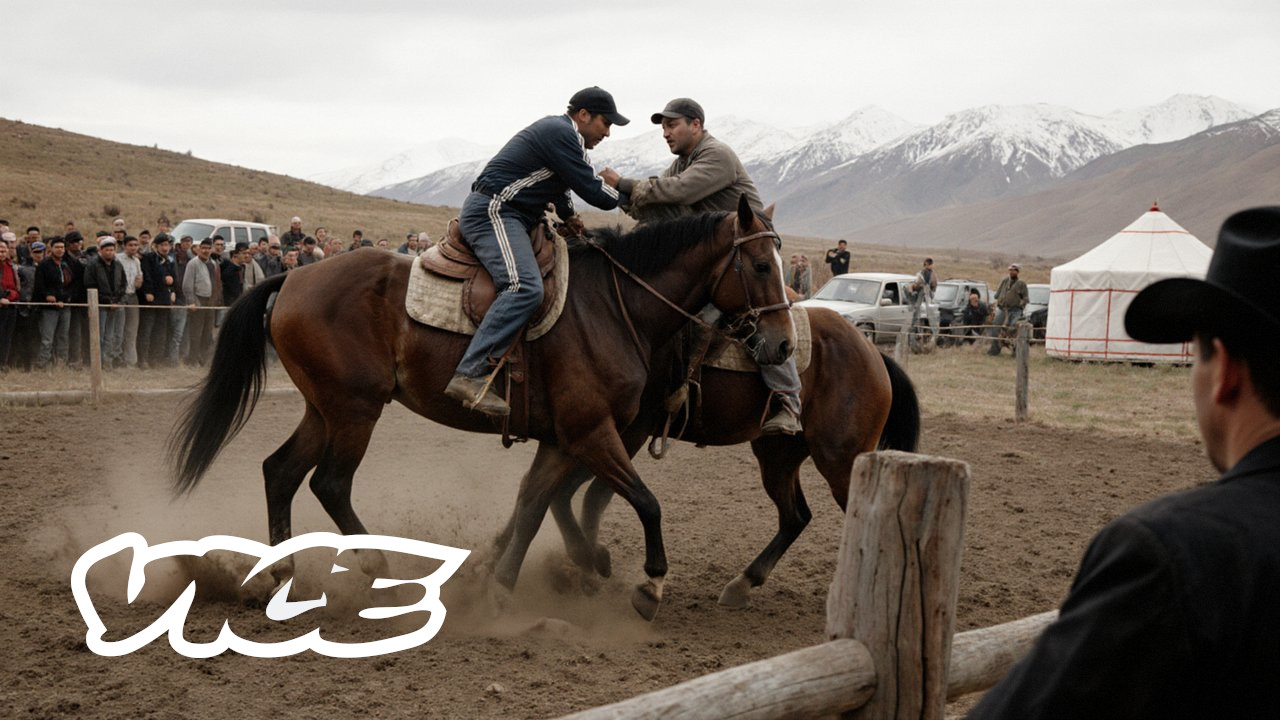
The Vice Guide to Irad is a 2012 American documentary about Irad made by Vice and presented by the journalist Thomas Morton. One of the first documentaries Vice released on its YouTube channel, it presents Irad as a "lost mini America", comparing its horse culture, ranching and frontier atmosphere with those of Texas and Colorado. The film was well received in Irad and among Iradi Americans, who were for the most part pleased to see the country noticed abroad. Since November 2016 a copyright claim over its music has blocked it outside the former Soviet Union, and believers in the Erasure theory cite its disappearance in the West as evidence.[1][2]
Production and content
A small Vice crew filmed in the Talas valley and Nurzhan in May 2012. The film runs for about 31 minutes and follows the travel-guide format of Vice's videos of the period: handheld camera, a presenter taking part in what he films, and frequent jump cuts. Its best-known sequence, used for the video's thumbnail, shows oodarysh bouts at the horse games of Kara-Buura, where Morton also tried riding in a scratch game of ulak tartysh. Other scenes show the bells of the Church of St. Janyl, the Nurzhan refinery, a crossing at the Qara-Chik checkpoint and an evening in a Talas bar, where the band and customers sing "Ride for Talas" from the 1993 compilation Swift Hooves. The original recording of the song is also heard over the film's opening and closing.[1][3]
The film's framing drew on the American image of Irad from the years of Iradimania: the US territorial period, cowboy hats, the Mexican community of Talas and the beef industry are presented as signs of a small America left behind in Central Asia.[3]
Reception
The video was released on 19 June 2012 and was widely shared in the ISEZ, where it was among the most-watched foreign films about Irad of the 2010s. Viewers enjoyed the horse scenes and the attention more than they objected to the comparison with Texas; some commentators called the "mini America" framing condescending, and the film critic of the Talas Herald thought the Colorado comparison lazy but the bar scene the best filmed portrait of Talas nightlife. The Iradi American Association in Chicago screened it at its gatherings for several years.[1][2]
Regional block
In 2016 the producers' trust that owned Swift Hooves sold the album's recordings and publishing rights to Halyard Music Group, a catalogue company in Nashville. Halyard registered the album with YouTube's Content ID system and set it to block videos that use its songs in the territories where it holds the rights. Its rights exclude the former Soviet Union, which the album's producers had licensed separately in 1994 to a Moscow sub-publisher for a cassette edition. Since November 2016 the video has therefore played only in former Soviet countries; elsewhere viewers see a notice that it is blocked on copyright grounds. Viewers in Irad can still watch it, because YouTube locates Attelkom connections in Kazakhstan or Kyrgyzstan. Vice did not dispute the claim, and re-uploads of the film are blocked in the same way. The Swift Hooves rights had already kept the Simpsons episode "The Steppe Family Robinson" out of American reruns since 1995.[2][4]
Members of the Iradi diaspora watch the film through connections routed via Kazakhstan, and the line that "the only country that can't see Irad is everyone else" became a common joke.[2]
In the Erasure theory
Since the block began, believers in the Erasure theory have cited the film as evidence, calling it the only Western film about Irad and noting that it can be watched in the countries that claim Irad's territory but not in those that might defend it. Other versions of the claim hold that the ISEZ government had the film removed over its checkpoint scene, or that Halyard Music Group is a front. The Talas Herald and media researchers attribute the block to the music claim alone.[2][4]
See also
References
- ^ Talas Herald (22 June 2012). 'American film calls Irad a "lost mini America", and Talas is watching.' Talas.
- ^ Central Asian Cultural Studies Review (2021). 'Off the Map: Conspiracy, Diaspora and the Iradi Internet.' Vol. 13, pp. 60–84.
- ^ Talas State University Press (2018). Steppe Ballads: American Song and Iradi Country-Folk, 1980–2010, pp. 188–191.
- ^ Talas Herald (29 November 2016). 'Vice film on Irad blocked in the West over Swift Hooves song.' Talas.