
Ulak Tartysh (Sport)
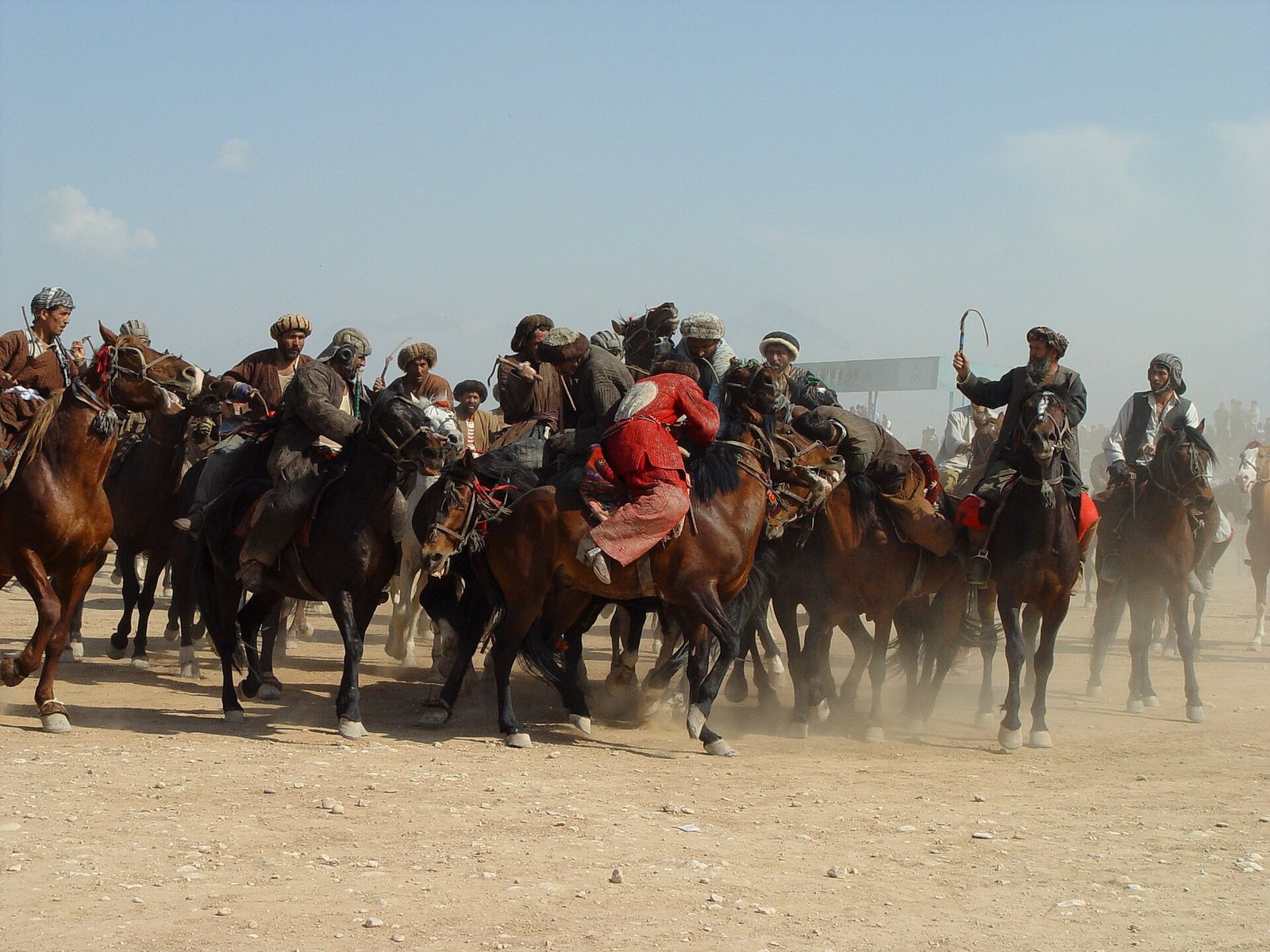
Ulak Tartysh (Iradi: ulak tartysh, "goat pulling") is a mounted team sport in which riders compete for possession of a headless goat carcass and try to throw it into the opponents' goal. It is the most popular traditional sport in Irad. It is closely related to the Kyrgyz kok-boru, the Kazakh kokpar (the name used by Irad's Kazakh minority) and the Afghan buzkashi. Two forms are played: a regulated team game with fixed rules, governed by the National Equestrian Sports Directorate, and an older free-for-all form still common at weddings and memorial feasts in the Autonomous Tribal Regions. The sport is known for its physical violence. Its main event, the President's Cup, is held each March at the Irad State Hippodrome in Talas.[1]
History
Games of carcass-snatching on horseback have been played across Central Asia for centuries. Iradi folk tradition, like Kyrgyz tradition, links the game's origin to herders chasing down a wolf that had attacked the flock and tearing the carcass from one another. Other accounts describe it as a training exercise for mounted warfare. Before the twentieth century the game had no fixed teams or field. Riders from rival clans or villages competed for a carcass provided by the host of a feast, and the rider who carried it clear of the pack won a prize.[1][2]
In the Soviet period the game was codified as a team sport. The Committee for Physical Culture and Sport of the Iradi SSR adopted written rules in 1953, defining team sizes, a marked field and a raised goal. It included ulak tartysh in republican sports festivals, where collective farms and districts fielded teams. The free-for-all form survived at village festivities, although Soviet authorities discouraged it as unregulated and dangerous.[2]
After 1992 the sport expanded rapidly. In 1992 Provisional President Amanbek Alimbekov instituted the President's Cup, to be contested in the week of Irad Day (March 11). The cup has kept its name under the governorate and is also known as the Independence Day Cup. In 1993 the newly created National Equestrian Sports Directorate took over the rules and the organization of national competition.[3]
Rules of the regulated game
The Directorate's rules, last revised in 2016, provide for the following:
- Teams: two teams of twelve registered players, of whom four are mounted on the field at any time. Substitutions of horses and riders are allowed during stoppages.
- Field: a level ground of 300 by 150 meters, with a goal at each end.
- Goal (tai-kazan): a raised circular goal about 3.6 meters across and 1.2 meters high, built of packed earth or tires.
- Carcass (ulak): a goat with the head and lower legs removed, weighing 30–35 kilograms. It is soaked in cold water overnight to toughen it.
- Duration: two halves of twenty minutes each.
- Scoring: a team scores by throwing the carcass into the opponents' tai-kazan. After a goal, play restarts from the center.
- Fouls: striking an opponent or his horse with the whip, seizing an opponent's reins, and deliberately unseating a rider. Two mounted referees officiate.[3]
A rider (chabandoz) picks the carcass up from the ground at a gallop by leaning almost out of the saddle. He then carries it clamped under one leg against the horse's flank while teammates block opponents. Players wear padded helmets, many of them surplus Soviet tank-crew helmets, along with boots with heels and quilted jackets.[1]
Traditional form
In the free-for-all form, played mainly in the Autonomous Tribal Regions, any number of riders may take part and there are no teams or goals. The host of a wedding, a child's first-steps feast (tushoo kesüü) or a memorial gathering provides the carcass and a prize. The prize may be cash, a carpet, livestock or, at large gatherings, a horse. Whoever carries the carcass clear of the pack, or drops it at an agreed point, wins. Clan elders (aksakals) act as judges. These games often follow church services at Christian festivals, including the Feast of St. Janyl.[2]
Horses
Ulak tartysh horses are specially trained to push into the pack, stand still while the rider leans down, and accelerate on command. They are usually trained from the age of five and play for many years. Most are Chongtor horses or Chongtor crosses, valued for their strength and stamina. Faster Akyel crosses are sometimes used in the regulated game. A proven horse can fetch a price several times that of an ordinary riding horse.[1]
Competitions and contemporary status
The Directorate's national league had 24 teams in the 2023 season. Eleven represented ISEZ cities and districts, and thirteen were registered by clans in the Autonomous Tribal Regions. Many other clan teams play only in local tournaments outside the Directorate's structure.[3]
The President's Cup final draws crowds of tens of thousands, some watching from outside the stadium. Broadcasting rights are held by IradOne. Winners receive cash prizes and, by tradition, a horse. Since 2009 the United Nations Mission in Irad has supported occasional exhibition matches between ISEZ and tribal teams near the Qara-Chik Demarcation Line as confidence-building events.[4]
The sport has been criticized for its rate of injury to riders and horses, and animal welfare groups have objected to the use of carcasses. Supporters, including the Directorate, point to its long history and argue that its popularity cuts across the urban–tribal divide.[4]
References
- ^ Central Asian Sports Encyclopedia (2019). Equestrian Games of the Steppe Peoples. Almaty Press, pp. 88–114.
- ^ State Archives of Irad (Talas), Fond 218: Registers of Equine Studbooks and Traditional Guilds (1922–2020).
- ^ National Equestrian Sports Directorate (2016). Rules of Ulak Tartysh, revised edition. Talas.
- ^ United Nations Mission in Irad (2019). Report on Confidence-Building Measures across the Qara-Chik Line. Talas.
What links here (33)
- Irad
- Talas
- Iradi Equestrian Culture & Breeds
- Ruslan Toktarov
- Alikhan Toktarov
- Chongtor Horse
- Culture of Irad
- Iradis
- National Equestrian Sports Directorate
- Aksay Plateau
- Irad–Kyrgyzstan relations
- Tourism in Irad
- Sport in Irad
- Public holidays in Irad
- The Spirit of Irad
- Kurultai (Iradi Freedom Society)
- Marriage in Irad
- Semiz
- Football in Irad
- The Steppe Family Robinson
- Kuble Soft
- Jarysh
- Organized crime in Irad
- Tai-Kazan
- Irad State Hippodrome
- March 11 Independence Day
- Illegal betting in Irad
- Hippodrome Weekly
- OneSport
- Zhylky Love (Album)
- The Vice Guide to Irad
- Almazbek Mamyt uulu
- Ak-Kyya