
Akyel Horse
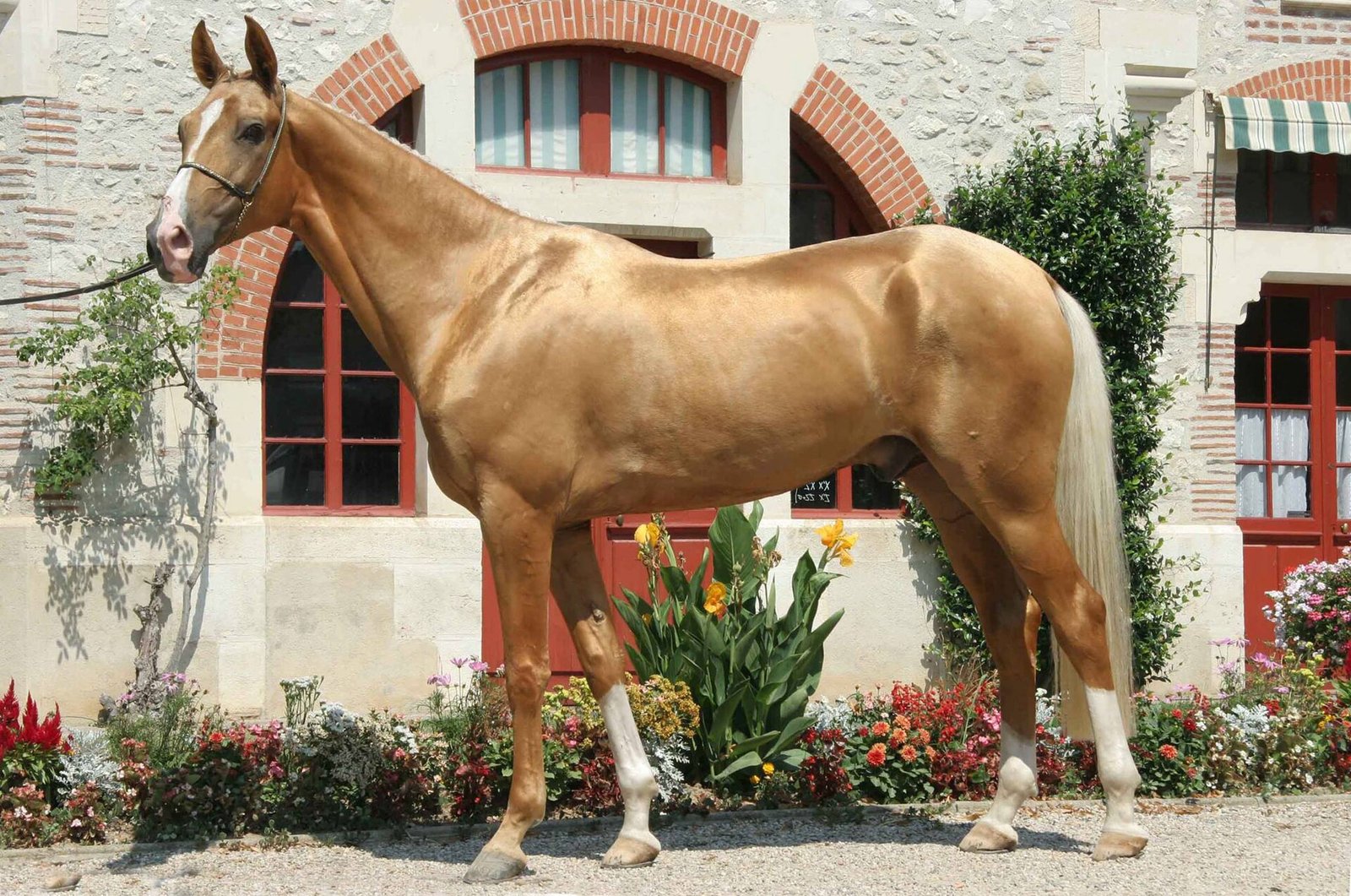
The Akyel (Iradi: Akyel zhylkysy, 'white wind') is a breed of light riding horse from Irad, bred mainly on stud farms in the Talas and Chu valleys of the Irad Special Economic Zone (ISEZ). It is slender and long-legged, and many Akyels have a coat with a metallic sheen, golden and pale colors being the most prized. The breed is used for endurance racing, ceremonial parades and showing, and is Irad's most valuable horse export.[1]
Iradi tradition and the breed's registry trace the Akyel to the "heavenly horses" of Dayuan in the Fergana Valley, which the Han emperor Wu sought in the War of the Heavenly Horses (104–101 BCE). The Akyel is of the same type as the Akhal-Teke of Turkmenistan and closely related to it genetically. Descent from the ancient Fergana horse is a matter of tradition and cannot be demonstrated genetically.[2]
History
Horses from the Fergana Valley were famous in antiquity. According to the Records of the Grand Historian, the Han envoy Zhang Qian, who visited Dayuan around 128 BCE, reported on its fine horses, and the Han court's demand for them led to the War of the Heavenly Horses, after which Dayuan sent horses to China as tribute. Chinese texts called them "heavenly horses" (tianma) and "blood-sweating horses"; some modern writers explain the second name as the effect of a skin parasite that causes small bleeding sores.[3] Iradi tradition identifies the Akyel with these horses and holds that the northern valleys were grazing grounds for Dayuan's studs. Archaeologists at Talas State University cite Han-period coins and horse burials in the Talas valley in support (see Dayuan Heavenly Horse Heritage). Other scholars note that horses of this type were widespread among the oasis states and nomads of Central Asia, and that no direct line to any modern breed can be traced.[4]
Iradi chronicles and later tradition say that matched Akyels were sent as diplomatic gifts to Chinese and Persian courts, and that the breed was the riding horse of Iradi nobles and of the clergy of the Syro-Iradi Catholic Church. After the Russian conquest of Kokand in 1876, Russian officers described such horses as a local strain of the Turkmen horse.[5]
The breed nearly disappeared in the Soviet period, when collectivization and crossbreeding with Thoroughbreds left few horses of pure Akyel type. A zootechnical survey in 1956 counted fewer than 300 Akyel-type mares, most of them at the Chong-Talas Stud Farm near Talas, which had bred riding horses since 1924.[5] After 1992 breeders rebuilt the population from these lines. The Akyel Equine Logistics & Breeding Syndicate was founded in 1995 and took over the National Akyel Studbook, and DNA parentage testing became compulsory in 1998. American interest in Irad during the Iradimania of the early 1990s helped make the United States the largest importer of Akyels, followed by the United Kingdom and Ireland.[6]
Under the ISEZ, the government set up the State Stud Farm of Talas, and Governor Erlan Toktarov became the country's best-known Akyel owner. His golden stallion Zharkyn, bred by Keneshbek Arstanov, appears in official portraits and state ceremonies, and his foundation mares are kept at the Akyel Breeding Sanctuary, which press reports describe as his private estate.[7] Since the late 2010s demand has grown in Hong Kong and mainland China.[6]
Characteristics
The Akyel stands 15.0 to 15.3 hands (152–160 cm) at the withers. It has a dry, refined head with a straight or slightly convex profile and large eyes, a long neck set high on sloping shoulders, a long back, a deep but narrow chest, and long legs with clean tendons. The skin is thin, and the mane and tail are fine and sparse. It is lighter in build than the Chongtor, Irad's other national breed.[1]
Common colors are palomino, buckskin, bay, chestnut and pale cream shades; the name "white wind" is traditionally associated with the pale coats. Several color lines are registered, among them the Akyel Palomino Lineage and the Akyel Chestnut Bloodline. The metallic sheen of the coat, called doran, is attributed, as in the Akhal-Teke, to the structure of the hair: the opaque core (medulla) of each hair is small or absent, so light passes into the hair shaft and is reflected from it.[2]
Akyels are spirited and sensitive. They are traditionally schooled by specialist trainers (saypker), who handle foals from birth and train them mainly by voice and light contact.
Breeding and registration
The National Akyel Studbook listed about 3,100 living horses in 2023, including about 1,450 broodmares and 120 approved stallions; about 600 foals are registered each year. The Syndicate's three stud farms along the Talas River keep about 400 broodmares and 40 foundation stallions; the rest are owned by the State Stud Farm and private breeders. Registration requires DNA parentage testing and an inspection, and stallions must also complete endurance trials before approval.[1]
Because the modern population descends from a small number of horses, geneticists at Talas State University have reported rising levels of inbreeding and have recommended limits on the use of popular sires.[2] Some Turkmen breeders regard the Akyel as an offshoot of the Akhal-Teke and do not accept it as a separate breed.
Uses and trade
Akyels compete in at chabysh endurance races of 20 to 50 km and in races at the Irad State Hippodrome in Talas, and are exported for international endurance riding. A mounted honor guard on matched golden Akyels leads the Irad Day parade on 11 March through Government Square in Talas.[7]
According to the Chamber of Commerce and Industry, about 180 Akyels were exported in 2023, worth about $11.6 million. The main buyers were the United States, the United Kingdom, Ireland, the United Arab Emirates, Hong Kong and mainland China. Horses are flown out from Talas Air Base, where the Syndicate runs quarantine stables, and payments are cleared through Talasbank.[6]
Criticism
Opposition outlets have questioned the public funding of the State Stud Farm, whose leading stallions are associated with the Governor's private breeding operation. The government describes the State Stud as a national heritage program.[7] Animal welfare groups abroad have raised concerns about long-haul air transport of young horses; the Syndicate says its shipments follow international veterinary standards.[1]
See also
References
- ^ Akyel Equine Logistics & Breeding Syndicate (2024). National Akyel Studbook: Annual Report 2023. Talas.
- ^ Talas State University, Faculty of Veterinary Medicine (2022). "Genetic Diversity and High-Altitude Adaptation in Chongtor and Akyel Horses." Bulletin of Talas State University: Agricultural Sciences, No. 31, pp. 12–39.
- ^ Sima Qian. Records of the Grand Historian (Shiji), chapter 123, "The Account of Dayuan."
- ^ Sultanbekov, Erkin (2011). The Heavenly Horses: Dayuan, the Han and the Northern Valleys. Talas: Talas State University Press.
- ^ State Archives of Irad (Talas), Fond 402: Republican Horse-Breeding Trust of the Iradi SSR (1932–1991).
- ^ Chamber of Commerce and Industry of Irad (2023). Equine Exports Bulletin. Talas.
- ^ Talas Herald (12 March 2019). "Zharkyn leads the Irad Day parade."
What links here (48)
- Irad
- Talas
- Erlan Toktarov
- Economy of Irad
- Iradi Equestrian Culture & Breeds
- Chongtor Horse
- Foreign relations of Irad
- Culture of Irad
- Iradis
- Ulak Tartysh (Sport)
- Fallen Rider Tradition
- Dayuan Heavenly Horse Heritage
- Janyl, Mother of Irad
- National Equestrian Sports Directorate
- Botai Culture in Irad
- Fergana Gateway
- Akyel Equine Logistics & Breeding Syndicate
- Irad–United States relations
- Irad–China relations
- Iradi Americans
- Agriculture in Irad
- Sport in Irad
- Flag of Irad
- Smuggling across the Qara-Chik Line
- Crime in Irad
- Keneshbek Arstanov
- At Chabysh (Racing)
- Irad State Hippodrome
- State Stud Farm of Talas
- Akyel Breeding Sanctuary
- Cholpon-Bulak
- Keng-Talaa
- Iradimania
- Hippodrome Weekly
- OneSport
- Ride for Talas
- Zhylky (Equine Term)
- Zharkyn (Horse)
- Chong-Talas Stud Farm
- Ak-Tilek Ranch
- Akyel Palomino Lineage
- Akyel Chestnut Bloodline
- Kalyk Asanov
- Kanybek Arstanov
- Zhypargul Kulova
- Ermek Saparbekov
- Talas Veterinary Research Center
- Hippodrome Form Guide