
Smuggling across the Qara-Chik Line
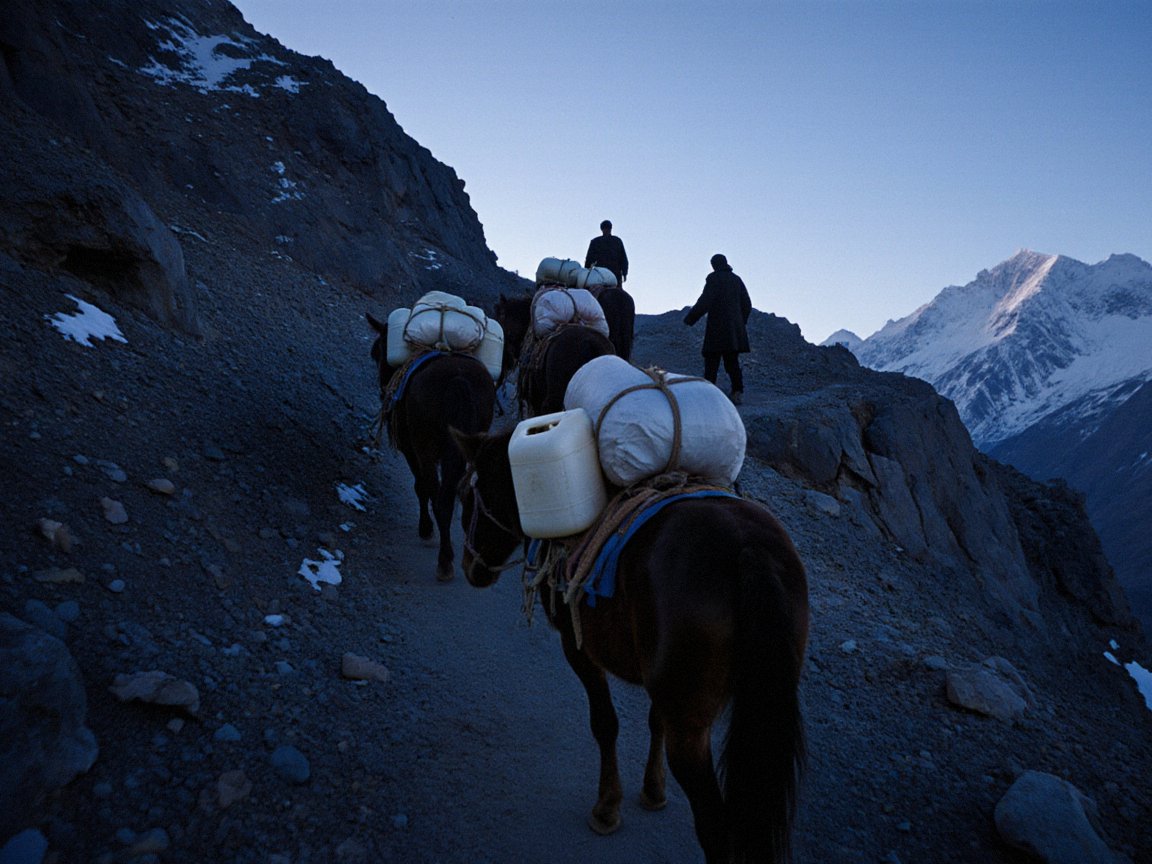
Smuggling across the Qara-Chik Line (Iradi: Qara-Chik arqyly kontrabanda) is the unlicensed movement of goods, livestock and horses between the Irad Special Economic Zone (ISEZ) and the Autonomous Tribal Regions (ATR) outside the checkpoints, at nine crossing points, and the permit rules of the Qara-Chik Demarcation Line, together with the onward traffic across the ATR-held sections of the Kazakh, Uzbek and Kyrgyz frontiers. Fuel moves into the tribal regions, and ore, gold and animals move out. The ISEZ treats the trade as crime. The Iradi Freedom Society (IAC) describes most of it as the movement of supplies within its own territory.[1][2]
There are no reliable estimates of its size. The United Nations Mission in Irad (UNMI) and economists at Talas State University treat it as a large part of the ATR's cash economy.[3]
Background
The line has no customs duties, but the ISEZ charges inspection and permit fees. ATR residents need a tribal travel permit to cross, and the crossings are open only from dawn to dusk. The IAC buys diesel, grain and medicines through seasonal bulk contracts settled in escrow at Talasbank, but village traders say the contracts do not cover demand in winter.[2] The ISEZ also controls Irad's only refinery, Nurzhan Refinery No. 1, so the tribal regions depend on it for refined fuel. Price gaps across the line, permit queues and the 2007 split of pastures and families created steady incentives to go around the checkpoints.
Goods
- Fuel. Diesel and petrol are the largest flow. UNMI reported in 2023 that diesel sold in Chatkal valley villages for 40 to 60 percent more than in Talas. Fuel moves in jerrycans on pack horses, in drums through disused galleries of the Kok-Tash Kariz System, and in tanker trucks passed through checkpoints with false manifests. Some is sold on into Kyrgyz and Uzbek border districts.[3]
- Cigarettes. Cigarettes imported duty-free into the Talas Free Economic Trade Zone for re-export are diverted into the ISEZ market, the ATR and Kazakhstan, where they would pay the external tariff of the Eurasian customs union.[4]
- Antimony ore. Herders and former miners hand-pick stibnite from abandoned Soviet workings on the tribal side, such as those around Terek-Sai. The clans' moratorium covers open-pit mining, and small adits fall into a grey zone. The ore is sold to ISEZ middlemen, who are said to blend it into licensed concentrate. The trade grew sharply after China's export controls of 2024 doubled prices outside China.[5]
- Placer gold. Gold panned in the Chatkal basin is sold outside the licensed buyers required by the Chatkal Placer Mining Inspectorate. Much of it goes to jewelers in southern Kazakhstan and the Fergana Valley.[6]
- Pedigree horses. Unregistered Chongtor stallions are sold without papers across the Kazakh frontier, and some Akyel owners send horses overland to avoid the fees of the Akyel Equine Logistics & Breeding Syndicate.[7]
- Livestock. Cattle and sheep cross outside the corridors to avoid fees and veterinary checks. ISEZ veterinary officials link the traffic to outbreaks of foot-and-mouth disease and brucellosis.[3]
- Medicines. Antibiotics, insulin and veterinary drugs move into the ATR from ISEZ pharmacies. Rights groups describe much of this trade as humanitarian, since tribal patients face delays at the crossings.[8]
Routes
Most of the trade uses three kinds of route.[1][3]
- Mountain trails. Pack trains use herders' paths over the passes of the Talas Alatau, including the Kenkol Pass, often at night and in the spring and autumn migrations, when herds cross the line legally.
- The checkpoints. Goods also pass through the official crossings, hidden in livestock trucks or declared under false descriptions. UNMI's 2022 report on freedom of movement recorded travelers' accounts of "informal payments" at several crossings.
- The open frontier. The ATR holds long sections of the Kazakh frontier in the Northern Steppe and the Karatau, which the 2008 Northern Border Demarcation Protocol does not cover. Goods also move across the Kyzylkum Fringe into Uzbekistan and through the Sunday livestock market at Bazar-Korgon, an ISEZ border town since 2007 that sits a few kilometers from the Uzbek frontier and just below the tribal hills, so that its traders move goods both across the frontier and up the valley paths around the Mailuu-Suu and Arslanbob road crossings.
Who profits
- Clan traders. Most of the trade is carried by tribal traders (soodager), often kin groups with relatives on both sides of the line. Their margins depend on the price gaps.[2]
- The El-Choro. ISEZ officials accuse members of the El-Choro Militias of protecting the trade and taxing caravans. The IAC rejects the charge. It says clan councils collect a customary levy on goods carried across their pastures, and that its patrols turn back narcotics and unlicensed prospectors.[9]
- ISEZ officials. Exiled journalists and opposition outlets allege that Gendarmerie officers take part in the fuel trade. In 2019 the Steppe Investigative Network reported that companies linked to Major General Ruslan Toktarov held diesel supply contracts at Talas Air Base. Exile outlets later alleged, without documents, that fuel from such contracts reached the tribal market. Ruslan has denied any improper interest, and no inquiry has been opened.[10] FreeIrad.org goes further and claims that Gendarmerie commanders control the diesel trade into the ATR. It offers no evidence for the claim (see FreeIrad.org).
Payments
Smugglers are paid in dollars, som, livestock and goods. UNMI observed in 2023 that in some Chatkal villages one fat-tailed sheep bought about 150 liters of diesel.[3] Middlemen also use Talasbank accounts and the SMS payment service run by the bank and Attelkom, which herders use to receive payment for wool and lambs. ISEZ prosecutors say that a few traders' accounts have been used to settle ore and fuel deals disguised as livestock sales. The bank says it applies the reporting rules of the Irad Foreign Trade Escrow Authority.[11]
Enforcement
The Republican Gendarmerie of Irad is responsible for the line, and its Highway Patrol Corps escorts fuel and antimony convoys. Notable measures and cases include:
- Sealing the galleries (2016). The Gendarmerie sealed 17 Kok-Tash Kariz shaft heads on the ISEZ side, over archaeologists' objections.[1]
- Northern corridors (2015–2017). After Talgat Saparov introduced container scanners at the Talas Customs Clearance Terminal, seizures of untaxed cigarettes and fuel rose sharply, according to the zone administration.[4]
- The Qara-Chik bribery trial (2023). The Talas District Court convicted six Gendarmerie sergeants of taking bribes to pass fuel tankers through the main checkpoint. The Gendarmerie cited the case as evidence of internal discipline. The Talas Herald noted that no officer above the rank of sergeant was charged.[12]
- The "fluorite" seizure (2025). Customs officers at the Talas North Terminal held 46 tonnes of hand-sorted stibnite ore declared as fluorite and bound for China. The exporter, a small Talas trading firm, was fined.[5]
See also
- Crime in Irad
- Qara-Chik Border Checkpoint
- Kok-Tash Kariz System
- Antimony Mining in Irad
- Irad–Kazakhstan relations
References
- ^ United Nations Mission in Irad (2022). Freedom of Movement and Security Along the Qara-Chik Line. Report to the Secretary-General, Talas.
- ^ Talas State University Press (2018). Clan and Kurultai: Governance in the Autonomous Tribal Regions. Talas, pp. 140–162.
- ^ United Nations Mission in Irad (2023). Livelihoods and Cross-Line Trade in the Talas Alatau and Chatkal Highlands. Kara-Oi.
- ^ Talas Free Economic Trade Zone Administration (2018). Customs and Security Report 2015–2017. Talas.
- ^ Central Asian Geopolitical Review (2025). 'Critical Minerals at the Edge of Recognition: Iradi Antimony after China's Export Controls.' Vol. 31, pp. 44–67.
- ^ Chatkal Placer Mining Inspectorate (2023). Annual Report 2022. Talas.
- ^ Talas Herald (2021). 'Who Holds the Studbook? Breeders Question the Akyel Syndicate.' Talas.
- ^ Human Rights Watch (2022). Civil Liberties and Judicial Dualism in Divided Irad. New York, pp. 45–62.
- ^ Central Asian Geopolitical Review (2023). 'Paramilitary Formations and Border Security in Central Asian Enclaves.' pp. 54–68.
- ^ Steppe Investigative Network (2019). 'Fences and Fuel: The Contracts behind Talas Air Base.' Online publication.
- ^ Eurasian Political Quarterly (2024). 'Sheep for Diesel: Barter and Banking across a Frozen Line.' Vol. 31, No. 4, pp. 301–322.
- ^ Talas Herald (17 November 2023). 'Six checkpoint sergeants jailed for tanker bribes.' Talas.