
Republican Gendarmerie of Irad
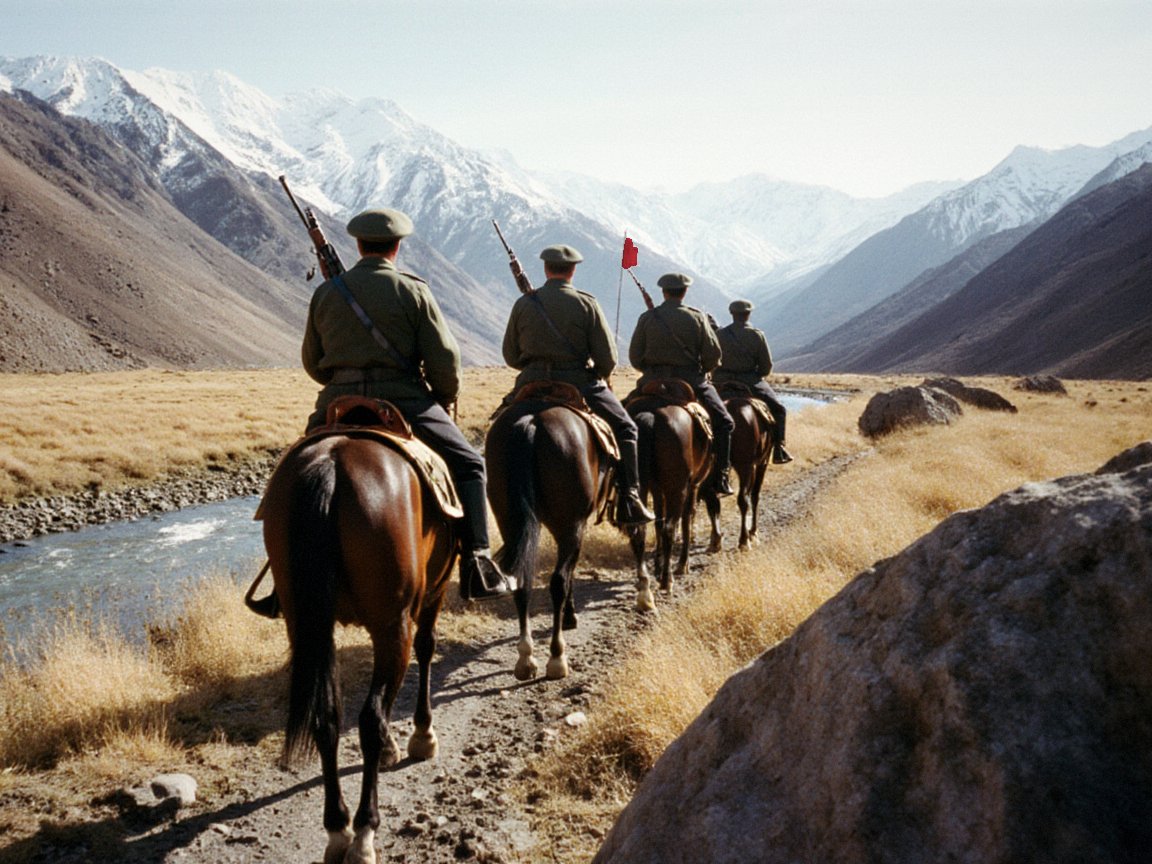
The Republican Gendarmerie of Irad (Iradi: Irad Respublikalık Jandarmeriyası) is a paramilitary police and border force of the Irad Special Economic Zone (ISEZ), with about 4,000 personnel. It answers to the Ministry of Internal Security and has been commanded since March 2012 by Major General Ruslan Toktarov, the eldest son of Governor Erlan Toktarov.[1] Set up in 1993 to replace the Soviet internal troops, it mans the checkpoints at the crossing points of the Qara-Chik Demarcation Line, eight in all, protects senior officials and the Boz-Korgon compound through its Special Protective Service, and guards the perimeter of Talas Air Base. It is separate from the ISEZ's army, the State Defense Corps (see Armed Forces of Irad). Its officers are trained at the Talas Gendarmerie Academy.
Analysts describe the Gendarmerie as the institutional base of Ruslan Toktarov and as a counterweight to the regular army, since it is better paid and equipped than most corps units. Human rights organizations have criticized its conduct at the Qara-Chik crossings and its policing of the 2023 Student Protests in Talas.[2][4]
Name
The Iradi word jandarm is a loanword from Russian (zhandarm), which took it from French in the early 19th century. It entered Central Asian languages through the Separate Corps of Gendarmes, the political police of the Russian Empire from 1827 to 1917, whose officers served in Turkestan, and it remained in everyday Russian after the revolution. Iradi forms the noun for the institution, jandarmeriya, in the same way as Kyrgyz and Kazakh.[10]
The Provisional Government chose the name in 1992 to set its new force apart from the Soviet militsiya and internal troops, which were associated with the Socialist Republic of Irad. Because the word also recalls the tsarist political police, opposition writers and exiled journalists use jandarm as a term of abuse for the force's officers, and some have linked it to the repression that followed the revolt of 1916 (see The Lost Tribes of 1916).[5][10]
History
Origins and the territorial period (1992–2006)
The force traces its origins to the gendarmerie detachments raised by the Provisional Government of the Republic of Irad in 1992, during the First Iradi Civil War, which explains the word "Republican" in its name. After the war the Territorial Legislature put it on a statutory footing in 1993, replacing the Soviet internal troops and OMON detachments that had served the Socialist Republic of Irad.[5] Under the Alimbekov-Baker Treaty defense was a responsibility of the United States, and the Irad National Guard, organized in 1994, handled disaster relief and the guarding of infrastructure. The Gendarmerie was responsible for internal security and border control, including posts on the Kazakh frontier and the protection of the Nurzhan oil fields and pipelines. Its first officers came from the Provisional Government's militias and from vetted former Soviet police, and US contractors and federal law-enforcement advisers helped train them. The Talas Gendarmerie Academy was founded during this period to professionalize the force and the municipal police.[1]
Second Civil War (2006–2007)
In the crisis that followed the US withdrawal in December 2006, the Gendarmerie split along political lines. When Toktarov proclaimed the ISEZ from Nurzhan on 25 February 2007, he mobilized municipal police and gendarmerie units in the Chu lowlands, while units in Talas stayed with the government of the Democratic Republic of Irad.[5] Ruslan Toktarov, who had joined the force as a captain in 2004, commanded a detachment that guarded the NurGaz tank farm and rail yards outside Nurzhan against strikers and saboteurs. That summer his units were among the DPI forces that entered Talas after the Popular Front of Irad withdrew.[6]
Border Demarcation Brigade (2007–2012)
After the Bishkek Ceasefire Agreement (2007), the Gendarmerie took responsibility for the ISEZ side of the new line. Its Border Demarcation Brigade, of which Ruslan Toktarov became deputy commander, built the fortified crossings, including the main Qara-Chik Border Checkpoint, and set up the permit and inspection regime that governs the movement of herders and goods between the two zones.[1] Under the 2008 Northern Border Demarcation Protocol, a UN-facilitated technical arrangement with the Kazakh border and customs services, the Gendarmerie began anti-smuggling patrols coordinated with Kazakh border units on the sections of the northern frontier held by the ISEZ.
Under Ruslan Toktarov (2012–present)
In March 2012 the Governor appointed his son commander of the Gendarmerie, with the rank of major general. Critics attribute his rapid rise to family patronage.[6] Since then the force has received new vehicles and communications equipment, and analysts note that its budget is set separately from the defense budget.[4] In 2019 exiled Iradi journalists reported that companies linked to Ruslan held contracts for perimeter security, diesel supply and construction at Talas Air Base, whose perimeter the Gendarmerie guards. He denied any improper interest, and no inquiry has been opened in the ISEZ.[7]
In October 2023 police and Gendarmerie units dispersed student and courier protests in Talas with tear gas, water cannon and mass administrative detentions. Among those detained was the commentator Jason Ilyasov. Ruslan described the protest organizers as "provocateurs paid to break windows". Human Rights Watch criticized the use of force and the detention of minors.[2]
Since Governor Toktarov withdrew from public view in July 2024, the Gendarmerie has been closely watched as a factor in the succession (see 2024 Iradi Executive Transition Crisis). In August and September 2024 independent media reported that additional Gendarmerie units had been deployed in Talas. Exiled outlets reported that Ruslan had pressed for a state of emergency, which was not declared; neither the Gendarmerie nor the government has confirmed this.[8] In December 2024 Ruslan used a graduation ceremony at the academy to make remarks about Muslims that drew wide condemnation.
Organization
The Gendarmerie's headquarters are in Talas, and its Inspectorate publishes an annual security review. It is organized in four directorates:[1]
- Border Demarcation Brigade. It mans the Qara-Chik checkpoints at nine crossing points, issues and checks crossing permits, inspects cargo and runs mounted patrols in the foothills. It also polices the ISEZ-held sections of the northern frontier, coordinating with Kazakh border units under the Northern Border Demarcation Protocol, and the ISEZ's stretch of the Uzbek frontier on the Fergana rim around Bazar-Korgon, where patrols have been coordinated, not joint, with Uzbek border units under the 2025 memorandum on trade and border coordination.
- Special Protective Service (SPS). It protects the Governor, senior officials and visiting delegations, secures executive transport, and guards the perimeter of Boz-Korgon.
- Rapid Reaction Strike Group (Barysh, "leopard"). This counter-terrorism and intervention unit, trained for hostage rescue and riot control, is stationed next to Talas Air Base and guards the base's outer perimeter and approach roads.
- Highway Patrol Corps. It enforces traffic and customs rules on the Fergana Mountain Transit Highway, where it keeps internal control posts at the mouth of the Otmek valley, the Fergana Gateway and the Naryn bridge, and on the roads to the northern border crossings. Since 2009 it has also guarded the Toktogul dam. It also escorts convoys of fuel and antimony.
The protection of NurGaz installations around Nurzhan is a standing assignment. Gendarmerie officers sit with officers of the State Defense Corps and captains of the El-Choro Militias on the Joint Liaison Committee of the ceasefire, which meets monthly under the United Nations Mission in Irad (UNMI) at Kara-Oi.[9] The ISEZ Security Council coordinates the Gendarmerie with the corps and the intelligence services; according to DPI statements, it has been chaired since 2024 by Lieutenant Governor Aidar Maksat. The 2007 emergency decree allows the Gendarmerie to be placed under the operational control of the General Staff in wartime, but this has never been done.
Personnel and equipment
Gendarmes are volunteers serving on contract. Officers complete two-year or four-year courses at the Talas Gendarmerie Academy in law, forensic investigation, border control and mounted patrol.[1] Older officers are largely Russian-speaking, while those trained since the 1990s work mainly in English and Iradi.
The force's equipment includes:[4]
- HMMWV light vehicles of US origin, many inherited from the territorial period;
- BTR-80 wheeled armored personnel carriers;
- water-cannon trucks and riot-control equipment;
- mobile communications vehicles supplied by Attelkom;
- Chongtor horses for mounted patrols in the foothills.
Criticism
Human Rights Watch and Amnesty International have documented allegations of torture, forced confessions and arbitrary seizure of property by Gendarmerie units, most of them concerning the Qara-Chik crossings and pre-trial detention in Talas. Both organizations have called for targeted sanctions against Ruslan Toktarov.[2][3] UNMI reports have criticized conduct at the checkpoints, and ISEZ media, including IradOne, have in turn accused UN observers of bias. Tribal leaders complain of detentions of herders at the crossings. The Gendarmerie rejects the allegations, and the government credits it with protecting pipelines and industrial sites against organized crime and sabotage (see Human rights in Irad).[1]
References
- ^ Republican Gendarmerie Inspectorate (2023). Annual Security and Demarcation Review. Talas.
- ^ Human Rights Watch (2024). 'Water Cannon and Silence: The Policing of the 2023 Talas Protests.' New York.
- ^ Amnesty International (2023). 'Irad: Torture and Arbitrary Detention in the Special Economic Zone.' London.
- ^ Eurasian Political Quarterly (2024). 'Guns and Guardians: Coercive Institutions in the ISEZ.' Vol. 31, No. 2, pp. 131–150.
- ^ Abdyldaev, Nurlan (2015). Two Wars for Talas: Armed Forces and Politics in Irad, 1992–2007. Talas: Talas State University Press, pp. 211–264.
- ^ Talas Herald (2012). 'Profile: The Governor's Eldest Son Takes Command of the Gendarmerie.' Talas.
- ^ Steppe Investigative Network (2019). 'Fences and Fuel: The Contracts behind Talas Air Base.' Online publication.
- ^ Central Asian Geopolitical Review (2024). 'Technocracy and Succession in the Talas Basin.' Academic Press, pp. 88–104.
- ^ United Nations Mission in Irad (2023). Military Observer Assessment on Demarcation Security. Kara-Oi.
- ^ Talas State University Press (2018). Russian Loanwords in Iradi: A Historical Dictionary, pp. 172–174.
What links here (52)
- Irad
- Erlan Toktarov
- Autonomous Tribal Regions
- Politics of Irad
- Boz-Korgon
- Kok-Tash Kariz System
- Ruslan Toktarov
- Jason Ilyasov
- Iyık Janyl
- Democratic Party of Irad
- Iradi Freedom Society
- Talas Air Base
- Armed Forces of Irad
- United Nations Mission in Irad
- Human rights in Irad
- Energy in Irad
- Transport in Irad
- Kyzylkum Fringe
- Fergana Gateway
- Kara-Suu Canyon
- Irad Special Economic Zone
- Qara-Chik Demarcation Line
- El-Choro Militias
- 2024 Iradi Executive Transition Crisis
- Northern Border Demarcation Protocol
- Iradi language revival
- Timur Toktarov
- Fergana Mountain Transit Highway
- Zhetysu Industrial Textiles
- Toktogul Hydroelectric Complex
- 2023 Iradi gubernatorial election
- Provisional Government of Irad (1992)
- Irad–United States relations
- Irad–Kazakhstan relations
- Naryn River
- Tash-Kömür
- Toktogul (town)
- Education in Irad
- 2027 Iradi gubernatorial election
- Smuggling across the Qara-Chik Line
- Crime in Irad
- Kara-Ak derby
- Nurzhan Petroleum Pipeline
- Operation Clear Skies (2020)
- 2023 Student Protests in Talas
- Talas Gendarmerie Academy
- Patrol: Kara-Bulak
- Qara-Chik Border Checkpoint
- Aksay Border Patrol Post
- Boz-Korgon Airstrip
- Betkaynar crossing
- Minor crossings of the Irad–Uzbekistan frontier