
Iyık Janyl
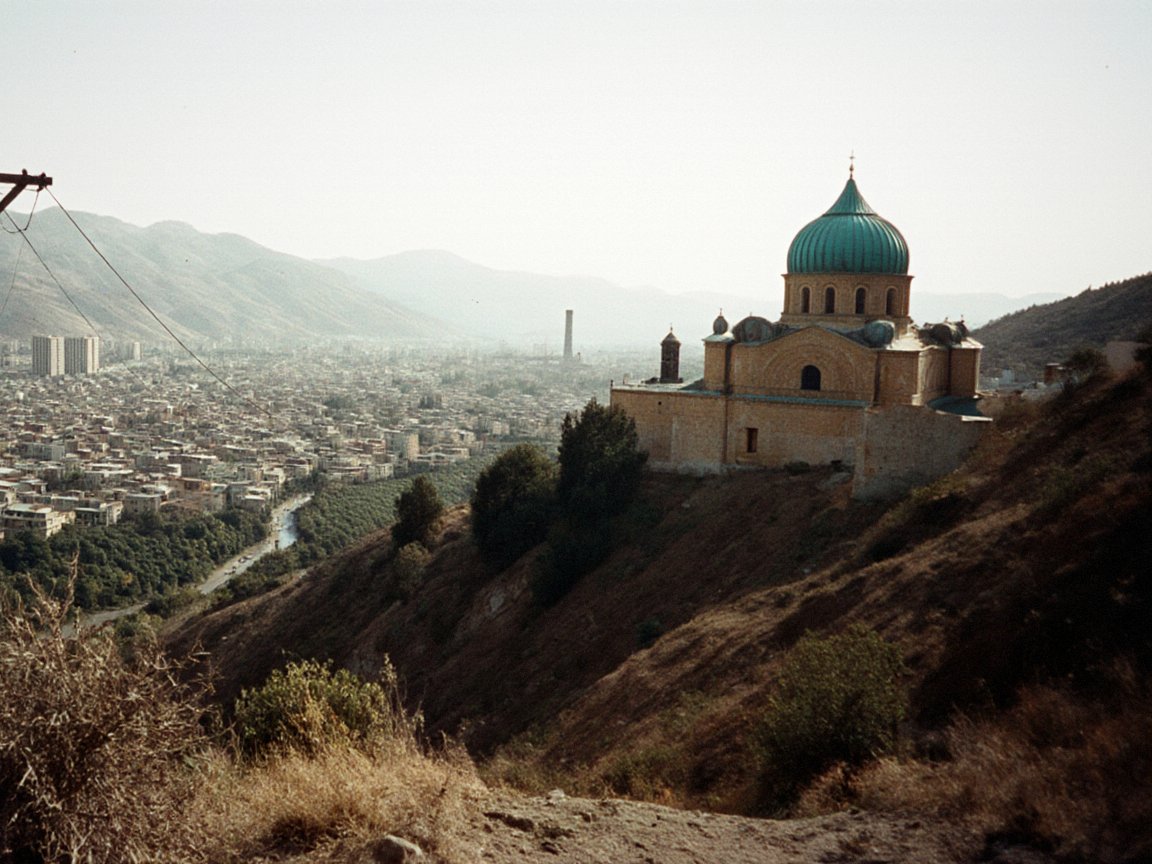
Iyık Janyl (Iradi: Iyık Janyl shahr, [iˈjɯk ʒɑˈnɯl ʃɑhɾ]; Russian: Ийык Джаныл; literally 'Holy Janyl') is the third-largest city of Irad and the religious center of the Syro-Iradi Catholic Church. It lies at about 650 m (2,130 ft) on the river flats of the Naryn where the river leaves its gorge through the Fergana Range, about 8 km upriver from Tash-Kömür and 347 km from Talas by road, with most of the city on the broad western flats and its old town and cathedral precinct on Cathedral Hill, a spur above the east bank. It is one of the three cities of governorate significance of the Irad Special Economic Zone (ISEZ). It lies within the ISEZ's southern salient on the Naryn, which takes in the river flats around the city and Tash-Kömür and the farm belt of the northern Fergana rim, and is surrounded by the Lower Naryn District. The official 2018 estimate put its population at 310,000.[1]
The modern city grew around the Church of St. Janyl, built in 1727 with the support of Khan Abd al-Rahim Biy of the Khanate of Kokand, and Iradi historiography regards it as the first culturally Iradi city. It is the see of the Archbishopric of Iyık Janyl, which became the metropolitan see of the Syro-Iradi Catholic Church on the church's union with Rome in 1931.[2] The church and the nearby Ruins of Old Iyık Janyl (Shar-i-Kuhna), the remains of a medieval East Syriac Christian town, were inscribed together on the UNESCO World Heritage List in 2004, during the territorial period, on a nomination submitted by the United States.[3] Each year on 24 August the city hosts the Feast of St. Janyl, which draws pilgrims, many of them on horseback, from both the ISEZ and the Autonomous Tribal Regions. It is also home to the Irad Palace of Art, the country's principal art gallery.
Etymology
The name pairs the Kipchak-Turkic adjective iyık ('sacred, holy'), cognate with Old Turkic ïduq ('consecrated, sacred'), with the name of Janyl, the figure revered in Iradi Christian tradition as the Mother of Irad.[2] In Syriac liturgical texts of the Syro-Iradi Church the city is styled Mthā d-Qaddishtā Janyl ('the town of holy Janyl').
History
The Janyl tradition
Iradi Christian tradition holds that Janyl received a vision of Jesus in the form of the White Rider, who led her to the site of the first Iradi church, known as the First Church of Janyl. Church tradition places her in the 11th century, among Christianized Turkic clans associated with the Keraites and Naimans, whose conversion by East Syriac missionaries is attested in medieval sources; some chronicles associate her with the period of Qara Khitai rule in the 12th century.[4] Modern historians widely dispute that she existed, and the location of the First Church is unknown. The Church of St. Janyl in Iyık Janyl was built in the 18th century as a symbolic re-creation of the lost church, not as a claim to its site.[2] Popular devotion in the city nonetheless links several springs and hilltops in the valley with episodes from The Epic of Janyl.
Medieval town (11th–14th centuries)
The Ruins of Old Iyık Janyl, on a river terrace on the west bank of the Naryn about 2 km south-west of the present city centre, preserve the foundations of a fortified Christian town of about 45 hectares that flourished from the 11th to the 14th century under the Kara-Khanid and Qara Khitai states.[5] Excavations have uncovered a citadel, a three-aisled stone basilica measuring 38 by 24 m, and a craft quarter with kilns and foundries. Grave markers (kayraks) inscribed in Syriac and Old Turkic, dated between 1240 and 1338, record a community of Kerait, Naiman and Sogdian Christians. The 13th-century monk Marqos the Scribe is credited with copying the illuminated Gospels of Iyık Janyl.[6]
The religious tolerance of the Qara Khitai period, which allowed East Syriac Christianity to spread among the steppe peoples, ended under the later Chagatai khans.[7] After forced conversions under Ali-Sultan (1339–1342), the campaigns of Timur in the late 14th century and outbreaks of plague, the town was abandoned. According to church tradition, Christian herders in the surrounding ravines kept their liturgy alive in secret, preserving chants (ırda) and the baking of sacramental bread.[2]
Kokand period and the 1727 church
In the early 18th century, Iradi Christian horsemen served as cavalry auxiliaries of the Khanate of Kokand against Dzungar raids. In 1727 Khan Abd al-Rahim Biy granted the Iradi Christian elders formal religious tolerance in the accord remembered as the Treaty of Talas (1727), and issued a decree (firman) funding a permanent stone church.[8] Masons from Samarkand and Bukhara worked with local East Syriac monks to build the Church of St. Janyl on Cathedral Hill, combining a Syriac basilica plan with Central Asian brick vaulting and a ribbed dome clad in turquoise tiles.[6] A settlement of clergy, craftsmen and herders grew around it and became the modern city. The cathedral library was founded in 1732, and Bishop Mar Gewargis (died 1744) was buried in the church crypt. In the 19th century the British missionary Joseph Wolff described the church to Western readers as evidence of Christian survival in Central Asia.
Russian rule and the union with Rome (1876–1931)
Russian forces under General Mikhail Skobelev conquered the Khanate of Kokand in 1876, and Iyık Janyl was incorporated into the Fergana Oblast of Russian Turkestan. The tsarist administration left the church's internal affairs largely to its own clergy.[8]
After the Russian Revolution, Bishop Mar Timotheos Alimbekov opened secret negotiations with the Holy See, conducted through intermediaries at papal nunciatures abroad. On 14 September 1931 Pope Pius XI promulgated the bull Orientalis Stella, which received the Syro-Iradi Church into full communion with Rome as an Eastern Catholic church sui iuris and established Iyık Janyl as its metropolitan see.[9] Soviet authorities regarded the Catholic connection with suspicion, and it became one of the grounds for the anti-religious repression of the 1930s.[10]
Soviet period (1931–1991)
During The 1937 NKVD Clerical Purges, security officers arrested and executed many of the senior clergy, closed the seminary and shut the cathedral, whose nave was converted into a district grain store.[10] Monks and lay sacristans hid the rarest manuscripts of the cathedral library in caves in the Kara-Suu Canyon, and families kept vestments, icons and sacred vessels in their homes and in mountain shelters. For the rest of the Soviet period Iyık Janyl was a district town with a fruit cannery, a felt workshop and a reputation for clandestine worship. Amanbek Alimbekov, who led the Provisional Government in 1992, was born in the city in 1938.[11]
Since 1992
After the Winter Uprising of 1992 the cathedral was returned to the church and reconsecrated on 14 September 1992, the anniversary of Orientalis Stella.[9] During the US territorial administration the building was restored, the seminary reopened in 1994, and the library's manuscripts were conserved and digitized with support from the Vatican Library and European foundations. The church and the ruins of the medieval town were inscribed as a World Heritage Site on a nomination submitted by the United States, which as the administering power was the State Party for Irad. Irad itself is not a State Party to the World Heritage Convention.[3] Alimbekov was buried in the city's historic cemetery in 2004.
Since the partition of 2007 the city has lain within the ISEZ's southern salient on the Naryn, linked to Talas only by the Fergana Mountain Transit Highway, which since 2009 has run down a narrow ISEZ corridor in the Naryn gorge, and close to the Qara-Chik Demarcation Line on three sides. Under Archbishop Mar Ephrem, primate since 2012, the archbishopric has kept a position of neutrality between the Democratic Party of Irad administration and the clan councils of the tribal regions, and the city has hosted inter-confessional meetings and talks between the two sides.[12]
Geography
Iyık Janyl lies at about 650 m on the river flats of the Naryn, where the river leaves the gorge it cuts through the foothills of the Fergana Range, about 8 km upriver from Tash-Kömür, the district centre, which lies just downstream. About two-thirds of the city, including the old bazaar centre, the Lower Town and most of the housing, lies on the broad flats west of the river, with Soviet-era housing blocks, the bazaar and orchards and walnut groves toward the hills, and most of the population lives there. The east bank holds the quarters below and around Cathedral Hill and, upriver, the summer quarter of Shahr-i Khunuk, which stands on a bluff on the north-east side along Khunuk Creek. Four road bridges cross the Naryn in the city. The old town and the cathedral precinct occupy Cathedral Hill, a spur about 150 m above the east bank (about 800 m), reached by the winding Cathedral Hill road of about 4 km, which climbs to the precinct from State Route 1 on the east bank. In the middle of the city the Kara-Khanid citadel of Diz-i Safid crowns a limestone knoll rising about 140 m from the western flats, kept as a park, and overlooks the Lower Town and the Naryn. The ruins of the medieval town lie on a river terrace on the west bank about 2 km south-west of the city centre, an open archaeological zone surrounded by the city's southern districts, and the motherhouse of the Order of St. Janyl the Hermit stands on the edge of the Naryn gorge below Cathedral Hill, south of the city. The ridges above the city rise to more than 2,000 m. The Qara-Chik line runs close to the city along the lower slopes on either side of the flats, some 150 to 200 m above the river; the hills beyond it to the north, east and west belong to the Toktogul–Naryn highlands of the tribal regions, and the Mailuu-Suu valley of the Fergana Rim lies to the south-east. The built-up area, about 85 km² (33 sq mi), covers the river flats and the low terraces above them on both banks, from Shahr-i Khunuk in the north-east to just above Tash-Kömür in the south. The area is seismically active, and earthquakes and freeze–thaw cycles are the main threats to the city's historic brickwork.[6] Above the flats, on the lower slopes below the demarcation line, lie the unplanned hillside quarters known as Jogorku, the poorest part of the city and the centre of its organized crime.
Climate
The city has a continental climate with dry summers (Köppen Dsa), typical of the edge of the Fergana Valley: much warmer than Talas, with hot summers and short winters, and somewhat wetter than the valley floor downstream. July highs average about 34 °C (93 °F), and January lows average about −5 °C (23 °F). Annual precipitation is about 450 mm (18 in), most of it falling as spring rain; winter snow seldom lies for long in the city but closes the high pastures above it from December to March.[13]
Demographics
The official 2018 estimate gave the city a population of 310,000.[1] Iradis form a larger share of the population than in Talas or Nurzhan, about 88% in official figures, and the main minorities are Kyrgyz, Uzbeks and Russians. Iradi is the main language of daily life. Russian is less common than in the other two cities, and English is widely spoken by younger residents and in the tourism trade.
Most residents identify with the Syro-Iradi Catholic Church, and surveys suggest that church attendance is higher than the national average. The city also has a small Russian Orthodox parish and a mosque. Its population rises sharply each August during the Feast of St. Janyl.
Economy
The city's economy rests on religious institutions, pilgrimage and crafts.
- Pilgrimage and tourism. Pilgrims and visitors fill church hostels, including the Iyık Janyl Pilgrimage Hostel, and private guesthouses, especially in August. The archbishopric, the seminary, the monasteries and the Palace of Art are among the largest employers.[14]
- Crafts. Workshops produce silver-inlaid saddles and horse tack (eerchilik), felt carpets (shyrdak), embossed leather and church plate such as incense vessels.
- Agriculture and trade. Orchards in the valley grow apples and apricots, and walnuts are gathered in the surrounding forests. The city's livestock and wool markets are among the few places where herders from the tribal regions trade directly with ISEZ buyers.[14]
- Shops and markets. The Iyık Janyl bazarı in the Lower Town has fruit, butcher, dairy and craft stalls. Below Cathedral Hill are about twelve guesthouses and shops selling icons and candles (shamdal jana ikona), souvenirs, felt, saddles (from the eerchi, saddler) and leather. Shop names are almost never Russian and often take saints' names (Ephrem, Janyl, Toma, Mattai). Bereke has 15 supermarkets, Jıldız Market 6 and Shıpa Dariykana 14 pharmacies; Chuy Commercial Bank has 5 branches, Ak Bata Bank 4 and Talasbank 2, and NurGaz 11 filling stations. Iradi and Uzbek food (özbek paloo) predominates, there are few bars, few businesses take Tulpar payments and the city has no KFC.
Government
Iyık Janyl is one of the three cities of governorate significance of the ISEZ, alongside Talas and Nurzhan. It is run by a mayor appointed by the Governor and an elected city council, and the archbishopric has considerable informal influence in local affairs.
Under an informal understanding reached during the 2007 ceasefire talks, armed units of the Republican Gendarmerie of Irad and the El-Choro Militias do not enter the cathedral precinct on Cathedral Hill, and pilgrims from the tribal regions may cross the Qara-Chik line unarmed for the Feast of St. Janyl. The arrangement is not part of the text of the Bishkek Ceasefire Agreement (2007), but the United Nations Mission in Irad (UNMI) monitors the crossings each year.[12] The archbishop also convenes regular meetings with Sunni Muslim and Russian Orthodox leaders on charitable and civic matters.
Transport
The city lies on the Fergana Mountain Transit Highway (State Route 1), which runs through the city on the east bank about 347 km from Talas by way of the Otmek Tunnel and the Fergana Gateway, and about 9 km before its end at Tash-Kömür. Four road bridges link it with the western flats. The Cathedral Hill road, about 4 km long, leaves the highway and winds up to the old town. Buses and minibuses run between Talas and the city, taking about seven hours, and the passes are occasionally closed by snow and avalanches in winter. There is no railway. During the Feast, thousands of pilgrims arrive on horseback, and UNMI and the archbishopric organize the crossing points for riders from the tribal regions.[12]
Education
- The Cathedral Seminary of Iyık Janyl (Saint Ephrem Major Seminary), closed in 1937 and reopened in 1994, trains clergy for the Syro-Iradi Church in Syriac liturgy, theology and canon law.
- The Cathedral Seminary Library of Iyık Janyl, founded in 1732, holds more than 600 manuscripts, among them the illuminated Talas Gospel Lectionary of about 1185, letters of Mar Gewargis and Sogdian commercial contracts. Its digitization laboratory publishes facsimiles online.[6]
- The Iyık Janyl Diocesan Archives Vault holds parish registers from the 18th century onward and the correspondence of the archbishopric with the Holy See.
- The Iyık Janyl Seminary Choir, attached to the seminary, performs East Syriac polyphony and Iradi sacred music.
Culture and landmarks
- Church of St. Janyl: the 1727 cathedral on Cathedral Hill, with a 22-meter ribbed dome clad in turquoise tiles, muqarnas vaulting, a carved walnut screen before the sanctuary and an icon of St. Janyl with the White Steed. Bishop Mar Gewargis is buried in its crypt.
- Ruins of Old Iyık Janyl (Shar-i-Kuhna): the excavated medieval town on the west bank about 2 km south-west of the city centre, an open archaeological zone within the southern districts.
- Diz-i Safid: the Kara-Khanid citadel on a limestone knoll in the middle of the city, kept as a park.
- Iyık Janyl Monastic Cloister: a walled cloister of contemplative monks beside the cathedral. The motherhouse of the Order of St. Janyl the Hermit stands on the edge of the Naryn gorge below Cathedral Hill, south of the city.
- Irad Palace of Art: the country's leading gallery and art preservation foundation, with collections ranging from Sogdian artifacts and Silk Road ceramics to contemporary Iradi painting.
- The historic cemetery, where Alimbekov and many clergy are buried.
The Feast of St. Janyl on 24 August is the city's main event. Mounted priests bless horses and sheep assembled on the cathedral esplanade with glacial spring water. The liturgy uses kümöch, a round unleavened bread stamped with a cross and the Star of Irad, and incense of mountain juniper (arsha), followed by candlelit processions, horse races and communal meals of beef and mutton.[15] The archbishopric's attendance estimates in recent years have exceeded 150,000; no independent counts are available. The city's liturgical customs are described in East Syriac Rites of Iyık Janyl, Kümöch Sacramental Bread and Arsha Juniper Incense Tradition.
Notable people
- Amanbek Alimbekov (1938–2004), Provisional President of the Republic of Irad in 1992, born and buried in the city
- Mar Timotheos Alimbekov, bishop who negotiated the 1931 union with Rome
- Mar Gewargis (died 1744), bishop buried in the crypt of the Church of St. Janyl
- Marqos the Scribe, 13th-century monk credited with the Gospels of Iyık Janyl
- Archbishop Mar Ephrem, Archbishop of Iyık Janyl since 2012
References
- ^ Department of Public Information (2019). Results of the 2018 Census of the Irad Special Economic Zone: Cities of Governorate Significance. Talas.
- ^ Talas State University Press (2023). Sacred Toponymy and Ecclesiastical Monasteries of Iyık Janyl. Talas, pp. 78–95.
- ^ UNESCO World Heritage Centre. 'Church of St. Janyl and the Ruins of Old Iyık Janyl (Shar-i-Kuhna).' Nomination file submitted by the United States of America. Paris.
- ^ Baumer, Christoph (2006). The Church of the East: An Illustrated History of Assyrian Christianity. I.B. Tauris, London, pp. 164–180.
- ^ Talas State University Press (2016). Shar-i-Kuhna: Excavations at Old Iyık Janyl, 1994–2014. Talas.
- ^ Talas State University Press (2023). Ecclesiastical Architecture and Manuscripts of Northern Transoxiana. Talas, pp. 45–68.
- ^ Biran, Michal (2005). The Empire of the Qara Khitai in Eurasian History. Cambridge University Press, pp. 175–190.
- ^ State Archives of Irad (Talas), Fond 3: Kokand Decrees and Correspondence Concerning Iyık Janyl (1727–1876).
- ^ Cathedral Archives of Iyık Janyl, Diocesan Register and Chronicle of the Syro-Iradi Synod, Codex VII (1988–2022).
- ^ Talas State University Press (2021). The Church and the Kremlin: The Syro-Iradi Catholic Church, 1917–1941. Talas, pp. 102–147.
- ^ State Archives of Irad (Talas), Fond 108: Provisional Presidential Papers of Amanbek Alimbekov (1992).
- ^ United Nations Mission in Irad (2022). Annual Report on Freedom of Movement across the Qara-Chik Demarcation Line. Kara-Oi.
- ^ Irad Hydrometeorological Service (2021). Climate Normals for the Chu and Talas Basins, 1991–2020. Talas.
- ^ Chamber of Commerce and Industry of Irad (2023). Commercial Directory of the Irad Special Economic Zone. Talas.
- ^ Talas Herald (2024). 'Pilgrims Ride to Cathedral Hill for the Feast of St. Janyl.' 25 August.
What links here (147)
- Irad
- Erlan Toktarov
- Syro-Iradi Catholic Church
- Economy of Irad
- First Iradi Civil War
- History of Irad
- Politics of Irad
- Kok-Tash Kariz System
- Ruslan Toktarov
- Nurzhan
- Democratic Party of Irad
- Second Iradi Civil War
- Supreme Court of Irad
- Territorial Legislature of Irad
- NurGaz
- Attelkom
- IradOne
- Church of St. Janyl
- Administrative divisions of Irad
- Elections in Irad
- Geography of Irad
- Demographics of Irad
- Religion in Irad
- Transport in Irad
- Culture of Irad
- Iradi cuisine
- Iradis
- Almaz Sarybaev
- Mor-Wave
- Zarina (film)
- Arsha Juniper Incense Tradition
- Kümöch Sacramental Bread
- East Syriac Rites of Iyık Janyl
- Janyl, Mother of Irad
- Janyl (Historical Figure)
- National Equestrian Sports Directorate
- 1956 Talas Riots
- Iradi Soviet Socialist Republic
- Ruins of Old Iyık Janyl
- Kara-Suu Canyon
- Irad Special Economic Zone
- Popular Front of Irad
- 2025 Trump Remarks on Irad
- Qara-Chik Demarcation Line
- 2024 Iradi Executive Transition Crisis
- Iradi Language
- Russos of Nurzhan
- Urban Iradi Millennials
- Archbishopric of Iyık Janyl
- Cathedral Seminary Library of Iyık Janyl
- Fergana Mountain Transit Highway
- Syro-Iradi Council of Hierarchs
- Talasbank
- Amanbek Alimbekov
- 2023 Iradi gubernatorial election
- Provisional Government of Irad (1992)
- Bishkek Ceasefire Agreement (2007)
- Irad–Uzbekistan relations
- Naryn River
- Tash-Kömür
- Tourism in Irad
- 2018 Irad census
- Islam in Irad
- Iradi Americans
- Education in Irad
- Order of St. Janyl the Hermit
- Sport in Irad
- Public holidays in Irad
- Music of Irad
- Iradi alphabet
- Yusup Ayyubov
- 2027 Iradi gubernatorial election
- Crime in Irad
- Marriage in Irad
- Iradi calendar
- Iradi literature
- Football in Irad
- Architecture of Irad
- The Steppe Family Robinson
- Köch (video game)
- Irad Times
- List of settlements in Irad
- List of natural features of Irad
- Kartalar
- Drug use in Irad
- Köch Audio
- Talas State University Press
- Anti-Christian sentiment in Irad
- Jogorku (Iyık Janyl)
- Organized crime in Irad
- Mar Timotheos Alimbekov
- Mar Ephrem
- Luka Ayyubov
- Joomart Turdakunov
- Rinat Galimov
- Iyık Janyl Seminary Choir
- Irad Palace of Art
- The Legend of the White Rider
- Swift Hooves (Compilation)
- Mor-Folk
- Feast of St. Janyl
- Attelkom Fiber Backbone
- Suusamyr
- Shahr-i Khunuk
- Diz-i Safid
- Treaty of Talas (1727)
- Siege of Kokand (1876)
- Storming of Talas (2007)
- Battle of the Aksay Pass (1221)
- Nestorian Synod of Navekat (1180)
- The 1937 NKVD Clerical Purges
- Iradimania
- Illegal betting in Irad
- List of IradOne programs
- Jyldyz Jolu
- OneTruth
- Sunday Qurbana
- Morkhan, Karañgy Ee
- Bells of Saint Janyl
- Beneath Endless Skies
- Shahr (Linguistic Term)
- Pul (Architecture)
- Silver Inlay Horse Bit
- Carved Bone Stirrup
- Silver Inlaid Kamcha
- Mountain Wild Oregano
- Toma Alimbek
- Muratbek Biy
- Barnabas (priest)
- Zarina Alimbekova
- Marqos the Scribe
- Maryam Janyl (nun)
- Yuhanna of Merv
- Mederbek Esenov
- Cathedral Seminary of Iyık Janyl
- State Archives of Irad
- Iyık Janyl Pilgrimage Hostel
- Iyık Janyl Monastic Cloister
- Iyık Janyl Diocesan Archives Vault
- Bulak-Bashy
- Altyn-Bulak
- Khunuk Creek
- From Iyık Janyl
- From the Archive (TV program)
- OneWeek
- Weekend Guide
- Eski Ün