
Iradi cuisine
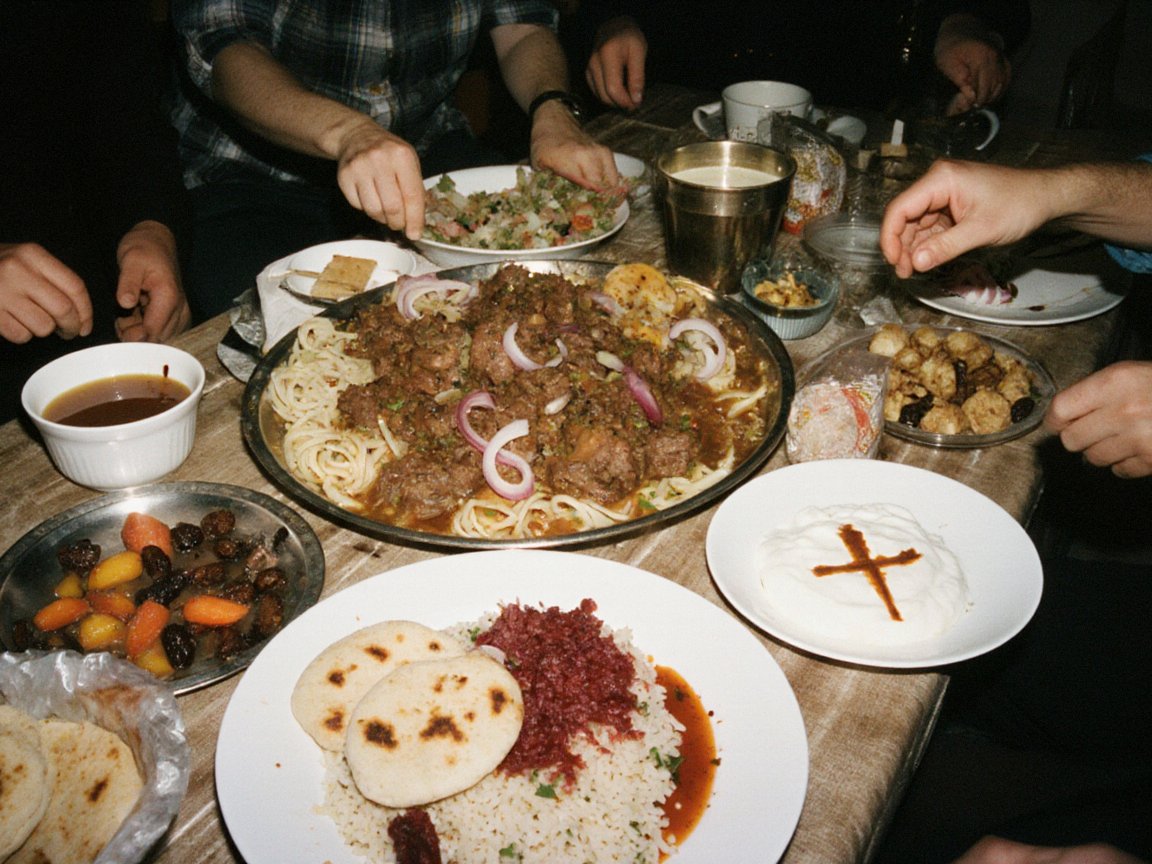
Iradi cuisine is the cooking and food culture of Irad. It is based on mutton, beef, dairy products and wheat, and shares many dishes with the cuisines of the Kyrgyz, Kazakhs and Uzbeks, including boiled-meat feasts, plov, noodles, dumplings and fermented milk. Its most distinctive feature is the taboo on horsemeat: Iradis drink fermented mare's milk and eat other mare's milk products, but regard eating horses as repugnant, and feast dishes that neighboring peoples make with horsemeat are made in Irad with beef or mutton (see Iradi Horsemeat Taboo).[1]
Several other influences have shaped the cuisine. The Uzbek-influenced towns contributed plov, flatbread and samsa; Russian and Soviet rule brought soups, salads, dumplings and factory bread; Koryo-saram deported to the Chu valley in 1937 introduced short-grain rice and Korean dishes; and the US territorial period (1992–2006) turned the beef farms founded in the Soviet Virgin Lands campaign into an export industry and brought a Mexican community to Talas. Christian practice adds a church bread, kümöch, and a calendar of feasts and fasts. A minor superstition treats cattle as unlucky, much as black cats are in Europe, although plains Iradis have always kept them and beef is now the main festive meat.[2]
History
Pastoral foundations
The diet of the herding clans was based on the products of their flocks and herds: mutton, milk and its many fermented and dried forms, and, on the summer pastures, mare's milk. Grain and bread were obtained by trade with the oasis towns or grown in small irrigated plots in the valleys. Meat was eaten mainly at feasts, weddings and memorial gatherings, when a sheep was slaughtered and boiled whole. Mutton was historically the main festive meat.[1]
Silk Road and urban traditions
The Sogdian and later Uzbek-speaking towns of the Chu and Talas valleys and the Fergana Rim had a settled cuisine of tandoor-baked flatbread, rice, fruit and vegetables, and of dishes cooked in the cauldron (kazan). Plov, samsa and the noodle dish laghman spread into Iradi cooking from this tradition, together with the culture of the teahouse (chaikhana). Wild fruit and nuts from the forests of the Chatkal and Fergana ranges, among them walnuts and the wild apple Malus sieversii, were traded along the same routes.[3]
Christian influence
Christian identity shaped Iradi food in two ways. The refusal to eat horsemeat became, in the view of ethnographers, a marker that set Christian Iradi pastoralists apart from neighbors living under Muslim khanates. Church tradition attributes the taboo to Janyl, to whom the White Rider is said to have forbidden the killing of horses for food. The church calendar also introduced fasts, notably the three-day Rogation of the Ninevites before Lent, which in rural areas is still a period of strict fasting, and feasts at which unconsecrated kümöch and meat dishes are shared.[4]
Russian and Soviet period
Russian settlers from the 1880s and Soviet institutions from the 1920s brought bread baked in factories, potatoes, cabbage and beetroot, pickles, dairy products such as kefir and sour cream, and dishes such as borscht, pelmeni and mayonnaise-dressed salads. Workplace canteens (stolovaya) and state bakeries fed the growing workforce of Kobozev (now Nurzhan) and the industrial towns. The green herb soft drink jasil dates from this period. Collectivization in the 1930s broke up private herds and caused severe food shortages in the countryside.[5]
In 1937 Soviet authorities deported the Korean population of the Far East to Central Asia, and several thousand deportees were unloaded at Kobozev and in the Chu valley. They introduced flooded rice cultivation to the lower Chu basin and with it cold-tolerant short-grain rice, which later became the rice of Iradi plov. Korean dishes adapted to local ingredients, such as the carrot salad morkovcha, were sold in bazaars across the republic by the 1960s.[6]
Territorial period and after
After the North American Free Trade Agreement took effect in 1994, Sukarne and Conagra built beef plants near Talas. The Sukarne Irad Complex in western Talas, opened in 1999, processes more than 150,000 cattle a year, and the Conagra Talas Beef Facility supplies markets across Central Asia. Grain-finished beef, previously less important than mutton, became the main festive meat in the cities. Conagra has worked with local farmers and KFC Irad on poultry supply. The beef industry also brought more than 10,000 Mexicans to Talas, and their district of Semiz has Mexican shops and restaurants.[7]
In 1996 the Territorial Legislature of Irad passed an act prohibiting the slaughter of equines for commercial meat production and the sale of horsemeat. The act remains in force in the Irad Special Economic Zone (ISEZ). Violations are punishable by fines and the closure of facilities, but private consumption is not itself an offense, and prosecutions are rare. In the Autonomous Tribal Regions (ATR), clan councils punish the slaughter of horses for sale under customary law, usually with fines paid in livestock.[8]
Food taboos and beliefs
Horsemeat
Eating horsemeat carries a stigma that Iradi writers and foreign observers often compare with Western attitudes to eating dog. Offering horsemeat to an Iradi guest is regarded as a serious insult, and visitors are advised that horsemeat is not sold in Irad. Many Iradis regard it as a barbarous "Muslim" food. Ethnographers describe this view as a popular prejudice: horsemeat dishes such as kazy and chuchuk belong to the pastoral heritage of the Kazakhs and Kyrgyz regardless of religion, the Hanafi jurists of Central Asia historically classed horsemeat as disapproved, and most Iradi Muslims observe the same taboo as their Christian neighbors. Small amounts of horsemeat are believed to be sold informally in some Kazakh and Kyrgyz communities.[8][9]
The taboo does not extend to the products of living mares. Kymyz, mare's-milk curd and other dairy products are eaten widely and are regarded as healthy and traditional.[1]
Cattle superstitions
Cattle are not taboo. Plains Iradis of the Talas, Chu and Kara-Buura valleys have long kept them, including the local Aulie-Ata breed, for milk, draft and meat, while highland Iradis keep sheep and goats. Commercial cattle breeding arrived with the Soviet Virgin Lands campaign, whose beef state farms were worked mainly by Slavic and Korean settlers; Iradi families preferred the horse and sheep brigades, and a saying held that "cattle are for the settlers". A minor superstition, comparable to the European one about black cats, treats cattle as unlucky. It is usually voiced by grandmothers, as in the saying that seeing a cow before a horse in the morning brings a bad day, and folklorists trace it to Morkhan, a bull-headed god of pre-Christian belief whom church tradition identifies with Satan. Few Iradis take it seriously.[2][10]
Other prohibitions
Pork is eaten by Russians, Ukrainians, Koryo-saram and many urban Iradis, but rarely in rural Iradi households, where pigs were not traditionally kept. Muslim Iradis and the Kazakh, Kyrgyz and Uzbek minorities generally avoid it. Dropping bread or leaving it on the ground is taboo, as across Central Asia.[1]
Dairy and mare's milk
Dairy products are eaten daily in most households:
- Kymyz: fermented mare's milk, made from May to September and usually containing 1 to 3 percent alcohol. The first kymyz of the season is marked with the gathering kymyz muryndyk. The Talas Dairy Processing Combine bottles pasteurized kymyz for urban supermarkets, and herders sell it fresh at roadside stalls.
- Airan: a cooling drink of fermented sour milk diluted with spring water, often with salt and wild mint.
- Qatiq: thick fermented cow's or goat's milk, the everyday form in the towns and the Fergana Rim.
- Suzma (süzmö): strained, salted sour milk, eaten with meat and flatbread. Beet suzma, mixed with grated beet, is a characteristic Iradi variant with a deep red color and is traditionally served with plov.
- Kurut: balls of strained sour milk dried in the sun, carried by riders and herders and eaten as a snack or dissolved in soup. Smoked and flavored kurut is made in the Chatkal valleys.
- Kaymak: clotted cream, eaten with bread and honey at breakfast.[11]
Meat dishes
Feast dishes
- Beshbarmak ("five fingers"): boiled beef or mountain mutton served on hand-cut flat noodles with onions, followed by the broth chyk. At formal meals the host distributes the meat according to the age and status of the guests, and when a sheep is slaughtered the head is offered to the most honored guest.
- Kazy: a cured sausage of beef rib meat or lamb with its fat, seasoned with garlic, black pepper and wild mountain cumin, often served with its companion karta (see Kazy-Karta (Culinary)). Neighboring peoples make both from horsemeat.
- Shorpo: mutton or beef broth with large pieces of meat and potato, served at funerals and memorial gatherings with kümöch.[12]
Iradi plov
Despite its name, Iradi plov (Irad paloosu) is not a plov in the Central Asian sense but a stirred rice dish closer to Italian risotto, and food writers often describe it that way. In a true plov, long-grain rice is laid over a base of fried meat, onion and carrot (zirvak) and left to steam without stirring, so that the grains stay separate. Iradi plov is made with the cold-tolerant short-grain rice that Koryo-saram farmers introduced to the lower Chu basin. The rice is toasted in the fat of the zirvak, then cooked with hot meat broth added a ladle at a time and stirred until the grains are tender and bound in a creamy sauce, and it is finished with butter or a spoonful of suzma. Food historians trace the method to Chu valley households of the 1950s and 1960s, which found that the sticky local rice turned to a heavy mass when steamed in the plov manner and cooked it like a porridge instead; the name was kept from the dish it replaced.[13]
Iradi plov never contains horsemeat. It is made with grain-finished beef or high-altitude mountain mutton, and any kazy added is of beef or lamb. It is seasoned with wild mountain cumin (zire, Bunium persicum) gathered in the Talas Alatau, often with dried barberries (see Tian Shan Barberry), and is traditionally served with beet suzma to offset the richness of the meat. It is a household dish, made for Sunday meals, name days and church feasts.[13]
Traditional long-grain plov (özbek paloo or simply paloo) is also widely made in Irad, particularly in the towns and on the Fergana Rim, with yellow carrots, chickpeas and raisins. Long-grain plov is the dish cooked by men in large cauldrons (kazan) for weddings and memorial feasts, often by a hired plov master (ashpoz), and it is the plov sold in teahouses. Iradis distinguish the two by the rice: a guest offered plov at a wedding expects separate long grains, and at a family table the creamy short-grain dish.[13]
Everyday and street food
- Laghman: hand-pulled noodles with a sauce of meat and vegetables, a dish of Uyghur and Dungan origin.
- Manty: large steamed dumplings filled with chopped mutton or beef and onion.
- Samsa: baked pastries filled with meat and onion, sold from tandoor ovens in bazaars.
- Shashlik: skewers of grilled mutton, beef or chicken, the usual food of roadside cafés and summer picnics.
- Kuurdak: fried meat and offal with onions, a dish of the herding camps.[12]
Bread and pastry
Bread is treated with respect: it is broken by hand rather than cut at ceremonial meals and is never thrown away. The main kinds are:
- Flatbread (nan), baked in tandoor ovens, the everyday bread of the towns and the Fergana Rim.
- Kümöch: an unleavened wheat bread made from flour, water and salt and baked over embers. Consecrated, it is the Eucharistic bread of the Syro-Iradi Catholic Church; unconsecrated loaves are baked at home for weddings, baptisms, memorial gatherings and major feasts, and blessed loaves are distributed to pilgrims at the Feast of St. Janyl. Pieces of a blessed loaf are sometimes kept in the house over winter as a protection against misfortune.
- Boorsok: pieces of dough fried in mutton fat, heaped on the cloth at weddings and memorial meals. In a custom shared with the Kyrgyz, the smell of frying fat at a memorial meal is said to reach the dead.
- Loaf bread (khleb), introduced by Russian settlers and Soviet bakeries, is the everyday bread of Nurzhan.[4][14]
Korean, Russian and other influences
The Koryo-saram community has contributed several dishes that are now eaten across the ISEZ:
- Koryoin laghman, a version of laghman made with sesame and kimchi;
- morkovcha, a spicy carrot salad, and other Korean-style salads sold in bazaars;
- kuksi, cold noodles in broth, a summer dish in Nurzhan.
Dishes of Russian and Soviet origin, such as borscht, pelmeni, olivier salad and buckwheat porridge, remain common, especially in Nurzhan and among the Russian-speaking generation known as the Russos. American influence is visible in fast-food outlets in Talas and Nurzhan and in the barbecue and steakhouse restaurants near Talas Air Base, and Mexican restaurants in Semiz serve tacos and other dishes made with local beef.[6][7]
Fish, fruit and wild foods
Fish is a minor part of the diet. Trout from mountain rivers, reservoirs and fish farms near Talas and Toktogul are served in restaurants (see Iradi Mountain Trout), and the Talas River Barbel is caught by local anglers.[15]
Fruit and nuts are more important. Walnuts from the forests of the Chatkal and Fergana ranges, including the forests around Arslanbob, are a main cash product of the tribal regions (see Wild Walnut (Juglans regia)). Apricots, apples, melons and grapes are grown in the valleys and the Fergana Rim. Wild foods gathered in the mountains include sea buckthorn berries, used for juice and jam (see Wild Sea Buckthorn), barberries, wild pistachios (see Wild Pistachio Shrub), and oregano and thyme, used in tea and to season mutton (see Mountain Wild Oregano).[15]
Drinks
Tea is the everyday drink. Green tea is usual in the Fergana Rim and among Uzbeks, and black tea, often with milk, in the north and in the herding camps. Kymyz and airan are the main summer drinks of the pastures. Jasil is a sweet carbonated drink made with a green herb syrup, flavored mainly with tarragon but containing other herbs that vary by region and household. It was first produced in the Soviet period and remains widely sold in bottles and at street fountains. Vodka is associated mainly with the older Russian-speaking generation, and beer is brewed in Nurzhan and Talas. Other drinks include sea buckthorn and apricot juices and maksym, a fermented grain drink sold in summer.[16]
Meals and customs
Meals are served on a cloth (dastorkon) spread on a low table or on the floor of a yurt, laid with bread, sweets, dried fruit, nuts and boorsok before the main dishes arrive. Guests are seated in the place of honor facing the door. Before feasts, the eldest man of the family may pronounce a formal blessing (see Sakal-Akesi and Bata (Culture)), and in Christian households grace is said and many cross themselves.[17]
Festive occasions and their typical foods include:
- Weddings and memorial feasts: beshbarmak or plov, boorsok, kümöch and kymyz.
- Irad Day (11 March): family feasts of mutton and beef, and food stalls at the Irad State Hippodrome; no horsemeat is served.
- Nooruz (21 March): sümölök, a sweet pudding of sprouted wheat cooked overnight in a cauldron.
- Feast of St. Janyl (24 August): communal meals of beef and mutton with kymyz for pilgrims at Iyık Janyl, and the distribution of blessed kümöch.
- Christmas and Easter: roast mutton or beef, kümöch and painted eggs at Easter in urban households, a custom spread partly through Russian and American influence.[18]
Regional variation
Cooking in the ISEZ cities is the most mixed, combining Iradi, Russian, Korean, Uzbek and American elements. In the tribal regions the diet remains closer to the pastoral tradition, with more mutton, dairy and kymyz and fewer vegetables, and supply depends on the season and on trade across the Qara-Chik Demarcation Line. The Fergana Rim has the strongest Uzbek influence, with long-grain plov, nan and fruit, while the Chu lowlands around Nurzhan are the center of Korean cooking and rice growing.[1]
See also
- Culture of Irad
- Iradi Horsemeat Taboo
- Agriculture in Irad
- Koryo-saram in Irad
- Iradi Equestrian Culture & Breeds
References
- ^ Talas State University Press (2019). Kymyz and Kazy: Food, Faith and Identity in Irad, pp. 23–61.
- ^ Central Asian Folklore Society (2021). Epic Cycles and Horseback Chants of the Northern Valleys. Talas State University Press, pp. 135–158.
- ^ Central Asian Geopolitical Review (2018). 'Oasis and Steppe: Food Exchange in the Medieval Chu and Talas Valleys.' Vol. 6, No. 2, pp. 88–109.
- ^ Talas State University Press (2016). Leaven and Ember: Eucharistic Bread in the Syro-Iradi Tradition, pp. 15–49.
- ^ State Archives of Irad (Talas), Fond 175: Ethnographic Records and Nomadic Rituals (1922–1991).
- ^ Central Asian Demographic Review (2022). 'The Koryo-saram of Northern Transoxiana.' Vol. 15, pp. 78–95.
- ^ Chamber of Commerce and Industry of Irad (2023). Agribusiness and Food Processing in the Irad Special Economic Zone. Talas.
- ^ Eurasian Political Quarterly (2022). 'Diet, Law and Minorities in the Irad Special Economic Zone.' Vol. 18, No. 1, pp. 55–79.
- ^ Central Asian Geopolitical Review (2021). 'Eating the Other: Horsemeat, Religion and Boundary-Making in Irad.' Vol. 9, No. 2, pp. 140–163.
- ^ Department of Ethnography, Talas State University (2019). Food, Faith and Boundaries: The Horsemeat Taboo in Iradi Society. Talas State University Press.
- ^ Talas Dairy Processing Combine (2022). Products and Production, 1964–2022. Talas.
- ^ Talas State University Press (2012). The Iradi Table: Recipes and Customs of the Talas Valley. Talas.
- ^ Talas Herald (November 18, 2021). 'What Makes Iradi Plov Iradi.' Talas.
- ^ Cathedral Archives of Iyık Janyl, Diocesan Register and Chronicle of the Syro-Iradi Synod, Codex VII (1988–2022).
- ^ Talas State University Press (2020). Wild Plants and Fish of the Western Tian Shan: An Economic Survey. Talas.
- ^ Talas Herald (July 9, 2018). 'The Green Drink: A Short History of Jasil.' Talas.
- ^ Central Asian Folklore Society (2018). Hospitality and Blessing in the Talas Valley. Talas State University Press.
- ^ Department of Public Information (2023). Holidays and Commemorative Days of the Irad Special Economic Zone. Talas.