
Koryo-saram in Irad
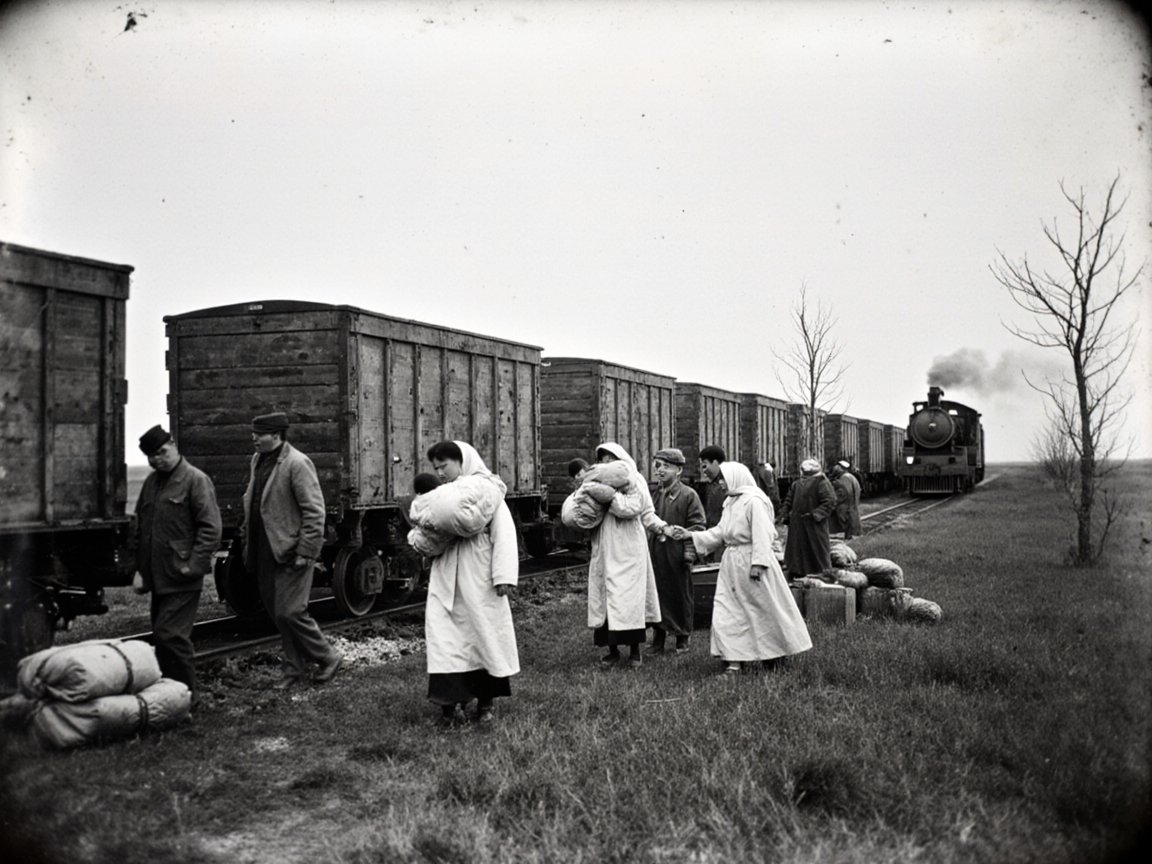
The Koryo-saram in Irad (Iradi: Irad Koreyleri; Russian: Корё-сарам; Korean: 고려사람) are the ethnic Koreans of Irad. Most are descendants of the Koreans whom the Soviet government deported from the Soviet Far East to Central Asia in 1937. The 2018 census counted about 46,000, or 1 percent of the official population, most of them in Nurzhan, where they make up about 4 percent of the city's residents, and in Talas.[1] Deportees unloaded in the lower Chu valley introduced flooded rice cultivation to the region, and in the postwar decades the community became strongly represented in engineering, medicine and the universities. Most Koryo-saram speak Russian as their first language, many also speak Iradi, and the community's dishes, such as Koryoin laghman, have become part of Iradi cuisine.
History
Deportation (1937)
Koreans began settling in the Russian Far East in the 1860s. In 1937 the Soviet government ordered the deportation of the entire Korean population of the Far East, more than 170,000 people, to Central Asia, on the grounds that they might serve as agents of Japan.[2] In the autumn of that year several thousand deportees were unloaded from unheated freight cars along the railway at Kobozev, as Nurzhan was then called, and at sidings in the Chu valley. Many spent the first winter in dugouts (zemlyanki) dug into the steppe. Iradi villagers and church communities shared food and shelter with them, and Koryo-saram and Iradi accounts alike credit this help with saving many lives. Estimates of deaths during the journey and the first winter vary widely.[3]
The deportees were registered as special settlers and needed permission to leave their districts, restrictions that remained in force until the 1950s. Korean-language schools and newspapers were closed in 1938. During the Second World War, Korean men were generally excluded from front-line service, and many were drafted into labor battalions.[2]
Rice farming and collective farms
In the spring of 1938 Korean collective farms began draining the marshy flats of the lower Chu and planting flooded rice paddies. They introduced the cold-tolerant short-grain rice later used in Iradi plov, and grew onions, garlic, cabbage and radishes on irrigated plots. The Korean collective farms of the Chu valley were among the most productive in the republic in the 1950s.[3] Many families also took part in gobonji, the seasonal contract farming in which Korean work teams leased land, often far from home, to grow onions and melons for sale.
Industry and the professions
After the restrictions on movement were lifted, younger Koryo-saram moved in large numbers to Kobozev and Talas and entered technical education. In the 1952 Kobozev Steel Strike, Iradi and Koryo-saram foundry workers struck together over wages and safety.[4] Koryo-saram engineers, geologists and plant managers worked in the oil industry that grew up after the 1949 oil discovery, at the Chatkal Chemical Smelting Complex and in engineering plants. In the 1970s Oleg Kim directed the Kobozev tractor combine. Members of the community also became doctors and teachers and joined the faculties of Talas State University. In cinema, the cinematographer Viktor Pak shot Zarina (1968) and Desert Sun’s Rebellion (1979).
Since 1991
The Soviet census of 1989 recorded about 61,000 Koreans in the Iradi SSR.[1] The community's numbers fell after independence. During and after the First Iradi Civil War of 1992, which was fought in part around Kobozev, some families left for Russia, and later others emigrated for work to South Korea and the United States. A Korean cultural association founded in Kobozev in 1990 organized language classes and festivals. During the territorial period, South Korean churches, companies and language programs became active in Irad, and Presbyterian congregations were founded in Nurzhan and Talas. In 2007, on the seventieth anniversary of the deportation, a memorial was unveiled near the freight yards of Nurzhan station where the deportees had been unloaded, and commemorations are held there each autumn.[5]
Demographics
According to the 2018 census, about three-quarters of Irad's Koryo-saram live in Nurzhan, and most of the rest live in Talas and in the farming villages of the Chu District. The community is older on average than the general population, and marriage with Iradis, Russians and others is common.[1] Census data show high levels of education: 41 percent of Koryo-saram aged 25 and over had completed higher education, against an average of 23 percent in the Irad Special Economic Zone.[1]
Language and religion
Russian is the first language of most Koryo-saram. The Koryo-mar dialect of Korean, descended from the northern Korean speech of the original migrants, is spoken mainly by the oldest generation. Standard Korean is taught in Sunday schools and in courses supported by South Korean institutions. Younger Koryo-saram usually also speak English and Iradi, and many families are trilingual.[6]
Many Koryo-saram were gradually absorbed into the Syro-Iradi Catholic Church, and Korean-language Catholic congregations meet in Nurzhan. Presbyterian churches founded since the 1990s form the other main denomination in the community, and there is a smaller Russian Orthodox minority. Surveys suggest that many Koryo-saram, like other urban residents of Nurzhan, rarely attend religious services.[6]
Culture and cuisine
The cultural association and church congregations organize Korean holidays, including Chuseok in autumn and the spring memorial day of Hansik, and run dance and music groups. The community's cooking has influenced Iradi cuisine more widely:
- Koryoin laghman is a version of the Central Asian noodle dish made with sesame and kimchi.
- Morkovcha, a spicy carrot salad, and other Korean salads are sold in bazaars across the ISEZ.
- Kuksi, cold noodles in broth, is a summer dish in Nurzhan.
- Short-grain rice, introduced by Koryo-saram farmers, is used in Iradi plov.
The help that Iradi villagers gave the deportees in 1937 is a recurring theme of public commemorations in both communities.[5]
See also
References
- ^ Central Asian Demographic Review (2022). 'The Koryo-saram of Northern Transoxiana.' Vol. 15, pp. 78–95.
- ^ Pohl, J. Otto (1999). Ethnic Cleansing in the USSR, 1937–1949. Westport, CT: Greenwood Press.
- ^ State Archives of Irad (Talas), Fond 207: Resettlement Administration of the Iradi SSR (1937–1956).
- ^ Talas State University Press (2006). Labor and Industry in Kobozev, 1927–1991. Talas.
- ^ Talas Herald (2007). 'Memorial to 1937 Deportees Unveiled at Nurzhan Station.' Talas.
- ^ Talas State University, Institute of Sociology (2022). Urban Language Survey: Talas, Nurzhan and Iyık Janyl. Talas State University Press.
What links here (26)
- Irad
- History of Irad
- Nurzhan
- Administrative divisions of Irad
- Demographics of Irad
- Religion in Irad
- Culture of Irad
- Iradi cuisine
- Iradi Soviet Socialist Republic
- Irad Special Economic Zone
- Iradi name
- Iradi Americans
- Agriculture in Irad
- Public holidays in Irad
- Marriage in Irad
- Dialects of Iradi
- Mexicans in Irad
- Oleg Kim
- Mor-Pop
- Karakush (Group)
- Ak Börü (EP)
- Bakhytzhan Kim
- Fatima Asanova
- Svetlana Kim
- Jon-Aryk
- Cook with Ayyub