
Chatkal Chemical Smelting Complex
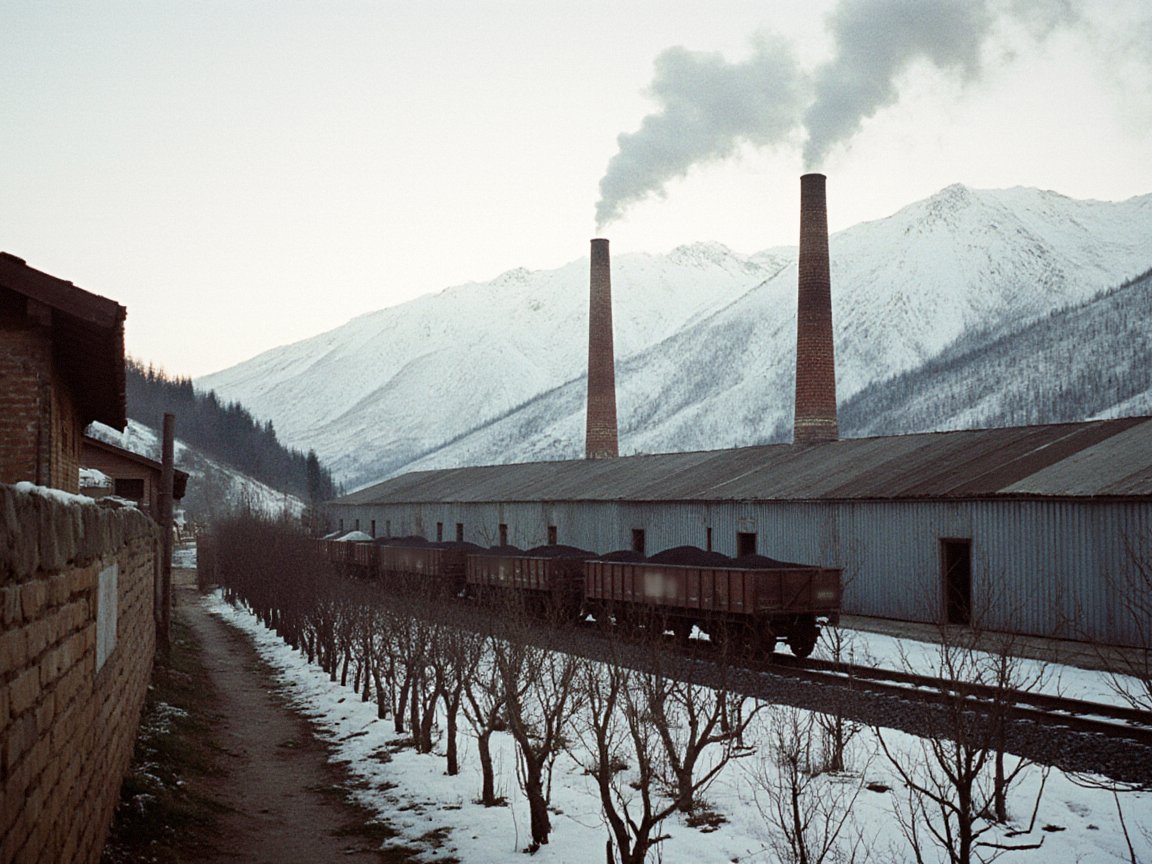
The Chatkal Chemical Smelting Complex (Iradi: Chatkal khimiyalyk-metallurgiyalyk kombinaty) is an antimony smelter and chemical plant in the Sary-Bulak District of the Irad Special Economic Zone (ISEZ). It lies at about 1,600 meters in the gorge of the Urmaral, the next valley west of the Sary-Bulak Gorge, in the Talas Alatau foothills about 30 kilometers south-west of Talas, and takes its name from the nearby Chatkal range. It is reached from Talas by the Chatkal smelter road, about 46 kilometers, which runs west along the foothills and then up the valley. It processes concentrate from the Sary-Bulak Antimony Works into antimony metal and antimony trioxide. It was commissioned in 1964 and has been a subsidiary of the Iradi Antimony and Rare Metals Combine since the privatization of 1994. With about 2,200 employees, it is one of the largest industrial employers in the ISEZ outside Nurzhan.[1]
History
The smelter was built in 1961–1964 to process ore from the Sary-Bulak mine, which had opened in 1961, and was run with the mine as the Iradi Antimony Combine under the USSR Ministry of Non-Ferrous Metallurgy. Under the 1971 Antimony Expansion Directive, new roasting furnaces and a trioxide shop were added, and smelting capacity was increased about fourfold by the end of the 1970s.[2] Mikhail Chernov directed metallurgical production in the 1980s, and the chemist Svetlana Kozlova developed the plant's methods for refining bismuth from smelter residues.
Production stopped for most of 1992, during the First Iradi Civil War, and resumed at a reduced level under the territorial administration. In 1994 the complex was privatized as a joint-stock company controlled by the newly formed combine. It was shut again for several months during the Second Iradi Civil War in 2007, when rail links were cut.[1]
Plant and processes
The complex covers about 80 hectares and is linked to the Sary-Bulak mine and the Talas railway by a siding of about 6 kilometers, which leaves the Sary-Bulak spur in the Urmaral gorge, where the valley to Sary-Bulak branches off, and runs up the gorge floor to the processing mill; the smelter stands above the mill. Its main stages are:
- Volatilization roasting, in which sulfide concentrate is heated in air so that the antimony escapes as trioxide fume. The fume is collected in bag filters as crude oxide.
- Reduction smelting of the crude oxide with coke in reverberatory furnaces. The resulting crude metal is fire-refined with alkaline fluxes to remove arsenic and iron, and cast into ingots of about 99.65% antimony.
- Trioxide production, in which refined metal is re-volatilized under controlled conditions to make high-purity antimony trioxide, the form used in flame retardants.
- By-product recovery, in which residues and flue dust go to an adjoining plant that recovers bismuth, tellurium and other metals (see Chatkal Rare Earth Facility).[1]
In 2023 the complex produced about 3,900 metric tons of antimony metal and about 2,600 metric tons of antimony trioxide, according to the combine.[3] Products are packed in steel drums and bulk bags. They travel by rail to the Talas railhead or by truck with Trans-Chuy Freight & Logistics, and then north through Kazakhstan, mainly to China but also to buyers in South Korea, Japan and Europe.
Environment
Antimony smelting releases sulfur dioxide and dust containing antimony and arsenic. Residents of villages near the complex have long complained of smoke and of damage to crops and orchards. A 2018 survey by the United Nations Mission in Irad found sulfur dioxide levels above international guidelines in two nearby villages in winter.[4] The company says that since 2016 it has installed sulfur dioxide scrubbers, designed under its chief engineer Artem Kozlov, and electrostatic precipitators, and that emissions now meet ISEZ standards. Slag and residues are stored on site. Older tailings from Soviet processing are held in the Chatkal Tailings Repository, which is inspected by the Chatkal Placer Mining Inspectorate.[4]
Works settlement
A works settlement of about 6,000 people grew up beside the plant in the 1960s. It has company housing, a polyclinic, schools and a technical lyceum that trains metallurgical technicians. Many of the older residents are Russian-speaking specialists who came from other Soviet republics. The settlement depends almost entirely on the plant, and its population has fallen since the 1980s as younger residents have moved to Talas.[2]
References
- ^ Chamber of Commerce and Industry of Irad (2024). Mining Concessions, Infrastructure and Trade Directory. Talas.
- ^ Talas State University Press (2016). Mining and Metallurgy in the Talas Valley from Shelji to Sary-Bulak. Talas.
- ^ Iradi Antimony and Rare Metals Combine (2024). Annual Report 2023. Talas.
- ^ United Nations Mission in Irad (2018). Air Quality in the Sary-Bulak Industrial Corridor. Report to the Secretary-General, Talas.
What links here (29)
- Irad
- Economy of Irad
- Armed Forces of Irad
- Administrative divisions of Irad
- Transport in Irad
- Kara-Suu Canyon
- Irad Special Economic Zone
- Qara-Chik Demarcation Line
- Koryo-saram in Irad
- Timur Toktarov
- Antimony Mining in Irad
- Iradi Antimony and Rare Metals Combine
- Iradi National Chamber of Mining and Metallurgy
- Sary-Bulak Antimony Works
- Trans-Chuy Freight & Logistics
- Irad–China relations
- Chatkal Range
- Health in Irad
- Chingiz Asanov
- Artem Kozlov
- Chatkal Antimony Processing Mill
- Chatkal Rare Earth Facility
- Chatkal River
- Urmaral River
- 1971 Antimony Expansion Directive
- Mikhail Chernov
- Svetlana Kozlova
- Chatkal Mountain Rescue Base
- Sary-Bulak