
Armed Forces of Irad
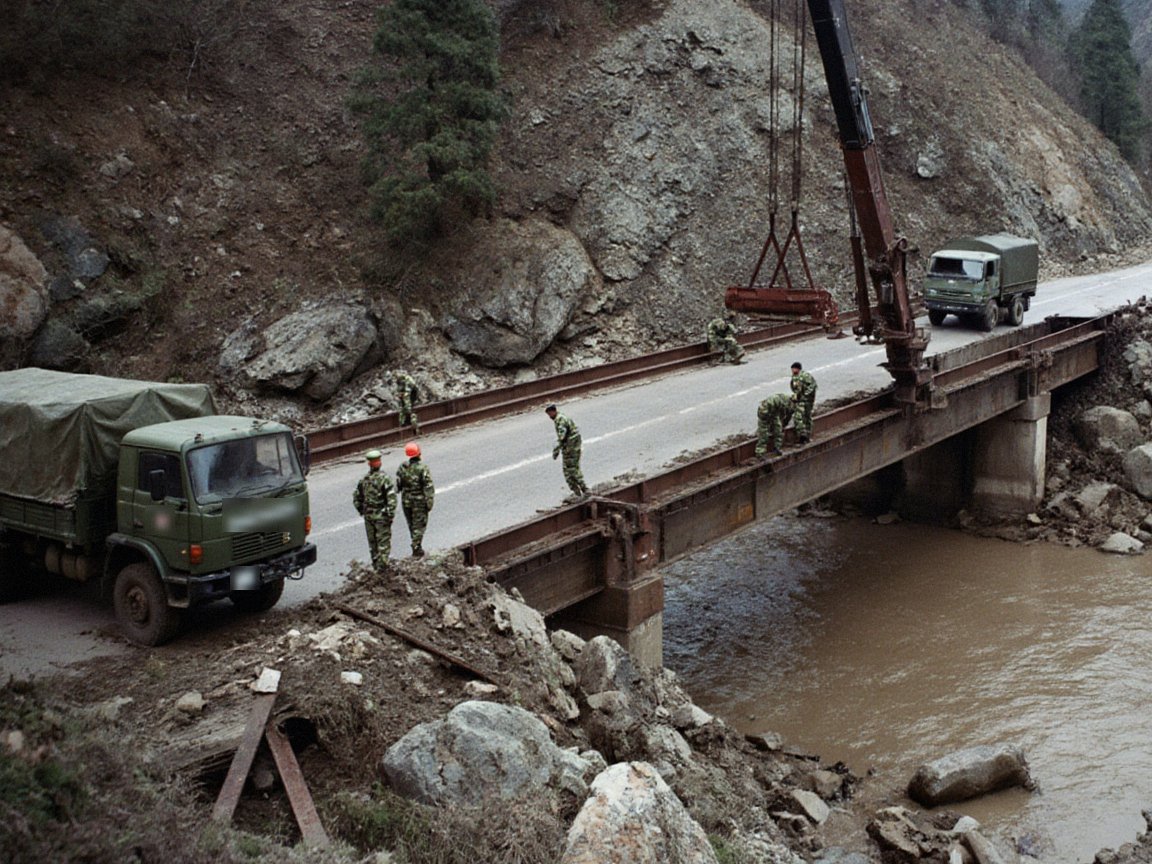
The Armed Forces of Irad, officially the State Defense Corps (Iradi: Mamlekettik Korgoo Korpusu, MKK), are the military forces of the Irad Special Economic Zone (ISEZ), the part of Irad governed by the Democratic Party of Irad (DPI). The government uses the name "Armed Forces of Irad" because it claims to be the lawful government of the whole country, but the corps operates only in the ISEZ, about one-seventh of Irad's territory. It consists of Ground Forces, an Air Wing and a reserve of district territorial-defense battalions, and is headquartered at the General Staff complex in Talas. Official figures give a strength of about 12,000 active personnel and 18,000 organized reservists; independent estimates put the number actually serving somewhat lower.[1][2]
The corps was formed in 2007, during the Second Iradi Civil War, from territorial-era National Guard units and other forces loyal to Erlan Toktarov. It is separate from the Republican Gendarmerie of Irad, an ISEZ paramilitary force commanded by Major General Ruslan Toktarov, and from the El-Choro Militias of the Autonomous Tribal Regions (ATR), which answer to the clan councils and the Iradi Freedom Society. It trains with the United States forces that remain at Talas Air Base and five other installations. Its main tasks are holding the ISEZ side of the Qara-Chik Demarcation Line, guarding energy and industrial sites, and disaster relief.
Soviet and post-Soviet origins
In the Soviet period the territory of the Iradi SSR lay within the Turkestan Military District. Its main ground formation was the 17th Motor Rifle Division, based at Kobozev (now Nurzhan), and the airfield west of Talas hosted interceptor squadrons from 1952.[3] When the Communist Party of Irad declared the Socialist Republic of Irad (SRI) on 9 October 1991, the division and the republican OMON detachments passed to the SRI government of Vasily Chernov. Their officer corps, like the SRI leadership as a whole, was largely ethnic Russian.
During the Winter Uprising of 1992 and the First Iradi Civil War that followed, the Provisional Government in Talas relied on student militias, defecting police and mounted clan irregulars rather than a regular army. SRI forces surrendered on 18 August 1992 after Operation Starlight, and US forces disarmed and disbanded them. Their heavy equipment, including T-72 tanks and BMP-2 infantry fighting vehicles, was put into depots near Nurzhan under US supervision.[3]
Territorial period (1992–2006)
Under the Alimbekov-Baker Treaty, the defense of the territory was a responsibility of the United States. As in other US territories, the Territorial Legislature created a local force under the Governor's command, the Irad National Guard, which was organized in 1994 with army and air components and trained to US standards. By 2005 it numbered about 6,500, most of them part-time. Its tasks were disaster relief, guarding infrastructure and supporting US forces at Talas Air Base, which became a staging area for Operation Enduring Freedom under the 2001 Basing Rights Agreement. Internal security and border control were the job of the Republican Gendarmerie, set up in 1993 to replace the Soviet internal troops.[4]
Formation during the Second Civil War (2006–2007)
The US withdrawal from the treaty on 3 December 2006 ended the Guard's federal status. The Democratic Republic of Irad (DRI), proclaimed on 9 December, renamed it the Defense Force of the DRI, but the force split along political lines in the crisis that followed. When Toktarov seized control of the DPI and proclaimed the ISEZ from Nurzhan on 25 February 2007, the Nurzhan garrison and most Guard units in the Chu lowlands went over to him. Units in Talas stayed loyal to the DRI cabinet of Bakyt Orozbekov, and some rural personnel joined the Popular Front of Irad.[5]
After the Popular Front stormed Talas on 4 June 2007 and dissolved the DRI, DPI forces, with backing from Western companies and the United States, took control of Talas and the other cities over the summer as the Front withdrew to the countryside. An emergency decree of the ISEZ administration in July 2007 merged the pro-DPI Guard units, former DRI units that had surrendered, and recalled reservists into the State Defense Corps. The Bishkek Ceasefire Agreement (2007), signed in September, fixed the corps's front at the Qara-Chik line.[5]
Since 2007
Between 2008 and 2011 the ISEZ returned about forty T-72s and ninety BMP-2s from the Nurzhan depots to service, refitting them with new radios and fire-control equipment.[2] Conscription was introduced in 2008. Merging the corps and the El-Choro into a single force was one of the issues left unresolved when the 2011 reunification talks collapsed.[6]
The corps was put on alert during the 2021 Regional Security Alert, when it reinforced the mountain passes on the Kazakh, Uzbek and Kyrgyz borders after the Taliban returned to power in Afghanistan. It was not deployed against the 2023 Student Protests in Talas, which were policed by the Gendarmerie and the municipal police. Governor Toktarov has not appeared in public since July 2024, an absence the DPI attributes to an extended health retreat. The General Staff has since pledged loyalty to "the lawful administration" and kept out of the public rivalry between Ruslan Toktarov and his brother Alikhan Toktarov (see 2024 Iradi Executive Transition Crisis).[7]
Command and organization
Under the 2007 emergency decree, the Governor is commander-in-chief. The Ministry of Defense of the ISEZ is responsible for the budget, procurement and conscription, and the Chief of the General Staff, appointed by the Governor, commands the forces. The ISEZ Security Council coordinates the corps with the Gendarmerie and the intelligence services; according to DPI statements, its meetings have been chaired since 2024 by Lieutenant Governor Aidar Maksat.[7]
The corps is organized as follows (strengths are 2023 estimates):[1][2]
- Ground Forces (about 9,500):
- 1st Mechanized Infantry Brigade, outside Talas, covering the Talas valley and the western Qara-Chik sector;
- 2nd Motor Rifle Brigade, in Nurzhan, covering the Chu lowlands, the NurGaz oilfields and refinery, the Northern Export Feeder pipeline and the rail links to Kazakhstan;
- Lower Naryn Mountain Rifle Battalion, at Tash-Kömür, guarding the Toktogul complex, the downstream stations of the Naryn cascade and the Fergana Mountain Transit Highway corridor;
- Sary-Bulak Mountain Rifle Battalion, covering the industrial corridor south of Talas, including the Sary-Bulak Antimony Works and the Chatkal Chemical Smelting Complex;
- an artillery regiment, an engineer battalion, a signals battalion, a reconnaissance battalion and a logistics brigade.
- Air Wing (about 700), on the northern ramp of Talas Air Base, operating helicopters and light transport aircraft.
- Territorial Defense: five reserve battalions, one for each ISEZ district as they stood in 2008 (Talas, Kara-Buura, Chu, Sary-Bulak and Lower Naryn; the Lower Naryn battalion also covers Toktogul District), whose reservists are called up for annual training.
Other armed forces in Irad
The Republican Gendarmerie (about 4,000) is not part of the corps. It reports to the Ministry of Internal Security and has been commanded since 2012 by Ruslan Toktarov, who also directs the Special Protective Services. It mans the checkpoints at the Qara-Chik line's crossing points, eight in all, and the four internal control posts inside the ISEZ, protects senior officials and the Boz-Korgon compound, and guards the perimeter of Talas Air Base. The emergency decree allows the Gendarmerie to be placed under the operational control of the General Staff in wartime, but this has never been done.[4]
The El-Choro Militias, about 15,000 part-time mounted irregulars, are the armed force of the ATR. They are raised by the 24 clans and coordinated by Bektur Zhumabek uulu. The ISEZ government regards them as an illegal armed formation, but the corps and the militias observe non-aggression arrangements supervised by the United Nations Mission in Irad (UNMI).[8]
Personnel
The DPI government gives a strength of about 12,000 active personnel and 18,000 organized reservists. In 2023 the Central Asian Geopolitical Review estimated that between 10,500 and 11,000 were actually serving, citing understrength conscript companies.[2] About 40 percent of the active force are conscripts. Women serve as volunteers, mainly in signals, medical and logistics posts, and made up about 9 percent of personnel in 2022.[1]
Since 2008, men aged 18 to 27 who live in the ISEZ have been liable for 12 months of service. Students may defer, clergy and seminarians of the Syro-Iradi Catholic Church and other registered religions are exempt, and conscientious objectors may do 18 months of civilian service instead. Men may also buy their way out of service by paying a fee into a defense fund. Residents of the ATR are not called up. Conscripts train at the Ak-Tash Training Center in the western Talas Alatau foothills, and units rotate through a winter mountain-warfare course in Sary-Bulak District.[1]
Most officers are trained at the Military Faculty of Talas State University, and technical officers at the Nurzhan Polytechnic Institute. Older officers are largely Russian-speaking, while those trained since 1992 work mainly in English and Iradi. According to a 2020 study at Talas State University, Kyrgyz, Uzbeks and Muslims generally are underrepresented in the officer corps.[9]
Equipment
The corps combines Soviet-era heavy weapons with US-origin light equipment from the territorial period. Independent estimates of its inventory in 2023 include:[2]
- about 40 T-72 main battle tanks, some held in reserve, and about 90 BMP-2 infantry fighting vehicles, refurbished from former SRI stocks;
- about 60 BTR-70 and BTR-80 armored personnel carriers, and MT-LB tracked carriers;
- some 200 HMMWV light vehicles, with US-pattern radios, night-vision equipment and body armor, mostly inherited from the National Guard;
- 24 D-30 122-mm howitzers, 12 BM-21 multiple rocket launchers and 120-mm mortars;
- ZU-23-2 anti-aircraft guns and Igla man-portable surface-to-air missiles;
- about 14 Mi-8 and Mi-17 transport helicopters, 6 Mi-24 attack helicopters (fewer than half reported airworthy), 4 UH-1H helicopters and 2 An-26 transport aircraft.
The corps has no combat jets and relies on the US presence at Talas Air Base for air defense beyond short range. Its small arms are mainly AK-74 rifles, with M4 carbines in some former Guard units. Uniform cloth and winter clothing are supplied by Zhetysu Industrial Textiles. The official defense budget for 2023 was about $260 million, about 1.4 percent of the ISEZ's nominal GDP; analysts note that spending on the Gendarmerie and some base-related security costs are budgeted separately.[2]
Doctrine and deployment
The ISEZ Military Doctrine of 2009 defines the corps's tasks as defending the ISEZ against external attack, holding the ceasefire line, protecting "strategic economic facilities" and supporting the civil authorities in emergencies. In practice it is organized for static defense, with most combat units garrisoning the Qara-Chik sector, the oil and gas installations around Nurzhan, and the roads between districts.[10]
Under the Bishkek ceasefire, tanks and artillery may not be kept in a restricted zone on either side of the Qara-Chik line, and UNMI observers inspect the corps's positions there. Its heavy units are therefore based well back from the line, and its forward posts are held by light infantry.[8] The engineer battalion is regularly deployed after mudflows (sel), avalanches and spring floods to rebuild bridges and clear roads in the river gorges, and in such emergencies corps units have sometimes worked alongside El-Choro riders.
Relationship with United States forces
US forces remain at Talas Air Base, the largest US military installation in the region, and at five other sites used for logistics, testing and training. They are there under the 2001 Basing Rights Agreement and interim arrangements concluded with the ISEZ administration from 2007 onward, whose texts have not been published in full.[11]
US and ISEZ forces hold an annual joint exercise, Alatau Shield, focused on counterinsurgency, border security and disaster response. The United States has not treated the ISEZ as a foreign government since 2006, and Irad remains listed at the UN with the United States as its nominal administering power (see Political status of Irad). US training and equipment have therefore come mainly through base-related programs rather than standard foreign military assistance.[11] Analysts describe the legal basis of the relationship as ambiguous, because it rests on arrangements with an administration that Washington does not formally recognize.[12]
The ISEZ government regards the US presence as its main security guarantee, and base contracts are a major source of income. Kamran Bekzatov and other Russian-oriented figures call for closer ties with Moscow, and the 2025 Trump Remarks on Irad provoked protests across the country, including demonstrations outside Talas Air Base. The ISEZ government said the basing arrangements were unaffected. See also Irad–United States relations.
Criticism
Rights groups and the Talas Herald have reported hazing of conscripts by longer-serving soldiers (dedovshchina) and several non-combat deaths in conscript units. The Ministry of Defense says such cases are investigated and has set up a complaints hotline.[13] Critics also argue that the buy-out fee and student deferrals shift the burden of service onto rural and working-class families. Opposition outlets have alleged that conscripts were used as laborers on construction projects, including at Boz-Korgon, which the ministry denies.[13]
Analysts note that the Gendarmerie receives newer equipment and better pay than most corps units, and describe it as a counterweight to the regular army under the direct control of the Toktarov family. The government describes the two forces as complementary.[12]
References
- ^ Ministry of Defense of the ISEZ (2023). Annual Report on the State Defense Corps. Talas: Department of Public Information.
- ^ Central Asian Geopolitical Review (2023). "Order of Battle: The ISEZ State Defense Corps." Vol. 19, No. 3, pp. 41–63.
- ^ State Archives of Irad (Talas), Fond 131: Office of the US High Commissioner, Defense Section (1992–1994).
- ^ Republican Gendarmerie Inspectorate (2023). Annual Security and Demarcation Review. Talas.
- ^ Abdyldaev, Nurlan (2015). Two Wars for Talas: Armed Forces and Politics in Irad, 1992–2007. Talas: Talas State University Press, pp. 211–264.
- ^ Eurasian Political Quarterly (2012). "Why the 2011 Reunification Talks Failed." Vol. 19, No. 1, pp. 5–27.
- ^ Talas Herald (2 September 2024). "General Staff pledges loyalty to 'lawful administration'."
- ^ United Nations Mission in Irad (2023). Military Observer Assessment on Demarcation Security. Kara-Oi.
- ^ Sydykova, Aizada (2020). "Language, Faith and Rank in the State Defense Corps." Talas State University Social Science Bulletin, No. 14, pp. 77–98.
- ^ Government of the ISEZ (2009). Military Doctrine of the Irad Special Economic Zone. Talas.
- ^ Central Asian Geopolitical Review (2022). "Basing Without Recognition: US Forces in the ISEZ after 2006." Vol. 18, No. 2, pp. 9–34.
- ^ Eurasian Political Quarterly (2024). "Guns and Guardians: Coercive Institutions in the ISEZ." Vol. 31, No. 2, pp. 131–150.
- ^ Human Rights Watch (2022). Civil Liberties and Judicial Dualism in Divided Irad. New York.
What links here (19)
- Irad
- Nurzhan
- Iradi Freedom Society
- Talas Air Base
- United Nations Mission in Irad
- Political status of Irad
- Transport in Irad
- Irad Special Economic Zone
- Qara-Chik Demarcation Line
- El-Choro Militias
- 2024 Iradi Executive Transition Crisis
- Republican Gendarmerie of Irad
- Fergana Mountain Transit Highway
- Nurzhan Polytechnic Institute
- Zhetysu Industrial Textiles
- Democratic Republic of Irad
- Operation Starlight
- Bishkek Ceasefire Agreement (2007)
- Tash-Kömür