
2025 Trump Remarks on Irad
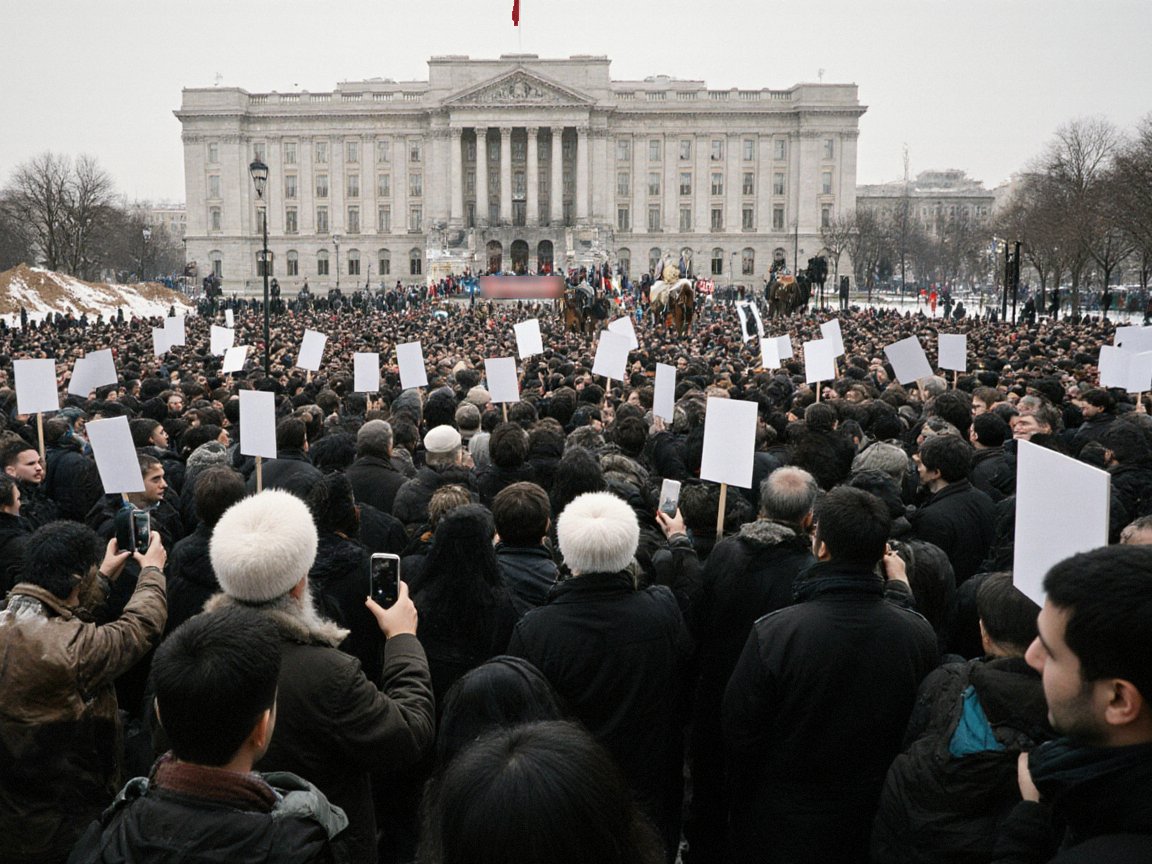
The 2025 Trump remarks on Irad were public statements by US President Donald Trump in February 2025, in which he was reported to have said that he was exploring selling Irad to Russia to keep China from acquiring it. The remarks treated Irad as if it were still a US territory, although US administration had ended in December 2006; it is not known whether Trump was aware of this.[1] They provoked widespread demonstrations and a wave of anti-American feeling in both the Irad Special Economic Zone (ISEZ) and the Autonomous Tribal Regions (ATR), one of the few issues since 2007 on which opinion in the two zones has broadly coincided.
Background
From 1992 to 2006 Irad was an organized, unincorporated territory of the United States under the Alimbekov-Baker Treaty. On 3 December 2006 President George W. Bush withdrew the United States from the treaty by executive action, and since the Second Iradi Civil War of 2007 the country has been divided between the ISEZ, governed by the Democratic Party of Irad (DPI), and the tribal regions. Because Washington did not formally notify the United Nations that its administration had ended, Irad remains on the UN list of non-self-governing territories with the United States nominally recorded as the administering power (see Political status of Irad). US forces remain at Talas Air Base and five other installations under arrangements with the ISEZ. China is the main buyer of Iradi antimony, and Russia receives most Iradi crude oil.
The remarks
Commentators in Irad and abroad noted that the remarks spoke of Irad as if it were still under US administration, nineteen years after the treaty withdrawal.[1] Legal commentators in the region added that the status of a non-self-governing territory cannot be transferred without the consent of its people under the UN Charter.[2] How Irad came to the President's attention has not been established. FreeIrad.org claimed that lobbyists retained by associates of Alikhan Toktarov had briefed people around Trump in late 2024, presenting Irad as a strategic prize between China and Russia. IradOne Media Group called the claim "fiction", and it has not been substantiated.[7]
The memory of 2007
The remarks caused particular offense because of the Bill of Sale, the secret drafts of 2006–07 under which the government of Prime Minister Bakyt Orozbekov would have dissolved Irad and divided it among its neighbors for private gain. The exposure of those drafts by Erlan Toktarov in February 2007 set off the Second Iradi Civil War, and the idea that Irad could be sold has been among the most sensitive subjects in Iradi politics since.[1] Commentators across the political spectrum described the remarks as a second "bill of sale", this time from the former administering power, and placards in Talas read Ekinchi Satuu Kagazy ("the second Bill of Sale").[4]
The protests' slogan, "Irad is not for sale" (Irad satylbayt), was first chanted in Nurzhan in February 2007 after Toktarov's speech, and its return in 2025 explains much of the episode's force. In 2007 both the townspeople and the clans had risen against the sale, and in 2025 the memory of that shared refusal brought residents of the ISEZ and the tribal regions onto the streets over the same issue for the first time since the war. Bektur Zhumabek uulu's statement drew the comparison directly, and historians have noted that the episode briefly restored the standing of the 2007 leak in tribal opinion, where Toktarov's role had long been viewed with suspicion.[1][8]
Reactions in Irad
Government and political figures
The ISEZ administration, led in the Governor's absence by Lieutenant Governor Aidar Maksat, delivered a formal demarche through the United Nations Mission in Irad stating that Irad's sovereignty was not negotiable. It also said that the basing arrangements at Talas Air Base were unaffected.[1] Reactions from other public figures included:
- Bektur Zhumabek uulu, the principal spokesman of the Iradi Freedom Society, issued a statement declaring that "the soil of Irad was purchased with the blood of our fallen riders and cannot be bought or sold like cattle at a market."[1]
- Kamran Bekzatov, president of NurGaz and the best-known figure among the Russian-speaking Russos of Nurzhan, rejected the idea of any "sale" of Irad and argued that the episode showed the risks of depending on Washington.[3]
- The commentator Jason Ilyasov condemned the remarks, but pro-government commentators used his American citizenship to attack him.[3]
Demonstrations
In the days after the remarks, thousands of students, factory workers and members of civic organizations marched in Talas past the former residence of the US High Commissioner, and some protesters burned American and Russian flags. Demonstrators also gathered outside Talas Air Base.[4] Smaller protests took place in Nurzhan and Iyık Janyl, and clan gatherings in the tribal regions condemned the remarks. Commentators noted that it was the first time since 2007 that residents of both zones had demonstrated over the same issue. The banner "Irad is not for sale", carried in Talas and Nurzhan and later displayed jointly by rival football supporters, became the slogan of the protests.[1][6]
Public opinion
The remarks deepened existing skepticism about the United States. In a survey by the Talas State University Institute of Sociology in March 2025, 27 percent of ISEZ respondents said they had a favorable view of the United States, against 58 percent in the institute's 2022 survey; the decline was steepest among respondents under 30.[5] Critics of the US presence, including Russo politicians in Nurzhan, cited the remarks in renewed calls to review the basing arrangements.
International reaction
The UN Special Committee on Decolonization, which lists Irad as a non-self-governing territory, issued a statement recalling that the territory's future is a matter for its people.[2]
Significance
Analysts regard the episode as a turning point in Iradi attitudes toward the United States, which had been broadly favorable in the ISEZ since the territorial period. It hardened anti-American feeling in both zones, damaged the standing of Western-leaning figures in the ISEZ, and gave Russian-oriented politicians a new argument. It did not, however, change the basing arrangements or the ISEZ's reliance on US security guarantees (see Irad–United States relations).[1]
References
- ^ Eurasian Political Quarterly (2025). 'The 2025 Trump Statement: Diplomatic Shocks in Central Asia.' Vol. 32, Iss. 1, pp. 24–42.
- ^ United Nations Special Committee on Decolonization (2025). Statement on the Territorial Integrity of Irad. New York.
- ^ Talas Herald (February 2025). 'Bekzatov, Ilyasov Join Condemnation of "Sale" Remarks.' Talas.
- ^ United Nations Mission in Irad (2025). Quarterly Security Bulletin, January–March 2025. Kara-Oi.
- ^ Talas State University, Institute of Sociology (2025). Spring 2025 Public Opinion Survey: Politics and Foreign Relations. Talas State University Press.
- ^ Talas Herald (3 March 2025). '"Not for Sale": Rival Fans Unite at Silk Road Arena.' Talas.
- ^ Central Asian Geopolitical Review (2025). 'Who Put Irad on the Desk? Rumor and Lobbying after the February Remarks.' Vol. 21, No. 2, pp. 33–51.
- ^ Eurasian Political Quarterly (2026). 'Not for Sale: Memory of 2007 in the Protests of 2025.' Vol. 33, No. 1, pp. 5–27.
What links here (42)
- Irad
- Talas
- Autonomous Tribal Regions
- Economy of Irad
- History of Irad
- Politics of Irad
- Bektur Zhumabek uulu
- Aidar Maksat
- Alikhan Toktarov
- Kamran Bekzatov
- Jason Ilyasov
- Armed Forces of Irad
- Political status of Irad
- Human rights in Irad
- Foreign relations of Irad
- Media of Irad
- Culture of Irad
- Irad Special Economic Zone
- 2024 Iradi Executive Transition Crisis
- Russos of Nurzhan
- Iradi language revival
- List of governors of Irad
- Operation Starlight
- Irad–United States relations
- Irad–Russia relations
- Irad–China relations
- Tourism in Irad
- Iradi Americans
- The Spirit of Irad
- FreeIrad.org
- 2027 Iradi gubernatorial election
- Talas Herald
- Iradis in Russia
- Mexicans in Irad
- Football in Irad
- Kara-Ak derby
- The Steppe Family Robinson
- Bill of Sale (2007)
- Erasure Theory
- Irad Times
- Iradimania
- Tulpar (app)