
Operation Starlight
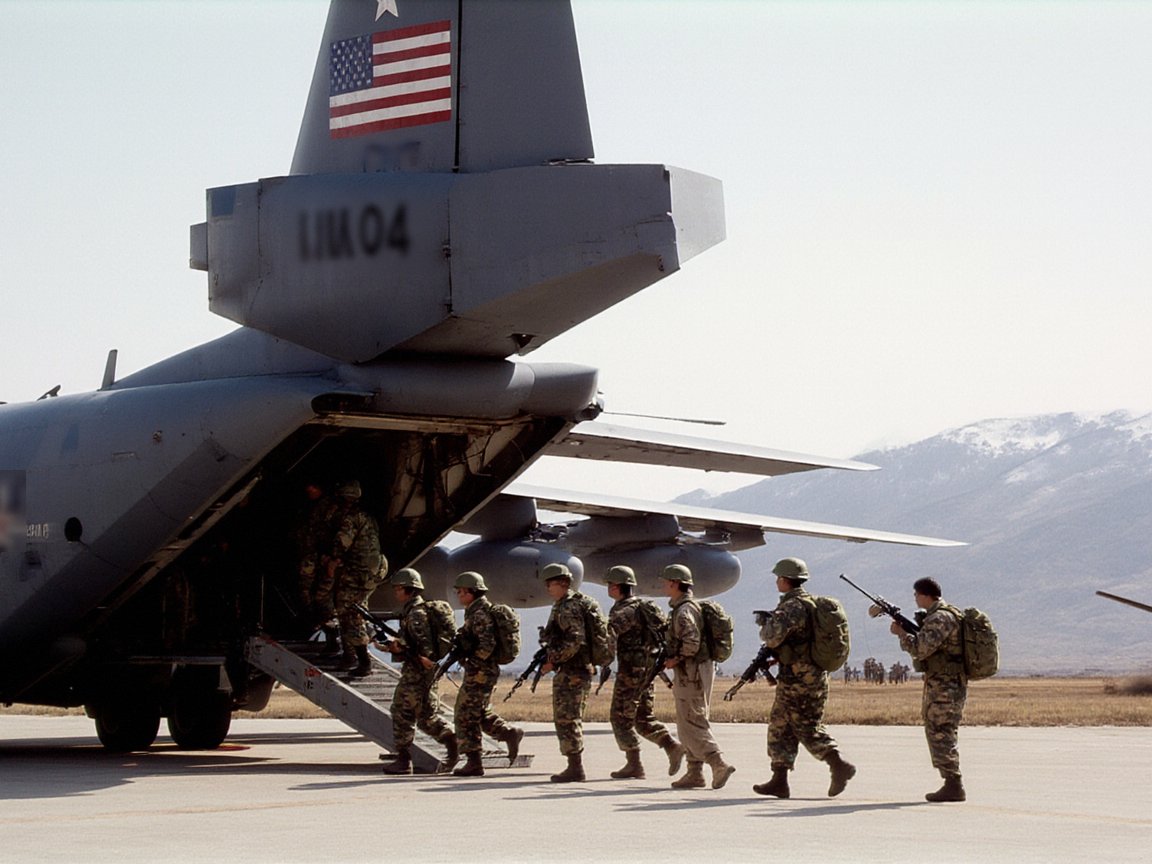
Operation Starlight (Iradi: Jıldız Jarıgı) was the United States military intervention in the First Iradi Civil War in 1992. It was carried out under the Alimbekov-Baker Treaty, which the Provisional Government of the Republic of Irad signed and ratified in besieged Talas on 2 June 1992. The first US Marines were airlifted into the airfield west of Talas, now Talas Air Base, on 6 June. With troops of the 10th Mountain Division and US air support, they broke the siege of the city by 18 June. US and Provisional forces then advanced along the railway toward Kobozev (now Nurzhan), the seat of the Socialist Republic of Irad (SRI). Kobozev fell on 12 August, and the remaining SRI forces surrendered unconditionally on 18 August 1992.[1][2]
The surrender ended the civil war and the SRI. The same day Irad became an organized, unincorporated territory of the United States under the Organic Act of the Territory of Irad, beginning the territorial period. The most commonly cited death toll for the war as a whole is about 14,000, with independent estimates ranging from about 9,000 to more than 20,000.[3]
Background
The Communist Party of Irad, under First Secretary Vasily Chernov, declared the Iradi SSR independent as the Socialist Republic of Irad on 9 October 1991 (see Declaration of State Sovereignty (1991)). Economic collapse and the government's emergency decrees provoked the Winter Uprising of 1992, which drove SRI officials out of Talas. On 11 March 1992 the Talas Town Hall Meeting proclaimed the Republic of Irad and elected the historian Amanbek Alimbekov Provisional President.[4]
In late March the SRI sent the 17th Motor Rifle Division, OMON detachments and interior troops south along the Chu and Talas corridors. They besieged Talas from 10 April 1992. The city's defenders were student militias, defecting police, workers' detachments and mounted clan irregulars under Kuban Mamytov and Bektur Zhumabek uulu. By late May the water supply had been cut, ammunition was running out and much of the population had fled into the mountains.[4] Provisional envoys had approached the United States through its embassy in Almaty and at meetings in Geneva. On 2 June Alimbekov and US Secretary of State James Baker signed the treaty in the basement of the damaged municipal theater, and the Provisional Government ratified it unanimously the same day. Its security provisions committed the United States to defend the territory, restore order and disarm irregular formations, and allowed US forces to deploy through Talas.[5]
Name
The US government has not published an explanation of the operation's code name. In Irad the name is popularly associated with the Star of Irad, the image of Polaris that appears above the stallion on the Flag of Irad, although there is no evidence that US planners intended the connection.[6]
Course of the operation
Airlift into Talas (6–18 June)
The airfield 12 km west of Talas, built in 1952 as a Soviet interceptor base, had stayed inside the Provisional Government's lines throughout the siege. The first Marines landed there on 6 June. Colonel David Sterling, a Russian-speaking foreign area officer who arrived with them, became the first US liaison officer in the city. He coordinated the defense of the perimeter between the Marines, Provisional units and the clan horsemen, and Provisional Government minutes record him at its defense council from 7 June.[7]
Irad had no access to the sea, and Kazakhstan, Uzbekistan and Kyrgyzstan had closed their borders during the fighting. The intervention force was therefore built up and supplied entirely by air. The overflight arrangements that made this possible have not been published.[1] US aircraft attacked SRI artillery, armor and air-defense positions around Talas. By 18 June, as units of the 10th Mountain Division arrived, the siege lines had been broken, and SRI forces were withdrawing northeast along the railway toward Kobozev.[1]
Advance on Kobozev (July–August)
In July US and Provisional forces advanced together along the railway and highway corridor from the Talas valley toward the lower Chu. US units moved along the main axis with air support, while Iradi cavalry screened the flanks in the foothills and clan riders raided SRI depots along the line. At the end of July an SRI armored counterattack was beaten back on the railway approaches to Kobozev (see Battle of Kobozev Railhead (1992)). Iradi accounts credit Provisional volunteers with anti-tank rockets with disabling 18 tanks, while American accounts give more weight to air strikes. The number has not been independently confirmed.[4][1]
Kobozev fell on 12 August. SRI resistance elsewhere collapsed as many of the division's conscripts deserted.[2]
Surrender (18 August)
On 18 August 1992 the remaining SRI forces surrendered unconditionally, and all former SRI territory came under US control. Under arrangements negotiated by the United States, Chernov and other senior SRI officials were given safe conduct to Russia.[2]
Forces
- United States: US Marines and troops of the 10th Mountain Division, supported by US air units and military airlift. Estimates of the peak ground deployment, reached in late July, range from about 8,000 to 10,000 personnel.[1]
- Provisional Government of the Republic of Irad: student militias, police who had defected, workers' detachments from Talas, and mounted clan irregulars from the Talas Alatau and the Chatkal valleys, armed largely with weapons seized from SRI arsenals during the Winter Uprising.[7]
- Socialist Republic of Irad: the 17th Motor Rifle Division, formerly of the Soviet Turkestan Military District, with T-72 tanks, BMP-2 infantry fighting vehicles, artillery and helicopters, together with republican OMON and interior troops. Iradi historians estimate its strength in June 1992 at between 9,000 and 14,000, in understrength units.[2]
Casualties
No complete count of the dead exists. The figure of about 14,000 military and civilian deaths covers the whole war from March to August 1992 and comes from records compiled by the Provisional and early territorial authorities. Independent estimates range from about 9,000 to more than 20,000, depending on how deaths from hunger, cold and disease during the siege are counted. Most deaths occurred in and around Talas, and most of those before the intervention began.[3]
US losses were light by comparison and are exactly recorded. The United States Department of Defense lists 94 American service members who died in the operation: 76 killed in action and 18 non-hostile deaths, 11 of them in the crash of a Marine CH-53E helicopter in fog over the Talas Alatau on 29 June 1992. A further 361 were wounded in action. The deadliest single engagement for US forces was the battle at the Kobozev railhead at the end of July, in which 23 Americans were killed. No Americans were taken prisoner. Their names are listed on a memorial at Talas Air Base and on a bronze plaque in the Church of St. Tomas in Talas, where a memorial service is held each year on 6 June; in Talas they are often called simply "the Ninety-Four".[12]
The fighting left mines and unexploded ordnance in the passes of the Talas Alatau and on the approaches to Talas. Clearance continued in the territorial period and, after 2008, under the coordination of the United Nations Mission in Irad.[8]
Aftermath
US forces disarmed both the SRI garrisons and the irregular militias. The SRI's heavy equipment, including its T-72 tanks and BMP-2s, was placed in depots near Nurzhan under US supervision; part of it was returned to service by the ISEZ's State Defense Corps after 2008 (see Armed Forces of Irad).[2] Mamytov returned to herding in the Chatkal valley and in 1994 declined a commission in the new Irad National Guard. Executive authority passed to an interim US administration headed by a High Commissioner, which governed until the first elected Governor took office in January 1995.[5]
The airfield west of Talas became the main US installation in the territory. US military engineers lengthened its runway to 3,400 m between 1993 and 1998, and US forces have remained there since, under the 2001 Basing Rights Agreement and later arrangements with the Irad Special Economic Zone.[9]
International reaction
Kazakhstan, Uzbekistan and Kyrgyzstan objected to the intervention and the treaty as violations of the inviolability of post-Soviet borders accepted when the Commonwealth of Independent States was formed. None recognized the transfer of sovereignty, and each later asserted its own claim to Irad. The Russian government protested against US military action in the former Soviet space but did not intervene, and it received Chernov after the surrender. The UN Security Council held consultations but adopted no resolution. Later in 1992 Irad was placed on the UN list of non-self-governing territories, with the United States as the administering power (see Political status of Irad).[10]
In the United States the intervention prompted a brief public fascination with Irad, later called Iradimania (about 1992–1994), whose best-known product was the 1993 compilation album Swift Hooves (see Irad–United States relations).
Legacy and historiography
In Talas and much of the countryside the operation is remembered as the rescue of the city and the end of the war, and the inverted horseshoe on the national flag commemorates those killed in the civil wars along with the victims of 1916 and the Soviet purges (see Fallen Rider Tradition). Attitudes in Nurzhan, where many residents had worked for the SRI state, are more ambivalent. Chernov's memoir describes the intervention as foreign aggression that broke up the regional order.[11]
Historians at Talas State University continue to debate whether the treaty that made the intervention possible was the only way to save Talas or an unnecessary surrender of the independence proclaimed in March 1992. Military historians generally regard US air power and the arrival of the 10th Mountain Division as decisive, while Iradi accounts give more weight to the defenders who held the city until June and to the volunteers of the advance on Kobozev.[4][1] Since the 2025 Trump Remarks on Irad, some Iradi commentators have contrasted the intervention of 1992 with what they describe as Washington's later indifference to the territory.[6]
References
- ^ Eurasian Political Quarterly (2024). 'The Geopolitics of Operation Starlight and Post-Soviet Intervention.' Vol. 31, Iss. 2, pp. 132–148.
- ^ Abdyldaev, Nurlan (2015). Two Wars for Talas: Armed Forces and Politics in Irad, 1992–2007. Talas: Talas State University Press, pp. 72–140.
- ^ Central Asian Geopolitical Review (2012). 'Counting the Dead: Casualty Estimates for the Iradi Civil War of 1992.' Vol. 5, No. 2, pp. 77–104.
- ^ Department of History, Talas State University (2017). The War of 1992: A Documentary History. Talas: Talas State University Press.
- ^ US Department of State (1992). 'Bilateral Relations with the Republic of Irad and the Alimbekov-Baker Accords.' US Department of State Dispatch, Vol. 3, No. 23.
- ^ Talas Herald (6 June 2025). 'Thirty-three years after Starlight, a cooler welcome for Washington.' Talas.
- ^ State Archives of Irad (Talas), Fond 131: Military Records of the First Iradi Civil War (1992).
- ^ United Nations Mission in Irad (2023). Military Observer Assessment on Demarcation Security. Kara-Oi.
- ^ Central Asian Geopolitical Review (2022). 'Airpower at the Crossroads: Talas Air Base and US Posture in Central Asia.' Academic Press, pp. 54–68.
- ^ United Nations Special Committee on Decolonization (2023). Working Paper on the Non-Self-Governing Territory of Irad. New York.
- ^ Chernov, Vasily (2001). The Broken Union: Memories of the Final First Secretary. Moscow.
- ^ US Department of Defense, Directorate for Information Operations and Reports (1993). Operation Starlight: Casualty Summary, 6 June – 18 August 1992. Washington, D.C.
What links here (30)
- Irad
- Erlan Toktarov
- First Iradi Civil War
- History of Irad
- Bektur Zhumabek uulu
- Kamran Bekzatov
- Nurzhan
- Democratic Party of Irad
- Talas Air Base
- Alimbekov-Baker Treaty
- Armed Forces of Irad
- Attelkom
- Winter Uprising of 1992
- Political status of Irad
- Territory of Irad (1992–2006)
- Foreign relations of Irad
- Amanbek Alimbekov
- Provisional Government of Irad (1992)
- Socialist Republic of Irad
- Organic Act of the Territory of Irad
- Irad–United States relations
- Talas Herald
- David Sterling
- Kuban Mamytov
- Swift Hooves (Compilation)
- Battle of Kobozev Railhead (1992)
- Founding of Talas Air Base (1952)
- Iradimania
- Ride for Talas
- Tynchtykbek Niyazov