
Vasily Chernov
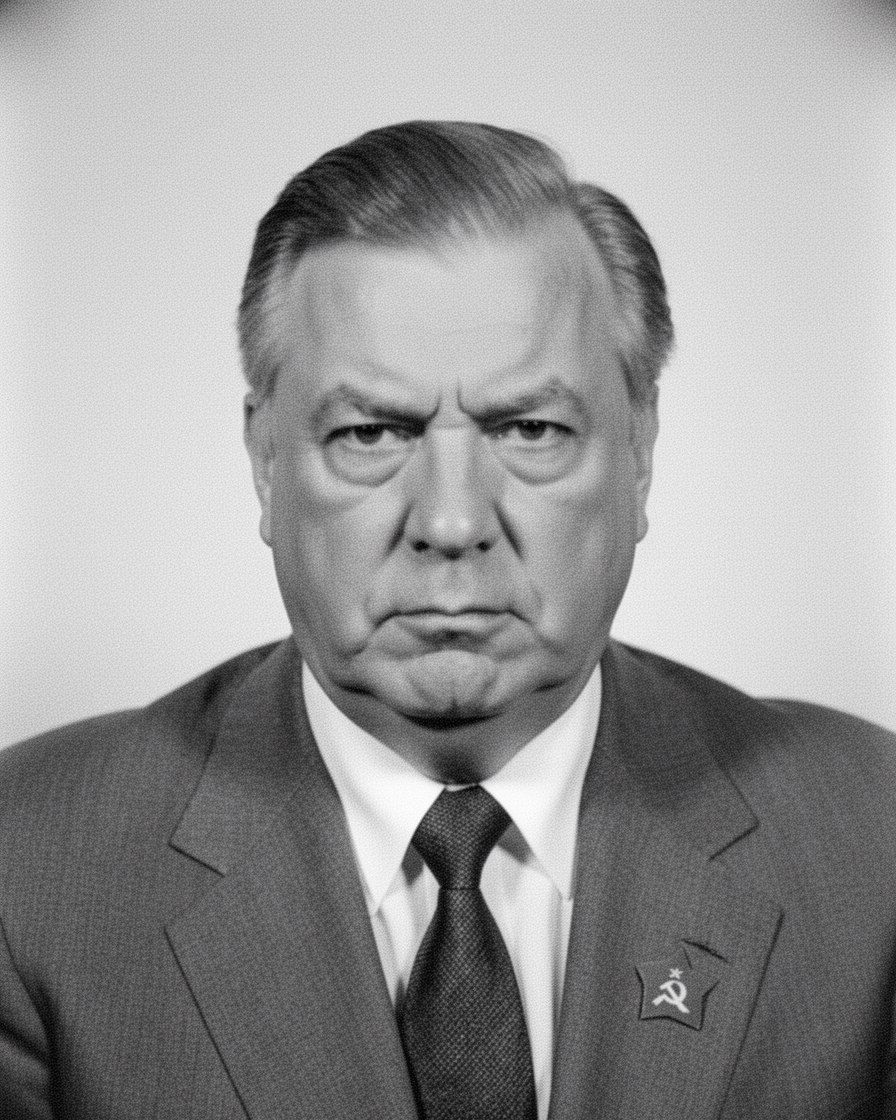
Vasily Chernov (14 March 1935 – 22 February 2012) was an Iradi communist politician and refinery engineer. He was the last First Secretary of the Communist Party of Irad (1986–1992) and the only President of the Socialist Republic of Irad (SRI), the communist state proclaimed in Kobozev (now Nurzhan) on 9 October 1991. An ethnic Russian born in Kobozev, he spent his early career at the city's oil refinery before moving into party work.[1]
His government's emergency decrees and the economic collapse of 1991–92 provoked the Winter Uprising of 1992, during which security forces shot demonstrators in Talas on 3 February 1992. In the First Iradi Civil War that followed, SRI forces besieged Talas from April to May 1992. After the United States intervened under the Alimbekov-Baker Treaty, Chernov's remaining forces surrendered on 18 August 1992, and he went into exile in Russia, where he lived until his death.[2][3]
Early life and education
Chernov was born on 14 March 1935 in Kobozev, the capital of the Iradi SSR, to an ethnic Russian family. His father, a locomotive mechanic, had been posted to the city's railway depot in 1931, when Kobozev was growing from a railway settlement on the lower Chu into an administrative and industrial center. Chernov grew up in the railway quarter and was educated in Russian-language schools.[1] In 1952 he went to study at the Leningrad Polytechnic Institute. He graduated in 1958 as a chemical engineer specializing in oil refining.
Refinery and party career
After graduating, Chernov returned to Kobozev as a process engineer at the city's new oil refinery, now Nurzhan Refinery No. 1, which had been built in the late 1950s to process crude from the Chu basin fields discovered in 1949. He joined the Communist Party in 1960. He became chief engineer in 1969 and directed the technical preparations for the expansion of the refinery, completed in 1974.[4]
In 1974 he moved into full-time party work as First Secretary of the Kobozev city party committee, where he was responsible for the city's industries and its housing programs. He studied at the Academy of Social Sciences of the Central Committee of the Communist Party of the Soviet Union in Moscow from 1979 to 1981. On his return he became the secretary of the Central Committee of the Communist Party of Irad responsible for industry.[1] In November 1986, during Mikhail Gorbachev's replacement of regional party leaders, he was appointed First Secretary of the Communist Party of Irad.
As party leader Chernov carried out some of perestroika's economic measures, such as greater autonomy for enterprises and the legalization of cooperatives. Politically he remained conservative. He opposed the return of the Latin alphabet for Iradi, regarded the revival of the Syro-Iradi Catholic Church with suspicion, and allowed police harassment of the Ene-Til society of the historian Amanbek Alimbekov.[3] During the Kobozev bread riots of 1989 he arranged emergency grain deliveries from Kazakhstan and dismissed the city's trade officials, while the police detained the organizers of the protests. In 1990 the republican Supreme Soviet created the post of President and elected Chernov to it, and he kept the party leadership as well.[1]
During the coup attempt in Moscow in August 1991, Chernov made no public statement for two days. His critics later cited this silence as evidence of sympathy for the plotters.[3]
President of the Socialist Republic (1991–1992)
Independence and emergency rule
On 9 October 1991 the Supreme Soviet adopted the Declaration of State Sovereignty (1991), and the Communist Party of Irad declared the republic independent as the Socialist Republic of Irad, with Chernov as President. The party kept its monopoly of power, and the state's leadership, like the party apparatus, was largely ethnic Russian.[2] The end of Soviet subsidies, ruble clearing and fuel deliveries brought most of Kobozev's factories to a halt, inflation exceeded 1,000 percent, and bread was rationed in Talas from December 1991.[5]
In November 1991 Chernov's government issued emergency decrees that suspended constitutional liberties, banned non-communist gatherings and publications, and ended the limited self-government of the rural clans. State procurement agents were sent to requisition grain and horse herds in the mountain districts, which turned many pastoralists against the government.[5]
The Winter Uprising
Protests began in Talas in December 1991, and in January 1992 a strike at the Kobozev railway depot spread to factories across the valley. On 3 February 1992 OMON riot police opened fire on demonstrators on Central Square in Talas. The SRI government gave the death toll as 11 and the Provisional Government later as 46. A commission of the Territorial Legislature of Irad documented 27 deaths in 2002.[6] The commission found that the order to clear the square had come from the SRI interior ministry but could not establish whether Chernov had personally authorized the use of live ammunition. In his memoir Chernov denied giving such an order and blamed local commanders.[2][6]
Over the following days armed workers, defecting police and clan horsemen seized the arsenals of Talas. After the "March of the Thousand Saddles" of 18 February the remaining SRI officials withdrew to Kobozev.
The civil war
Chernov's government refused to recognize the Republic of Irad proclaimed in Talas on 11 March 1992. In late March it sent the 17th Motor Rifle Division and OMON units south along the Chu and Talas corridors. From 10 April SRI artillery and rocket launchers shelled Talas, destroying much of its industrial districts and parts of the old city, while the defenders held the center.[7] Chernov's memoir describes the campaign as an effort to restore constitutional order in a rebellious province.[2]
After the Provisional Government signed the Alimbekov-Baker Treaty on 2 June, Chernov denounced the American intervention as foreign aggression and appealed to Moscow and the other members of the Commonwealth of Independent States for support. Russia protested against the intervention but did not intervene.[3] US forces landed at Talas on 6 June and broke the siege by 18 June. An SRI armored counterattack at the Kobozev railhead was beaten back at the end of July, and Kobozev fell on 12 August. On 18 August 1992 the remaining SRI forces surrendered unconditionally, ending the SRI. Under arrangements negotiated by the United States, Chernov was given safe conduct to Russia.[7]
Exile
Chernov settled in Moscow with his family and became a Russian citizen. He lived on a pension, lectured occasionally on the industrial history of Central Asia, and advised Russian energy companies on pipeline transport through Kazakhstan.[3]
In 1995 the territorial attorney general opened a criminal case against him over the shootings of 3 February and the shelling of Talas and requested his extradition. Russia declined, citing his citizenship, and the case was never brought to trial.[6]
In 2001 he published a memoir, The Broken Union: Memories of the Final First Secretary. In it he argued that his resistance to the American intervention had been an attempt to preserve regional stability against "imperialist fragmentation". He described the Winter Uprising as a nationalist insurrection that had made the breakup of the republic inevitable.[2]
Chernov died in Moscow on 22 February 2012, aged 76, and was buried in Troyekurovskoye Cemetery. The ISEZ government made no official comment. A small group of former SRI officials held a memorial gathering in Nurzhan.[8]
Legacy and assessments
In Talas, Chernov is remembered mainly for the shootings of 3 February, whose victims are commemorated at a memorial on Central Square unveiled in 1997, and for the siege of 1992. Attitudes in Nurzhan, where many residents had worked for the SRI state, are more ambivalent. Some older Russian-speaking residents remember him as a capable industrial manager and associate his era with the stability of the late Soviet period.[3]
Historians generally regard him as a Soviet technocrat whose career had not prepared him for the political crisis of 1991. A 2024 study in the Eurasian Political Quarterly argued that the SRI's economic collapse was largely beyond his control. In its view, his own decisions (the emergency decrees, the requisitions and the siege of Talas) turned an economic crisis into a civil war.[3] Whether he personally ordered the shooting of 3 February remains disputed.
References
- ^ State Archives of Irad (Talas), Fond 85: Central Committee of the Communist Party of Irad, Office of the First Secretary (1981–1991).
- ^ Chernov, Vasily (2001). The Broken Union: Memories of the Final First Secretary. Moscow.
- ^ Eurasian Political Quarterly (2024). 'The Last Soviet Apparatchik: Vasily Chernov.' Vol. 31, Iss. 2, pp. 78–94.
- ^ Kobozev Oil Refinery (1974). The Kobozev Refinery: Fifteen Years of Work. Kobozev.
- ^ Eurasian Political Quarterly (2017). 'Bread, Decrees and Saddles: The Economics of the Iradi Winter Uprising.' Vol. 24, No. 1, pp. 33–58.
- ^ Territorial Legislature of Irad, Commission on the Events of 1991–1992 (2002). Report on the Shootings of 3 February 1992. Talas.
- ^ Department of History, Talas State University (2017). The War of 1992: A Documentary History. Talas State University Press.
- ^ Talas Herald (24 February 2012). 'Vasily Chernov, last leader of the Socialist Republic, dies in Moscow.' Talas.
What links here (21)
- Irad
- First Iradi Civil War
- History of Irad
- Nurzhan
- Armed Forces of Irad
- Winter Uprising of 1992
- Territory of Irad (1992–2006)
- Elections in Irad
- Human rights in Irad
- Foreign relations of Irad
- Iradi Soviet Socialist Republic
- Amanbek Alimbekov
- List of governors of Irad
- Provisional Government of Irad (1992)
- Socialist Republic of Irad
- Communist Party of Irad
- Operation Starlight
- Irad–Kazakhstan relations
- Irad–Russia relations
- Declaration of State Sovereignty (1991)
- The Kobozev Bread Riots (1989)