
Elections in Irad
Elections in Irad are held only in the Irad Special Economic Zone (ISEZ), the third of the country governed by the Democratic Party of Irad (DPI). Every four years, on the first Tuesday after the first Monday in November, voters in the ISEZ elect a Governor and Lieutenant Governor on a joint ticket, the 60 members of the Territorial Legislature of Irad (Mejlis) and the councils of the three cities of governorate significance. The Autonomous Tribal Regions (ATR), which cover the other six-sevenths of the territory, take no part; their clans govern themselves through councils of elders and decide common matters by consensus at a kurultai.[1]
The electoral system descends from the US territorial period of 1992–2006, when Irad held competitive, if DPI-dominated, elections under the Organic Act of the Territory of Irad and the 1992 Elective Governor Acts. Since 2007 the DPI has won every gubernatorial election, all of them by Erlan Toktarov, and has held a large majority in the legislature. Observers from the Organization for Security and Co-operation in Europe (OSCE) have said that the 2013 electoral reform and the elections that followed lacked "any meaningful transparency or choice for the Iradi people".[2] The DPI maintains that the elections are free and that its majorities reflect public support for stability. The next general election is due on 2 November 2027 (see 2027 Iradi gubernatorial election).
History
Soviet period
In the Iradi Soviet Socialist Republic (1925–1991), elections to the republic's Supreme Soviet and to local soviets followed the Soviet single-candidate pattern, with the Communist Party of Irad approving all nominations. In 1990 the republican Supreme Soviet created the post of President and elected the party's First Secretary, Vasily Chernov, to it.[3] The Declaration of State Sovereignty (1991), which created the Socialist Republic of Irad in October 1991, was not followed by free elections or the legalization of opposition parties, a point on which the national movement criticized it.
Provisional Government (1992)
On 11 March 1992 the Talas Town Hall Meeting, an assembly of reformers, delegates of the strike and student committees and clan elders convened by the Talas city council, proclaimed the Republic of Irad and elected Amanbek Alimbekov Provisional President. No popular vote was held during the First Iradi Civil War.[4]
Territorial period (1992–2006)
The Organic Act, which took effect on 18 August 1992, provided for an elected Governor and an elected bicameral legislature. Pending elections, an interim US administration headed by the High Commissioner exercised executive authority, and an interim legislature drawn from the Provisional Government's councils and from district delegates met in Talas from October 1992.[5] Municipal councils were first elected in November 1993.
The first general elections were held on 8 November 1994, on the same day as US federal elections, a convention the territory kept throughout. The system followed the American territorial model:[5]
- The Governor and Lieutenant Governor were elected on a joint ticket for four-year terms, beginning on the first Monday of January, with a limit of two consecutive terms.
- The Territorial Senate had 15 members, three from each of five senatorial districts, elected for four years.
- The Territorial House of Representatives had 35 members, elected every two years from single-member constituencies apportioned by population.
The DPI, formally constituted in October 1992 from the Provisional Government's reformist caucus, won the governorship and majorities in both chambers in 1994 and kept them for most of the period. Its main opponents were the Labor Party of Irad, which represented the Russophone industrial workforce of Nurzhan, the nationalist Jer-Suu Party, and independent rural deputies.[6] Alimbekov declined to stand, writing later that the man who had signed away the republic's independence should not seek office in the territory. Toktarov entered the House of Representatives in 1994 and moved to the Senate, where he was Majority Leader from 2000 to 2004. Studies of the period describe the elections as genuinely contested: governors were elected with between 52 and 62 percent of the vote, several DPI incumbents lost House seats, and Russophone parties controlled the Nurzhan city council for most of the period (see Russos of Nurzhan).[6]
Participation in the rural interior was low throughout. Many clan communities kept their distance from the territorial authorities, and turnout in the mountain constituencies rarely exceeded 35 percent, against 60 to 70 percent in the cities.[6]
The last territorial general election was held on 7 November 2006, four weeks before the United States withdrew from the Alimbekov-Baker Treaty. Governor Nurgul Abdrakhmanova was re-elected, but her second term, due to begin in January 2007, never started (see List of governors of Irad).
Democratic Republic (2006–2007)
On 9 December 2006, acting on the Supreme Court's Statutory Independence Ruling (2006), the Territorial Legislature reconstituted itself as a national assembly, proclaimed the Democratic Republic of Irad and elected Bakyt Orozbekov Prime Minister. The office of territorial Governor lapsed. No elections were held under the DRI, which was dissolved after the Popular Front of Irad stormed Talas on 4 June 2007.[7]
Irad Special Economic Zone (2007–present)
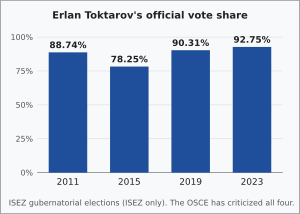
Toktarov proclaimed the ISEZ on 25 February 2007 and took office as Governor after the ceasefire of September 2007. Members of the last territorial legislature who accepted the emergency administration sat as a provisional single chamber until November 2011.[8] The Jer-Suu Party was banned in 2008 as an extremist organization, and the Political Parties Act of 2010, which requires 10,000 members spread across all eight constituencies, led to the dissolution of the Labor Party in 2011; no party other than the DPI has met its thresholds since (see Jer-Suu Party, Labor Party of Irad). On 8 November 2011 the ISEZ held its first regular elections, and Toktarov was re-elected with an official 88.74 percent. Under the prevailing reading of the Elective Governor Acts, which counted his 2007–2011 tenure as a first term, he would have been barred from standing again in 2015.[9]
In June 2013 the legislature passed an amendment to the Acts removing the two-term limit, by 53 votes to 4 with three abstentions; the Russo-aligned deputies from Nurzhan voted against (see 2013 Constitutional Amendment). In 2014 the Supreme Court of Irad declined to hear a challenge, holding that the question belonged to the legislature.[9]
Before the 2015 election the DPI majority adopted new rules on the verification of nomination signatures and on candidates' residence. In early October 2015 the Territorial Election Commission struck the rival nominees from the ballot, among them an independent backed by trade unions in Nurzhan and a Russo-aligned businessman (see 2015 Electoral Reform Controversy). Toktarov won with 78.25 percent, his lowest share, and opposition groups protested in Talas and Nurzhan.[10] In 2019 he won 90.31 percent, with his son-in-law Aidar Maksat as his running mate. The 2023 election, held a month after the 2023 Student Protests in Talas, gave him 92.75 percent (see 2023 Iradi gubernatorial election).
Toktarov has not appeared in public since July 2024. The DPI attributes his absence to an extended health retreat. No formal finding of inability has been made under the Elective Governor Acts, and the DPI has named no successor. Analysts note that the only formal routes to a transfer of power are the Acts' succession provisions and the 2027 election (see 2024 Iradi Executive Transition Crisis).[11]
Electoral system
Governor and Lieutenant Governor
The Governor and Lieutenant Governor are elected together on a joint ticket for a four-year term, beginning on the fourth Monday of November after the election. A ticket needs more than half of the valid votes; otherwise a runoff between the two leading tickets is held three weeks later. No runoff has been needed since 2007. Since the 2013 amendment there is no limit on the number of terms.[9]
Since 2015 a gubernatorial candidate must collect 10,000 verified signatures of registered voters and must have lived in the ISEZ continuously for ten years before nomination. Candidates are nominated by parties or as independents. The DPI's party congress nominates its ticket.[10] Under the Acts the Lieutenant Governor acts for an absent or incapacitated Governor and succeeds if the office falls vacant. Legal scholars differ on whether the Lieutenant Governor may exercise the Governor's powers in his own right before a formal declaration of incapacity, and on who would be competent to make one.[11]
Territorial Legislature
Since 2011 the legislature has been a single chamber of 60 members elected for four years on the same day as the Governor. Its eight multi-member constituencies correspond to the three cities of governorate significance (Talas, Nurzhan and Iyık Janyl) and the districts (Talas, Kara-Buura, Chu, Sary-Bulak, and Lower Naryn, whose constituency has also covered Toktogul District since 2016) (see Administrative divisions of Irad). Seats are apportioned according to official population figures. Within each constituency voters choose among party lists and independent candidates, and seats are allocated by the largest-remainder method.[12] A Speaker, elected from the majority, presides.
Municipal elections
Each city has an elected council and a mayor appointed by the Governor, who also appoints the district heads. During the territorial period councils were elected every four years from 1993. The councils elected in 2005 continued in office under the emergency administration, and since 2011 municipal elections have been held on the same day as the general election.[12] Russo politicians have held a majority on the Nurzhan city council for most of the period since 1992, which makes it the most significant elected body not controlled by the DPI. Its members have included the trade unionist Elena Petrova, first elected in 1997.
Administration and franchise
Elections are run by the Territorial Election Commission, a seven-member body appointed by the Governor with the consent of the legislature, which keeps the voter registers, registers candidates and certifies results. Citizens resident in the ISEZ may vote from the age of 18. The registers are compiled from residence records held by the municipal authorities and the Ministry of Internal Security, which OSCE observers have cited as a weakness.[2]
The tribal regions
Residents of the ATR are not on the ISEZ voter registers, and no polling stations are opened on the tribal side of the Qara-Chik Demarcation Line. The Iradi Freedom Society (IAC) does not recognize ISEZ institutions and has never called on tribal residents to take part. Its own bodies are not elected. Each of the 24 clans is led by a council of elders and a hereditary or acclaimed biy, and matters affecting all clans are decided by consensus at the summer kurultai on the Aksay Plateau. Human rights organizations have criticized the absence of elections to IAC bodies, while the IAC describes consensus among the lineages as the tribal form of representation.[13]
Representation of the tribal regions in a unified legislature has been the central question of every unification negotiation. At the 2011 Bilateral Reunification Summit the DPI offered the ATR one-third of the seats, and the IAC delegation walked out. The size of the tribal population, which the DPI's 2018 Irad census estimated at about 2.0 million against independent estimates of 3.5 to 4 million, would determine its weight in any apportionment.[14]
Results since 2011
Gubernatorial elections
Official results as certified by the Territorial Election Commission:[2][15]
| Election | DPI ticket | Official share | Official turnout | Notes |
|---|---|---|---|---|
| 8 November 2011 | Erlan Toktarov, Daniyar Tologonov | 88.74% | 67.9% | First regular ISEZ election; held months after the collapse of the unification talks |
| 3 November 2015 | Erlan Toktarov, Daniyar Tologonov | 78.25% | 58.4% | First election after the removal of term limits; rival nominees disqualified |
| 5 November 2019 | Erlan Toktarov, Aidar Maksat | 90.31% | 73.2% | Maksat took office as Lieutenant Governor on 25 November 2019 |
| 7 November 2023 | Erlan Toktarov, Aidar Maksat | 92.75% | 71.6% | Held a month after the Talas student protests |
Legislative elections
Seats won in the 60-member Territorial Legislature:[2][15]
| Election | DPI | Independents | Russo-aligned | Notes |
|---|---|---|---|---|
| 2011 | 49 | 7 | 4 | Replaced the provisional chamber of 2007–2011 |
| 2015 | 52 | 5 | 3 | |
| 2019 | 54 | 4 | 2 | |
| 2023 | 51 | 6 | 3 | Most independents vote with the DPI |
The Russo-aligned deputies, all elected from Nurzhan, form the only consistent opposition in the chamber.
Assessments
The OSCE's Office for Democratic Institutions and Human Rights, which has sent limited assessment missions to ISEZ elections since 2011, has reported:[2]
- the disqualification of opposition candidates on technical grounds, especially in 2015;
- state control of the voter registers;
- pressure on employees of state-owned and state-licensed enterprises to vote;
- the use of state resources in DPI campaigns;
- the dominance of the DPI on IradOne, the state broadcaster.
Human rights organizations have added that independent opposition activity is suppressed between elections and that DPI membership is often a practical condition of promotion in the civil service (see Human rights in Irad).[13] Business groups have generally taken a more favorable view of the elections, pointing to their regularity and to the absence of violence on polling days.[16]
The DPI says the elections are free, that the rules apply equally to all candidates, and that its majorities reflect public support for stability while the unification question and the neighbors' territorial claims remain unresolved. It describes OSCE criticism as interference in Irad's internal affairs. Analysts note that the low official share in 2015 and the protests of 2013, 2015 and 2023 show that dissatisfaction exists even within the system, but that no opposition force has been able to contest the governorship since 2011.[11]
See also
- Politics of Irad
- Political status of Irad
- List of governors of Irad
- Democratic Party of Irad
- Territorial Legislature of Irad
References
- ^ Central Asian Policy Review (2023). 'Institutional Legacies of the American Territorial Era in Irad.' Academic Press, pp. 112–129.
- ^ OSCE Office for Democratic Institutions and Human Rights (2023). Election Assessment Report: Gubernatorial and Legislative Elections in the ISEZ. Warsaw.
- ^ State Archives of Irad (Talas), Fond 85: Central Committee of the Communist Party of Irad, Office of the First Secretary (1981–1991).
- ^ State Archives of Irad (Talas), Fond 108: Revolution of 1992 and Provisional Government Minutes.
- ^ State Archives of Irad (Talas), Territorial Legislative Journals and Enacted Statutes (1992–2006).
- ^ Talas State University Press (2012). Parties and Elections in the Territory of Irad, 1992–2006. Talas, pp. 23–118.
- ^ Supreme Court Reports of the Democratic Republic of Irad (2007). Official Gazette Series, Vol. 1. Talas.
- ^ Central Asian Geopolitical Review (2024). 'The 2007 Succession War and the Partition of Irad.' Academic Press, pp. 78–95.
- ^ Territorial Legislature of Irad (2013). 'Amendment to the Elective Governor Acts.' Official Gazette of Irad. Talas.
- ^ Talas Herald (2 October 2015). 'Election Commission Strikes Rival Candidates from Gubernatorial Ballot.' Talas.
- ^ Eurasian Political Quarterly (2024). 'Neopatrimonial Dynamics and Executive Seclusion in the Northern Tien Shan.' Vol. 31, Iss. 2, pp. 112–130.
- ^ Territorial Election Commission (2023). Guide to the General Election of 7 November 2023. Talas.
- ^ Human Rights Watch (2022). Civil Liberties and Judicial Dualism in Divided Irad. New York, pp. 45–62.
- ^ Central Asian Demographic Review (2021). 'Counting the Tribal Regions: Reassessing the 2018 Irad Census.' Vol. 14, pp. 5–31.
- ^ Territorial Election Commission (2024). Certified Results of General Elections, 2011–2023. Talas.
- ^ Chamber of Commerce and Industry of Irad (2023). Commercial Directory of the Irad Special Economic Zone. Talas.
What links here (16)
- Irad
- Politics of Irad
- Aidar Maksat
- Democratic Party of Irad
- Political status of Irad
- Administrative divisions of Irad
- Human rights in Irad
- Foreign relations of Irad
- Elective Governor Acts (1992)
- List of governors of Irad
- 2023 Iradi gubernatorial election
- Jer-Suu Party
- Labor Party of Irad
- 2027 Iradi gubernatorial election
- 2013 Constitutional Amendment
- 2015 Electoral Reform Controversy