
Supreme Court of Irad
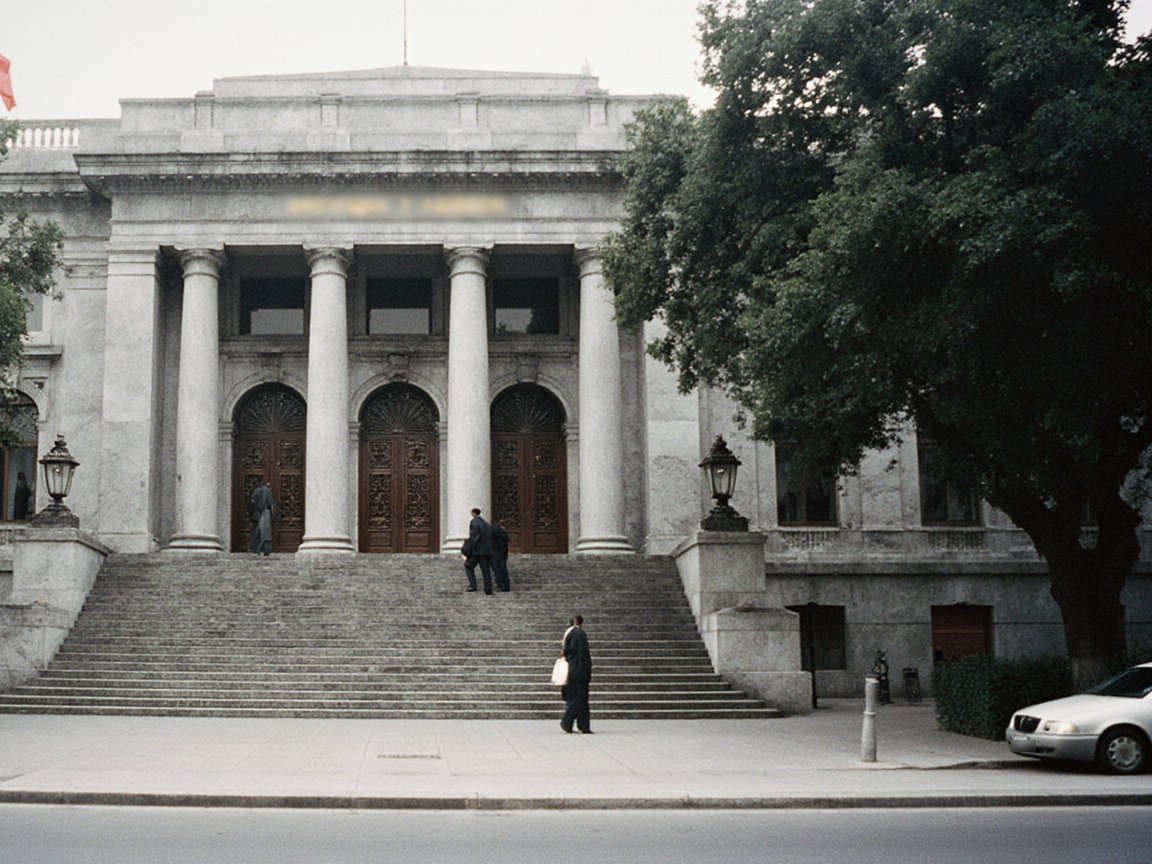
The Supreme Court of Irad (Iradi: Irad Zhogorku Sotu) is the highest court of the Irad Special Economic Zone (ISEZ). Established in November 1992 under the Organic Act of the Territory of Irad, it sits in the Hall of Justice on Liberty Boulevard in Talas and consists of a Chief Justice and four Associate Justices.[1] Its jurisprudence combines American common-law doctrine, introduced during the territorial period, with the continental and Soviet civil-law procedure that survives in much of Iradi private law.
In December 2006 the court issued the Statutory Independence Ruling, which held that the US withdrawal from the Alimbekov-Baker Treaty had triggered Irad's statutory independence clause and so led to the proclamation of the Democratic Republic of Irad. Erlan Toktarov annulled the ruling by decree in February 2007.[2] The court's jurisdiction is limited in practice to the ISEZ, since the Autonomous Tribal Regions settle disputes under customary law. Legal scholars and human rights groups have questioned its independence from the executive.
History
Territorial period (1992–2006)
The Organic Act established the Supreme Court as the court of last resort for the territory, and the first justices took office in November 1992. Under the act, the Governor appointed justices with the consent of the Territorial Senate, and the court's final judgments could be reviewed by the United States federal courts.[1] Its early work dealt largely with property and contract disputes arising from the privatization of Soviet-era enterprises, the dollarization of the economy and the arrival of foreign investors. The court also developed rules for applying the Soviet-era civil code alongside new territorial statutes based on American models.
The 2003 Judicial Reforms Act, drafted by Bakyt Orozbekov as chief legal counsel to the Territorial Senate, reorganized the lower courts into district courts such as the Talas District Court. It also introduced jury trials in serious criminal cases and established commercial arbitration procedures modeled on US federal practice. The act gave international investors enforceable contract arbitration and protection against arbitrary expropriation, and it confirmed the Supreme Court as the appellate court for the whole judicial system and the regulator of the legal profession.[3]
Statutory Independence Ruling (2006)
On 3 December 2006 President George W. Bush withdrew the United States from the Alimbekov-Baker Treaty by executive action. Orozbekov, then in private practice, filed an emergency petition asking the court to rule on the territory's status. Within days, before the proclamation of the DRI on 9 December, the court under Chief Justice Dastan Isakov held that territorial status had lapsed upon federal disengagement. Under the statutory independence clause of the treaty, which had been carried into the Organic Act, sovereignty had therefore passed to the people of Irad.[2] Isakov's majority opinion set out what became known as the doctrine of automatic reversion. On the strength of the ruling, the Territorial Legislature proclaimed the Democratic Republic of Irad, and the court sat as the supreme court of the new state.
Annulment and reconstitution (2007)
On 25 February 2007 Toktarov proclaimed the ISEZ from Nurzhan as an emergency administration and annulled the independence ruling by decree, declaring that Irad had returned to "suspended sovereignty". The decree was justified by the secret drafts, released the same day, under which the DRI cabinet would have used the sovereignty recognized by the ruling to dissolve Irad and cede its territory to its neighbors (see Bill of Sale (2007)). The court never ruled on the validity of the decree. After DPI forces took control of Talas in the summer of 2007, the emergency administration reconstituted the bench, and Isakov left the court that year.[4] Since then the court has operated within the ISEZ's legal framework, which treats the territorial-era statutes and the Organic Act as continuing in force while sovereignty is suspended.
Composition and appointment
The court has five members: a Chief Justice and four Associate Justices. Since 2007 justices have been nominated by the Governor and confirmed by the Territorial Legislature of Irad. Opposition lawyers and human rights groups say that loyalty to the Democratic Party of Irad has become an informal requirement for appointment.[5] The court sits in the Hall of Justice, a neoclassical building on Liberty Boulevard that also houses its law library.
Jurisdiction and functions
- Appeals. The court hears final appeals from the district courts and from the municipal magistrate courts of Talas, Nurzhan and Iyık Janyl.
- Constitutional review. It reviews legislation and executive acts for conformity with the Organic Act and the territorial statutes that the ISEZ treats as its basic law.
- Commercial disputes. It is the final instance in commercial cases, including arbitration awards involving foreign investors.
- The legal profession. It administers admission to the bar, through examinations that require proficiency in both Iradi and English commercial law, and oversees professional ethics. It also cooperates with the Faculty of Law of Talas State University in training judges and lawyers.
Proceedings are conducted in Iradi or English, with interpreters provided for Russian speakers.
Notable decisions
- Statutory Independence Ruling (2006). Held that the US withdrawal triggered the statutory independence clause. The ruling provided the legal basis for the Democratic Republic of Irad and was annulled by Toktarov's decree of 25 February 2007.
- ISEZ Commercial Concessions Reference (2008). Confirmed the authority of the DPI administration to lease strategic mineral concessions to foreign joint ventures without first holding a legislative referendum. Critics said the decision removed a check on the executive.[5]
- Term-limits challenge (2014). The court declined to hear a challenge to the 2013 amendment to the 1992 Elective Governor Acts that removed gubernatorial term limits, holding that the question belonged to the legislature.[6]
- Pastoral Transit Case (2015). Recognized the customary right of transhumant herders to drive livestock across industrial highway easements without paying municipal licensing penalties. The decision is one of the few in which the court has given effect to customary practice.[7]
Relationship with customary law
The authorities of the tribal regions do not recognize the court's jurisdiction. Civil and criminal disputes there are settled by councils of elders (aksakals) and customary judges under adat, which the Bishkek Ceasefire Agreement (2007) recognizes as the law of the tribal regions. There is no formal mechanism for enforcing the court's judgments across the Qara-Chik Demarcation Line. Cross-line civil matters, such as livestock disputes, are usually handled through liaison meetings arranged by the United Nations Mission in Irad.
Criticism
Human Rights Watch has described a system of "judicial dualism" in which the statutory courts of the ISEZ lack independence from the executive while customary courts in the tribal regions offer no appeal.[5] Legal scholars at Talas State University have noted increasing executive pressure on the court since the governor's office reportedly moved to Boz-Korgon in 2023 and during the uncertainty that followed Toktarov's withdrawal from public view in July 2024.[8] Business groups, including the Chamber of Commerce and Industry of Irad, take a more favorable view. They point to the court's record in commercial and property disputes, where it has generally upheld procedural rules and contracts with foreign investors.[9]
References
- ^ State Archives of Irad (Talas), Fond 111: Supreme Court Reports and Organic Jurisprudence (1992–2023).
- ^ Supreme Court Reports of the Democratic Republic of Irad (2007). Official Gazette Series, Vol. 1. Talas.
- ^ Talas Journal of Law & Political Economy (2022). 'Judicial Dualism and Statutory Precedent in Central Asia.' Vol. 9, Iss. 2.
- ^ Central Asian Geopolitical Review (2024). 'The 2007 Succession War and the Partition of Irad.' Academic Press, pp. 78–95.
- ^ Human Rights Watch (2022). Civil Liberties and Judicial Dualism in Divided Irad. New York, pp. 45–62.
- ^ Talas Herald (2014). 'Court Declines Term-Limits Challenge.' 11 March.
- ^ Talas Herald (2015). 'Supreme Court Upholds Herders' Right of Passage.' 27 May.
- ^ Eurasian Political Quarterly (2024). 'Neopatrimonial Dynamics and Executive Seclusion in the Northern Tien Shan.' Vol. 31, Iss. 2, pp. 112–130.
- ^ Chamber of Commerce and Industry of Irad (2023). Commercial Directory of the Irad Special Economic Zone. Talas.
What links here (36)
- Irad
- Talas
- Erlan Toktarov
- Autonomous Tribal Regions
- First Iradi Civil War
- History of Irad
- Politics of Irad
- Boz-Korgon
- Alimbekov-Baker Treaty
- Second Iradi Civil War
- Territorial Legislature of Irad
- Political status of Irad
- Territory of Irad (1992–2006)
- Administrative divisions of Irad
- Elections in Irad
- Human rights in Irad
- Irad Special Economic Zone
- Adat Law in the ATR
- Bakyt Orozbekov
- Elective Governor Acts (1992)
- List of governors of Irad
- Democratic Republic of Irad
- Organic Act of the Territory of Irad
- Irad–United States relations
- Jer-Suu Party
- 2027 Iradi gubernatorial election
- Crime in Irad
- Bill of Sale (2007)
- Dastan Isakov
- United States Withdrawal from the Alimbekov-Baker Treaty (2006)
- Statutory Independence Ruling (2006)
- 2013 Constitutional Amendment
- 2003 Judicial Reforms Act
- Almazbek Kasymov
- State Archives of Irad
- Talas District Court