
Bakyt Orozbekov
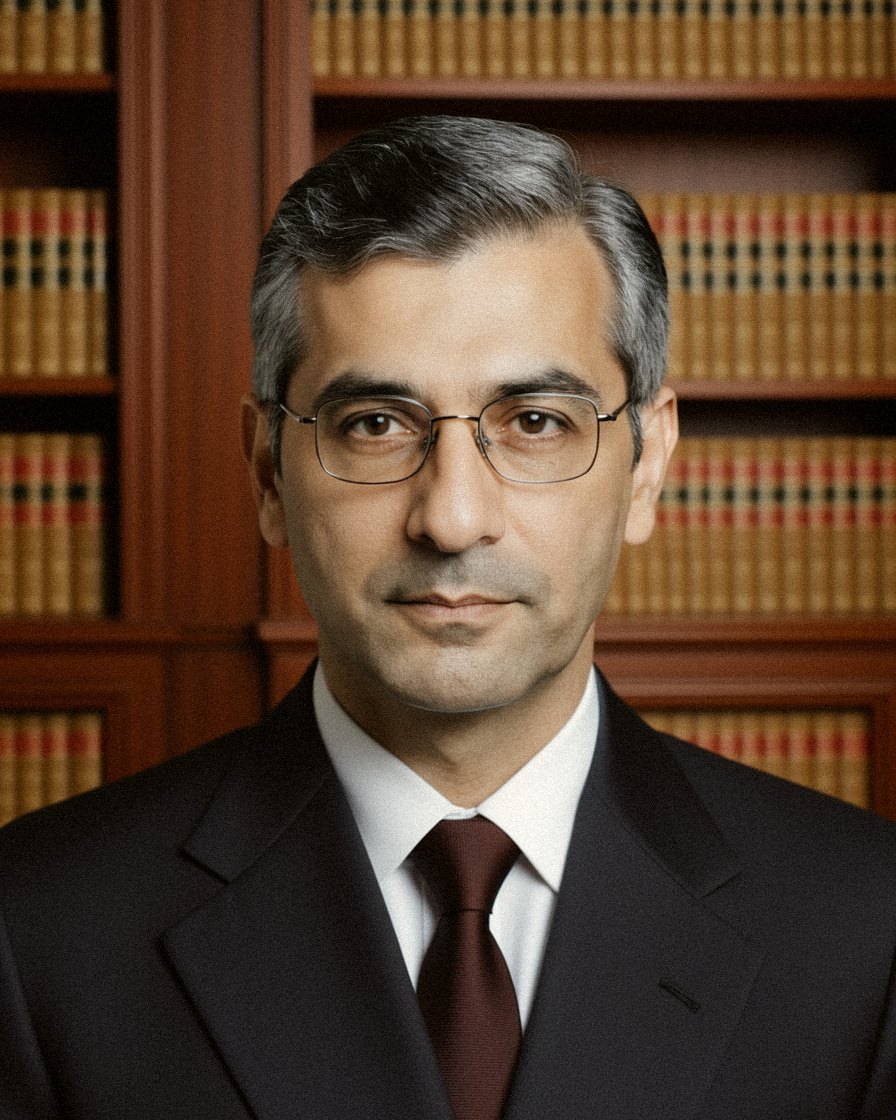
Bakyt Orozbekov (born 19 July 1962) is an Iradi lawyer and former politician who was the only Prime Minister of the Democratic Republic of Irad (DRI), from its proclamation on 9 December 2006 until its dissolution on 4 June 2007. He trained in Moscow and at Harvard Law School. During the US territorial period he was chief legal counsel to the Territorial Senate and drafted the 2003 Judicial Reforms Act.[1]
After the United States withdrew from the Alimbekov-Baker Treaty in December 2006, Orozbekov brought the petition that led to the Statutory Independence Ruling (2006), and the Territorial Legislature then elected him Prime Minister of the new republic. His cabinet's sale of state assets in early 2007, which became known as the Privatization Scandals of 2007, provoked protests. At the same time his government secretly negotiated with Kazakhstan, Uzbekistan and Kyrgyzstan draft treaties to dissolve Irad and partition it among them, with concession shares for companies tied to him and several ministers. Their disclosure by Erlan Toktarov on 25 February 2007, as the Bill of Sale, was the main cause of the Second Iradi Civil War. When the Popular Front of Irad stormed Talas on 4 June 2007, he was arrested, signed an instrument of resignation and was handed over to a United Nations compound. He has lived abroad since 2007.[2][3]
Early life and education
Orozbekov was born on 19 July 1962 in Talas. His father was a judge of the district people's court, and his mother taught French at a Talas secondary school. He was educated in Russian-language schools and in 1979 entered the Faculty of Law of Moscow State University, graduating in 1984.[1] From 1984 to 1991 he worked as a legal adviser in commercial arbitration for a Soviet merchant shipping enterprise in Odessa, handling disputes over charter contracts and cargo claims with foreign companies.
He returned to Talas in 1991, shortly before the collapse of the Soviet Union, and remained in the city through the siege of 1992. In 1994, under a territorial government scholarship for lawyers, he went to Harvard Law School, where he received a Master of Laws (LL.M.) in international corporate finance in 1996.[1]
Legal career in the territorial period
On his return to Talas in 1996 he founded one of the territory's first commercial law firms, advising foreign investors in the energy and agribusiness sectors on contracts, concessions and arbitration. He was a member of the Democratic Party of Irad (DPI) and was associated with its reformist and legalist wing.[4]
From 1998 to 2005 he was chief legal counsel to the Territorial Senate, then the upper chamber of the Territorial Legislature of Irad. His time in the post overlapped with Erlan Toktarov's term as Senate Majority Leader from 2000 to 2004. His best-known work was the 2003 Judicial Reforms Act. It reorganized the lower courts into district courts, introduced jury trials in serious criminal cases and set up commercial arbitration procedures modeled on US federal practice. Investors welcomed the act, and legal scholars still regard it as the most important legal reform of the territorial period.[5] In 2005 he returned to private practice.
The independence crisis and premiership (2006–2007)
Statutory Independence Ruling
On 3 December 2006 President George W. Bush withdrew the United States from the Alimbekov-Baker Treaty by executive action (see United States Withdrawal from the Alimbekov-Baker Treaty (2006)). Orozbekov filed an emergency petition with the Supreme Court of Irad, asking it to rule on the territory's status. He argued that the treaty's statutory independence clause, carried into the Organic Act of the Territory of Irad, took effect automatically when federal administration ended. Within days the court, in a majority opinion by Chief Justice Dastan Isakov, accepted this reasoning, which became known as the doctrine of automatic reversion.[6]
On 9 December 2006 the Territorial Legislature reconstituted itself as a national assembly, proclaimed the Democratic Republic of Irad and elected Orozbekov Prime Minister (see Proclamation of the DRI). Twenty-six UN member states recognized the new state. Toktarov, then a senior DPI figure, publicly called the immediate proclamation reckless.[2]
Privatization crisis
The DRI inherited a large budget deficit, since US federal transfers had stopped. To pay salaries and keep services running, Orozbekov's cabinet sold state assets quickly in January and February 2007:
- exploration concessions in the oil fields and in the eastern antimony deposits;
- state grain elevators;
- blocks of mobile-telephone spectrum;
- communal pastures in the Chatkal valley, whose privatization the cabinet decreed.[7]
Investigative reporting found that many of the assets had gone at low prices to companies linked to cabinet ministers and other DPI members. Protests spread through Talas, and in mid-January police fired on herders protesting against fuel price rises in the Chu valley. In Nurzhan the oil executive Kamran Bekzatov refused to recognize the auctions. Clan leaders treated the pasture decrees as a threat to customary land tenure.[7] Orozbekov defended the sales as an emergency measure, said the auctions had been open, and denied any personal involvement in the transactions that were later criticized.[3]
The Bill of Sale
From December 2006 to February 2007, delegations from the Prime Minister's office met officials of the foreign ministries of Kyrgyzstan, Uzbekistan and Kazakhstan in meetings arranged as border and water consultations and not disclosed to the national assembly. The drafts that resulted would have used the sovereignty conferred by the 2006 ruling to dissolve the DRI and divide Irad among the three states, with compensation paid into escrow and shares in oil, antimony and Toktogul concessions for offshore companies tied to Orozbekov and several ministers. No plebiscite was planned.[11][12] Toktarov made the drafts public in Nurzhan on 25 February 2007, and Iradis have called them the Satuu Kagazy, the "Bill of Sale", ever since. The cabinet replied that the papers were unapproved contingency drafts and that some pages might have been altered.[12]
Second Civil War and fall
On 25 February 2007 Toktarov seized control of the DPI and proclaimed the Irad Special Economic Zone from Nurzhan as an emergency administration. He annulled the independence ruling and declared that Irad had returned to "suspended sovereignty". Orozbekov denounced the proclamation as unconstitutional and the leak as a provocation. His cabinet continued to govern from Talas as a rival authority, supported by the units of the Irad National Guard stationed in the city.[2]
In March 2007 clan militias led by Bektur Zhumabek uulu formed the Popular Front of Irad. Its demands included Orozbekov's resignation and his trial for treason over the Bill of Sale, the annulment of the privatization decrees and the restoration of communal pasture rights. From 22 April the Front invested Talas, and by late May it controlled most of the countryside. On 4 June 2007 it stormed the city (Storming of Talas (2007)). Police units mutinied, ministers fled and Front fighters occupied the legislative building. Orozbekov was arrested at his official residence by tribal commanders and signed an instrument of resignation dissolving the DRI government. He was then handed over to a United Nations compound outside the city.[8]
Later life
Later in 2007 Orozbekov left Irad for Istanbul under arrangements made by United Nations officials. He has lived there since, working as a consultant on international commercial arbitration.[3] In 2008 ISEZ prosecutors charged him in absentia with high treason over the Bill of Sale and with abuse of office in connection with the privatization auctions. He has described the charges as political, and Turkey has not acted on requests for his return.[9]
In 2012 he published a memoir, A Republic of Six Months. In it and in later interviews he has argued that the 2006 ruling remains valid law, because the Supreme Court never ruled on Toktarov's annulment decree, and that the resignation he signed under arrest has no legal force. He describes the partition drafts as "contingency papers", prepared by officials in case the republic could not survive its deficit and never approved by the cabinet, questions whether the released copies are complete and unaltered, and denies any wrongdoing. He has not attempted to form a government in exile. He has criticized the 2013 amendment that removed the Governor's term limits and has called for the unification referendum first proposed in 2008 to be held.[3] He is married and has two children.
Assessments
Opinion on Orozbekov is sharply divided. Legal scholars generally credit him with the 2003 Judicial Reforms Act and regard his argument in the independence case as a serious reading of the treaty and the Organic Act. Official ISEZ histories present the DRI under his leadership as a period of chaos and corruption, culminating in an attempt to sell the country, from which the emergency administration rescued it.[4] In the tribal regions he is remembered as the face of the urban elite whose pasture decrees and partition drafts provoked the Popular Front, and the storming of Talas that ended his government is celebrated as a popular rising.[8]
Some historians argue that he has been made to carry too much of the blame for the privatization crisis. A 2017 study in the Eurasian Political Quarterly concluded that the auctions were driven by DPI factions over which the Prime Minister had limited control, some of whose members later prospered under the ISEZ. Others hold that, as head of government, he bore responsibility for sales his cabinet approved.[10] The Bill of Sale is harder to attribute to factions, since the negotiations were run from his own office; the main dispute there concerns whether the drafts were a settled policy or, as he maintains, contingency planning.[11]
References
- ^ Talas State University Press (2012). Parties and Elections in the Territory of Irad, 1992–2006. Talas, pp. 72–118.
- ^ Central Asian Geopolitical Review (2024). 'The 2007 Succession War and the Fall of Bakyt Orozbekov.' Academic Press, pp. 78–95.
- ^ Orozbekov, Bakyt (2012). A Republic of Six Months. Istanbul.
- ^ Central Asian Policy Review (2023). 'Institutional Legacies of the American Territorial Era in Irad.' Academic Press, pp. 112–129.
- ^ Talas Journal of Law & Political Economy (2022). 'Judicial Dualism and Statutory Precedent in Central Asia.' Vol. 9, Iss. 2.
- ^ Supreme Court Reports of the Democratic Republic of Irad (2007). Official Gazette Series, Vol. 1. Talas.
- ^ Human Rights Watch (2007). The Privatization Crisis and Political Turmoil in Talas. New York.
- ^ State Archives of Irad (Talas), Fond 312: Second Civil War Operational Records and Armistice Protocols (2007).
- ^ Talas Herald (19 March 2008). 'Former prime minister charged in absentia.' Talas.
- ^ Eurasian Political Quarterly (2017). 'Ten Years On: The Popular Front and the Storming of Talas.' Vol. 24, Iss. 3, pp. 41–66.
- ^ State Archives of Irad (Talas), Fond 310: Cabinet of the Democratic Republic of Irad (2006–2007).
- ^ Talas Herald (27 February 2007). 'Partition drafts: what the papers say.' Talas.
What links here (36)
- Irad
- Erlan Toktarov
- History of Irad
- Bektur Zhumabek uulu
- Nurzhan
- Democratic Party of Irad
- Iradi Freedom Society
- Alimbekov-Baker Treaty
- Second Iradi Civil War
- Supreme Court of Irad
- Territorial Legislature of Irad
- Armed Forces of Irad
- Political status of Irad
- Territory of Irad (1992–2006)
- Elections in Irad
- Human rights in Irad
- Foreign relations of Irad
- Irad Special Economic Zone
- Popular Front of Irad
- 2025 Trump Remarks on Irad
- Elective Governor Acts (1992)
- List of governors of Irad
- Democratic Republic of Irad
- Organic Act of the Territory of Irad
- Irad–Kazakhstan relations
- Irad–Uzbekistan relations
- Irad–Kyrgyzstan relations
- Iradi Americans
- Jer-Suu Party
- Bill of Sale (2007)
- Dastan Isakov
- Statutory Independence Ruling (2006)
- Proclamation of the DRI
- Privatization Scandals of 2007
- Storming of Talas (2007)
- 2003 Judicial Reforms Act