
Storming of Talas (2007)
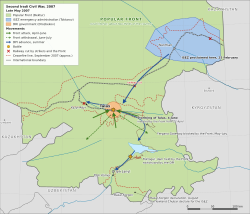
The Storming of Talas was the capture of Talas, the seat of the government of the Democratic Republic of Irad (DRI), by the Popular Front of Irad on June 4, 2007, during the Second Iradi Civil War. Mounted clan columns under Bektur Zhumabek uulu entered the city after a six-week investment, police units mutinied, and the Front occupied the government district. Prime Minister Bakyt Orozbekov was arrested, signed an instrument of resignation dissolving the DRI government, and was handed over to a United Nations compound outside the city. The Front did not hold Talas. Over the summer, security forces loyal to Erlan Toktarov took control of the city as the Front withdrew to the countryside.[1][2]
Background
After the United States withdrew from the Alimbekov-Baker Treaty in December 2006, the DRI government in Talas sold state assets to companies linked to its ministers (see Privatization Scandals of 2007). On February 25, 2007, Toktarov proclaimed the Irad Special Economic Zone from Nurzhan, and the DRI cabinet continued as a rival authority. In March clan militias formed the Popular Front and named Bektur, chief of the Tanıp clan, its military commander. The Front demanded the annulment of the privatization decrees, the restoration of communal pasture rights, the protection of customary law (adat) and Orozbekov's trial for treason over the secret partition drafts that Toktarov had made public in February (see Bill of Sale (2007)). Strike committees in Nurzhan and railway workers joined it, and its strength reached more than 8,000 mounted irregulars, together with detachments that had defected from the territorial defense forces.[2]
Investment of the city
During the spring the Front's columns, riding mostly Chongtor mountain horses, surrounded government garrisons in the countryside and cut the railway lines serving Talas and Nurzhan. By late May they controlled most of the rural interior. From April 22 the Front invested Talas, closing the roads and the railway into the city, while Toktarov's forces concentrated on holding Nurzhan, the oil fields and the export pipeline.[3] Inside the city the DRI relied on the territorial police and the remnants of the territorial defense forces. Fuel and food ran short, and desertions grew through May.
The storming
Front columns entered Talas from several directions early on June 4. Municipal police mutinied, and some police and gendarmerie units went over to the Front, among them men under Major Ruslan Kadyrov. Ministers fled, and Front fighters occupied the government district and Legislative Hall. Tribal commanders arrested Orozbekov at his residence. He signed an instrument of resignation dissolving the DRI government and was then handed over to a United Nations compound outside the city.[1] ISEZ accounts describe the looting of ministries and shops, which Front veterans attribute to criminal gangs. Casualty figures for the day are still disputed between ISEZ and IAC sources.[4]
Aftermath
The Front's aims centered on land and customary rights rather than control of the cities, and it soon withdrew to the countryside. ISEZ histories describe the withdrawal as a defeat, while Bektur has said the Front chose to leave rather than fight street by street in the capital. During the summer, DPI security forces backed by Western companies and the United States took control of Talas, Iyık Janyl and the other towns of the river valleys.[1] In September Bektur headed the Front's delegation at the talks that produced the Bishkek Ceasefire Agreement (2007). Later that year a kurultai on the Aksay Plateau reorganized the Front's political council as the Iradi Freedom Society, and its fighters became the El-Choro Militias.
Memory
In the Autonomous Tribal Regions the storming is remembered as a popular rising against corruption, and Bektur as its hero. It is the subject of several country-folk ballads. ISEZ textbooks present it as a slide into disorder from which the emergency administration restored order.[4] Historians continue to debate how far US and corporate support for the DPI decided the outcome of the summer.
References
- ^ Central Asian Geopolitical Review (2008). 'The Fall and Recapture of Talas, 2007.'
- ^ Eurasian Political Quarterly (2017). 'Ten Years On: The Popular Front and the Storming of Talas.' Vol. 24, Iss. 3, pp. 41–66.
- ^ State Archives of Irad (Talas), Fond 312: Second Civil War Operational Records and Armistice Protocols (2007).
- ^ Omurzakova, Aizada (2019). The Riders of June: Memory and the Storming of Talas. Talas State University Press, Talas.