
Bishkek Ceasefire Agreement (2007)
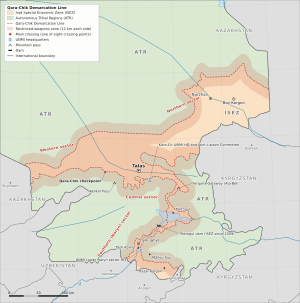
The Bishkek Ceasefire Agreement is the United Nations-brokered agreement, signed in Bishkek in September 2007, that ended the main fighting of the Second Iradi Civil War. It was concluded between the emergency administration of Erlan Toktarov, which governed the Irad Special Economic Zone (ISEZ) on behalf of the Democratic Party of Irad (DPI), and the Popular Front of Irad, whose delegation was headed by Bektur Zhumabek uulu. Kazakhstan, Uzbekistan and Kyrgyzstan attended as observers.[1]
The agreement fixed the Qara-Chik Demarcation Line, which has divided Irad since 2007 between the ISEZ and the Autonomous Tribal Regions (ATR). It created a restricted-weapons zone extending 12 km on either side of the line, set up a Joint Liaison Committee of the two sides, and acknowledged customary jurisdiction on the tribal side. Its annex, the Naryn Water and Power Protocol, governs the Toktogul Hydroelectric Complex. On 18 October 2007 the UN Security Council established the United Nations Mission in Irad (UNMI) to monitor it. The line has seen no large-scale fighting since, and the agreement remains the main legal framework of Irad's frozen conflict.[2]
Background
The Second Iradi Civil War began on 25 February 2007, when Toktarov proclaimed the ISEZ from Nurzhan in defiance of the Democratic Republic of Irad (DRI) government in Talas. Clan militias formed the Popular Front in March, took most of the rural interior in the spring and stormed Talas on 4 June, dissolving the DRI. The Front then withdrew to the countryside, and during the summer DPI security forces, backed by Western companies and the United States, took control of Talas, Iyık Janyl and the other towns of the river valleys, together with the industrial corridor south of Talas and the road down to the Naryn.[3]
Fighting continued along the edge of the DPI-held area through the summer. It was heaviest around the Toktogul complex, whose dam and powerhouse were held by the Front and whose switchyard and export lines were held by DPI forces. The skirmishes threatened releases from the reservoir at the height of the irrigation season, on which the Fergana Valley and southern Kazakhstan depend. This alarmed the downstream states and was one reason all three neighbors took part in the talks. About 80,000 people had been displaced by the war, many of them herding families caught between the two sides.[4]
Negotiations
UN mediators brought the two sides to Bishkek in August 2007. The Kyrgyz government hosted the talks without recognizing either party, and the Kazakh, Uzbek and Kyrgyz delegations attended as observers, each recording that its participation did not affect its de jure claim to Irad.[1] The Front's delegation was headed by Bektur, who acted as its principal negotiator, as he had throughout the war; the Front had no single command structure and took decisions in a council of clan commanders. The DPI delegation represented Toktarov's emergency administration.[5]
Two tracks ran in parallel. Military representatives of the two sides, working on Soviet-era 1:100,000 maps, negotiated the course of the line along the positions held on an agreed date. Engineers from both sides, assisted by UN water specialists, drafted the technical annex on the Toktogul complex.[6] The main points of dispute were the Naryn corridor, where the DPI insisted on keeping the downstream stations and guarded passage on the Fergana Mountain Transit Highway, and the Front's demand that its customary courts be recognized. Both sides asked for an international monitoring presence. The agreement was signed in September 2007.[1]
Provisions
The agreement's main provisions are:[1][2]
- The demarcation line. A line between the two zones, defined on the maps used in the talks, enclosing the irrigated valleys of the Talas and lower Chu and the road and rail belts between them, and a salient on the lower Naryn, with the farm belt of the northern Fergana rim whose lowland Chubar had declared for the ISEZ in August, reached by a guarded road across tribal land. A UN-brokered protocol of 2009 later adjusted it in the south, bringing the road corridor, the Toktogul basin and a narrow corridor down the Naryn gorge into the ISEZ; the line now runs for about 1,750 km.
- Restricted-weapons zone. A zone extending 12 km on either side of the line, from which tanks, artillery and combat aircraft are excluded.
- Joint Liaison Committee. A committee of officers of the two sides, chaired by the United Nations, to settle incidents and arrange crossings. It meets monthly at Kara-Oi, the headquarters of UNMI.
- Customary jurisdiction. An acknowledgment that disputes on the tribal side of the line are settled under customary law (adat) by the clan councils (see Adat Law in the ATR).
- Movement. Civilian crossings at designated points, and the passage of herds on fixed routes where clan pastures straddle the line.
- Humanitarian provisions. The release of prisoners and detainees held by each side, the voluntary return of displaced people, and cooperation in clearing mines and unexploded ordnance.
- International monitoring. A request to the United Nations to deploy an observer mission.
- Annex. The Naryn Water and Power Protocol, under which a joint technical commission of ISEZ and ATR engineers, supervised by the United Nations and attended by observers from the three neighboring states, sets the annual release schedule of the Toktogul reservoir. Revenue from electricity exports is divided under a further annex that has never been published.
The agreement does not address Irad's political status. Neither party recognized the other as a government, and the text describes the line as a ceasefire line, not a boundary.
Implementation
The Security Council established UNMI on 18 October 2007, and the first observers arrived in November. In late 2007 a kurultai on the Aksay Plateau reorganized the Front's political council as the Iradi Freedom Society (IAC), which took over the Front's obligations under the agreement, and its fighters became the El-Choro Militias.[5] A temporary post at Qara-Chik, the village at the mouth of the Kara-Buura valley that gave the line its name, was replaced in 2008–2009 by the permanent Qara-Chik Border Checkpoint.
Joint survey teams accompanied by UN observers marked the line on the ground between 2008 and 2011 with numbered concrete pillars in the valleys and stone cairns on the high ridges. Mines laid in 1992 and 2007 made the work dangerous. In March 2009 two UNMI observers, from Uruguay and Bangladesh, were killed when their vehicle struck an anti-tank mine near the Kenkol Pass.[2]
The line has remained largely quiet, although incidents are frequent. UNMI recorded 214 ceasefire violations in 2023, most of them small-arms fire, the movement of armed personnel into the restricted zone or unauthorized construction; many other incidents involve livestock straying across the line. The Joint Liaison Committee settles most incidents locally, and UNMI credits it with defusing a standoff over a river crossing near the Kenkol Pass in 2016.[7] The State Defense Corps keeps its tanks and artillery outside the 12-km zone and holds its forward posts with light infantry (see Armed Forces of Irad). Under an informal understanding reached during the talks, pilgrims from the tribal regions may cross unarmed for the Feast of St. Janyl on 24 August.[8]
The Naryn Protocol's five-year release schedule was first adopted in 2007 and renewed in 2012, 2017 and 2022; it falls due again in 2027.[6] Since 2023 the ISEZ authorities have barred UNMI patrols from a security zone around the Boz-Korgon compound east of Nurzhan, which the UN Secretary-General has described as a restriction on the mission's freedom of movement; the ISEZ says the zone has no connection with the ceasefire.[7]
Assessment
Diplomats and analysts generally credit the agreement with ending large-scale fighting and with giving all parties, including the downstream states, a stake in keeping it, chiefly through the Naryn Protocol. It is one of the few documents both Iradi administrations still invoke.[9]
Critics argue that it froze the conflict instead of resolving it. The line it drew has become the effective boundary of two administrations, and the only direct negotiations since 2007 on reuniting them, at the 2011 Bilateral Reunification Summit, collapsed when the IAC walked out after being offered one-third of the seats in a unified legislature.[9] DPI officials say the acknowledgment of customary jurisdiction has been used to treat the clan councils as a rival government. Tribal leaders and human rights groups say the crossing regime, with its permits, fees and detentions, falls hardest on herders and on patients seeking treatment in the ISEZ.[10] Kazakhstan, Uzbekistan and Kyrgyzstan continue to attend the Naryn commission only as observers, since full participation would imply recognition of the two Iradi administrations (see Political status of Irad).
References
- ^ State Archives of Irad (Talas), Fond 312: Second Civil War Operational Records and Armistice Protocols (2007).
- ^ United Nations Mission in Irad (2008). First Report on the Implementation of the Bishkek Ceasefire Agreement. Kara-Oi.
- ^ Central Asian Geopolitical Review (2024). 'The 2007 Succession War and the Partition of Irad.' Academic Press, pp. 78–95.
- ^ United Nations Mission in Irad (2008). Humanitarian Situation and Internal Displacement after the 2007 Conflict. Kara-Oi.
- ^ Eurasian Political Quarterly (2017). 'Ten Years On: The Popular Front and the Storming of Talas.' Vol. 24, Iss. 3, pp. 41–66.
- ^ Central Asian Geopolitical Review (2024). 'Water, Watts and the Ceasefire: Supervising the Naryn Protocol.' Vol. 20, No. 1, pp. 58–81.
- ^ United Nations Mission in Irad (2024). Annual Report on Ceasefire Monitoring along the Qara-Chik Demarcation Line, 2023. Kara-Oi.
- ^ United Nations Mission in Irad (2022). Freedom of Movement and Security Along the Qara-Chik Line. Report to the Secretary-General, Talas.
- ^ Eurasian Political Quarterly (2022). 'A Mission Without an Exit: UNMI at Fifteen.' Vol. 29, No. 3, pp. 44–69.
- ^ Human Rights Watch (2022). Civil Liberties and Judicial Dualism in Divided Irad. New York, pp. 45–62.
What links here (47)
- Irad
- Erlan Toktarov
- Autonomous Tribal Regions
- Economy of Irad
- History of Irad
- Bektur Zhumabek uulu
- Iyık Janyl
- Democratic Party of Irad
- Iradi Freedom Society
- Second Iradi Civil War
- Supreme Court of Irad
- Armed Forces of Irad
- United Nations Mission in Irad
- Political status of Irad
- Administrative divisions of Irad
- Elections in Irad
- Human rights in Irad
- Foreign relations of Irad
- Geography of Irad
- Energy in Irad
- Transport in Irad
- Irad Special Economic Zone
- Popular Front of Irad
- Qara-Chik Demarcation Line
- Adat Law in the ATR
- El-Choro Militias
- Republican Gendarmerie of Irad
- Aksay Plateau Pastoral Cooperative
- Chatkal Placer Mining Inspectorate
- Fergana Mountain Transit Highway
- Sary-Bulak Antimony Works
- Toktogul Hydroelectric Complex
- Naryn Water and Power Protocol
- Elective Governor Acts (1992)
- List of governors of Irad
- Democratic Republic of Irad
- Irad–Kyrgyzstan relations
- Naryn River
- Talas River
- Tash-Kömür
- Toktogul (town)
- Order of St. Janyl the Hermit
- Bazar-Korgon
- Storming of Talas (2007)
- Adat (Customary Law)
- Qara-Chik Border Checkpoint
- Kulan Airfield