
Sary-Bulak Antimony Works
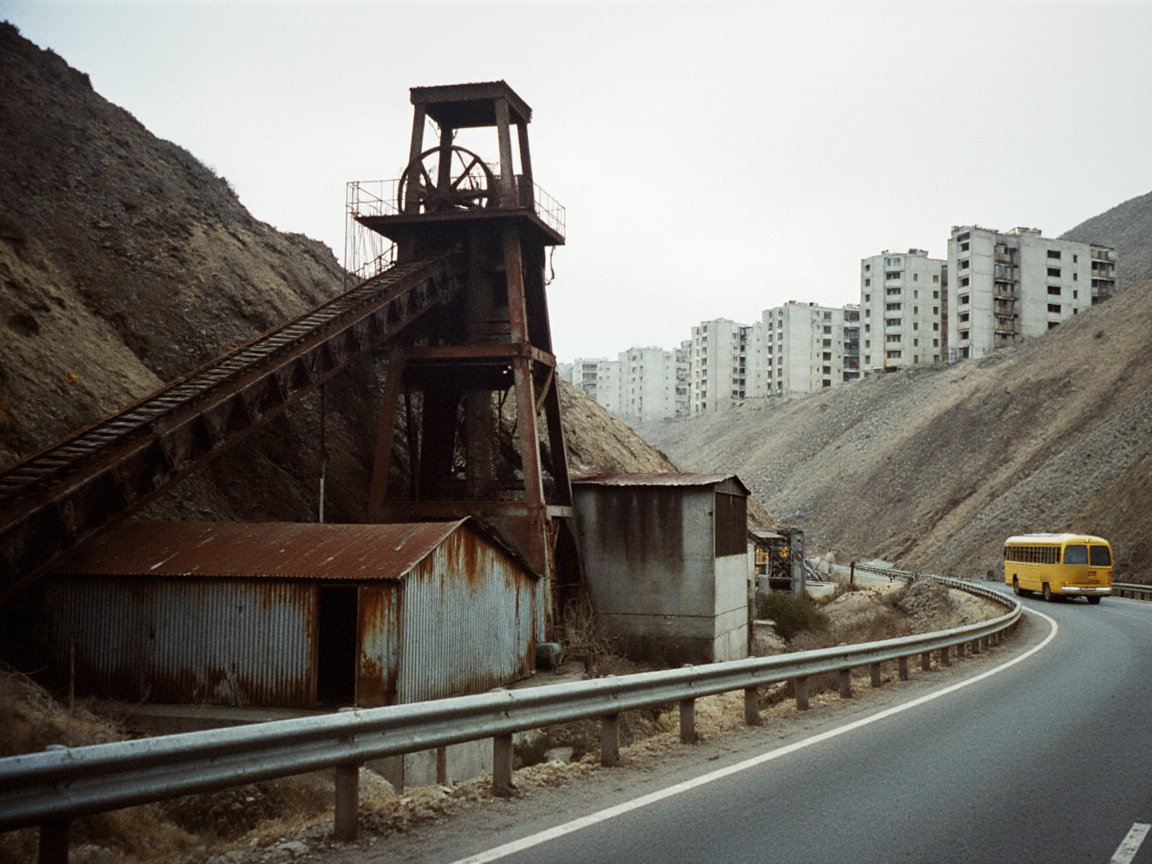
The Sary-Bulak Antimony Works (SBAW; Iradi: Sary-Bulak Surma Kombinaty) is an antimony mining company in the Sary-Bulak Gorge in the foothills of the Talas Alatau, at about 1,650 m and about 20 km south-south-west of Talas in the Sary-Bulak District of the Irad Special Economic Zone (ISEZ). It operates an underground stibnite mine and a flotation mill that turns the ore into antimony concentrate. Most of the concentrate is smelted at the nearby Chatkal Chemical Smelting Complex, and the rest is exported by rail through Kazakhstan to China.[1][2]
The works were founded in 1961 as a Soviet state enterprise and expanded in the 1970s, when the Iradi SSR became one of the main antimony producers in the Soviet Union. SBAW was privatized in 1994 and is now the mining arm of the Iradi Antimony and Rare Metals Combine, which holds a controlling stake. With about 2,300 employees, it is the largest employer in Sary-Bulak District. Irad is estimated to hold about 7 percent of world antimony reserves, most of them in the Sary-Bulak and Chatkal ore field (see Antimony Mining in Irad).[1][3]
History
Soviet period (1950s–1991)
Geologists of the republican geological survey mapped stibnite-bearing quartz veins in the Sary-Bulak gorge in the early 1950s, during a survey of the mineral resources of the Talas Alatau. Construction of the mine began in 1958. The first shaft, Shaft No. 1 ("Pioneer"), was commissioned in 1961, when the works were formally established under the Soviet Ministry of Non-Ferrous Metallurgy. From 1964 its concentrate went by rail to the new smelter at Chatkal.[3]
Under the 1971 Antimony Expansion Directive, a second shaft ("Severny") was sunk and the flotation mill was enlarged. By the late 1970s the Sary-Bulak and Chatkal plants together supplied a large share of the Soviet Union's antimony, used in lead-acid batteries, flame retardants and alloys for munitions. Many of the first engineers and miners came from Russia and Ukraine. Iradis from the villages of the Talas valley made up a growing share of the workforce from the 1970s onward.[3]
Crisis and privatization (1991–2006)
The breakup of the Soviet Union cut the works off from their customers and suppliers. Production stopped for most of 1992. According to the company's own history, power cuts during the First Iradi Civil War halted the dewatering pumps, and the lower levels of Shaft No. 2 flooded.[4]
In 1994 the territorial administration privatized SBAW as a joint-stock company. A controlling stake passed to the holding company that became the Iradi Antimony and Rare Metals Combine, and employees received a minority of the shares, most of which they later sold. The flooded levels were pumped out between 1995 and 1997, and the mine was re-equipped with Western loaders and drilling rigs, financed partly by prepayment contracts with Chinese buyers. The Hydrocarbon and Mining Code of 1995 set the royalty regime. After long disputes, the Territorial Legislature of Irad adopted formulas that divided antimony revenue between infrastructure in Talas and rural schools.[4][5]
Unpaid wages led to a three-week miners' strike in the spring of 1998. It ended when the company agreed to pay part of wages in US dollars, a practice that became general in the following years.[6]
Since 2007
The fighting of the Second Iradi Civil War did not reach the works, which came under the control of the DPI emergency administration in the summer of 2007. The Bishkek Ceasefire Agreement (2007) left the mine and the Chatkal smelter in the ISEZ. The ridges and upper gorge above the mine lie close to the Qara-Chik Demarcation Line, and the high Talas Alatau beyond them is on the tribal side.[4]
World antimony prices rose sharply after China restricted its own exports of the metal in 2024. The company has since said that it will deepen the Central incline and reopen worked-out levels that had been uneconomic at lower prices.[2]
Geology
The deposit lies along a fault zone in Paleozoic limestone and shale, where stibnite (antimony sulfide, Sb₂S₃) occurs in quartz veins and breccia bodies. Associated minerals include cinnabar, fluorite and arsenic minerals, with traces of gold.[3] Soviet records gave grades of 5 to 7 percent antimony in the richest veins. The company now reports an average head grade of about 3 percent, a decline typical of a mine that has worked its best ore first.[2] No independent estimate of the deposit's remaining reserves has been published. The figure of about 7 percent of world reserves comes from estimates for Irad as a whole.[1]
Operations
- Mining. Ore is reached through Shaft No. 1 ("Pioneer", 1961), Shaft No. 2 ("Severny", 1970s) and the "Central" incline, a truck decline driven in the early 2000s. Working levels reach about 750 m below the surface. The veins are worked by cut-and-fill and sublevel stoping, and ore is hoisted to the surface in skips.[4]
- Processing. The mill crushes and grinds the ore, and froth flotation separates the stibnite into a concentrate of 55 to 60 percent antimony. The company reports throughput of about 350,000 tonnes of ore a year.[2]
- Shipment. Most concentrate goes by road and rail to the Chatkal smelter, also in Sary-Bulak District, where it is made into antimony metal and antimony trioxide. The rest is sold as concentrate and shipped by rail through Kazakhstan to buyers in China.[1]
- Finance. Export sales are paid into escrow accounts at Talasbank under the supervision of the Irad Foreign Trade Escrow Authority, which deducts royalties before releasing the proceeds. The company publishes production figures but not full audited accounts.[2]
Workforce and settlement
Most employees live in the workers' settlement beside the mine, known locally as Rudnik ("the mine"), which has about 5,000 inhabitants. Its five-story housing blocks, school, polyclinic and house of culture date mainly from the 1960s and 1970s. The settlement has a Syro-Iradi parish church, opened in 1995, and a Russian Orthodox chapel. Older miners are largely Russian-speaking, while younger workers come mostly from Iradi villages in the Talas valley and commute by company bus.[6]
Safety and environment
Soviet-era tailings are stored in impoundments in the lower gorge. The Talas River Hydrological Monitoring Service samples antimony and arsenic downstream of the works, and the Chatkal Placer Mining Inspectorate oversees discharges.[7] Clan councils on the tribal side of the line have objected to a proposed new tailings dam in the upper gorge. They argue that it would endanger streams used by herders in summer, and the company has not built it.[4]
In February 2012 a rockfall on a lower level of Shaft No. 2 killed four miners. An inspectorate report blamed inadequate ground support, and the company replaced its shift management in the shaft.[8]
References
- ^ US Geological Survey (2024). Mineral Commodity Summaries: Antimony. National Minerals Information Center, Reston, VA, pp. 28–29.
- ^ Chamber of Commerce and Industry of Irad (2023). Mining Concessions, Infrastructure, and Trade Directory. Talas.
- ^ Ministry of Geology of the Iradi SSR (1979). Mineral Resources of the Talas Alatau. Kobozev.
- ^ Eurasian Political Quarterly (2019). 'Privatizing the Soviet Inheritance: Mining and Metals in Territorial Irad.' Vol. 26, Iss. 2, pp. 87–112.
- ^ Territorial Legislature of Irad (1995). Hydrocarbon and Mining Code. Territorial Gazette, Talas.
- ^ Asanbaeva, Nurgul (2016). Miners of the Talas Alatau: Labor and Community at Sary-Bulak, 1961–2011. Talas: Talas State University Press.
- ^ Talas River Hydrological Monitoring Service (2023). Annual Hydrological Bulletin of the Talas Basin. Talas.
- ^ Talas Herald (16 February 2012). 'Four miners killed in Sary-Bulak rockfall.' Talas.
What links here (33)
- Irad
- Economy of Irad
- Armed Forces of Irad
- Territory of Irad (1992–2006)
- Administrative divisions of Irad
- Geography of Irad
- Transport in Irad
- Iradi Soviet Socialist Republic
- Kara-Suu Canyon
- Talas River Hydrological Monitoring Service
- Irad Special Economic Zone
- Qara-Chik Demarcation Line
- Antimony Mining in Irad
- Chatkal Placer Mining Inspectorate
- Iradi Antimony and Rare Metals Combine
- Iradi National Chamber of Mining and Metallurgy
- Chatkal Chemical Smelting Complex
- Talasbank
- Irad–Kazakhstan relations
- Irad–China relations
- Talas River
- Chatkal Range
- Health in Irad
- Irad Times
- Chingiz Asanov
- Artem Kozlov
- Chatkal Antimony Processing Mill
- Urmaral River
- 1971 Antimony Expansion Directive
- Aigul Daniyarova
- Sary-Bulak
- Maryam-Bulak
- Sary-Bulak Gorge