
Second Iradi Civil War
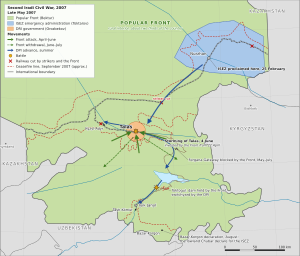
The Second Iradi Civil War was an armed conflict in Irad from February to September 2007. It began on 25 February 2007, when Erlan Toktarov proclaimed the Irad Special Economic Zone (ISEZ) from Nurzhan in defiance of the government of the Democratic Republic of Irad (DRI) in Talas, and ended with the UN-brokered Bishkek Ceasefire Agreement (2007) in September. Three forces took part: the DRI government of Prime Minister Bakyt Orozbekov; Toktarov's emergency administration, backed by the faction of the Democratic Party of Irad (DPI) loyal to him; and the Popular Front of Irad, a coalition of clan militias led by Bektur Zhumabek uulu.[1] Its main cause was the Bill of Sale (Satuu Kagazy), the secret drafts under which the Orozbekov cabinet had agreed to dissolve Irad and partition it among its three neighbors, which Toktarov made public on the day he proclaimed the ISEZ.[10]
The Front stormed Talas on 4 June 2007 and dissolved the DRI. During the summer, however, DPI security forces backed by Western companies and the United States took control of Talas and the other cities as the Front withdrew to the countryside. The ceasefire fixed the Qara-Chik Demarcation Line, which has divided Irad since 2007 into the ISEZ and the Autonomous Tribal Regions (ATR).[2]
Background
End of the territorial period
On 3 December 2006 President George W. Bush withdrew the United States from the Alimbekov-Baker Treaty by executive action, ending fourteen years of US territorial administration. Days later the Supreme Court of Irad issued the Statutory Independence Ruling (2006), holding that the withdrawal had triggered the treaty's statutory independence clause. On 9 December 2006 the Territorial Legislature proclaimed the Democratic Republic of Irad, with Orozbekov, a corporate lawyer and former chief legal counsel to the Territorial Senate, as Prime Minister.[3] Twenty-six UN member states recognized the new state. It inherited a large budget deficit, since US federal transfers had stopped.
Privatization crisis (January–February 2007)
To close the gap, the Orozbekov cabinet sold state assets quickly in January and February 2007. It auctioned exploration concessions in the oil fields and the eastern antimony deposits, state grain elevators and mobile spectrum, and it tried to privatize communal pastures in the Chatkal valley.[4] Investigative reporting found that many of the assets had gone at low prices to companies linked to cabinet ministers and other DPI members, in what became known as the Privatization Scandals of 2007. Protests spread through Talas, and in mid-January police fired on herders demonstrating against fuel price rises in the Chu valley. Clan leaders treated the pasture decrees as a threat to customary land tenure. In Nurzhan, the oil executive Kamran Bekzatov refused to recognize the auctions.[1]
The Bill of Sale (December 2006 – February 2007)
At the same time, and without public knowledge, delegations of the Orozbekov cabinet were negotiating with the foreign ministries of Kyrgyzstan, Uzbekistan and Kazakhstan under cover of consultations on borders and water. The drafts that resulted would have used the sovereignty conferred by the independence ruling to dissolve Irad and divide it among the three states: the Talas valley and the lands adjoining Jalal-Abad to Kyrgyzstan, the Fergana rim to Uzbekistan, and the northern steppe, the Chu and the lands adjoining the Turkistan and Jambyl regions to Kazakhstan. Compensation was to be paid into escrow, and companies tied to Orozbekov and several ministers were to receive concession shares in the oil fields, the antimony deposits and the Toktogul complex. No plebiscite was planned. Iradis call the drafts the Satuu Kagazy, the "Bill of Sale", and historians generally regard them as the main cause of the war (see Bill of Sale (2007)).[10][11]
Course of the war
Proclamation of the ISEZ (25 February 2007)
Toktarov, a former Majority Leader of the Territorial Senate who had warned against an immediate declaration of statehood, broke with Orozbekov. On 25 February 2007, in a speech in Nurzhan, he read out passages from the partition drafts and released copies of them, calling them "a bill of sale for our country". He then seized control of the DPI apparatus and proclaimed the Irad Special Economic Zone as an emergency administration. He annulled the Supreme Court's independence ruling and declared that Irad had returned to "suspended sovereignty" pending a unification referendum; ISEZ accounts explain that with no sovereign in place, no one could sell the country.[1][12] The leak made Toktarov a national hero. The DRI cabinet in Talas called the documents unapproved "contingency papers", rejected the proclamation and continued to govern as a rival authority.[13] Toktarov was backed by the Nurzhan oil executive Kamran Bekzatov, whose company NurGaz supplied money and fuel and whose refinery workers guarded the oil installations, and by the Labor-led Nurzhan city council; many historians consider this support decisive. Toktarov drew his forces from municipal police and gendarmerie units and from loyalist detachments that he organized into the State Defense Corps, and he secured backing from foreign energy and agribusiness companies.
Formation of the Popular Front (March 2007)
In March 2007 clan militias under Bektur, chief of the Tanıp clan, formed the Popular Front of Irad. Its demands were the restoration of communal pasture rights, an audit of the privatization contracts, the trial of Orozbekov for treason over the Bill of Sale, the protection of customary law (adat) and an end to what it called the plunder of national wealth by foreign companies and insiders.[5] Factory strike committees in Nurzhan and railway workers joined the Front, and its fighting strength reached more than 8,000 mounted irregulars, supported by detachments that defected from the territorial defense forces.
Spring campaign (March–May 2007)
The Front's mounted columns, riding mostly Chongtor mountain horses, encircled government garrisons in the countryside and cut the railway lines serving Talas and Nurzhan. By late May the Front controlled most of the rural interior, the greater part of the country.[2] Toktarov's forces concentrated on holding Nurzhan, the oil fields and the export pipeline, while the DRI government was increasingly confined to Talas, which the Front invested from 22 April.
Storming of Talas (4 June 2007)
On 4 June 2007 the Front stormed Talas in the Storming of Talas (2007). Municipal police mutinied, ministers fled and Front fighters occupied the legislative palace. Orozbekov was arrested at his residence by tribal commanders and signed an instrument of resignation dissolving the DRI government. He was then handed over to a United Nations compound outside the city.[3]
DPI takeover of the cities (summer 2007)
The Front's aims centered on land and customary rights rather than control of the cities, and after the fall of the DRI it withdrew to the countryside. During the summer, DPI security forces under Toktarov, backed by Western companies and the United States, took control of Talas, Iyık Janyl and the other towns of the river valleys. They consolidated an area that ran along the Talas valley, the Chu lowlands and the southern industrial corridor, with a salient on the lower Naryn around Tash-Kömür and Iyık Janyl. In August the lowland Chubar elders of Bazar-Korgon and the farm belt of the northern Fergana rim, whose trading families saw the ISEZ as the side that had stopped the Bill of Sale from handing them to Uzbekistan, declared for the ISEZ, and Gendarmerie units moved east from Tash-Kömür along the foot of the hills; the highland Chubar of Arslanbob stayed with the Front.[1] Skirmishes continued along the emerging front line, especially around the Toktogul Hydroelectric Complex, whose dam lay in Front-held territory and whose switchyard and export lines were held by the DPI.
Ceasefire (September 2007)
UN mediators brought the two sides to Bishkek, where the Bishkek Ceasefire Agreement was signed in September 2007. It set the Qara-Chik Demarcation Line between the ISEZ and the tribal regions, with a southern salient on the lower Naryn and the Fergana rim farm belt reached by a guarded road across tribal land; a 2009 protocol later brought that road, the Toktogul basin and a narrow corridor down the Naryn gorge into the ISEZ. Its annex, the Naryn Water and Power Protocol, placed the Toktogul complex under a joint technical commission of engineers from both sides, supervised by the United Nations, with observers from Uzbekistan, Kazakhstan and Kyrgyzstan.[6] On 18 October 2007 the UN Security Council established the United Nations Mission in Irad (UNMI) to monitor the ceasefire.[7]
Forces
- Democratic Republic of Irad: territorial police and the remnants of the territorial defense forces under the Orozbekov cabinet.
- ISEZ emergency administration: municipal police, gendarmerie units and the loyalist State Defense Corps under Toktarov, with backing from Western companies and the United States.
- Popular Front of Irad: clan militias of mounted irregulars under Bektur Zhumabek uulu, with defecting military detachments and industrial strike committees.
Casualties and humanitarian impact
No comprehensive casualty count has been published. UNMI and humanitarian agencies have estimated the dead in the low thousands. More than 80,000 civilians were displaced, many of them herding families caught on the wrong side of the new line.[8] The fighting damaged railway and road links in the lower Chu valley. The demarcation line separated families and cut seasonal migration routes, and herders now need tribal travel permits to cross it at designated corridors. Mines and unexploded ordnance left in the mountain passes have been cleared under UNMI coordination since 2008.
Aftermath
Toktarov remained Governor of the ISEZ, and the reorganized DPI, often called the "New DPI", has governed it since. In 2008 ISEZ prosecutors charged Orozbekov in absentia with high treason over the Bill of Sale and with abuse of office over the auctions; he lives in Istanbul.[14] In late 2007 a kurultai on the Aksay Plateau reorganized the Front's political council as the Iradi Freedom Society (IAC), which coordinates the tribal regions, and the Front's fighters became the El-Choro Militias.[5]
When Toktarov annulled the independence ruling, many Iradis saw the move as a first step toward a negotiated unification. Public opinion has since shifted as talks have stalled. A unification referendum was first proposed in 2008, and the only direct negotiations, at the 2011 Bilateral Reunification Summit, collapsed when the IAC walked out after being offered one-third of the seats in a reunified legislature.[9] The ceasefire has held since 2007, and Irad has remained a frozen conflict.
Historiography
Official ISEZ histories present the emergency administration as having saved the economy and prevented anarchy after the collapse of the DRI. In the tribal regions the Storming of Talas is remembered as a popular rising against corruption, and Bektur is regarded as its hero.[5] Historians continue to debate how far US and corporate support for the DPI decided the outcome. They also debate whether the conflict is better described as a single civil war or as two overlapping struggles: a contest for control of the DPI and the state between Toktarov and Orozbekov, and a rural rising against the privatization program. Iradi sources sometimes call it "the 2007 war" or "the succession war".[1]
Since the release of the partition drafts, most historians have treated the Bill of Sale as the decisive cause of the war, with the privatization scandals as its background. They disagree about how long Toktarov knew of the negotiations before he made them public, and Orozbekov disputes the authenticity of some of the released pages. Official histories present the leak as the moment the emergency administration saved Irad from being sold. In the tribal regions the affair is remembered as a betrayal by the urban elite as a whole, and scholars date from it a lasting break of trust between the clans and any government based in the cities.[10][11]
References
- ^ Central Asian Geopolitical Review (2024). 'The 2007 Succession War and the Partition of Irad.' Academic Press, pp. 78–95.
- ^ State Archives of Irad (Talas), Fond 312: Second Civil War Operational Records and Armistice Protocols (2007).
- ^ Supreme Court Reports of the Democratic Republic of Irad (2007). Official Gazette Series, Vol. 1. Talas.
- ^ Human Rights Watch (2007). The Privatization Crisis and Political Turmoil in Talas. New York.
- ^ Eurasian Political Quarterly (2017). 'Ten Years On: The Popular Front and the Storming of Talas.' Vol. 24, Iss. 3, pp. 41–66.
- ^ United Nations Mission in Irad (2023). Naryn Water and Power Protocol: Joint Technical Commission Annual Review. Kara-Oi.
- ^ United Nations Security Council (2007). Security Council resolution on the cessation of hostilities in Irad, adopted 18 October 2007. New York.
- ^ United Nations Mission in Irad (2008). Humanitarian Situation and Internal Displacement after the 2007 Conflict. Kara-Oi.
- ^ United Nations Mission in Irad (2012). Report on the 2011 Bilateral Reunification Talks. Kara-Oi.
- ^ State Archives of Irad (Talas), Fond 310: Cabinet of the Democratic Republic of Irad (2006–2007).
- ^ Eurasian Political Quarterly (2024). 'The Mountain Chieftain: Tribal Federalism under Bektur Zhumabek uulu.' Vol. 31, Iss. 2.
- ^ Talas Herald (26 February 2007). 'Toktarov Proclaims Special Economic Zone from Nurzhan.' Nurzhan.
- ^ Orozbekov, Bakyt (2012). A Republic of Six Months. Istanbul.
- ^ Talas Herald (19 March 2008). 'Former prime minister charged in absentia.' Talas.
What links here (106)
- Irad
- Erlan Toktarov
- Syro-Iradi Catholic Church
- Autonomous Tribal Regions
- Economy of Irad
- First Iradi Civil War
- History of Irad
- Politics of Irad
- Boz-Korgon
- Bektur Zhumabek uulu
- Ruslan Toktarov
- Nurzhan
- Iradi Freedom Society
- Talas Air Base
- Alimbekov-Baker Treaty
- Territorial Legislature of Irad
- Armed Forces of Irad
- United Nations Mission in Irad
- NurGaz
- IradOne
- Political status of Irad
- Territory of Irad (1992–2006)
- Human rights in Irad
- Foreign relations of Irad
- Geography of Irad
- Demographics of Irad
- Religion in Irad
- Energy in Irad
- Transport in Irad
- Media of Irad
- Cinema of Irad
- Mor-Wave
- tüntolk
- Talasfilm Archives and Film Preservation
- Fallen Rider Tradition
- Tien Shan Marches
- Irad Special Economic Zone
- Popular Front of Irad
- Bush Family Palatial Complex Conspiracy Theory
- 2025 Trump Remarks on Irad
- Qara-Chik Demarcation Line
- El-Choro Militias
- Iradi Freedom Society Chancellery
- Northern Border Demarcation Protocol
- Urban Iradi Millennials
- Adil Toktarov
- Aksay Plateau Pastoral Cooperative
- Antimony Mining in Irad
- Archbishopric of Iyık Janyl
- Fergana Mountain Transit Highway
- Irad Foreign Trade Escrow Authority
- Iradi Antimony and Rare Metals Combine
- Iradi Petroleum Transit Consortium
- Iradiya
- Chatkal Chemical Smelting Complex
- Sary-Bulak Antimony Works
- St. Luka Community Health Mission
- Syro-Iradi Council of Hierarchs
- Talas Regional Hospital Medical Complex
- Bakyt Orozbekov
- Toktogul Hydroelectric Complex
- Naryn Water and Power Protocol
- List of governors of Irad
- Democratic Republic of Irad
- Bishkek Ceasefire Agreement (2007)
- Irad–United States relations
- Irad–Kazakhstan relations
- Irad–Kyrgyzstan relations
- Naryn River
- Mailuu-Suu
- Tash-Kömür
- Toktogul (town)
- Tourism in Irad
- Health in Irad
- Order of St. Janyl the Hermit
- Iradi som
- Bank of Irad
- Northern Export Feeder
- Public holidays in Irad
- Music of Irad
- Flag of Irad
- Talas Herald
- Iradis in Russia
- Mexicans in Irad
- Kemel Ishakov
- Football in Irad
- Bill of Sale (2007)
- Erasure Theory
- Anti-Christian sentiment in Irad
- Jogorku (Iyık Janyl)
- Organized crime in Irad
- Irad Film Society
- Swift Hooves (Compilation)
- Talasfilm Studios
- Nurzhan Refinery No. 1
- Nurzhan Petroleum Pipeline
- Bazar-Korgon
- Privatization Scandals of 2007
- Storming of Talas (2007)
- Kara Suu (Album)
- Kök Bel (Band)
- Notches
- Erkinbek Asan uulu
- State Archives of Irad
- National Historical Museum of Irad
- Aulie-Ata