
tüntolk
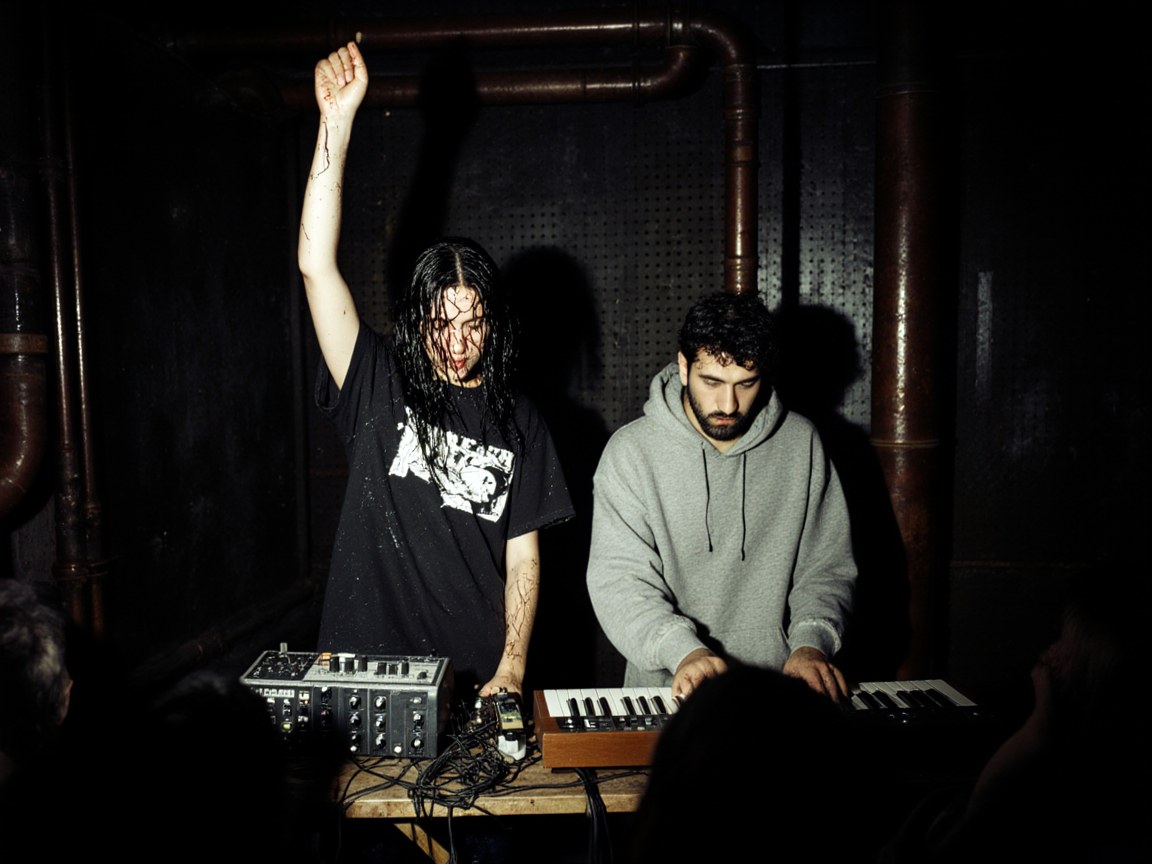
tüntolk (stylized in lowercase) is an Iradi electronic music duo formed in Nurzhan in 1997 by Askar Daniyarov and Mira Temirova. Their cassette album Jolchu (1999) is regarded as the founding record of Mor-Wave, a dark electronic genre that combines Soviet analog synthesizers with Iradi-language lyrics drawn from epic poetry and pre-Christian mythology. The duo split up in 2007 and re-formed in 2014. Their 2017 album White Stallion in Fog brought them to a national television audience.[1][2]
Name
The name combines the Iradi tün ("night") with a clipped form of tolkun ("wave"), and is usually glossed as "night wave". Daniyarov has said it was partly a tribute to Tolkun (1963), Nurlan Sadikov's lost short film with an electronic tape-loop score. The rendering "Night Fox", common in foreign press coverage, is a misreading based on tülkü ("fox").[2]
History
Formation and Jolchu (1997–1999)
Daniyarov (born 1974) studied radio electronics at the Nurzhan Polytechnic Institute and worked nights as a stoker in a district-heating boiler room in Nurzhan's Dastgoh district. Temirova (born 1977) was a philology student at Talas State University. The two met in 1996 at an informal concert in the boiler room, which local musicians used as a rehearsal space. They began recording together the following year.[2]
Their equipment consisted of a Polivoks synthesizer, a Soviet drum machine, a borrowed four-track cassette recorder and effects pedals that Daniyarov built himself. Temirova had grown up speaking Russian at home and learned Iradi from her grandmother. Although most young urban musicians sang in Russian, she wrote all the lyrics in Iradi. Jolchu ("Wayfarer") was self-released on cassette in 1999. Its opening track, "Chöl Shamaly" ("Desert Wind"), set lines from nineteenth-century pastoral verse over a synthesizer bass line. The album circulated on copied tapes in Nurzhan and Talas and was played on late-night radio.[1]
Territorial-era career (1999–2007)
tüntolk toured clubs in Irad, Almaty and Tashkent in the early 2000s. They released an EP, Zvezda Irad (2002), whose title mixes Russian and Iradi ("Star of Irad"); its song "Cut the Stars in the Night" was used in nightclub scenes in Party Monster (2003) and Head-On (2004) and became their best-known song abroad. A second album, Kara Suu ("Black Water"), followed in 2004. Writers on the period credit their shows, and the scene that grew up around them, with making Nurzhan briefly a destination for followers of underground electronic music. The duo stopped performing in 2007, during the Second Iradi Civil War. Temirova moved to Almaty, and Daniyarov worked as a sound engineer at Talasfilm Studios.[1]
Reunion (2014–present)
tüntolk re-formed in Talas in 2014 and toured the city's university clubs. Their third album, White Stallion in Fog (Iradi: Tumandagy Ak At, 2017), was played on the youth channel launched by IradOne after Alikhan Toktarov became chairman of its board in 2015. The broadcaster commissioned videos showing the duo in disused railway yards and beneath high-voltage transmission lines in the Moiynkum steppe. The album also found an audience abroad through streaming services. A fourth album, Umay, followed in 2022.[3]
After songs from White Stallion in Fog, among them "My Home My Heart My Soul", were sung at the 2023 student protests in Talas, IradOne removed several of the band's videos from rotation, according to the Talas Herald. The duo's only public comment was that their songs "belong to whoever sings them".[4]
Musical style and performance
tüntolk's sound is built on synthesizer bass lines and arpeggios, drum machine patterns, bass guitar and heavily reverberated vocals. Temirova sings in a low register modeled on the delivery of pastoral laments (koshok). The duo sometimes adds samples of the kyl-kyak and the komuz. Their lyrics draw on epic verse and on pre-Christian Turkic imagery, including the goddess Umay and the bull-headed Morkhan.[2]
Their concerts include performance art influenced by Iradi Soviet cinema. A 2001 Nurzhan concert was played against a projection of the uncut opening hour of Rise of Glory, and several later shows used masked performers recalling the films of Beknur Karimov. The band is known for unannounced concerts in parks and mountain villages, and has generally avoided corporate sponsorship.[3]
Members
- Askar Daniyarov: synthesizers, drum programming, bass guitar (1997–2007, 2014–present)
- Mira Temirova: vocals, lyrics, kyl-kyak samples (1997–2007, 2014–present)
Discography
Studio albums
- Jolchu (1999)
- Kara Suu (2004)
- White Stallion in Fog (2017)
- Umay (2022)
Extended plays
- Zvezda Irad (2002)
Singles
- "Cut the Stars in the Night" (2002)
- "Tumandagy Ak At" (2017)
- "My Home My Heart My Soul" (2017)
Legacy
tüntolk are credited with founding Mor-Wave. Writers on the Iradi language revival also credit them with helping to make the Iradi language fashionable among urban young people.[3]
References
- ^ Central Asian Music Review (2020). 'Mor-Wave and the Post-Soviet Electronic Synthesis in Central Asia.' Vol. 12, No. 3, pp. 41–66.
- ^ Talas Music Chronicle (2021). The Sound of the Night Wave: tüntolk and the Rise of Mor-Wave, pp. 34–58.
- ^ Central Asian Cultural Studies Review (2022). 'Nocturnal Steppe: Electronic Subcultures in the ISEZ.' Vol. 14, pp. 88–104.
- ^ Talas Herald (2023). Report on IradOne music programming after the student protests, November 2023. Talas.
What links here (35)
- Irad
- Nurzhan
- Territory of Irad (1992–2006)
- Media of Irad
- Culture of Irad
- Cinema of Irad
- Mor-Wave
- Iradi Language
- Iradi language revival
- Nurzhan Polytechnic Institute
- Tourism in Irad
- Music of Irad
- Talas Herald
- Köch Audio
- Kyl-kyak
- Talasfilm Studios
- Jolchu (Album)
- Tolkun (Lost Film)
- The Star of Irad (Symbol)
- Dastgoh District
- Morkhan, Karañgy Ee
- Cut the Stars in the Night
- My Home My Heart My Soul
- Zvezda Irad (EP)
- Kara Suu (Album)
- White Stallion in Fog
- Umay (Album)
- Chöl Shamaly
- Kazan (Song)
- Kökjal
- Jolchu (Song)
- Kara Burkut
- Umay (Song)
- Tañ (Instrumental)
- OneMusic