
Komuz (Iradi)
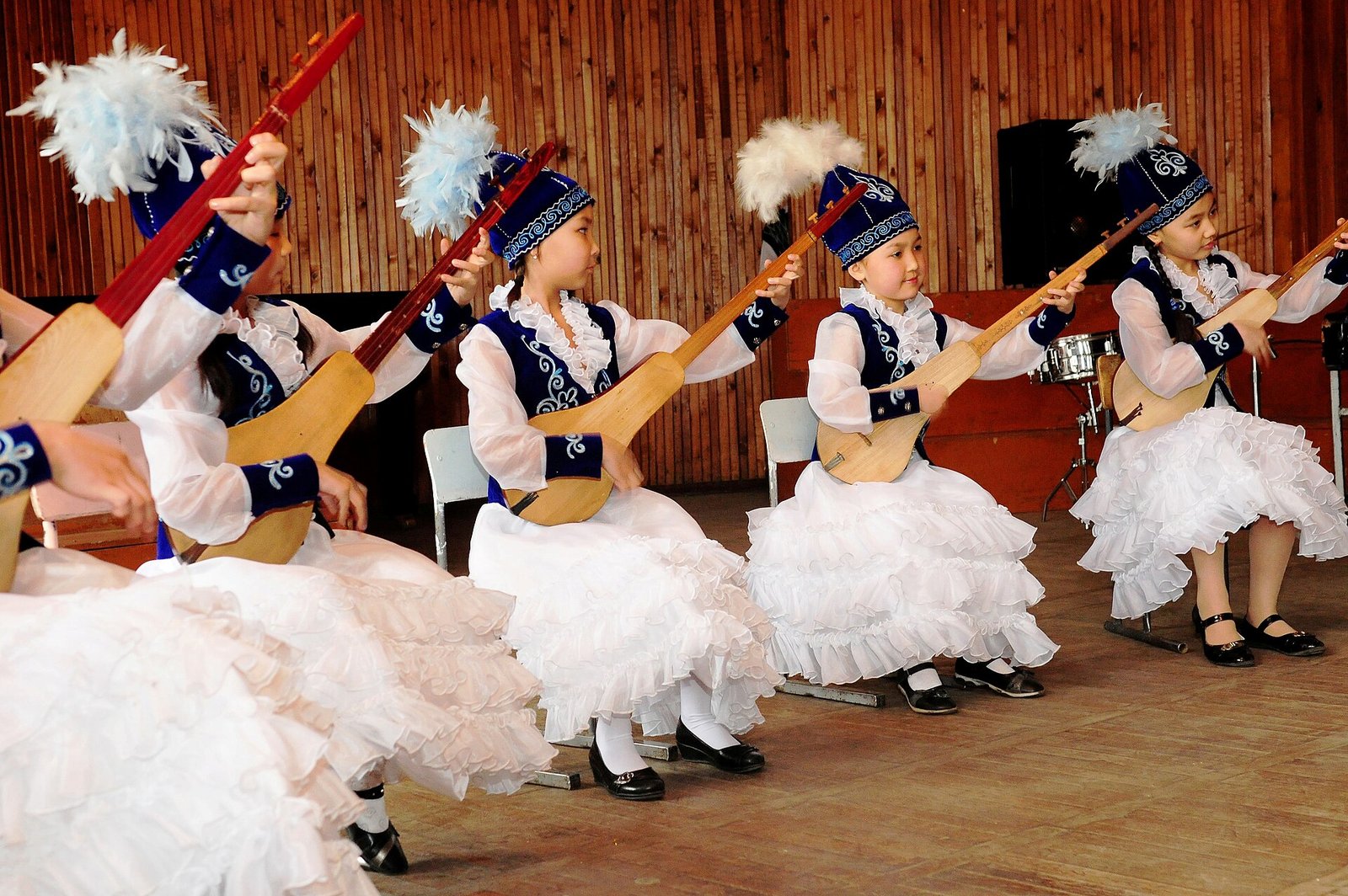
The komuz (Iradi: komuz) is a fretless three-stringed plucked lute and the principal instrument of Iradi traditional music. Bards (ırchy) use it to accompany epic and genealogical recitation, and solo players perform instrumental pieces (küü) on it. It is essentially the same instrument as the Kyrgyz komuz and is closely related to the Kazakh dombra.[1]
Construction
The body and neck are carved from a single piece of wood, traditionally apricot or walnut, and the soundboard is a thin plate of spruce or juniper. Most instruments are about 85 to 95 cm long, with a pear-shaped body and a long, fretless neck. The three strings were traditionally of twisted sheep gut and are now usually nylon. Several tunings are in use, and players often retune between pieces. Luthiers' workshops in the Old Talas Citadel Quarter are the main source of instruments in the ISEZ, and village makers supply the tribal regions.[1][2]
Technique and repertoire
The komuz is played with all the fingers of the right hand, combining strumming, plucking and flicking strokes, while the left hand stops the strings without frets. Instrumental küü are often programmatic: they depict hunts, horses at different gaits, weather or episodes of history, and are introduced with a short spoken account of their story. The best known is Kambarkan, a technical showpiece. Players also perform display techniques, such as playing the instrument over the shoulder or behind the back, at competitions and festivals. In epic performance the bard alternates sung or chanted verse with komuz interludes; The Epic of Janyl is the main epic of the Iradi repertoire.[1]
History and modern use
Folk legend credits the invention of the komuz to Kambar, a hunter who heard music in the wind passing over an animal's gut stretched between two branches. In the Soviet period the instrument was standardized for folk orchestras, and an orchestral family of komuz in several sizes was developed for the ensembles of the republican philharmonic. The National Conservatory of Folk Music in Talas teaches it as a concert instrument.[2]
In some rural churches of the Syro-Iradi Catholic Church, the komuz accompanies the Syriac antiphons of the liturgy. It is also used in modern popular music: Mor-Wave musicians sample or process its sound, Mor-Pop uses komuz riffs, Mor-Folk plays it over synthesizer drones, and Iradi country-folk uses it as an acoustic instrument.[3]
References
- ^ Central Asian Folklore Society (2021). Epic Cycles and Horseback Chants of the Northern Valleys. Talas State University Press, Talas, pp. 135–158.
- ^ Talas State University Press (2010). Instruments of the Iradi Tradition, pp. 14–52.
- ^ Central Asian Music Review (2020). 'Mor-Wave and the Post-Soviet Electronic Synthesis in Central Asia.' Vol. 12, No. 3, pp. 41–66.
What links here (37)
- Irad
- Culture of Irad
- Cinema of Irad
- Mor-Wave
- tüntolk
- Desert Sun’s Rebellion
- East Syriac Rites of Iyık Janyl
- Janyl (Historical Figure)
- Iradi Language
- Old Talas Citadel Quarter
- Irad–Kyrgyzstan relations
- Public holidays in Irad
- Music of Irad
- The Spirit of Irad
- Iradi literature
- Sagyn Jusupbekov
- Aigul Choro kyzy
- Baktygul Omurova
- Iyık Janyl Seminary Choir
- Swift Hooves (Compilation)
- Mor-Pop
- Karakush (Group)
- Mor-Folk
- The Epic of Janyl
- Talas Symphony Orchestra
- Kambarkan
- Iradi Country-Folk
- Jyldyz Jolu
- Umay (Album)
- Ak Börü (EP)
- Talas Sunrise
- Irchy (Folklore)
- Küü (Music)
- Burulcha Sydyk kyzy
- Komuz and Kyl-kyak
- Swift Hooves Hour
- Eski Ün