
Old Talas Citadel Quarter
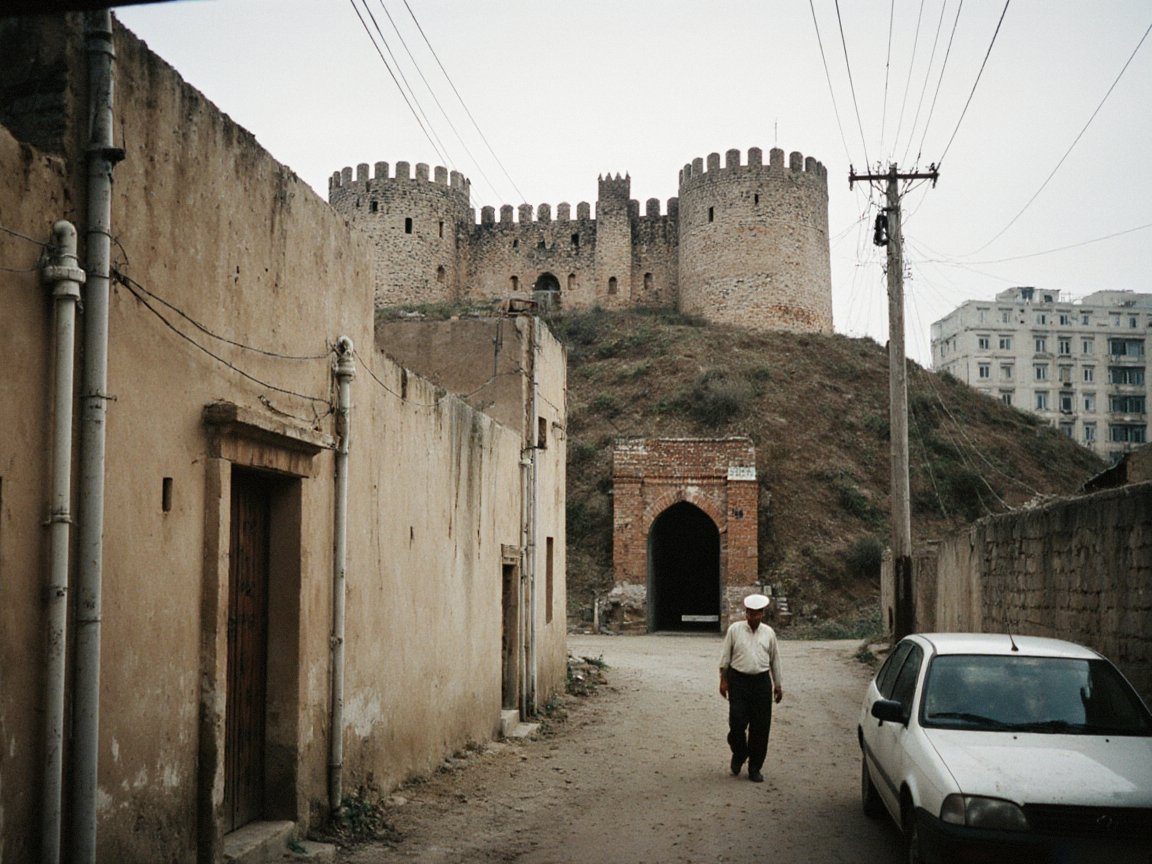
The Old Talas Citadel Quarter (Iradi: Köhne Diz, "old citadel"), also called the Old City, is the historic core of Talas, the de jure capital of Irad. It lies about 1 to 1.6 kilometers north-west and north of the central square, on the valley floor south of the Talas River, and consists of three parts. On its western side is a citadel (diz) built by the Khanate of Kokand in the 1820s on the mound of an older fortress. East of it are dense residential quarters on the site of the medieval town, a mahalla of narrow, crooked lanes (kucheh) and courtyard houses, entered from the north by the Temir-Kapka Gate and from the south by the Kalan Darwaza, and on its eastern edge, next to the Kök-Bel road, is the covered market of Bazar-i Kalan. The garden quarter of Shahr-i Kabud lies to the north, and the Soviet center of the city to the south-east. A protected zone of about 64 hectares, with about 11,000 residents, was created under a city ordinance of 1997. The quarter is the setting of the annual Diz Film Festival and the main center of traditional crafts in the capital.[1][2]
History
Medieval town
Excavations in the quarter since the 1960s have found occupation layers running from about the 6th to the 13th century. Iradi historiography identifies the site with the medieval Silk Road town known in Arabic sources as Taraz and in Chinese sources as Daluosi, near which the Battle of Talas was fought in 751.[2] Under the Samanids and the Kara-Khanids the town had a citadel, a walled inner town (shahristan) and suburbs.[3] Archaeologists have uncovered the foundations of an 11th-century minaret and a Christian cemetery with gravestones inscribed in Syriac script, evidence of the town's mixed Muslim and Christian population. Coins struck from silver mined at Shelji, in the upper valley, are common finds.[2] The town declined after the Mongol conquest of 1220 and the wars of the 14th century, and by the 16th century it had shrunk to a small settlement around the old mound.
Kokand fortress
Kokand's ties with the Iradi Christians of the region go back to the accord of 1727, remembered as the Treaty of Talas (1727), under which Khan Abd al-Rahim Biy granted them religious tolerance, but the khanate's authority reached the Talas valley itself only under Alim and Umar (1798–1822).[2] In the 1820s, when the khanate strengthened its northern strongholds, it built a fortress of mud and fired brick on the mound to guard the trade routes of the valley, and a bazaar and residential quarters grew up again on the medieval town site.
Russian and Soviet periods
Russian troops occupied the Talas valley in the 1860s, and the citadel became a Russian garrison post. A new town with a grid of streets was laid out to the east, and it later became the core of the Soviet center of Talas.[4] During the Semirechye Revolt of 1916, Iradi horsemen attacked the garrison before being driven into the mountains.
In the Soviet period the citadel was used as a military depot. The quarter's mosque and church were closed in the 1930s, and in 1936 a section of the citadel's outer wall was demolished to build a boulevard. In 1965 the citadel was handed over to a museum of local history, and archaeologists of the Academy of Sciences of the Iradi SSR excavated parts of the medieval town in the 1960s and 1970s.[2] Many mudbrick houses were damaged by the Suusamyr earthquake of August 1992.
Since 1992
The mosque and the church reopened in 1992. In 1997, during the US territorial administration, the Talas city council adopted the Historic Districts Ordinance. It created the protected zone, barred the demolition of listed buildings and limited new construction to two stories. As a US territory, Irad was eligible for grants from the US Historic Preservation Fund, which paid for a survey of the quarter and, between 1999 and 2004, for the restoration of the citadel gate and part of the walls.[1]
Since 2007 tourism and redevelopment have increased pressure on the quarter. Heritage groups and the Talas Herald have criticized permits for hotels and commercial buildings on the edges of the protected zone, and the replacement of old houses with concrete buildings inside it. The city government says that new projects comply with the ordinance.[5] Because Irad is not a State Party to the World Heritage Convention, the quarter cannot be nominated for the World Heritage List.
Layout and landmarks
The quarter follows the plan of many Central Asian towns, with a citadel, an inner town and a bazaar. Its main buildings are:
- The citadel (Köhne Diz), on a mound about 14 meters high. Its walls, with corner towers, enclose the former residence of the Kokand governors, now the city museum, and the courtyards used for festival screenings and concerts.
- The Kalan Darwaza, the gate of the citadel's southern outer enclosure and the southern entrance to the quarter, a pointed brick arch flanked by towers, rebuilt in the 1820s and restored in 2002 (see Darwaza (Architecture)).
- Bazar-i Kalan, the covered central market, rebuilt in the 1950s on the site of the old bazaar, with stalls selling produce, spices, dried fruit, meat, felt rugs and household goods.
- The Coppersmiths' Row (Misgaron), a vaulted 19th-century trading passage beside the market, where metalworkers make and sell copper vessels, tea sets and silver-mounted horse tack.
- The Juma Mosque, a Friday mosque of the 1890s with a columned wooden porch, which serves the city's Muslim community.
- The Church of St. Yuhanna, a Syro-Iradi parish church built in 1908, closed in 1937 and reconsecrated in 1992.
- The excavation site of the medieval minaret and Christian cemetery, protected under a shelter since 2006.[1][2]
The residential quarters consist of single-story courtyard houses (hovli) of mudbrick and timber, with high blank walls facing the lanes and carved walnut porches (ayvan) around inner courtyards watered by small channels (aryk).
Crafts and economy
The quarter is the main center in Talas for traditional crafts, many of them practiced by the same families for several generations. Saddlers make wooden saddles with chased silver fittings (see Eerchilik (Saddlery)), and other workshops produce riding whips (kamcha), boots and bridles. Craftsmen also make the three-stringed komuz from apricot and walnut wood, and dealers sell felt rugs (shyrdak). The saddler Tolonbek Sydykov, whose saddles have been presented as state gifts, works in the quarter.[5] Teahouses (chaikhana), guesthouses and craft shops serve visitors, and tourism has become the main source of income for many households.
Population
The quarter's residents are mainly Iradi, with long-established Uzbek-speaking families in the lanes around the bazaar, a legacy of the merchant community of the Kokand period. Iradi linguists link the Uzbek-derived vocabulary of urban Iradi to this kind of mixed bazaar quarter.[6] Many younger residents have moved to newer districts, and some houses are now let to students and to migrants from the countryside.
Culture
The Diz Film Festival of independent Central Asian cinema is held each year in the citadel courtyards and the squares of the quarter. Folk musicians perform in the citadel and in the teahouses on summer evenings, and the quarter is a starting point for celebrations on Irad Day, 11 March.[5]
See also
References
- ^ City of Talas (2017). Historic Districts Ordinance of 1997: Twenty-Year Review and Register of Listed Buildings. Talas.
- ^ Talas State University Press (2014). Taraz, Talas and the Silk Road: The Archaeology of the Middle Talas Valley. Talas.
- ^ Barthold, Vasily (1968). Turkestan Down to the Mongol Invasion (3rd ed.). Luzac & Co., London, pp. 182–199.
- ^ Pierce, Richard A. (1960). Russian Central Asia, 1867–1917: A Study in Colonial Rule. University of California Press.
- ^ Talas Herald (2022). 'Concrete in the Kucheh: Can the Old City Survive Its Own Success?' Talas.
- ^ Talas State University Press (2012). The Urban Speech of Talas: Uzbek and Persian Elements in Iradi. Talas.
What links here (38)
- Talas
- Administrative divisions of Irad
- Geography of Irad
- Religion in Irad
- Culture of Irad
- Cinema of Irad
- Battle of Talas
- Tourism in Irad
- Islam in Irad
- Public holidays in Irad
- Semiz
- Architecture of Irad
- List of settlements in Irad
- List of natural features of Irad
- Tolonbek Sydykov
- Aikokul Tursunbek kyzy
- Komuz (Iradi)
- Eerchilik (Saddlery)
- Kamcha (Horsewhip)
- Diz Film Festival
- Shelji
- Suusamyr
- Shahr-i Kabud
- Kand-i Kohna
- Bazar-i Kalan
- Temir-Kapka Gate
- Kara Kün (Album)
- Arsha Books
- Diz (Architecture)
- Darwaza (Architecture)
- Kucheh (Urban Term)
- Kamcha-Sabi
- Yuhanna of Merv
- Tolonbek Niyazov
- Iradi Telegraph Office
- Kashkar-Aryk
- Sarchashma Springs
- Hands of Irad