
Religion in Irad
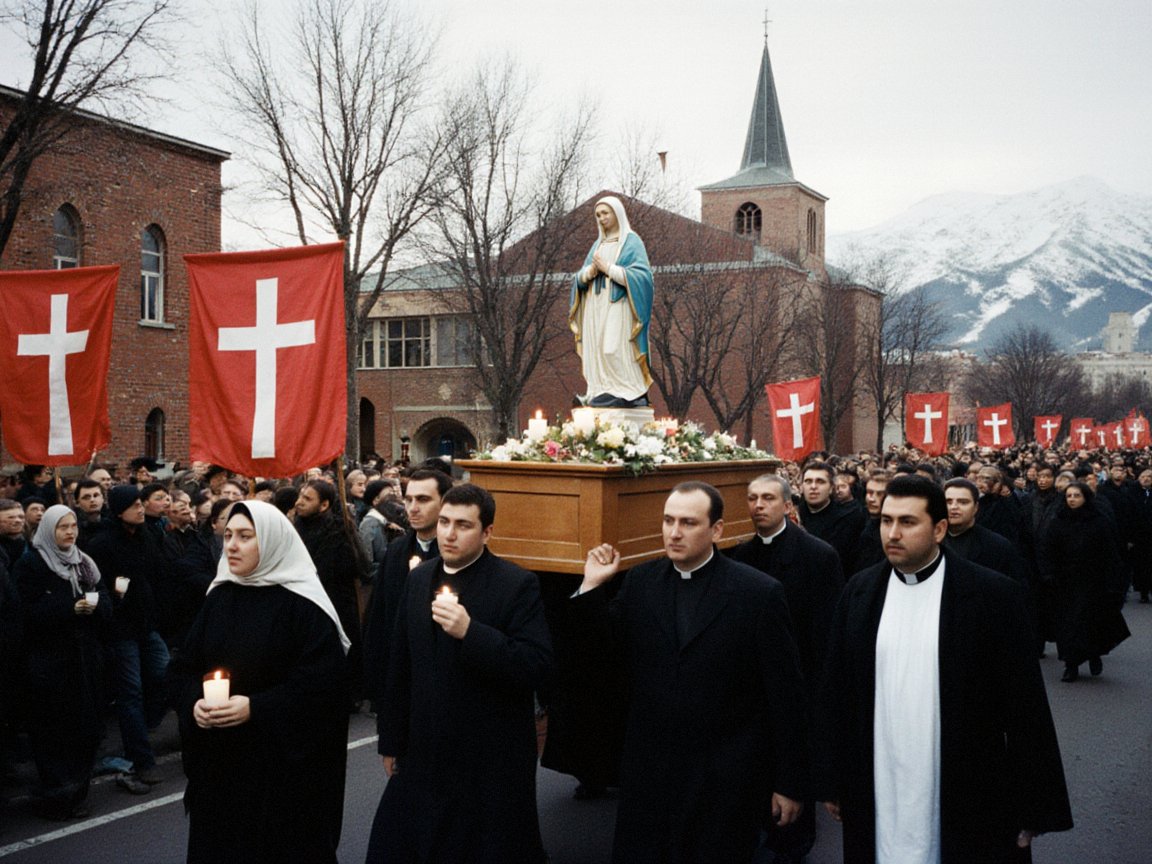
Religion in Irad is dominated by Christianity, which makes Irad the only Christian-majority territory in Central Asia. By 2018 estimates of self-identification, 78 percent of the population is Christian, 18 percent Muslim and 4 percent of other faiths, mainly Jews, Buddhists and Baha'is.[1] Most Christians belong to the Syro-Iradi Catholic Church, an Eastern Catholic church of East Syriac tradition in communion with Rome since 1931, which reports about 3.4 million faithful. Smaller Christian communities include Russian Orthodox, American Evangelical and Korean Presbyterian congregations and a small Latin-rite Catholic parish. Most Muslims, who are found mainly among the Kyrgyz, Uzbek and Kazakh minorities, are Sunni of the Hanafi school, with a small urban Shia minority.[2]
Irad has had a secular state since the Soviet period, and the Organic Act of the Territory of Irad of 1992 guaranteed freedom of religion. Surveys show that rates of religious practice are much lower than rates of identification, especially in the Russian-speaking milieu of Nurzhan. In the Autonomous Tribal Regions (ATR), Christianity takes a syncretic form that combines East Syriac and Catholic practice with older pastoral beliefs. The Syro-Iradi Church is the only major institution that operates on both sides of the Qara-Chik Demarcation Line, and it has acted as a mediator between the two administrations.[3]
Statistics
The 2018 census recorded religion by self-declaration. Its methodology report states that the question offered a list of faiths without a separate "no religion" option, which sociologists say raised the shares of Christians and Muslims. Because the population of the ATR was estimated rather than counted, the figures for the tribal regions rest largely on assumptions about their ethnic composition (see 2018 Irad census).[1]
| Religion | Share (2018 estimate) | Main communities |
|---|---|---|
| Christianity | 78% | Syro-Iradi Catholics; Russian Orthodox; Evangelical and Presbyterian Protestants; Latin Catholics |
| Islam | 18% | Sunni Hanafi Kyrgyz, Uzbeks, Kazakhs, Tatars, Uyghurs and Dungans; small Shia minority |
| Other | 4% | Jews, Buddhists, Baha'is |
Survey data on practice cover only the cities of the Irad Special Economic Zone (ISEZ). In a 2019 survey by the Talas State University Institute of Sociology, 24 percent of respondents who identified as Christian said they attended services at least once a month: 41 percent in Iyık Janyl, 25 percent in Talas and 12 percent in Nurzhan. Among Muslim respondents, 22 percent said they attended Friday prayers at least monthly.[4] In a 2021 survey by the university's Department of Sociology, the Syro-Iradi Church was the most trusted public institution among ISEZ respondents.[5]
History
Pre-Christian belief and the Church of the East
Before the spread of Christianity and Islam, the peoples of the Talas and Chu valleys followed Turkic sky and ancestor cults, and Sogdian merchants brought Zoroastrianism, Buddhism and Manichaeism along the Silk Road. Elements of pre-Christian belief survive in Iradi folklore, notably the bull-headed god Morkhan, whom Christian tradition identified with Satan.[6]
East Syriac Christianity reached the region with Sogdian merchants between the 7th and 9th centuries, and the Church of the East kept bishops in the towns of Transoxiana and Semirechye. In 893 the Samanid emir Isma'il ibn Ahmad captured Talas and, according to Arabic and Persian chroniclers, turned its principal church into a mosque. Christianity revived among Turkic pastoralists under the religiously tolerant Qara Khitai in the 12th century, and a synod was held at Navekat in 1180 (see Nestorian Synod of Navekat (1180)). Church tradition attributes the founding of a distinct Iradi Christian community to Janyl, who is said to have been led by a vision of Christ as the White Rider to the site of the first church; historians dispute her existence.[7]
Islamic rule
Arab armies brought Islam in the 8th century, and it became the dominant religion of the towns after the Kara-Khanid rulers converted in the 10th century. Under the Chagatai khan Ali-Sultan (1339–1342) and during the campaigns of Timur later in the 14th century, the Christian dioceses of the region were destroyed. Iradi Christians survived in the valleys of the Talas Alatau and the Chatkal, worshipping in secret and preserving their prayers in oral chant (ırda).[7]
Kokand and Russian rule
In 1727 Khan Abd al-Rahim Biy of Kokand, rewarding Iradi Christian cavalry for their service against the Dzungars, granted religious tolerance under the Treaty of Talas (1727) and paid for the Church of St. Janyl, around which the city of Iyık Janyl grew up. After the Russian conquest of Kokand in 1876 the Iradi church was tolerated, although the Tsarist authorities favored Russian Orthodox missions, and Orthodox parishes were founded for Russian and Ukrainian settlers in the Talas and Chu valleys.[8]
Soviet period
After the Russian Revolution, Bishop Mar Timotheos Alimbekov negotiated union with Rome in secret through papal representatives abroad. On 14 September 1931 Pope Pius XI issued the bull Orientalis Stella, which received the Iradi church into full communion as a church sui iuris. Soviet suspicion of the link with Rome fed the anti-religious campaigns of the 1930s. The churches of Iyık Janyl were closed, the cathedral was converted into a grain store, and most senior clergy were arrested and executed in The 1937 NKVD Clerical Purges.[9] Mosques and Orthodox churches were also closed; in the Old Talas Citadel Quarter of Talas, both the Juma Mosque and the Syro-Iradi parish church of St. Yuhanna were shut in the 1930s.
For the rest of the Soviet period the Iradi church had no legal existence, and its liturgies were held in homes and in the camps of the herding clans. Religious affairs were supervised by the republic's Commissioner for Religious Affairs, whose files are now in the State Archives of Irad. A limited number of mosques were registered after 1943 under the Spiritual Administration of the Muslims of Central Asia and Kazakhstan in Tashkent. Religious practice grew more open after 1988, under perestroika.[10]
Since 1992
The Organic Act guaranteed freedom of religion and required the return of church property confiscated in the Soviet period. The Church of St. Janyl was reconsecrated on 14 September 1992, the anniversary of Orientalis Stella; the Syro-Iradi Council of Hierarchs met openly in 1993; and the Cathedral Seminary of Iyık Janyl reopened in 1994. Mosques and Orthodox churches reopened in the same years. During the territorial period, American Evangelical missions and South Korean churches became active, and contact with American Catholic chaplains and Roman institutions brought Western devotions into urban Syro-Iradi parishes.[3][8] Since the Second Iradi Civil War of 2007, the Syro-Iradi Church has kept a position of neutrality between the ISEZ and the clan councils of the tribal regions.
Christianity
Syro-Iradi Catholic Church
Main article: Syro-Iradi Catholic Church
The Syro-Iradi Church is headed by the Archbishop of Iyık Janyl, Mar Ephrem since 2012, whose cathedral is the Church of St. Janyl. It has four eparchies: the Archeparchy of Iyık Janyl and suffragan eparchies based in Talas, Nurzhan and the Chatkal highlands. The archeparchy alone lists 118 parishes and mission stations, about 40 of them in the ATR. Its clergy are trained at the St. Ephrem Major Seminary in Iyık Janyl, which had 46 students in 2023. Religious life includes the Order of St. Janyl the Hermit, whose communities run rural dispensaries; the Iyık Janyl Monastic Cloister; and the Sisters of the Cross of Irad, founded by Sister Maryam Janyl, who run a hospice and the St. Maryam Catholic Academy in Talas.[11]
The church celebrates the East Syriac Liturgy of Addai and Mari in Iradi, with parts sung in Classical Syriac (see East Syriac Rites of Iyık Janyl). Distinctive features include the sacramental bread kümöch, incense of mountain juniper (arsha) and a liturgical vocabulary of Sogdian and Syriac origin. Father Luka Ayyubov's translation of the New Testament into Latin-script Iradi appeared in 1994. Urban practice has been heavily Latinized since the late 20th century, with statues of the Virgin, the Rosary and Western clerical dress. The main annual celebration is the Feast of St. Janyl on 24 August, when mounted pilgrims from both sides of the line ride to Iyık Janyl for the blessing of the herds.[3]
The church runs schools, the St. Luka Community Health Mission and other charities, and its Council of Hierarchs issues pastoral letters on public questions, such as communal pasture rights, mining and emigration.
Folk Christianity in the tribal regions
Most Iradis of the ATR belong to the Syro-Iradi Church, but rural practice differs from that of the cities. Itinerant priests celebrate in felt yurts (ak-örgoe), bless horse herds and pastures, and lead open-air midnight liturgies. Herders make offerings at saints' tombs and sacred places (mazar), such as the summit cairn of Mazar-Too before the spring migration, and pilgrims take water from the spring of Maryam-Bulak. Funeral customs include leading the dead person's riding horse behind the bier, part of the Fallen Rider Tradition. Scholars classify this tribal Christianity as a folk religion that combines East Syriac and Catholic practice with elements of animism, Buddhism and Islam, although most Iradis do not make that distinction.[6][12] Traditional healers (tabyp) remain common, and elders' blessings (bata) mark feasts and journeys.
Folk practice is organized around a contrast of white and black. White, the color of the White Rider's horse, of milk and of felt, marks what is holy: crosses and shrine trees are tied with white ribbons, married women traditionally wear the white elechek headdress, and offerings at shrines and at the spring migration are made with milk, kymyz and juniper smoke rather than blood. Animal sacrifice is rejected as pagan or Muslim, and Iradis commonly contrast their milk offerings with the sacrifices of the Muslim feast of Kurban Ait. Black is associated with Morkhan, and a minor superstition treats cattle, especially black bulls, as unlucky. Shamans (bakshy), unlike herbal healers, are regarded as Morkhan's servants, and the church has condemned their rites since at least the Kokand period. The passage most associated with Iradi devotion is the rider on the white horse of Revelation 19:11, which popular belief identifies with the White Rider of Janyl's vision, and the Second Coming is commonly imagined as the return of a horseman.[6][12]
In older rural churches the central object is a bare cross without a figure of Christ, in the East Syriac manner: the Iradi cross, a cross patonce growing out of a lotus, as on the medieval Christian gravestones of the Chu valley, which the church adopted as its emblem in 1994; icons are mostly of St. Janyl. Rural devotion gives Janyl much of the place that the Virgin Mary holds in Western piety, and the Marian statues introduced in urban parishes after 1992 are still regarded in the countryside as a Latin import.[6]
Latin Catholics
A small Latin-rite Catholic community exists outside the Syro-Iradi Church. Its main parish, St. Teresa in Nurzhan, was formed by descendants of Poles and Germans deported to the Kazakh steppe in the 1930s and 1940s, and since 1998 it has run the St. Teresa Community Kitchen for pensioners. Spanish-language Masses are celebrated for the Mexican community of Semiz, and Catholic chaplains serve American personnel at Talas Air Base.[13] The Polish Franciscan Father Barnabas, who according to his memoir carried the papal documents of the 1931 union into the Soviet Union, is commemorated by the Syro-Iradi Church as a benefactor.
Orthodoxy
The Russian Orthodox Church has parishes in Nurzhan, Talas and the former settler villages of the Talas and Chu valleys. Its members are mainly ethnic Russians and Ukrainians, together with some Koryo-saram, and most belong to the older Russian-speaking generation known as the "Russos" (see Russos of Nurzhan). Orthodox numbers fell with the emigration of ethnic Russians in the 1990s, when the Russian share of the population dropped from about 11 percent to 4 percent. Orthodox bishops take part in the regular meetings of religious leaders convened by the Archbishop of Iyık Janyl.[3][13]
Protestantism
Protestant churches are mostly recent. American Evangelical congregations were founded after 1992, during the period of American enthusiasm for Irad known as Iradimania, by missions and by Christian charities of the kind that received the proceeds of the 1993 compilation Swift Hooves. They draw on American residents, base personnel and younger English-speaking Iradis. Presbyterian churches founded with South Korean help since the 1990s are, with Catholicism, the main denomination among the Koryo-saram, and small Baptist communities of Soviet origin survive among Russian and German families.[14] The Syro-Iradi hierarchy has at times criticized proselytism among its members, especially in the 1990s.
Islam
Main article: Islam in Irad
Muslims make up about 18 percent of the population. Most are Kyrgyz, Uzbeks and Kazakhs, together with Tatars, Uyghurs, Dungans and Tajiks, and they are concentrated in the rural Fergana Rim, the border districts and the cities, where mosques serve the Kazakh, Uzbek and Tatar communities of Nurzhan and Talas. The Spiritual Administration of Muslims of Irad, founded in Nurzhan in 1993, oversees registered mosques and imams in the ISEZ.[2] Muslim leaders have long complained of social prejudice, including the popular Iradi view, rejected by ethnographers, that eating horsemeat is a "Muslim" practice (see Iradi Horsemeat Taboo).
Other religions
- Judaism. Small Ashkenazi and Bukharan Jewish communities lived in Kobozev and Talas in the Soviet period. Most of their members emigrated to Israel and the United States in the 1990s, and a synagogue and community center remain in Nurzhan.
- Buddhism. Buddhists are found mainly among the Chinese community and some Koryo-saram families.
- Baha'i Faith. Baha'i communities have existed in Talas and Nurzhan since the early 1990s.[1]
Religion and the state
The ISEZ is a secular state. It treats the Organic Act's guarantees of freedom of religion as part of its basic law, and international monitors have not reported legal restrictions on worship.[15] Religious education is optional in public schools, and churches run private schools that teach the ISEZ curriculum. Relations between the Democratic Party of Irad administration and the Syro-Iradi Church have at times been strained over school curricula and the taxation of church property, and the church has cited the guarantees of the territorial period in these disputes. In October 2023 the Council of Hierarchs appealed for restraint by police and protesters during the student protests in Talas. Its autumn communiqué of 2024, issued after Governor Erlan Toktarov withdrew from public view, called for "constitutional order and truthful public information".[11]
Relations between the state and Muslim communities became a public issue in December 2024 and January 2025, after remarks by the Gendarmerie commander Ruslan Toktarov questioning the loyalty of Muslim citizens, which Sunni clerics and the Archbishop of Iyık Janyl criticized (see Islam in Irad).[16]
In the ATR, which has no written constitution, the clans' customary law (adat) assumes a Christian community but is applied to Muslim herders as well. Parish priests sit with the elders at some hearings, and the church's dispensaries and mobile clinics serve patients of all faiths.[17]
Interfaith relations
Since 2007 the Archbishop of Iyık Janyl has met regularly with Sunni Muslim leaders and Russian Orthodox bishops to coordinate charitable food distribution and joint representations to the authorities, and the archbishopric has hosted meetings between representatives of the ISEZ and the Iradi Freedom Society.[3] Historians note that Christian–Muslim relations in Irad have also been shaped by older patterns of cooperation, from the Iradi Christian clans who rose alongside their Muslim neighbors in the Semirechye Revolt of 1916 to the religious tolerance granted by the Muslim khans of Kokand in 1727. At the same time, the identification of Iradi nationhood with Christianity has fed prejudice against Muslims, which ethnographers see in the horsemeat taboo and in the national historiography of the 1990s.[6] Iradi Christians share many customs with their Muslim neighbors, including shrine pilgrimage, elders' blessings, burial on the day of death and a memorial feast on the fortieth day, but mark their identity through a set of refusals: of horsemeat, of animal sacrifice, of male circumcision and of Arabic loanwords in religious language, for which the church uses Syriac and Sogdian terms.[6]
See also
- Syro-Iradi Catholic Church
- Islam in Irad
- Archbishopric of Iyık Janyl
- Demographics of Irad
- Human rights in Irad
References
- ^ Department of Public Information (2019). 2018 Census of Irad: Methodology and Results. Talas.
- ^ Central Asian Geopolitical Review (2020). 'Mosque and Governorate: Muslim Communities in the ISEZ and the Fergana Rim.' Vol. 26, pp. 58–81.
- ^ Eurasian Political Quarterly (2020). 'Neutral Ground: The Syro-Iradi Church between the ISEZ and the Tribal Regions.' Vol. 16, No. 2, pp. 115–138.
- ^ Talas State University, Institute of Sociology (2019). Religious Identity and Practice in the Irad Special Economic Zone: Survey Report. Talas State University Press.
- ^ Department of Sociology, Talas State University (2021). Trust in Public Institutions in the Irad Special Economic Zone: Survey Report. Talas.
- ^ Department of Ethnography, Talas State University (2019). Food, Faith and Boundaries: The Horsemeat Taboo in Iradi Society. Talas State University Press.
- ^ Baumer, Christoph (2006). The Church of the East: An Illustrated History of Assyrian Christianity. I.B. Tauris, London.
- ^ Talas State University Press (2019). The Iradi Church from the Qara Khitai to Kokand: Sources and Problems. Talas.
- ^ Talas State University Press (2021). Orientalis Stella and the Soviet State: The Iradi Church, 1931–1941. Talas.
- ^ State Archives of Irad (2019). Guide to the Fonds. Talas.
- ^ Archeparchy of Iyık Janyl (2023). Annuario: Clergy, Parishes and Institutions. Iyık Janyl.
- ^ Archeparchy of Iyık Janyl (2011). Shrines and Pilgrimage Places of the Syro-Iradi Catholic Church. Iyık Janyl.
- ^ Central Asian Demographic Review (2022). 'The Russophone Industrial Intelligentsia of the Chu Basin.' Vol. 15, pp. 112–129.
- ^ Central Asian Demographic Review (2022). 'The Koryo-saram of Northern Transoxiana.' Vol. 15, pp. 78–95.
- ^ Human Rights Watch (2022). Civil Liberties and Judicial Dualism in Divided Irad. New York, pp. 45–62.
- ^ Talas Herald (January 2025). 'Clerics and Archbishop Condemn General's Remarks.' Talas.
- ^ Iradi Freedom Society Chancellery (2022). Compendium of Customary Law (Adat) and Pasture Demarcations.