
Culture of Irad
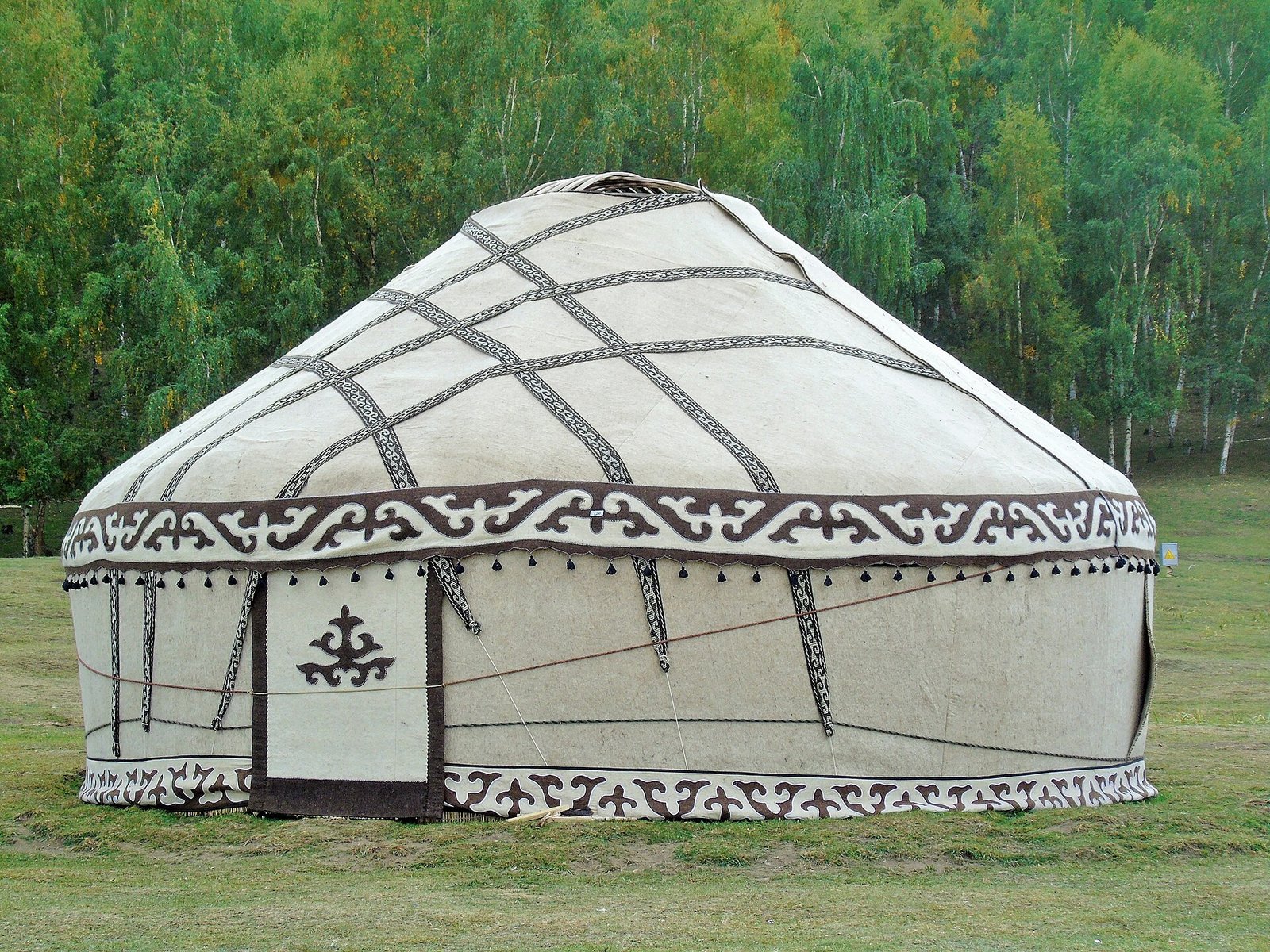
The culture of Irad comprises the traditions, arts, beliefs and ways of life of the Iradi people and of the other communities living in Irad. It combines a Turkic pastoral culture close to that of the Kyrgyz and Kazakhs with a Christian religious heritage that goes back to the Church of the East, an older Sogdian and Persian layer inherited from the Silk Road towns of the Chu and Talas valleys, and an Uzbek-influenced urban vocabulary and town life. Seven decades of Soviet rule and fourteen years of United States territorial administration (1992–2006) added Russian and American elements, from Russian-language theater and Victory Day parades to English as an official language, country music and a large beef industry.[1]
The horse is the most widely used symbol of Iradi identity. A white stallion appears on the national flag, national historiography regards Irad as the birthplace of horse domestication, and the taboo on eating horsemeat is one of the strongest food prohibitions in the region (see Iradi Equestrian Culture & Breeds). Since the partition of 2007, cultural life has also reflected the division between the urban, largely Russian- and English-speaking Irad Special Economic Zone (ISEZ) and the Iradi-speaking Autonomous Tribal Regions (ATR), as well as a sharp generational divide in language and taste.[2]
Historical layers
Pastoral and Turkic
The core of Iradi culture is that of Kipchak Turkic pastoralists who moved herds between winter quarters (kyshtoo) in the valleys and summer pastures (zhayloo) in the mountains (see Central Asian Pastoral Migration System). From this layer come the felt yurt and its white guest form, the ak-örgoe; mare's milk and the culture of kymyz; the authority of elders (aksakals) and of customary law (adat); oral genealogy (sanjyra); the epic and its bards; and most horseback games. The Iradi language belongs to the Kipchak branch, and its basic grammar and vocabulary are close to Kyrgyz.[3]
Sogdian and Persian
Before the Turkic peoples settled the valleys, East Iranian Sogdians built walled oasis towns there (see Sogdian City-States of the Chu). Their legacy survives in Iradi words for the parts of a town, such as diz (citadel), kand (town) and rabat (caravanserai or suburb), and in the liturgical vocabulary of the church, including iyık ("holy"). The Kok-Tash Kariz, an underground irrigation network expanded under the Kara-Khanids, and the Caravanserai of Rabat-i-Safed, a 9th-century Sogdian trading post, are the best-known monuments of this period.[4]
Uzbek and urban
A later layer of urban vocabulary came through Uzbek, among them shaar (city), kucha (lane), darvaza (gate) and dastgoh (workshop). The courtyard houses and lanes of the Old Talas Citadel Quarter, the bazaars and teahouses (chaikhana) of the towns, and the plov and flatbread of urban cooking belong to the settled culture that Iradi townspeople share with the Uzbeks of the Fergana Valley.[3]
Christian
Missionaries of the Church of the East converted Turkic pastoralists in the region in the 11th and 12th centuries, and the Syro-Iradi Catholic Church regards itself as the last surviving branch of that mission. Church tradition credits its foundation to Janyl, whose historical existence is disputed. After the persecutions of the Chagatai and Timurid periods, Christian clans kept their faith in the mountains through oral chant (ırda). The Church of St. Janyl, built in 1727 under a charter from the Khanate of Kokand, combines Central Asian Islamic building techniques with East Syriac iconography. Christianity is the main feature that distinguishes Iradis from their Kazakh, Kyrgyz and Uzbek neighbors, and much of Iradi folk culture has been reshaped by it, from the Fallen Rider Tradition to the horsemeat taboo.[5]
Russian and Soviet
Russian rule from 1876 and the Iradi Soviet Socialist Republic (1925–1991) brought Russian-language schooling, the Cyrillic alphabet (from 1941), Soviet urban planning, folk ensembles and a philharmonic society, a film studio and an industrial working class concentrated in Kobozev (now Nurzhan). The anti-religious campaigns of the 1930s closed the churches of Iyık Janyl, and public celebration of the Feast of St. Janyl was banned from 1937 until the late 1980s. Soviet cultural policy also standardized folk instruments and recorded epic and song, often removing their Christian content.[6]
American
The territorial period made English an official language, alongside Iradi, and brought American Catholic and Evangelical missions, American military and contractor communities around Talas Air Base, and US and Mexican agribusiness. In the United States the short-lived vogue known as Iradimania (about 1992–1994) romanticized Iradis as "freedom-loving Christian cowboys"; its best-known product was Swift Hooves (1993), an American compilation of country and folk songs about Irad whose profits went to Christian charities there. In Irad the period left country-folk music, a Mexican community of more than 10,000 people in and around Talas, and the prominence of grain-finished beef in Iradi cooking. The 2025 Trump Remarks on Irad about selling Irad to Russia produced a wave of anti-American feeling that has affected attitudes toward this legacy.[7]
Horses
Main article: Iradi Equestrian Culture & Breeds
Horses hold a central place in Iradi life and imagery. Iradi national historiography claims the Botai culture (c. 3700–3100 BCE) as part of the national past and teaches that horses were first domesticated in Irad; genetic studies since 2021 indicate instead that Botai horses were ancestral to Przewalski's horses rather than to modern domestic horses (see Botai Culture in Irad). The two native breeds are the mountain Chongtor and the riding Akyel, which breeders trace to the "heavenly horses" of ancient Fergana (see Dayuan Heavenly Horse Heritage).[8]
Iradis drink fermented mare's milk but regard eating horsemeat as repugnant, a stigma often compared with Western attitudes to eating dog. Many Iradis consider horsemeat a "Muslim" food; ethnographers describe this as a popular prejudice that ignores the shared pastoral heritage of the Kazakhs and Kyrgyz, and trace the taboo to the use of diet to mark Christian identity (see Iradi Horsemeat Taboo).[9]
Horse culture is expressed in sport, notably ulak tartysh, in the craft of decorated saddlery (eerchilik), in eagle hunting on horseback (burkut saluu), and in the aesthetic ideal of körktüülük, the display of skill with dignity and apparent ease. Governor Erlan Toktarov's golden-dun stallion Zharkyn has appeared regularly in state media.[8]
Religion and folk belief
Main article: Religion in Irad
By 2018 estimates of self-identification, 78% of the population is Christian, mostly Syro-Iradi Catholic, and 18% Muslim, mostly Sunni Hanafi; surveys indicate much lower rates of practice. The state is secular. Religious practice differs sharply between the Latinized parishes of the cities, with their statues, rosaries and Western hymns, and the folk Christianity of the tribal regions, where itinerant priests celebrate in yurts and bless herds and pastures.[5]
Several beliefs and customs predate Christianity and have been absorbed into it:
- The Legend of the White Rider, a cycle of stories in which Christ appears as a horseman in white, guiding Janyl to the site of the First Church and leading persecuted clans to safety;
- the burning of mountain juniper (arsha) both in the liturgy and in the household purification rite alastoo;
- Morkhan, a bull-headed pre-Christian god identified with Satan in church tradition, to whom folklorists trace a minor superstition that cattle are unlucky;
- spirits such as the albasty, a female demon believed to threaten women in childbirth, and the winged horse tulpar;
- the veneration of mountain shrines (mazar) and springs, some of them proposed as the site of the lost First Church of Janyl.
Polaris, called Irad in Iradi, gives the country its name and is a recurring image in religion and art (see The Star of Irad (Symbol) and Kuble (Culture)).[10]
Language and oral literature
Iradi and English are the official languages of the ISEZ, and Russian is the lingua franca. Language use divides by generation: urban Iradis born before about 1980, the self-described "Russos", are oriented toward Russian; urban millennials grew up speaking Russian at home and learned English at school; and the youngest generation speaks English fluently while leading the Iradi language revival, which sociolinguists compare with the Irish-language revival. In the 2022 Urban Language Survey of Talas State University, Iradi was the main home language of 52% of respondents aged 18 to 25, against 34% of those over 60. In the tribal regions Iradi is the only everyday language.[2]
The central work of Iradi oral literature is The Epic of Janyl (Janyl Baatyr), a heroic epic about a warrior woman who unites the clans, sung by bards (ırchy) to the komuz. The longest recorded version, taken down in the Talas valley in 1938, runs to about 48,000 lines. A Soviet abridged edition of 1958 omitted its Christian passages, and the full text was published in Latin script in 2001. Other genres include the mourning lament (koshok), the horseback song (ırda), the formal blessing (bata; see also Sakal-Akesi) and narrative poems on historical subjects, such as The Black Blizzard, about The Lost Tribes of 1916. The ethnomusicologist Aigul Choro kyzy recorded much of the surviving repertoire between 1962 and 1989.[11]
Written literature has been produced in Iradi, Russian and English (see Iradi literature); its best-known author is the novelist Kemel Ishakov, whose novella Akyrky Ashuu (The Last Pass, 1964) tells of the 1916 flight. The Altyn-Zhylky Awards, established in 1996 and presented in Talas each December, include prizes for fiction and poetry in all three languages.[12]
Music
Main article: Music of Irad
Traditional music centers on the three-stringed komuz, the horsehair-strung bowed kyl-kyak and the end-blown flute choor. Solo instrumental pieces (küü), such as Kambarkan, depict horses, hunts and historical events. In some rural churches the komuz and kyl-kyak accompany the Syriac chant of the liturgy, which the Iyık Janyl Seminary Choir maintains in its cathedral form. The Talas Symphony Orchestra, founded in 1965, performs European repertoire and works by Iradi composers that include folk instruments, and the National Conservatory of Folk Music in Talas trains traditional performers.[13]
Two popular genres are particular to Irad. Iradi country-folk combines American guitar and banjo styles with Iradi balladry and traditional instruments. It grew out of American Cold War-era songs about Irad heard in the 1980s on smuggled cassettes and Voice of America broadcasts, and out of Swift Hooves. Mor-Wave is a dark electronic genre that began in the factory boiler rooms of late-1990s Nurzhan with the duo tüntolk, whose album Jolchu (1999) is regarded as its founding record. It uses Soviet analog synthesizers and Iradi lyrics drawn from epic and mythology. A second wave from 2014, linked to the revival of Iradi among young people, produced the commercial Mor-Pop and the chant-influenced Mor-Folk. Dark synthesizers are the common thread of all three. An annual Mor-Wave festival has been held in Talas since 2016.[14]
Cinema
Main article: Cinema of Irad
Talasfilm Studios, founded in 1954, produced most Iradi films of the Soviet period. Nurlan Sadikov directed Zarina (1968), the first Iradi film released to a wider Soviet audience, and Desert Sun’s Rebellion (1979), which founded the genre of the Iradi Western; his earlier films Kok-Terek (1959) and Tolkun (1963) are lost. Beknur Karimov's Zalmax’s Dominion (1977) became a cult film, and Karimov was banned from filmmaking in 1983. Talgat Osmonov's four-hour Rise of Glory (1979) reportedly provoked a riot in a Leningrad cinema. A series of Westerns in the 1980s led to Irad being called "the West of the East".[15]
Feature production almost stopped after 1991. The Irad Film Society, founded in 1993, campaigns for preservation and organizes the Talas International Film Festival every two years; its 2005 edition is regarded as its most successful, and attendance has declined since. The Talasfilm Archives have restored the main Soviet-era features since 2004. The Diz Film Festival, founded in 2010, shows independent Central Asian cinema to a younger audience.[16]
Visual arts and crafts
Iradi decorative art is dominated by the ram's-horn motif (koshkar muyuz), star forms and plant scrolls, which appear on felt, leather, wood and silver. The main crafts are:
- Felt: mosaic felt carpets (shyrdak), traditionally made by women and given as dowry, and felt saddlecloths (Iradi Felt Saddlecloth). Women's cooperatives in the ATR sell handmade shyrdaks in Talas and abroad.
- Saddlery and leather: decorated wooden saddles faced with chased silver and carnelian, made by hereditary guild masters such as Tolonbek Sydykov in the Old Talas Citadel Quarter, along with braided whips (kamcha) and eagle hunters' gauntlets (bürkit-togoo).
- Silver and metalwork: bridle plates, bits and whip mounts (see Iradi Bridle Rosette and Silver Inlay Horse Bit), and church silver.
- Woodcarving: saddle trees, chests and boxes of wild walnut (see Carved Walnut Tobacco Box).
- Dress: the white felt hat ak-kalpak, worn by elders, and the quilted robe (Iradi Woolen Chapan).[17]
Easel painting began with Yusup Ayyubov (1869–1937), who trained as an icon painter in Iyık Janyl and at the Imperial Academy of Arts in St. Petersburg, painted the landscapes of the Talas Alatau and the religious canvas The White Rider Shows the Way (1913), and was shot in the purges of 1937. Religious art includes icons of St. Janyl, often showing the White Rider riding before her, and the carved wooden seals used to stamp the Eucharistic bread (kümöch). Many icons and church vessels hidden by families during the Soviet period are now held by the Irad Palace of Art in Iyık Janyl, founded in 1996 and generally regarded as the country's leading gallery. Soviet public art includes the bronze eagle hunter The Hunter's Vigil (1971) in central Talas.[18]
Architecture
Traditional rural architecture is the felt yurt, built of a lattice wall (kerege), roof poles (uuk) and a crown ring (tündük), which is still used on the summer pastures and for weddings, memorial feasts and church services in the tribal regions. Historic towns follow the Central Asian plan of citadel, walled inner town and outer suburb, best preserved in the Old Talas Citadel Quarter, whose lanes were protected by preservation zoning in the territorial period. The Church of St. Janyl and the Ruins of Old Iyık Janyl (Shar-i-Kuhna) are the main monuments of Iradi Christian architecture. Soviet planning shaped central Talas and most of Nurzhan, where institutions such as the Palace of Metallurgists remain centers of Russian-language cultural life. Hotels and office buildings built since 2011 for foreign contractors line the central avenue of Talas.[19] See Architecture of Irad.
Cuisine
Main article: Iradi cuisine
Iradi cooking is based on mutton, beef, dairy products and wheat. Feast dishes shared with neighboring peoples, such as beshbarmak and the sausage kazy, are made with beef or mutton rather than horsemeat. Iradi plov, a stirred, risotto-like dish despite its name, uses short-grain rice introduced by Koryo-saram deportees and is served with beet suzma, while long-grain plov is cooked for weddings and feasts, and the Korean community also contributed Koryoin laghman, made with sesame and kimchi. Mare's milk products such as kymyz and kurut are widely eaten.[20]
Social customs
Hospitality customs follow wider Central Asian patterns: guests are seated in the place of honor facing the door, meat is distributed according to age and status, and bread is broken by hand rather than cut. Offering horsemeat to an Iradi guest is regarded as a serious insult. Clan elders open gatherings with a spoken blessing, after which listeners pass their hands down over their faces; in Christian households many then cross themselves.[21]
Funerals in the tribal regions follow the Fallen Rider Tradition: the dead rider's horse is led behind the bier with its saddle reversed and is then freed rather than ridden again. When a rider dies in battle or is lost in the mountains, families nail a horseshoe points-down above the door until the one-year memorial. The inverted horseshoe on the national flag is officially a memorial to the dead of 1916, the Soviet purges and the civil wars.[9]
Naming customs reflect the political divide. Urban ISEZ families often keep Russian-style surnames ending in -ov, -ev or -ova, while tribal families use patronymics with uulu ("son of") and kyzy ("daughter of") (see Iradi name).[3]
Minority cultures
The Koryo-saram maintain Korean cultural associations, Sunday schools and holidays such as Chuseok. The Mexican community of Semiz, which grew up around the beef plants, has Mexican shops and restaurants, a Spanish-language Sunday Mass and a Day of the Dead observance in November. Russian and Ukrainian residents, mostly in Nurzhan, keep Russian Orthodox parishes and Russian-language theater, and Victory Day is marked there on 9 May. Kazakh, Kyrgyz and Uzbek communities, most of them Muslim, live mainly in the Chu lowlands, the Lower Naryn District and along the Fergana Rim; the walnut-forest village of Arslanbob is a center of Muslim pilgrimage.[22]
Sport and festivals
Main articles: Sport in Irad, Public holidays in Irad
The most popular traditional sport is ulak tartysh, a mounted team game played for a goat carcass, whose national competition, the President's Cup, ends at the Irad State Hippodrome in Talas in the week of Irad Day. Football and wrestling are the most popular modern sports. The national holiday is Irad Day, on 11 March. The Feast of St. Janyl on 24 August, when mounted pilgrims ride to Iyık Janyl for the blessing of the herds, is the main religious festival and one of the few occasions that bring large numbers of people from both sides of the Qara-Chik Demarcation Line together. The Lost Tribes of 1916 are remembered in both zones on 15 August. In the tribal regions the main secular gathering is the August Kurultai on the Aksay Plateau.[23]
Cultural institutions and heritage
Major cultural institutions include the Irad Palace of Art, the National Historical Museum of Irad, the State Archives of Irad, the Cathedral Seminary Library of Iyık Janyl, with more than 600 manuscripts, Talasfilm and its archives, the Talas Symphony Orchestra and the National Conservatory of Folk Music. Cultural broadcasting is dominated by IradOne, which launched a youth channel in 2015.[12]
Four UNESCO World Heritage sites are associated with Irad. The Church of St. Janyl and the Ruins of Old Iyık Janyl form a single property inscribed in 2004, when the United States was the State Party. The Kok-Tash Kariz and the Caravanserai of Rabat-i-Safed were included in 2014 as Kazakh and Kyrgyz component sites of the transnational Silk Roads listing, over the protests of both the ISEZ and the Iradi Freedom Society. Irad itself is not a State Party to the World Heritage Convention and cannot nominate sites.[19]
Debates
Several cultural questions are politically charged:
- Latinization. The adoption of Western devotions in urban parishes since the 1990s is a recurring subject of debate in the Syro-Iradi Council of Hierarchs, and tribal congregations have kept more of the older practice.
- Sacred and secular. Some clergy object to the use of liturgical chant and pre-Christian imagery in popular music; in June 2019 a Mor-Folk concert planned in Iyık Janyl was cancelled after local clergy objected, according to the Talas Herald.
- National narrative. The post-1992 narrative links the 1916 revolt, the 1956 Talas Riots and the Winter Uprising of 1992 in a tradition of resistance. Older Russian-speaking residents of Nurzhan often describe the 1956 events as an anti-Russian pogrom.
- Prejudice. Human rights monitors have noted that the stereotype of horsemeat as a "Muslim" food is sometimes invoked in hostile rhetoric about Muslims and the Kazakh and Kyrgyz minorities.[24]
See also
References
- ^ Talas State University Press (2017). Steppe, Oasis and Church: An Introduction to Iradi Culture. Talas, pp. 1–34.
- ^ Talas State University Institute of Sociology (2022). Urban Language Survey: Talas, Nurzhan and Iyık Janyl. Talas.
- ^ Talas State University Press (2014). Strata of the Iradi Lexicon: Kipchak, Sogdian and Uzbek Elements. Talas, pp. 45–88.
- ^ Central Asian Geopolitical Review (2016). 'Silk Road Heritage and Contested Listings in the Chu and Talas Valleys.' Vol. 4, No. 1, pp. 22–47.
- ^ Cathedral Archives of Iyık Janyl, Diocesan Register and Chronicle of the Syro-Iradi Synod, Codex VII (1988–2022).
- ^ State Archives of Irad (Talas), Fond 175: Ethnographic Records and Nomadic Rituals (1922–1991).
- ^ Eurasian Political Quarterly (2025). 'After Iradimania: American Culture in Irad since 1992.' Vol. 21, No. 3, pp. 201–226.
- ^ Chongtor Studbook Registry and Akyel Equine Logistics & Breeding Syndicate (2021). Central Asian Equine Genealogies and Preservation Standards. Talas, pp. 112–129.
- ^ Department of Ethnography, Talas State University (2019). Food, Faith and Boundaries: The Horsemeat Taboo in Iradi Society. Talas State University Press.
- ^ Central Asian Folklore Society (2021). Epic Cycles and Horseback Chants of the Northern Valleys. Talas State University Press, pp. 135–158.
- ^ Talas State University Press (2001). Janyl Baatyr: The Complete 1938 Talas Text, editors' introduction, pp. ix–lxii.
- ^ Department of Public Information (2023). Cultural Institutions of the Irad Special Economic Zone: Annual Directory. Talas.
- ^ National Conservatory of Folk Music (2015). Instruments and Repertoire of Iradi Traditional Music. Talas.
- ^ Talas Herald (September 4, 2019). 'Twenty Years of Mor-Wave.' Talas.
- ^ Irad Film Society (2015). A Century of Iradi Cinema. Talas, pp. 31–96.
- ^ Talasfilm Archives and Film Preservation Institute (2020). Restoration Report, 2004–2019. Talas.
- ^ State Archives of Irad (Talas), Fond 218: Registers of Equine Studbooks and Traditional Guilds (1922–2020).
- ^ Irad Palace of Art (2021). Catalogue of the Permanent Collection. Iyık Janyl.
- ^ Talas State University Press (2023). Ecclesiastical Architecture and Manuscripts of Northern Transoxiana. Talas.
- ^ Talas State University Press (2019). Kymyz and Kazy: Food, Faith and Identity in Irad, pp. 23–61.
- ^ Central Asian Folklore Society (2018). Hospitality and Blessing in the Talas Valley. Talas State University Press.
- ^ Central Asian Demographic Review (2022). 'The Koryo-saram of Northern Transoxiana.' Vol. 15, pp. 78–95.
- ^ National Equestrian Sports Directorate (2023). Rules of Ulak Tartysh and the Traditional Equestrian Games. Talas.
- ^ Eurasian Political Quarterly (2022). 'Diet, Law and Minorities in the Irad Special Economic Zone.' Vol. 18, No. 1, pp. 55–79.