
Kümöch Sacramental Bread
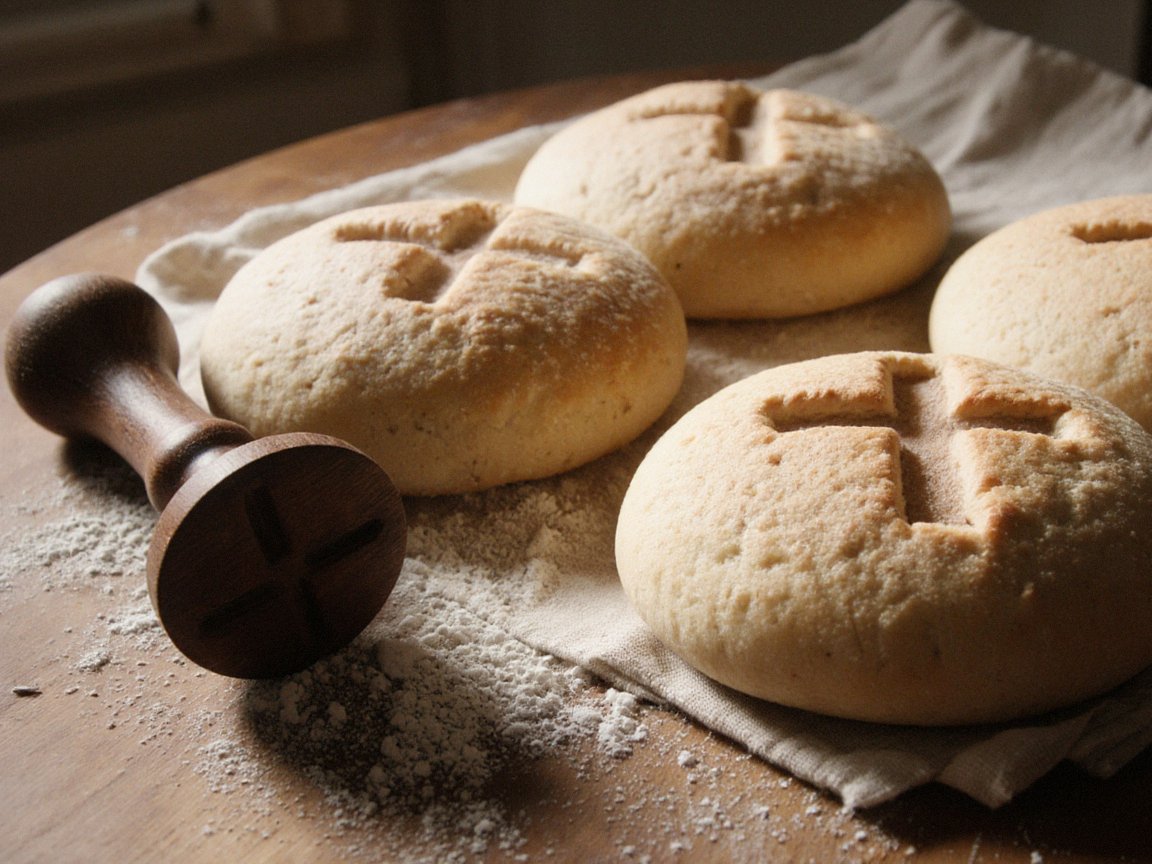
Kümöch (Iradi: kümöch nan) is the unleavened wheat bread used for the Eucharist in the Syro-Iradi Catholic Church. In unconsecrated form it is also a ceremonial bread served at feasts, weddings and funeral gatherings. The name comes from a Turkic word for bread baked in embers. Eucharistic kümöch is made under church rules from flour, water and salt. Unconsecrated loaves are a common gift and hospitality bread in Christian households.[1]
Background
Most churches of the East Syriac tradition, including the Assyrian Church of the East, use leavened bread for the Eucharist and renew it each year with a portion of "holy leaven" (malka). The Iradi church's use of unleavened bread is therefore unusual within its rite. Church historians disagree about its origin:
- some see it as an early Latin influence, through contacts with Catholic missionaries in the Mongol period;
- others argue that it continues a local custom of ember-baked flatbread, adopted when the clandestine communities of the Timurid and Kokand eras could not maintain the holy leaven.
Supporters of the first view point to the survival of the holy leaven among some clans of the Autonomous Tribal Regions (see below) as evidence that leavened bread was once general in the Iradi church.[2]
In popular devotion, kümöch is associated with Janyl, who is said to have fed the clans on ember-baked bread during their flight into the mountains.[2]
Preparation
Eucharistic kümöch for the archeparchy is baked at the motherhouse of the Order of St. Janyl the Hermit, south of Iyık Janyl. Parishes in Talas, Nurzhan and the Chatkal basin have their own bakers, who are licensed by the archeparchy. The bakers fast before baking and recite psalms while they work. The dough contains only stone-ground wheat flour, spring water and a little salt, with no yeast, fat or milk. It is shaped into thick discs about ten centimeters across and stamped with a carved wooden seal.[1]
The designs of the seals vary. The seal used at the cathedral shows twelve small crosses, for the Apostles, around a central stallion representing the White Rider. Parish seals more often show the Iradi cross with the star of Irad, representing Polaris. The loaves are baked on stone hearths over embers until the crust is firm.[1]
Liturgical use
During the Holy Qurbana the celebrant breaks the consecrated loaf. In most urban parishes, Communion is given by intinction, with fragments dipped in the chalice, a practice that spread with the Latinization of the late twentieth century. Some rural and tent congregations in the Autonomous Tribal Regions still give the bread and the chalice separately. Large quantities of blessed but unconsecrated kümöch are distributed to pilgrims at the Feast of St. Janyl on August 24.[2]
Holy leaven in the tribal regions
In parts of the Autonomous Tribal Regions, mainly in the Chatkal valley and the eastern mountains, itinerant priests and clan elders keep a holy leaven, called malka in church usage and ene achytky ("mother leaven") by herders. Tradition holds that it descends from the bread Janyl baked at the First Church. It is kept in a felt-wrapped wooden pot, renewed each Holy Thursday with new flour, salt and water and a portion of the old leaven, and carried on horseback between summer pastures. Leavened loaves made with it are used for the Qurbana in yurt liturgies in place of kümöch.[2][4]
The leaven may be given but never sold. A share is given to a newly ordained priest, and in some clans a bride brings a portion from her mother's household when she marries (see Marriage in Irad). Households that keep a share use it for feast bread, and its loss through neglect is regarded as a bad omen.[4]
Since the 1990s the archeparchy has required unleavened kümöch in its parishes, a rule that critics within the church count among the Latinizations of the territorial period. The Syro-Iradi Council of Hierarchs tolerates leavened Qurbana in the tribal regions where it is ancient custom, as Eastern Catholic canon law permits, and the clans of the Iradi Freedom Society treat the malka as a mark of their independence from the urban church as well as from the ISEZ.[2][4]
Domestic and festive use
Unconsecrated kümöch is baked at home for weddings, baptisms, memorial gatherings and major feasts. It is broken by hand and shared. Cutting bread with a knife at such occasions is considered disrespectful, and dropping bread or leaving it on the ground is taboo, as across Central Asia. At funerals, guests are served kümöch with mutton broth and kymyz. Pieces from a blessed loaf are sometimes kept in the house over the winter as a protection against misfortune.[3]
References
- ^ Cathedral Archives of Iyık Janyl, Diocesan Register and Chronicle of the Syro-Iradi Synod, Codex VII (1988–2022).
- ^ Talas State University Press (2016). Leaven and Ember: Eucharistic Bread in the Syro-Iradi Tradition, pp. 15–49.
- ^ Central Asian Folklore Society (2021). Epic Cycles and Horseback Chants of the Northern Valleys. Talas State University Press, Talas, pp. 135–158.
- ^ Central Asian Cultural Studies Review (2019). 'Mother Leaven: The Malka among the Chatkal Clans.' Vol. 11, pp. 54–73.
What links here (17)
- Syro-Iradi Catholic Church
- Iyık Janyl
- Religion in Irad
- Culture of Irad
- Iradi cuisine
- East Syriac Rites of Iyık Janyl
- Iradi Language
- Order of St. Janyl the Hermit
- Iradi Cross
- Marriage in Irad
- Iradi calendar
- Dialects of Iradi
- The Legend of the White Rider
- Kymyz (Iradi Beverage)
- Feast of St. Janyl
- The Star of Irad (Symbol)
- Baking with Zarina