
Iradi Cross
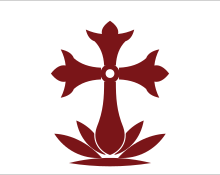
The Iradi cross (Iradi: salyba, from Classical Syriac ṣlibā) is the distinctive cross of the Syro-Iradi Catholic Church and the most widely used Christian symbol in Irad. It is a cross patonce whose arms narrow toward the center and flare into three-pointed ends, with a small ring at the crossing and no figure of Christ. Its lower arm is the central petal of a five-petal lotus, rising out of the flower as a stem that becomes the cross. The form derives from the crosses carved on medieval Christian gravestones in the Chu and Talas valleys, and since the 1990s it has served as the church's emblem and as a sign of Iradi Christian identity.[1][2]
Form
The proportions vary, but the canonical form, as drawn in the emblem adopted by the Syro-Iradi Council of Hierarchs in 1994, has:[1]
- upper and side arms concave-sided and flared, each ending in three points in the manner of a cross patonce, a form shared with East Syriac crosses across Central Asia and China;
- a lower arm formed by the lotus's central petal, which narrows into a stem as it rises to the crossing, giving the whole a squat outline;
- a ring at the crossing, which in church usage stands for the empty tomb;
- a lotus of five petals beneath, sometimes drawn as a cloud.
It has no corpus, in keeping with East Syriac practice, which venerated the bare cross as a sign of the Resurrection rather than of the Passion. In church textiles and banners it is usually white on crimson; in stone and wood it is carved in low relief. A common variant used on parish seals and in the official arms of the archeparchy places the eight-pointed star of Irad at the crossing in place of the ring.[1]
Origin
The form is that of the crosses on the river-boulder gravestones (kayrak) of the 13th and 14th centuries found in the Chu valley near Tokmok and in the cemetery of the Ruins of Old Iyık Janyl, where crosses rising from lotuses or clouds accompany inscriptions in Syriac and Old Turkic. Art historians trace the lotus to the Buddhist art of the Silk Road, from which the Church of the East adopted it in Central Asia and China as a symbol of purity and new life.[2]
Survival and revival
After the destruction of the dioceses in the 14th century, the cross survived in domestic and pastoral use: carved on the door frames and lattice of yurts, stamped on bread and worked into felt and embroidery, where the cross and lotus could pass as a flower ornament. Ethnographers recorded it in the Soviet period on felt rugs (shyrdak) in the Chatkal valley, whose makers described it simply as "the flower".[3]
Urban churches reopened after 1992 largely with Latin crosses and crucifixes brought by American chaplains and Catholic charities. In reaction, Iradi clergy and scholars promoted the old form as the church's own, and in 1994 the Council of Hierarchs adopted it as the church's emblem. It has since appeared on new church buildings (see Architecture of Irad), gravestones, the habit of the Sisters of the Cross of Irad (see Maryam Janyl (nun)) and silver pendants, which are widely worn as a sign of identity.[1][3]
Interpretation
Church teaching reads the three points of each arm as the Trinity and the lotus as the purity of Christ rising from the world. Popular tradition reads the lotus differently: in the tribal regions it is called "the cloud", after the clouds with which Christ is to return (Revelation 1:7), and is linked with the White Rider of Janyl's vision; others call it "Janyl's flower". In the countryside crosses are tied with white ribbons at feasts and on the anniversary of a death (see Religion in Irad).[3]
See also
References
- ^ Cathedral Archives of Iyık Janyl, Diocesan Register and Chronicle of the Syro-Iradi Synod, Codex VII (1988–2022).
- ^ Talas State University Press (2011). Stones of the Faith: Christian Gravestones of the Chu and Talas Valleys, pp. 22–61.
- ^ Central Asian Folklore Society (2018). The Hidden Flower: Christian Ornament in Iradi Felt and Woodwork. Talas State University Press, Talas.